- Home
- About Us
- Industry
- Services
- Reading
- Contact Us
Southeast Asia Halal Cosmetics Market: Current Analysis and Forecast (2025-2033)
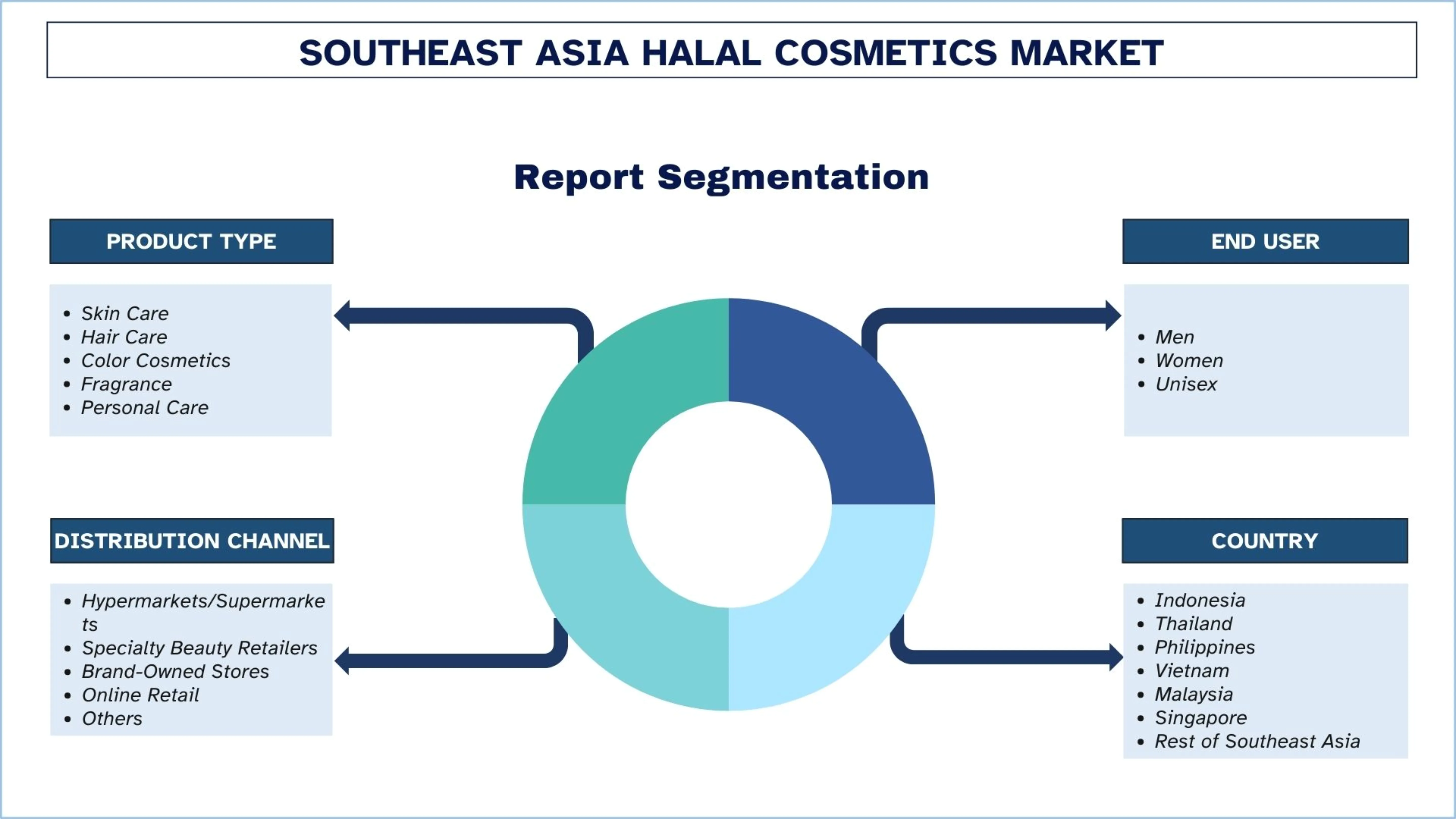
Emphasis on Product Type (Skin Care, Hair Care, Color Cosmetics, Fragrance, Personal Care); End User (Men, Women, Unisex); Distribution Channel (Hypermarkets/Supermarkets, Specialty Beauty Retailers, Brand-Owned Stores, Online Retail, Others); and Country.
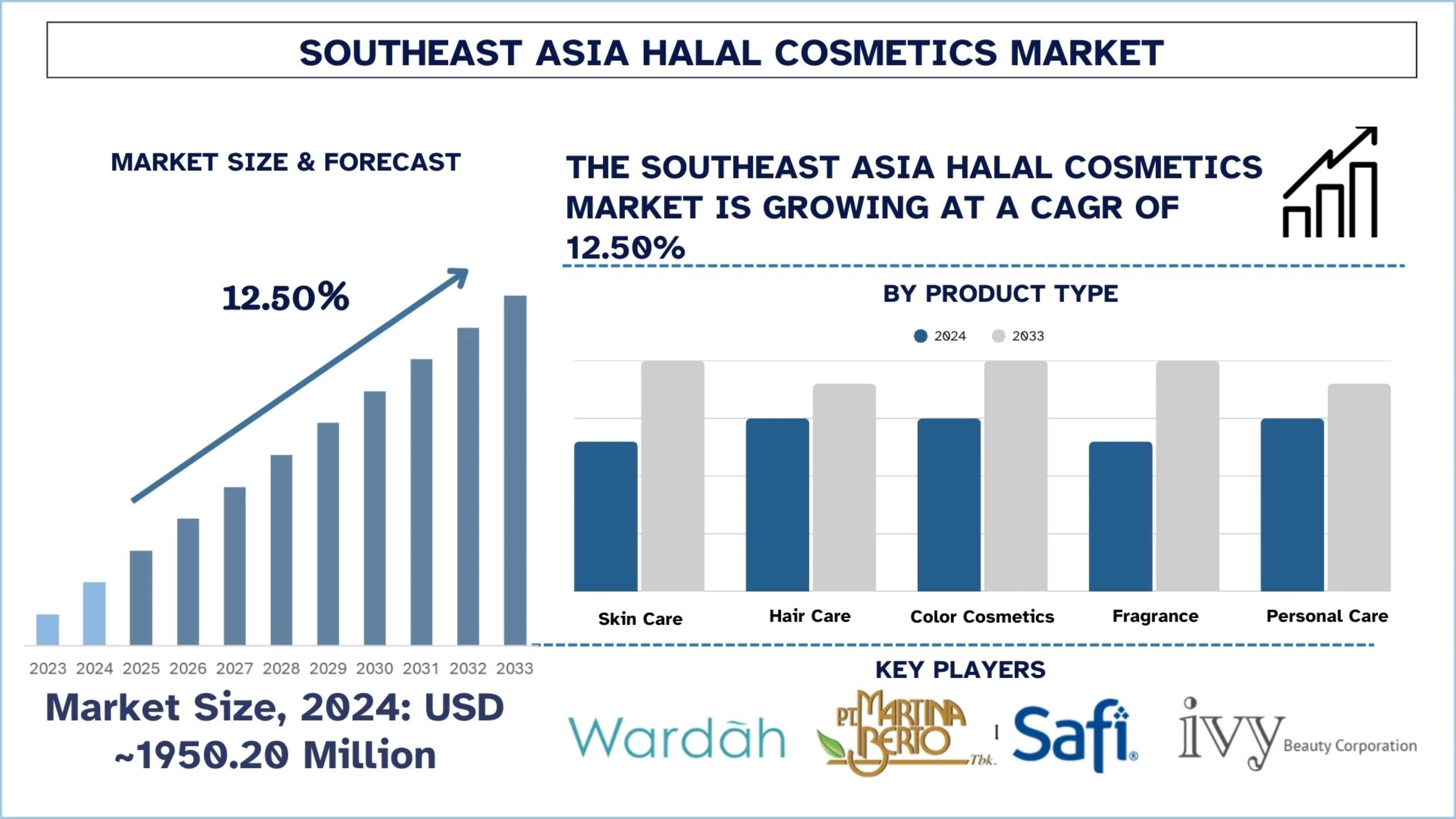
Southeast Asia Halal Cosmetics Market Size & Forecast
The Southeast Asia Halal Cosmetics Market was valued at ~USD 1950.20 million in 2024 and is expected to grow at a strong CAGR of approximately 12.50% during the forecast period (2025-2033F), driven by a large and growing child population and rising health awareness among parents.
Southeast Asia Halal Cosmetics Market Analysis
Halal cosmetics refer to beauty and personal care products prepared using ingredients and production processes that are in line with Islamic law. Halal Cosmetics does not contain forbidden goods, such as alcohol whose origin is not permitted, or animal products not prepared in accordance with Shariah requirements.
Southeast Asian manufacturers are enhancing growth by implementing organised compliance with halal certification, upgrading production in accordance with GMP, and implementing end-to-end ingredient traceability systems. The rising investment into R&D of alcohol-free, vegan-oriented, and wudhu-conformist versions of the products that are adjusted to the conditions prevalent in tropical areas and the variety of skin tones. Also, the regional brand presence is being broadened through digital-first strategies such as social commerce, influencer-led campaigns, etc. Brands are growing margins by expanding into premium product lines and dermatologically tested halal cosmeceuticals. Furthermore, e-commerce at borders and export preparation is facilitating scaling of the region outside of national borders.
For example, on May 15, 2025, the Head of the Halal Product Assurance Agency (BPJPH) emphasized that Cosmetic Products must have halal certification after October 17, 2026, marking the end of a two-year transition period since the policy was enacted in October 2024. Under Government Regulation Number 42 of 2024 concerning the Implementation of the Halal Product Assurance Sector, as of October 17, 2026, a number of products must be halal-certified, including medicinal products, cosmetics, chemical products, genetically engineered products, and consumer goods.
Southeast Asia Halal Cosmetics Market Trends
This section discusses the key market trends that are influencing the various segments of the Southeast Asia Halal Cosmetics market, as found by our team of research experts.
Growth of Halal Tourism
The growth of halal tourism in Southeast Asia is also a major trend, driving demand for halal cosmetics. Nations like Indonesia and Malaysia are reinforcing Muslim-oriented infrastructure, such as halal-certified hotels and shops, and airports, which boost the presence of certified beauty products. Also, the incremental growth in retail is being experienced by the spending on personal care and travel-size halal cosmetics by tourists. Adding to this, the Halal-certified brands are being sold in increased amounts in duty-free stores and hospitality channels to serve international Muslim travellers. This consumer exposure and brand credibility are expanding because of the integration of tourism and retail ecosystems. Halal tourism will further enhance the adoption of cross-border products as travel by Muslims recovers and the connectivity within the region increases.
Southeast Asia Halal Cosmetics Industry Segmentation
This section provides an analysis of the key trends in each segment of the Southeast Asia Halal Cosmetics market, along with forecasts at the country level for 2025-2033.
The skin care market held the dominant share of the Halal Cosmetics market in 2024.
Based on product type, the market is segmented into skin care, hair care, colour cosmetics, fragrance, and personal care. Among these, the skin care market held the largest share in Southeast Asia in 2024, as it is used daily and has a high product replacement rate. Halal-certified cleansers, serums, and moisturisers are among the key personal care products that consumers prefer due to their traditional religious compliance and clean beauty. Moreover, the continuous innovation of products in brightening, anti-acne, and tropical-climate formulations also enhances category growth and the frequency of product purchases. For example, in November 2025, ParagonCorp, the company behind leading halal beauty brands such as Wardah, Emina, and Make Over, officially launched Light+ by Wardah, a new halal skincare and makeup line born from the aspirations of 1,000 young Indonesians.
The online retail segment is expected to grow at a significant CAGR during the forecast period (2025-2033).
Based on the distribution channel, the market is segmented into hypermarkets/supermarkets, specialty beauty retailers, brand-owned stores, online retail, and others. Among these, the online retail segment is expected to grow at a significant CAGR during the forecast period (2025-2033). The online retail is the most rapidly expanding distribution channel that helps halal beauty brands expand regionally with fewer entry barriers. Social commerce ecosystems and e-commerce platforms enhance availability in areas beyond urban centres, enhancing the visibility of the products and price transparency. Direct-to-consumer marketing, influencer partnerships, and digital marketing are driving the growth of customer acquisition and cross-board sales. As per the International Trade Administration, U.S. Department of Commerce, cross-border ecommerce development varies by individual markets within the Asia Pacific region, with China (71.4) scoring the highest in a ranked development index. South Korea (66.7) and Singapore (65.5) are the next-ranked markets on the cross-border ecommerce development index, followed by Japan (61.1), Thailand (58.8), Malaysia (57.7), and Indonesia (54.3).
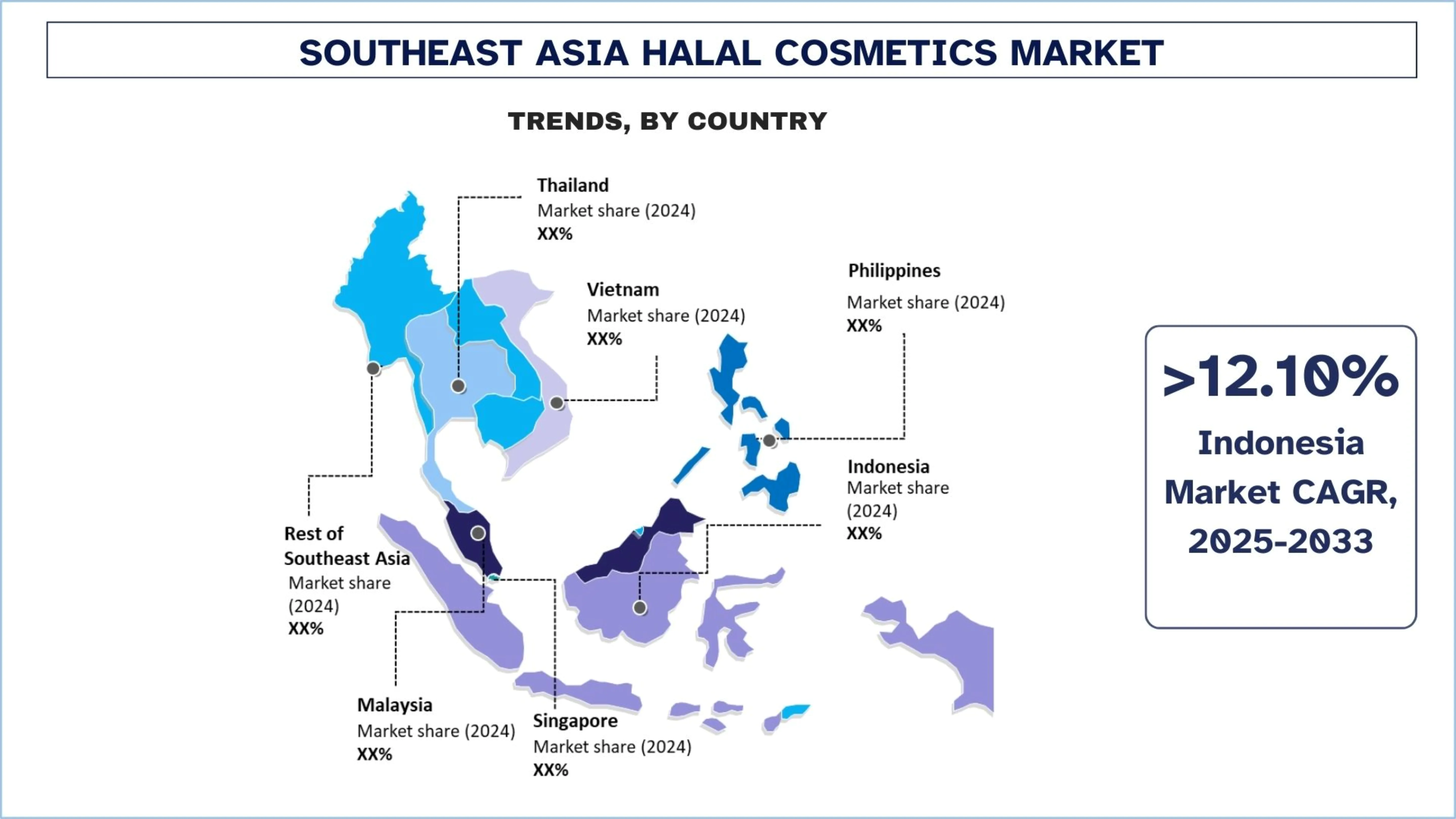
Indonesia held a dominant share of the Southeast Asian Halal Cosmetics market in 2024
The market of halal cosmetics in Southeast Asia is dominated by Indonesia, due to the largest Muslim population in the world and the good regulatory structure that enforces the use of halal certification. The fact that the government enforces halal compliance, which enhances consumer confidence and standardizes the industry, leads to systematic market growth. Also, the rapid pace of digital integration and the vibrant local beauty industry stimulate the development of local brands and innovation. Moreover, the growth of the urban middle class is driving increased expenditure on personal care and high-quality halal skincare. Furthermore, it has strong local OEM potential, which contributes to the development of the local label and to export preparedness, strengthening Indonesia's role as the growth anchor of the region.
For example, on June 24, 2025, Kao launched Biore Breeze Deodorant, a halal-certified deodorant in Indonesia, reinforcing its commitment to ethical product development and deepening its engagement with the world’s largest Muslim-majority market.
The product is available in gel and spray formats and was formulated at Kao’s Indonesian R&D centre, which opened in 2023. This product addresses the preferences of Muslim consumers, particularly women who wear the hijab in Indonesia’s hot, humid climate, by offering effective, skin-friendly odour protection that aligns with religious values.
This launch comes ahead of Indonesia’s October 2026 deadline mandating halal certification for all household and personal care products.
Southeast Asia Halal Cosmetics Industry Competitive Landscape
The Southeast Asia Halal Cosmetics market is competitive, with several global and international market players. The key players are adopting different growth strategies to enhance their market presence, such as partnerships, agreements, collaborations, new product launches, geographical expansions, and mergers and acquisitions.
Top Southeast Asia Halal Cosmetics Companies
Some of the major players in the market are Wardah (PT Paragon Technology and Innovation), PT. Martina Berto, Tbk (Martha Tilaar Group), Safi (Wipro Unza Holdings Ltd.), IVY Beauty Corporation, CLARA INTERNATIONAL BEAUTY GROUP, Sky Resources Sdn. Bhd., SO.LEK Cosmetics, DERMASCIENCE SDN BHD., VNI Scientific Sdn Bhd, GIM Cosmetic.
Recent Developments in the Southeast Asia Halal Cosmetics Market
On 12 May 2025, the Asian Productivity Organization (APO) Secretariat and the Lao National Productivity Organization (LNPO) jointly launched the Development of Demonstration Companies (DMP) project Enhancing Productivity for Halal Certification in Lao PDR at the headquarters of the Ministry of Industry and Commerce in Vientiane, Thailand.
Southeast Asia Halal Cosmetics Market Report Coverage
Details | |
Base year | 2024 |
Forecast period | 2025-2033 |
Growth momentum | Accelerate at a CAGR of 12.50% |
Market size 2024 | ~USD 1950.20 million |
Country analysis | Indonesia, Thailand, Philippines, Vietnam, Malaysia, Singapore, Rest of Southeast Asia |
Major contributing Country | Vietnam is expected to grow at the highest CAGR during the forecasted period. |
Companies profiled | Wardah (PT Paragon Technology and Innovation), PT. Martina Berto, Tbk (Martha Tilaar Group), Safi (Wipro Unza Holdings Ltd.), IVY Beauty Corporation, CLARA INTERNATIONAL BEAUTY GROUP, Sky Resources Sdn. Bhd., SO.LEK Cosmetics, DERMASCIENCE SDN BHD., VNI Scientific Sdn Bhd, GIM Cosmetic |
Report Scope | Market Trends, Drivers, and Restraints; Revenue Estimation and Forecast; Segmentation Analysis; Demand and Supply Side Analysis; Competitive Landscape; Company Profiling |
Segments Covered | By Product Type, By End User, By Distribution Channel, By Country |
Reasons to Buy the Southeast Asia Halal Cosmetics Market Report:
The study includes market sizing and forecasting analysis confirmed by authenticated key industry experts.
The report briefly reviews overall industry performance at a glance.
The report covers an in-depth analysis of prominent industry peers, primarily focusing on key business financials, product portfolios, expansion strategies, and recent developments.
Detailed examination of drivers, restraints, key trends, and opportunities prevailing in the industry.
The study comprehensively covers the market across different segments.
Customization Options:
The Southeast Asia Halal Cosmetics Market can further be customized as per requirements or any other market segment. Besides this, UnivDatos understands that you may have your own business needs; hence, feel free to contact us to get a report that completely suits your requirements.
Table of Content
Research Methodology for the Southeast Asia Halal Cosmetics Market Analysis (2023-2033)
We analyzed the historical market, estimated the current market, and forecasted the future market of the Southeast Asian Halal Cosmetics market to assess its Distribution Channel in major countries. We conducted exhaustive secondary research to gather historical market data and estimate the current market size. To validate these insights, we carefully reviewed numerous findings and assumptions. Additionally, we conducted in-depth primary interviews with industry experts across the Southeast Asian Halal Cosmetics value chain. After validating market figures through these interviews, we used both top-down and bottom-up approaches to forecast the overall market size. We then employed market breakdown and data triangulation methods to estimate and analyze the market size of industry segments and sub-segments.
Market Engineering
We employed the data triangulation technique to finalize the overall market estimation and derive precise statistical numbers for each segment and sub-segment of the Southeast Asia Halal Cosmetics market. We split the data into several segments and sub-segments by analyzing various parameters and trends, including product type, end user, distribution channel, and country within the Southeast Asian Halal Cosmetics market.
The Main Objective of the Southeast Asia Halal Cosmetics Market Study
The study identifies current and future trends in the Southeast Asia Halal Cosmetics market, providing strategic insights for investors. It highlights market attractiveness, enabling industry participants to tap into untapped markets and gain a first-mover advantage. Other quantitative goals of the studies include:
- Market Size Analysis: Assess the current and forecast market size of the Southeast Asia Halal Cosmetics market and its segments in terms of value (USD).
- Southeast Asia Halal Cosmetics Market Segmentation: Segments in the study include areas of product type, end user, distribution channel, and country.
- Regulatory Framework & Value Chain Analysis: Examine the regulatory framework, value chain, customer behavior, and competitive landscape of the Southeast Asia Halal Cosmetics industry.
- Country Analysis: Conduct a detailed country analysis for key areas such as Indonesia, Thailand, the Philippines, Vietnam, Malaysia, Singapore, and the Rest of Southeast Asia.
- Company Profiles & Growth Strategies: Company profiles of the Southeast Asia Halal Cosmetics market and the growth strategies adopted by the market players to sustain the fast-growing market.
Frequently Asked Questions FAQs
Q1: What is the Southeast Asia Halal Cosmetics market’s current market size and growth potential?
The Southeast Asia Halal Cosmetics market was valued at ~USD 1950.20 million in 2024 and is projected to expand at a CAGR of 12.50% from 2025 to 2033, driven by strong Muslim consumer demographics, increasing disposable income, regulatory enforcement of halal certification, and rapid digital retail adoption.
Q2: Which segment has the largest share of the Southeast Asia Halal Cosmetics market by product type?
The Skin Care segment accounts for the largest market share due to its daily-use consumption pattern and high product replenishment rate. Halal-certified cleansers, moisturizers, serums, and treatment products dominate revenue contribution.
Q3: What are the driving factors for the growth of the Southeast Asia Halal Cosmetics market?
Market growth is primarily supported by the region’s large and expanding Muslim population, rising health and ingredient transparency awareness, and mandatory halal certification policies in certain countries. Rapid e-commerce penetration, influencer-driven digital marketing, and increasing alignment between halal, clean, and ethical beauty trends are accelerating adoption.
Q4: What are the emerging technologies and trends in the Southeast Asia Halal Cosmetics market?
Key trends include the convergence of halal and clean beauty positioning, growth of wudhu-friendly and alcohol-free formulations, expansion of vegan-certified halal products, and increasing premiumization. Digital-first brand strategies and social commerce platforms are transforming distribution models.
Q5: What are the key challenges in the Southeast Asia Halal Cosmetics market?
Companies face regulatory fragmentation across ASEAN countries, increasing halal certification compliance costs, and intense price competition in the mass segment. Maintaining traceable halal-compliant supply chains adds operational complexity.
Q6: Which country dominates the Southeast Asia Halal Cosmetics market?
Indonesia dominates the Southeast Asia Halal Cosmetics market, supported by its large Muslim population base, structured halal certification enforcement, and strong domestic manufacturing ecosystem. Government-backed halal regulations and growing local brand competitiveness further reinforce Indonesia’s leadership position in both consumption and production.
Q7: Who are the key players in the Southeast Asia Halal Cosmetics market?
Leading companies in the Southeast Asia Halal Cosmetics market include:
• Wardah (PT Paragon Technology and Innovation)
• PT. Martina Berto, Tbk (Martha Tilaar Group)
• Safi (Wipro Unza Holdings Ltd.)
• IVY Beauty Corporation
• CLARA INTERNATIONAL BEAUTY GROUP
• Sky Resources Sdn. Bhd.
• SO.LEK Cosmetics
• DERMASCIENCE SDN BHD.
• VNI Scientific Sdn Bhd
• GIM Cosmetic
Q8: What investment opportunities exist in the Southeast Asia Halal Cosmetics market?
Investment opportunities are emerging in premium halal skincare, halal-certified OEM manufacturing, men’s grooming products, and cross-border e-commerce expansion. Vietnam and other emerging ASEAN markets offer high-growth potential from a low penetration base.
Q9: How can new entrants successfully enter the Southeast Asia Halal Cosmetics market?
New entrants should prioritize halal certification compliance, partner with established OEM manufacturers, and adopt a digital-first distribution strategy. Localization of formulations for tropical climates and targeted influencer marketing campaigns can accelerate brand visibility.
Related Reports
Customers who bought this item also bought
Dehydrated Culinary Herbs Market: Current Analysis and Forecast (2025-2033)
Emphasis on Product Type (Basil, Oregano, Rosemary, Thyme, Sage, Parsley, Mint, Cilantro, and Others); Form (Whole, Powdered, and Flakes); Application (Food Processing, Restaurants & Foodservice, Household, Nutraceuticals, and Others); Distribution Channel (Supermarkets/Hypermarkets, Specialty Food Stores, Online Retail, and Others); and Region/Country
February 5, 2026