Carbon Accounting Software Market: Current Analysis and Forecast (2025-2033)
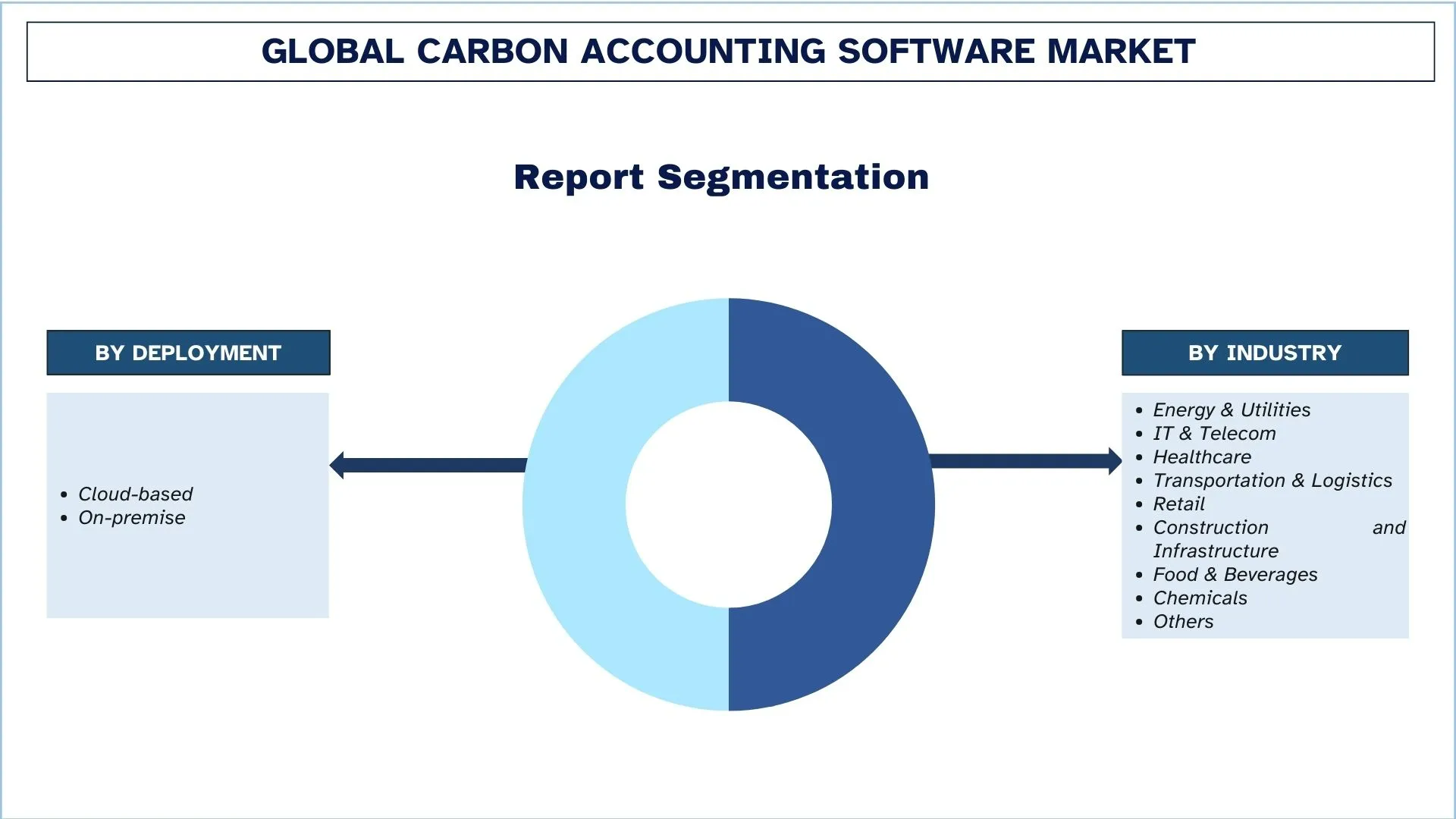
Emphasis on Deployment (Cloud-based, On-premise); Industry (Energy & Utilities, IT & Telecom, Healthcare, Transportation & Logistics, Retail, Construction & Infrastructure, Food & Beverages, Chemicals, Others); and Region/Country
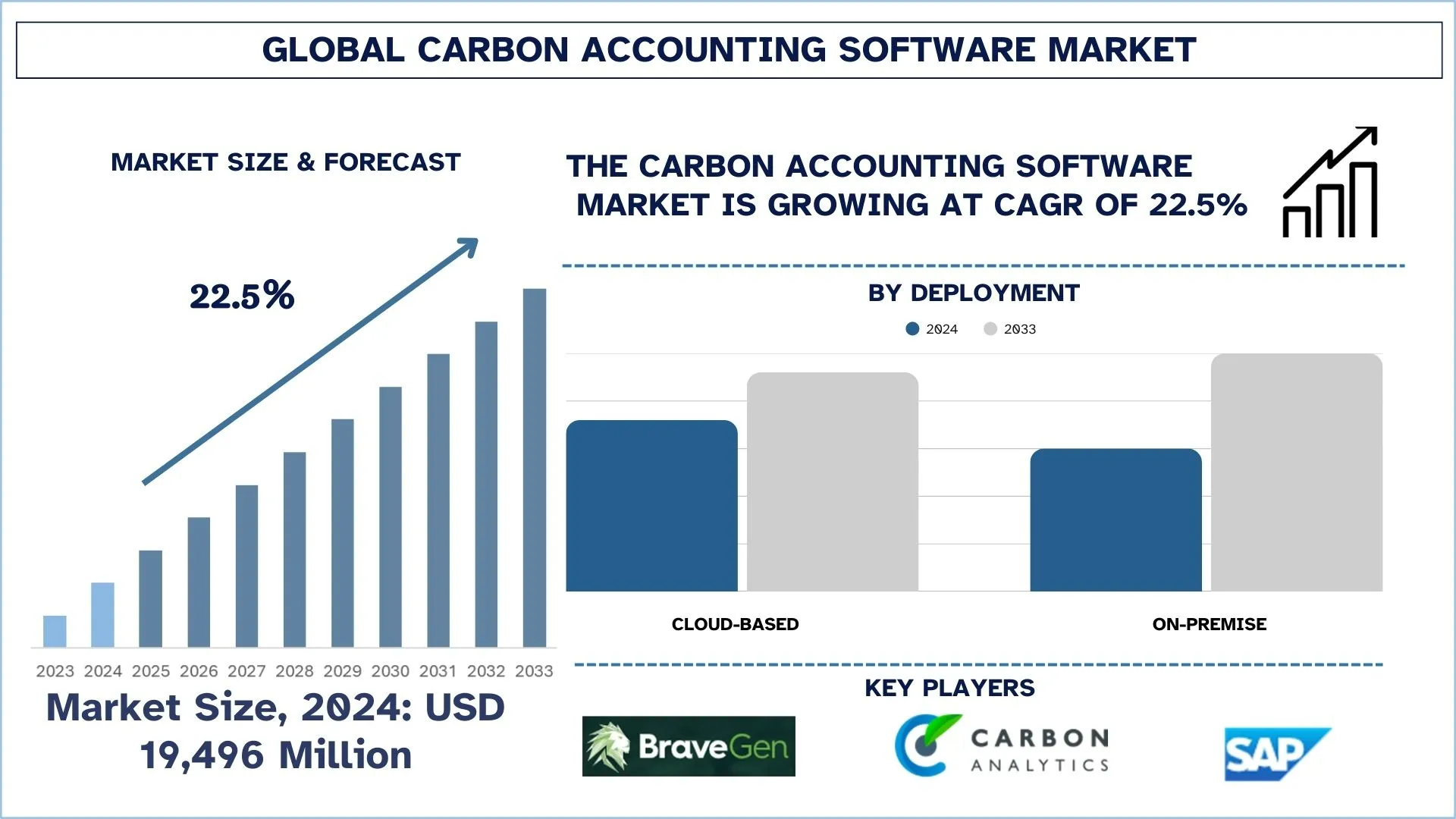
Global Carbon Accounting Software Market Size & Forecast
The Global Carbon Accounting Software Market was valued at USD 19,496 million in 2024 and is expected to grow at a strong CAGR of around 22.5% during the forecast period (2025-2033), driven by rising sustainability reporting needs and net-zero initiatives.
Carbon Accounting Software Market Analysis
Carbon accounting software is a computer program that allows organizations to measure, monitor, manage, and report their emissions of greenhouse gases in their operations, supply chain, and product lifecycle. Through its data capturing of energy use, fuel use, transportation, waste generation, logistics, and procurement activities, it transforms raw business inputs to precise carbon figures in line with the standards, including the Greenhouse Gas Protocol, ISO 14064, and the regulatory carbon reporting requirements.
The carbon accounting software market is expanding as more organizations are pressurized globally to quantify and minimize their carbon emissions in response to stricter environmental laws, ESG disclosures, and the net-zero bans. Businesses in all sectors are turning more towards making sustainability a part of the business strategy, in the quest to attain a better brand name, satisfaction of investors, and to escape fines. The increasing consciousness of climate change, corporate visibility, and the necessity to get the right data in terms of sustainability further promote its acceptance in different industries. Moreover, growing product launches by leading players further flourish the growth of the market.
For instance, in October 2025, Diginex announced the launch of its new Carbon Ledger platform aimed at streamlining transparency and verification of corporate carbon-offset portfolios. The initiative marks a strategic push into validated carbon-accounting solutions, aligning with emerging ESG and net-zero market demands.
Global Carbon Accounting Software Market Trends
This section discusses the key market trends that are influencing the various segments of the global Carbon Accounting Software market, as found by our team of research experts.
Growing adoption of cloud-based platforms for scalable emissions tracking
The increasing use of cloud-based systems in scalable emissions monitoring is becoming one of the significant trends in the carbon accounting software market in the future. The deployment of clouds urges organizations to centrally store the emissions data in several centers and geographical locations to avoid the inconvenience of monitoring them in real-time and to facilitate their integration into the existing business systems. The necessity to have flexible and high-capacity data infrastructure is increasing as companies continue to increase their sustainability activities and monitor Scope 3 emissions in their global supply chains. Cloud solutions are also less expensive than upfront investments, as they improve security through continuous updates and provide automated analytics to support decision-making.
Carbon Accounting Software Industry Segmentation
This section provides an analysis of the key trends in each segment of the global carbon accounting software market report, along with forecasts at the global, regional, and country levels for 2025-2033.
The Cloud-based Market Dominates the Global Carbon Accounting Software Market
Based on the deployment category, the market is categorised into cloud-based and on-premise. Among these, the cloud-based segment has the largest market share because of its reduced initial expenses, less complex implementation, scalability, and integration with several data sources in its global operations. Real-time analytics and remote access are also supported by cloud solutions and are therefore very effective in organizations that have a wide range of supply chains. The cloud-based segment is set to expand considerably in the future as more companies look to digital sustainability solutions and look to have flexible and automated systems to satisfy the changing reporting needs.
The Energy & Utilities Industry Dominates the Global Carbon Accounting Software Market.
Based on the industry category, the market is segmented into energy & utilities, IT & telecom, healthcare, transportation & logistics, retail, construction & infrastructure, food & beverages, Chemicals, and others. Among these, the maximum market share is currently occupied by the energy and utilities industry since it is among the greatest emitters of greenhouse gases, and with the high regulatory requirements, where emissions monitoring, reporting, and reduction are mandatory. The utilities and energy generators are obligated to monitor the Scope 1, 2, and, to an ever-increasing extent, the Scope 3 emissions, compelling the adoption of strong technologies. However, the Transportation & Logistics segment is anticipated to experience the most significant growth because of the increased environmental pollution associated with fuel, the growth of global supply chains, and intensified governmental pressure alongside corporate sustainability objectives to decarbonize fleet operations and enhance the transparency of supply chains.
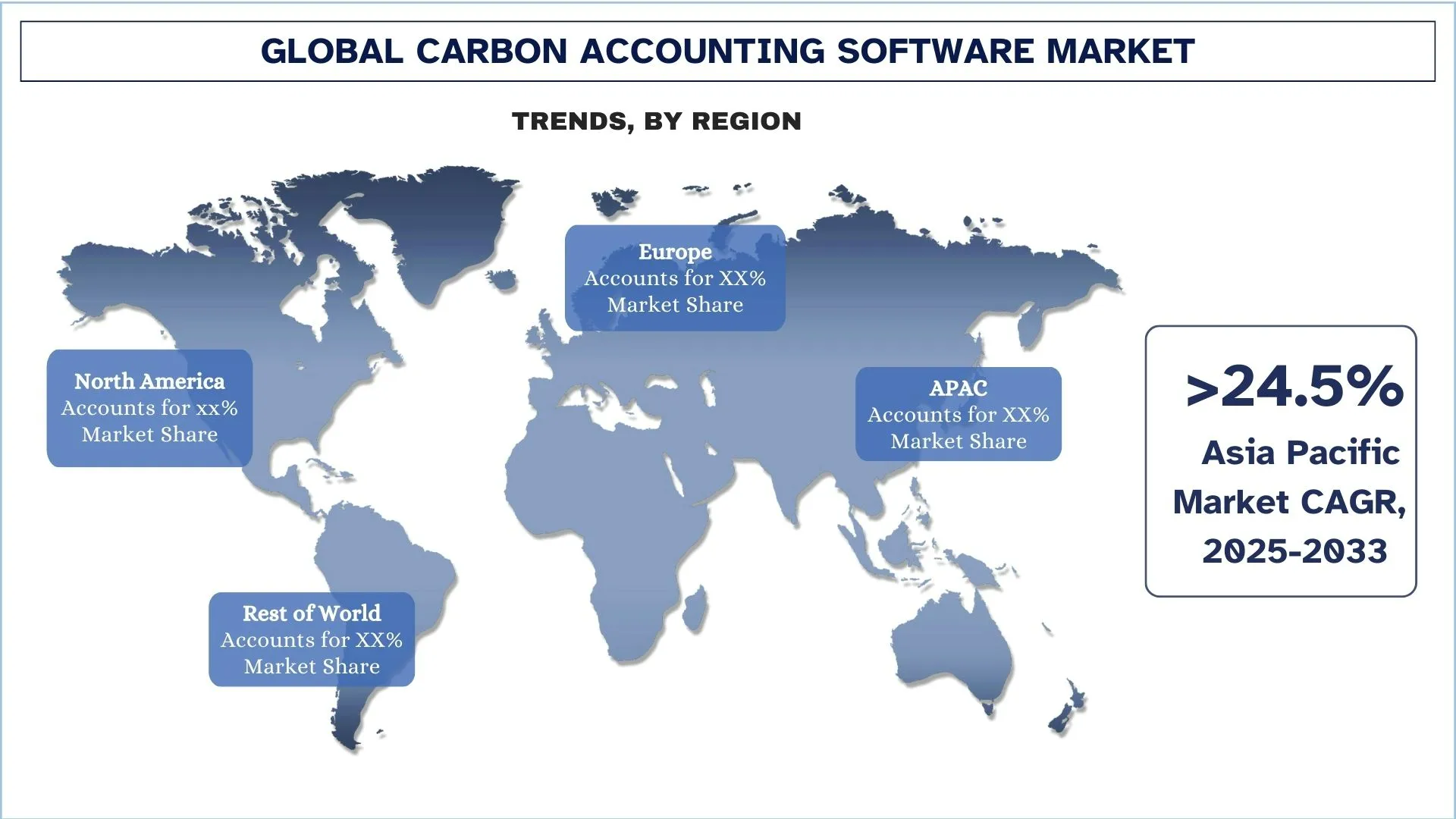
North America holds the largest market share in the global Carbon Accounting Software market
The carbon accounting software market has the highest market share in the North America region because of its excellent regulatory framework, high level of technology infrastructure, and early adoption of sustainable practices. In the U.S. and Canada, the pressure on companies to limit and monitor greenhouse gas emission levels is growing, and investors, stakeholders, and government regulations are increasing the demand on these companies to accurately measure carbon. The region also has a number of carbon management leadership software providers, which speeds up innovation and market adoption. Moreover, great consciousness of ESG standards, epibiotic climate declarations, and corporate net-zero guarantees also enhance the uptake, which makes North America a major centre of carbon accounting technology advancement.
The United States held a Dominant share of the North America Carbon Accounting Software Market in 2024
The United States holds a major market share of the North America Carbon Accounting Software Market mainly because it has a mature corporate governance setting and has a significant involvement in global climate programs. The U.S. has many companies with operations in foreign countries, and they are subject to standard, transparent emission reporting that ensures consistency across borders. Climate policies at the federal and state levels, along with market-based actions like carbon pricing and sustainability-based financing, encourage organizations to use carbon tracking tools such as carbon accounting software. Digital readiness and large-scale adoption of clouds are favored in the U.S., which allows it to implement them faster and more easily. Also, the powerful sustainability programs of Fortune 500 companies have had a cascading effect, influencing the mass market towards their implementation in the mid- and small-sized business landscape, which has solidified U.S. dominance in the region.
Carbon Accounting Software Industry Competitive Landscape
The global carbon accounting software market is competitive, with several global and international market players. The key players are adopting different growth strategies to enhance their market presence, such as partnerships, agreements, collaborations, geographical expansions, and mergers and acquisitions.
Top Carbon Accounting Software Market Companies
Some of the major players in the market are BraveGen (Energy Solution Providers Limited), Carbon Analytics PBC, SAP SE, Net0, Normative, Sphera Solutions, Inc. (Delaware corporation), Salesforce Inc., Greenly, SINAI Technologies, Inc., and Microsoft.
Recent Developments in the Carbon Accounting Software Market
In October 2025, Greenly announced the launch of its new AI-powered carbon accounting platform, EcoPilot, which automates data collection, structuring, and emissions-factor assignment, enabling companies to model Scope 3 reductions and run “what-if” scenarios for net-zero pathways.
In June 2024, SCS Consulting Services (SCS) announced a new partnership with leading carbon accounting platform developer “Sustain Life”, offering a comprehensive carbon management solution for organizations of all sizes.
In July 2023, Plan A and Alphabet announced an exclusive long-term partnership to provide fleet managers with the software tools and expertise to account for their fleet emissions, identify and take effective action to decarbonize their operations, and eventually mitigate their climate impact.
Global Carbon Accounting Software Market Report Coverage
Report Attribute | Details |
Base year | 2024 |
Forecast period | 2025-2033 |
Growth momentum | Accelerate at a CAGR of 22.5% |
Market size 2024 | USD 19,496 million |
Regional analysis | North America, Europe, APAC, Rest of the World |
Major contributing region | The Asia-Pacific region is expected to dominate the market during the forecast period. |
Key countries covered | U.S., Canada, Germany, U.K., Spain, Italy, France, China, Japan, and India. |
Companies profiled | Microsoft, Carbon Analytics PBC, SAP SE, Net0, Normative, Sphera Solutions, Inc. (Delaware corporation), Salesforce Inc., Greenly, SINAI Technologies, Inc., and BraveGen (Energy Solution Providers Limited). |
Report Scope | Market Trends, Drivers, and Restraints; Revenue Estimation and Forecast; Segmentation Analysis; Demand and Supply Side Analysis; Competitive Landscape; Company Profiling |
Segments Covered | By Deployment, By Industry, and By Region/Country |
Reasons to Buy the Carbon Accounting Software Market Report:
The study includes market sizing and forecasting analysis confirmed by authenticated key industry experts.
The report briefly reviews overall industry performance at a glance.
The report covers an in-depth analysis of prominent industry peers, primarily focusing on key business financials, type portfolios, expansion strategies, and recent developments.
Detailed examination of drivers, restraints, key trends, and opportunities prevailing in the industry.
The study comprehensively covers the market across different segments.
Deep dive regional level analysis of the industry.
Customization Options:
The global Carbon Accounting Software market can further be customized as per the requirements or any other market segment. Besides this, UnivDatos understands that you may have your own business needs; hence, feel free to contact us to get a report that completely suits your requirements.
Table of Content
Research Methodology for the Global Carbon Accounting Software Market Analysis (2023-2033)
We analyzed the historical market, estimated the current market, and forecasted the future market of the global carbon accounting software market to assess its application in major regions worldwide. We conducted exhaustive secondary research to gather historical market data and estimate the current market size. To validate these insights, we carefully reviewed numerous findings and assumptions. Additionally, we conducted in-depth primary interviews with industry experts across the carbon accounting software value chain. After validating market figures through these interviews, we used both top-down and bottom-up approaches to forecast the overall market size. We then employed market breakdown and data triangulation methods to estimate and analyze the market size of industry segments and sub-segments.
Market Engineering
We employed the data triangulation technique to finalize the overall market estimation and derive precise statistical numbers for each segment and sub-segment of the global carbon accounting software market. We split the data into several segments and sub-segments by analyzing various parameters and trends, including deployment, industry, and regions within the global carbon accounting software market.
The Main Objective of the Global Carbon Accounting Software Market Study
The study identifies current and future trends in the global carbon accounting software market, providing strategic insights for investors. It highlights regional market attractiveness, enabling industry participants to tap into untapped markets and gain a first-mover advantage. Other quantitative goals of the studies include:
Market Size Analysis: Assess the current and forecast market size of the global carbon accounting software market and its segments in terms of value (USD).
Carbon Accounting Software Market Segmentation: Segments in the study include areas of deployment, industry, and region.
Regulatory Framework & Value Chain Analysis: Examine the regulatory framework, value chain, customer behavior, and competitive landscape of the carbon accounting software industry.
Regional Analysis: Conduct a detailed regional analysis for key areas such as Asia Pacific, Europe, North America, and the Rest of the World.
Company Profiles & Growth Strategies: Company profiles of the carbon accounting software market and the growth strategies adopted by the market players to sustain the fast-growing market.
Frequently Asked Questions FAQs
Q1: What is the global carbon accounting software market’s current market size and growth potential?
As of 2024, the global carbon accounting software market is valued at USD 19,496 million. The market shows strong growth potential and is expected to expand at a CAGR of 22.5% from 2025 to 2033, driven by rising sustainability reporting needs and net-zero initiatives.
Q2: Which segment has the largest share of the global carbon accounting software market by deployment category?
The cloud-based carbon accounting software segment currently holds the largest market share, due to its scalability, lower cost, and ease of integration across global operations.
Q3: What are the driving factors for the growth of the global carbon accounting software market?
Top growth drivers of the carbon accounting software market include:
• Stringent environmental regulations and mandatory carbon reporting policies worldwide
• Growing corporate focus on ESG initiatives and net-zero commitments
• Technological advancements such as AI, automation, and IoT.
Q4: What are the emerging technologies and trends in the global carbon accounting software market?
Emerging trends in the carbon accounting software market include:
• Growing adoption of cloud-based platforms for scalable emissions tracking
• Rising integration with Lifecycle Assessment (LCA) and product-level carbon tracking
Q5: What are the key challenges in the global carbon accounting software market?
Key challenges in the carbon accounting software market include:
• High implementation costs for large enterprise solutions
• Concerns regarding data security and confidentiality
Q6: Which region dominates the global carbon accounting software market?
North America currently dominates the market, supported by strong sustainability regulations, ESG investment growth, and major software providers in the region.
Q7: Who are the key competitors in the global carbon accounting software market?
Top players in the carbon accounting software industry include:
• Microsoft
• Carbon Analytics PBC
• SAP SE
• Net0
• Normative
• Sphera Solutions, Inc. (Delaware corporation)
• Salesforce Inc.
• Greenly
• SINAI Technologies, Inc.
• BraveGen (Energy Solution Providers Limited)
Q8: How does carbon accounting software support organizations in achieving net-zero goals and ESG compliance?
It automates emissions tracking and reporting to meet global ESG standards while helping businesses identify reduction opportunities to reach net-zero targets efficiently.
Q9: How are AI and automation transforming carbon accounting capabilities?
AI improves data accuracy and real-time insights, while automation reduces manual effort and enhances supply chain transparency for better sustainability decisions.
Related Reports
Customers who bought this item also bought

India IT and BPO Services Market: Current Analysis and Forecast (2026-2034)
Emphasis on Service Type (IT Services, BPO Services, Engineering & R&D Services); Outsourcing Type (Onshore, Offshore, Nearshore); Organization Size (Large Enterprises, SMEs); End-User Industry (BFSI, IT & Telecom, Healthcare, Retail & E-commerce, Manufacturing, Others); and Region/States
Gi-Fi Technology Market: Current Analysis and Forecast (2025-2033)
Emphasis on Product Type (Display Devices and Network Infrastructure Devices); Technology (System on chip and Integrated Circuit Chip); Application (Consumer Electronics, Commercial, and Networking); and Region/Country
DNA Data Storage Market: Current Analysis and Forecast (2026-2034)
Emphasis on Type (Cloud and On-Premises); Technology (Sequence-based DNA Data Storage and Structure-based DNA Data Storage); End-User (Government, Healthcare & Biotechnology, Media & Telecommunication, and Others); and Region/Country
Cloud Service Brokerage Market: Current Analysis and Forecast (2026-2034)
Emphasis on Service Type (Integration and Support, Automation and Orchestration, Billing and Provisioning, Migration and Customization, Security and Compliance, and Others); Platform (Internal Brokerage Enablement and External Brokerage Enablement); Deployment (Private, Public, and Hybrid); Enterprise Size (Large Enterprises, and Small & Medium-Sized Enterprises); End-Use (IT & Telecom, BFSI, Government & Public Sector, Healthcare, Consumer Goods & Retail, Manufacturing, Energy & Utilities, and Others); and Region/Country