Dark Store Fulfillment and Delivery Orchestration Platforms Market: Current Analysis and Forecast (2025-2033)
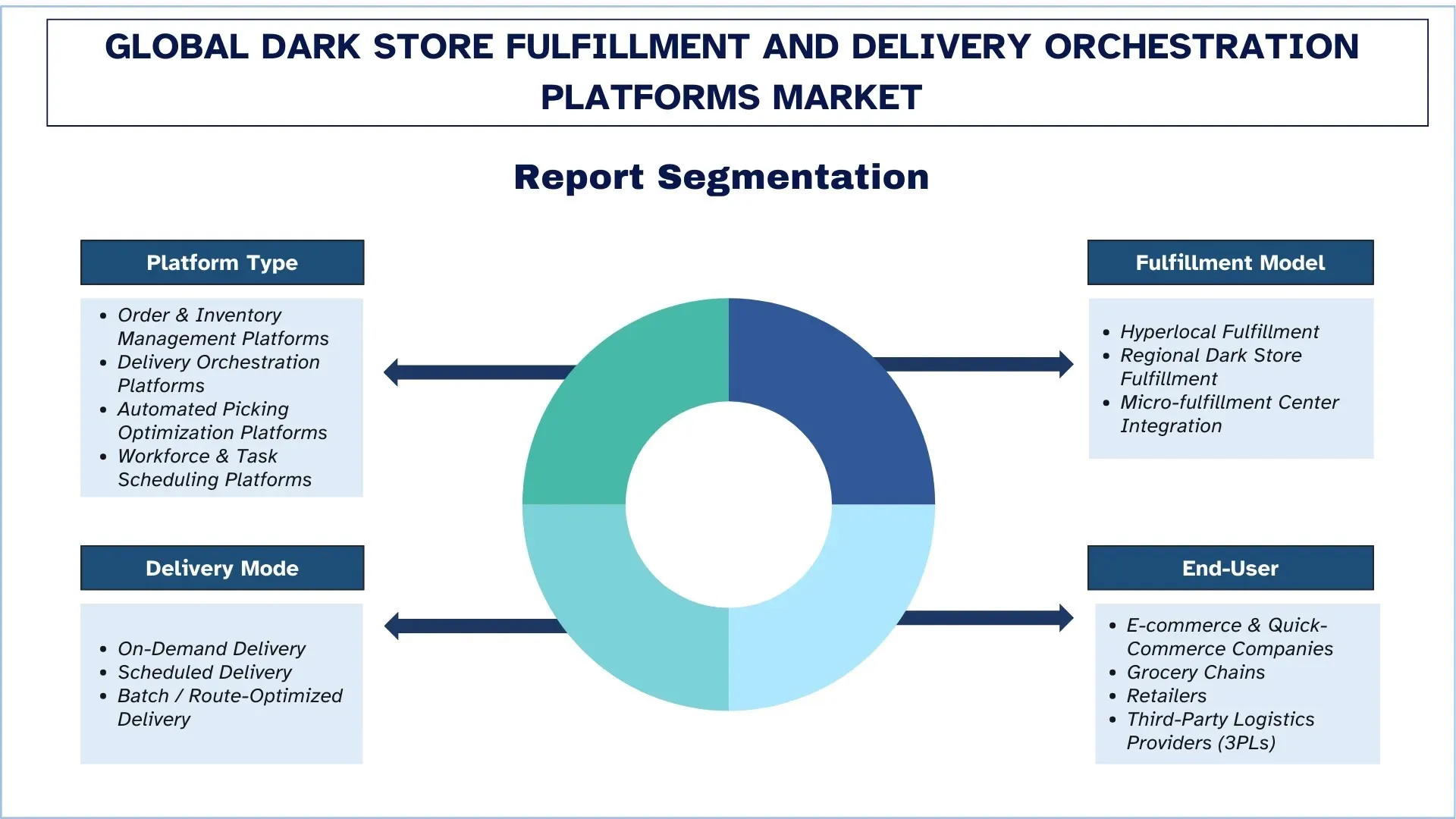
Emphasis on Platform Type (Order & Inventory Management Platforms, Delivery Orchestration Platforms, Automated Picking Optimization Platforms, and Workforce & Task Scheduling Platforms); Fulfillment Model (Hyperlocal Fulfillment, Regional Dark Store Fulfillment, and Micro-fulfillment Center Integration); Delivery Mode (On-Demand Delivery, Scheduled Delivery, and Batch / Route-Optimized Delivery); End-User (E-commerce & Quick-Commerce Companies, Grocery Chains, Retailers, and Third-Party Logistics Providers (3PLs)), and Region/Country
Global Dark Store Fulfillment and Delivery Orchestration Platforms Market Size & Forecast
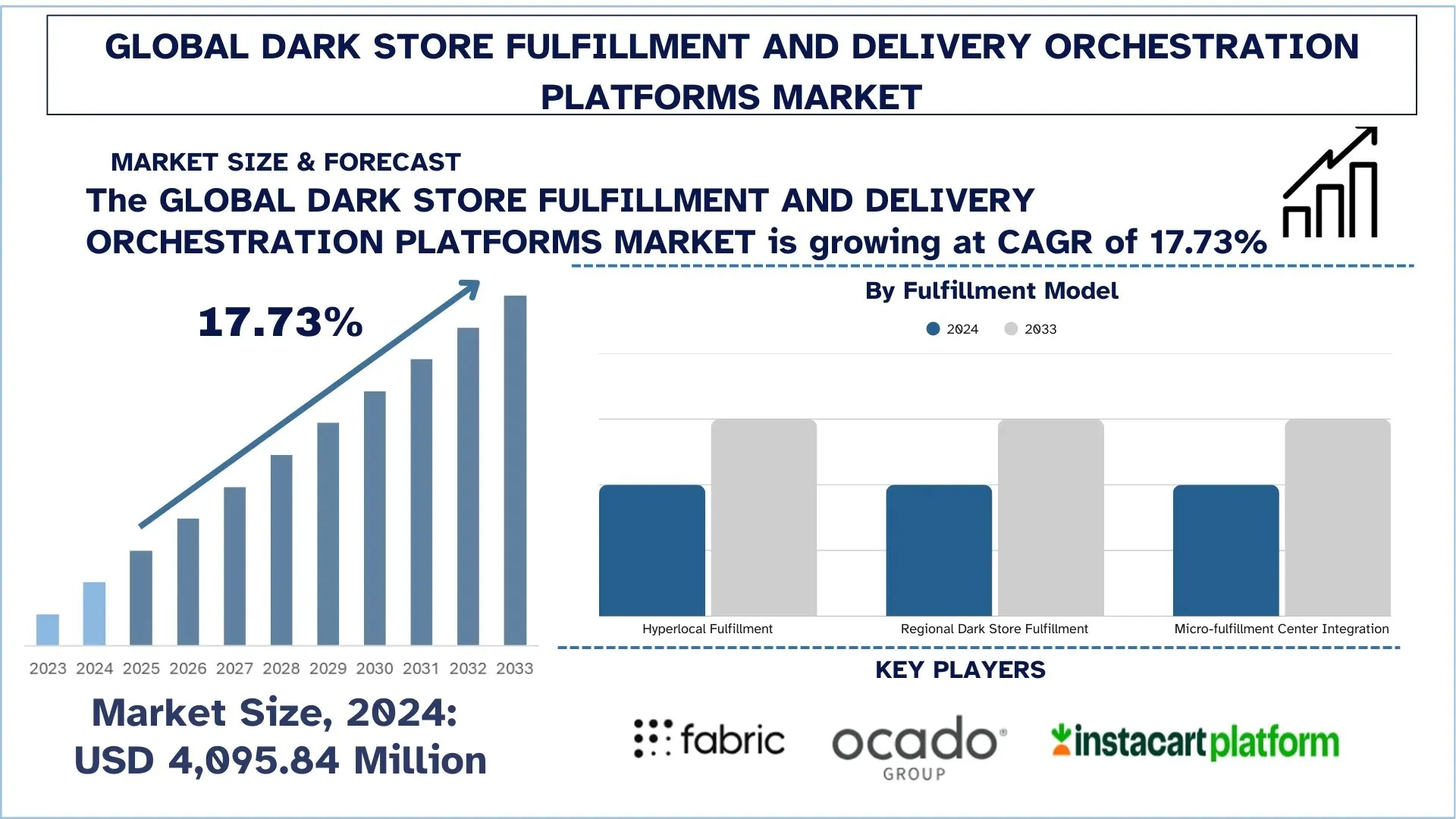
The Global Dark Store Fulfillment and Delivery Orchestration Platforms Market was valued at USD 4,095.84 million in 2024 and is expected to grow at a CAGR of around 17.73% during the forecast period (2025–2033F). The growing demand for rapid last-mile delivery, the expansion of online grocery and quick commerce, and the focus on real-time visibility and cost efficiency are driving the global dark store fulfillment and delivery orchestration platforms market growth.
Dark Store Fulfillment and Delivery Orchestration Platforms Market Analysis
The orchestration of dark-store and delivery fulfillment is increasingly complex, and contemporary retail practice demands precise and reliable picking and last-mile delivery across a broad range of demand and traffic conditions. Increased customer demand is fueling the growth in the global dark store fulfillment and delivery orchestration market, which demands to be served by speed, accuracy, and transparency as omnichannel store retail and quick commerce gain momentum. As the primary interface among inventory, labor, couriers, and customers, orchestration platforms are regarded by retailers and logistics partners as vital to service quality, operational efficiency, and the customer experience. This is reinforced by the fact that manual siloed workflows are being replaced by high-performance, lightweight software architectures that enhance productivity, reduce costs, and increase delivery densities. At the same time, the advent of AI-driven personalization and intelligent routing last year has strained platforms that can interact well with POS, WMS, micro-fulfillment automation, and third-party delivery networks to make fulfillment architecture smarter, more responsive, and future-oriented.
Global Dark Store Fulfillment and Delivery Orchestration Platforms Market Trends
This section discusses the key market trends that are influencing the various segments of the global dark store fulfillment and delivery orchestration platforms market, as found by our team of research experts.
AI-Driven Decisioning in Real Time
The global dark store fulfillment and delivery orchestration platforms market is increasingly adopting AI-driven, real-time decisioning, with operators shifting from fixed rules to continuously optimized execution. Rather than using fixed picking waves, predefined delivery zones, or manual exception handling, AI-enabled systems accept live signals, orders, inventory, labor availability, traffic, and perishable constraints to recalculate promises, reprioritize picks, rebalance capacity, and initiate proactive interventions before service levels are compromised. This shift is accelerating because dark-store economics depend on small improvements in accuracy, on-time performance, and courier utilization, especially during peaks when cancellations, substitutions, and delays can spike. To illustrate this momentum, the National Retail Federation (NRF) indicates that 59 percent of the surveyed retailers are already planning on or exploring the use of AI in their supply chains and warehouses, which underscores how quickly AI is becoming an integral part of operations rather than an experiment. All in all, AI-intermediated orchestration is refining fulfillment into a more predictive, responsive, and constantly learning operating model.
Dark Store Fulfillment and Delivery Orchestration Platforms Industry Segmentation
This section provides an analysis of the key trends in each segment of the global dark store fulfillment and delivery orchestration platforms market report, along with forecasts at the global, regional, and country levels for 2025-2033.
The Order & Inventory Management Platforms Segment Dominates the Dark Store Fulfillment and Delivery Orchestration Platforms Market
Based on platform type, the global dark store fulfillment and delivery orchestration platforms market is segmented into Order & Inventory Management Platforms, Delivery Orchestration Platforms, Automated Picking Optimization Platforms, and Workforce & Task Scheduling Platforms. In 2024, the Order & Inventory Management Platforms segment is anticipated to hold the largest market share and continue its dominance throughout the forecast period. This is mainly because dark stores and micro-fulfillment networks rely on real-time inventory accuracy, catalog alignment, replacement, and promise control to meet tight delivery windows and prevent cancellations. These platforms are the operational source of truth, which allows them to achieve high fill rates, fewer out-of-stocks, smooth omnichannel integration, and customer satisfaction, as well as facilitate the rapid SKU addition, replenishment across multiple areas, and compliance needs, which causes them to be at the center of the performance of retailers and the consumer trust. Nevertheless, that segment, the Delivery Orchestration Platforms one, will be growing the most quickly because of the rise in volumes of quick-commerce, the increased dependence on the third-party fleets, and the necessity to improve the cost per drop in the busy urban setting.
The Hyperlocal Fulfillment Segment held the Largest Market Share in the Dark Store Fulfillment and Delivery Orchestration Platforms Market.
Based on the fulfillment model, the global dark store fulfillment and delivery orchestration platforms market is segmented into Hyperlocal Fulfillment, Regional Dark Store Fulfillment, and Micro-fulfillment Center Integration. In 2024, the Hyperlocal Fulfillment segment is anticipated to hold the largest market share and continue its dominance throughout the forecast period. This is mainly due to the fact that quick commerce and on-demand grocery growth are mostly based on high urban catchments, where retailers offer ultra-fast delivery, and thus, real-time inventory visibility, high pick rates, and courier coordination are the key to avoiding substitutions and order lateness. These hyperlocal designs are software-intensive to strike the right trade-off between speed and accuracy by using smart slotting, dynamic order throttling, and real-time ETA, which can directly enhance customer satisfaction and cushion margins during high-frequency purchases with small baskets. The Micro-fulfillment Center Integration segment, however, will increase at the most rapid rate because of the automation expansion by retailers to overcome labor shortages, wage increases, and the need for regular service during peak hours. Operators have been embracing systems that can flawlessly combine robotics, automated storage/retrieval systems, and conveyor-enabled picking with OMS/WMS and last-mile partners to optimize throughput, minimize pick costs, enhance order accuracy, and expand the economics of rapid delivery beyond core city areas.
Asia Pacific Dominated the Global Dark Store Fulfillment and Delivery Orchestration Platforms Market
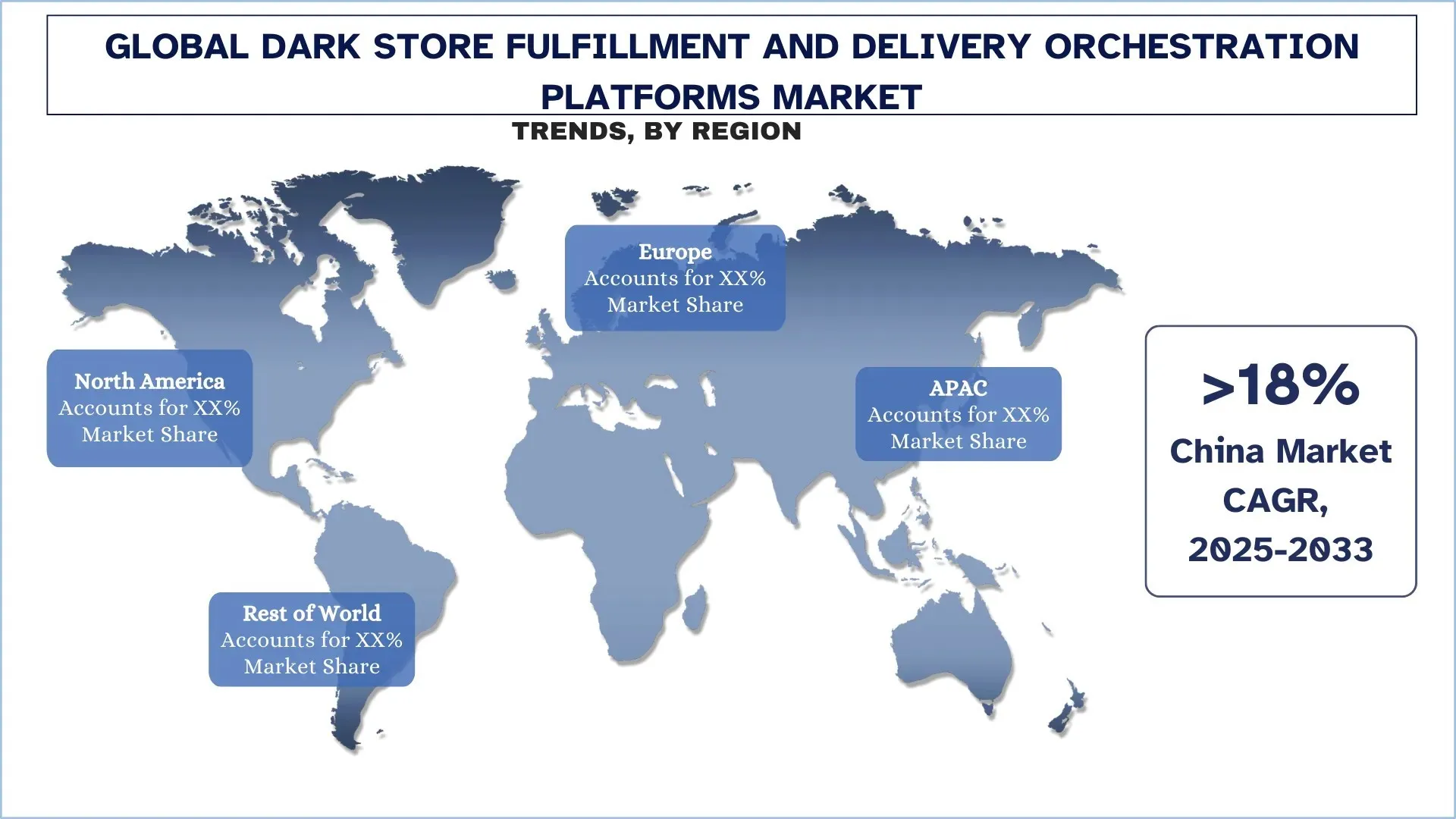
The Asia-Pacific region has been at the forefront of the global market for dark-store fulfillment and delivery-orchestration systems, driven by e-grocery, quick commerce, and mobile-first consumer behavior, particularly in China, India, and Southeast Asia. The region hosts some of the largest e-commerce systems, stores, and last-mile networks globally, resulting in high demand for real-time order management, inventory transparency, picking optimization, and delivery coordination within high-density urban catchments. With the volume of online order deliveries growing steadily and same-day and instant delivery becoming the new standard, the complexity of fulfillment software functionality, including dynamic slotting, courier dispatch, and substitution logic, as well as ETA intelligence, is only becoming a more significant need. The market growth is also fueled by rapid urbanization and a rising middle class in emerging markets. Stiff rivalry is forcing operators to reduce cost-to-serve and improve service reliability. Additionally, the region has placed greater emphasis on scalable digital infrastructure, payment systems, and platform-based logistics, which have accelerated the introduction of higher-order orchestration capabilities. With customer experience, speed, and operational efficiency becoming strategic priorities, Asia-Pacific is the first to innovate and implement these capabilities, making it the leading market for dark store fulfillment and delivery orchestration platforms.
China held a dominant Share of the Asia Pacific Dark Store Fulfillment and Delivery Orchestration Platforms Market in 2024
China has swept over the Asia-Pacific market because of its unmatched quantity of manufacturing, integrated chains, and the huge number of domestic consumers. The base generates huge economies of scale and a cost advantage. Moreover, active government policies and strategic investments in digital machinery, logistics, and technology (such as AI and automation) have boosted its competitiveness. Being the world's factory, the primary source of innovation, China uses its mass production, technology adoption, and export systems to establish regional trends and make price dictators, as well as a major supplier and essential consumption market in almost all sectors of the industry.
Dark Store Fulfillment and Delivery Orchestration Platforms Industry Competitive Landscape
The global dark store fulfillment and delivery orchestration platforms market is competitive, with several global and international market players. The key players are adopting different growth strategies to enhance their market presence, such as partnerships, agreements, collaborations, new product launches, geographical expansions, and mergers and acquisitions.
Top Dark Store Fulfillment and Delivery Orchestration Platforms Companies
Some of the major players in the market are Fabric, Ocado Group plc, Instacart Platform, Shipday, Woolworths Group (Takeoff Technologies), Dematic, Exotec, Bringg, Mara Labs Inc., and Onfleet, Inc.
Recent Developments in the Dark Store Fulfillment and Delivery Orchestration Platforms Market
In October 2025, Reliance Retail is aggressively expanding its quick-commerce business, JioMart, to compete with rivals like Blinkit. The company opened 600 new dark stores to pivot towards a sub-30-minute delivery model, achieving a 42% quarterly growth in daily orders. This fast-growing channel now accounts for 20% of Reliance Retail's total revenue, leveraging its extensive physical store network to dominate the market.
In September 2025, Takeoff Technologies introduced a new dark store fulfillment and delivery orchestration system that utilizes proprietary artificial intelligence to synchronize real-time inventory and deliveries. It was a significant breakthrough in the operation efficiency in the global dark store arrangement and delivery orchestration system market after more than five years of research and development.
Global Dark Store Fulfillment and Delivery Orchestration Platforms Market Report Coverage
Report Attribute | Details |
Base year | 2024 |
Forecast period | 2025-2033 |
Growth momentum | Accelerate at a CAGR of 17.73% |
Market size 2024 | USD 4,095.84 Million |
Regional analysis | North America, Europe, APAC, Rest of the World |
Major contributing region | Asia Pacific is expected to dominate the market during the forecast period. |
Key countries covered | U.S., Canada, Germany, U.K., Spain, Italy, France, China, Japan, and India |
Companies profiled | Fabric, Ocado Group plc, Instacart Platform, Shipday, Woolworths Group (Takeoff Technologies), Dematic, Exotec, Bringg, Mara Labs Inc., and Onfleet, Inc. |
Report Scope | Market Trends, Drivers, and Restraints; Revenue Estimation and Forecast; Segmentation Analysis; Demand and Supply Side Analysis; Competitive Landscape; Company Profiling |
Segments Covered | By Platform Type; By Fulfillment Model, By Delivery Mode, By End-User, and By Region/Country |
Reasons to Buy the Dark Store Fulfillment and Delivery Orchestration Platforms Market Report:
The study includes market sizing and forecasting analysis confirmed by authenticated key industry experts.
The report briefly reviews overall industry performance at a glance.
The report covers an in-depth analysis of prominent industry peers, primarily focusing on key business financials, type portfolios, expansion strategies, and recent developments.
Detailed examination of drivers, restraints, key trends, and opportunities prevailing in the industry.
The study comprehensively covers the market across different segments.
Deep dive regional-level analysis of the industry.
Customization Options:
The global dark store fulfillment and delivery orchestration platforms market can further be customized as per the requirements or any other market segment. Besides this, UnivDatos understands that you may have your own business needs; hence, feel free to contact us to get a report that completely suits your requirements.
Table of Content
Research Methodology for the Global Dark Store Fulfillment and Delivery Orchestration Platforms Market Analysis (2023-2033)
We analyzed the historical market, estimated the current market, and forecasted the future market of the global dark store fulfillment and delivery orchestration platforms market to assess its application in major regions worldwide. We conducted exhaustive secondary research to gather historical market data and estimate the current market size. To validate these insights, we carefully reviewed numerous findings and assumptions. Additionally, we conducted in-depth primary interviews with industry experts across the dark store fulfillment and delivery orchestration platforms value chain. After validating market figures through these interviews, we used both top-down and bottom-up approaches to forecast the overall market size. We then employed market breakdown and data triangulation methods to estimate and analyze the market size of industry segments and sub-segments.
Market Engineering
We employed the data triangulation technique to finalize the overall market estimation and derive precise statistical numbers for each segment and sub-segment of the global dark store fulfillment and delivery orchestration platforms market. We split the data into several segments and sub-segments by analyzing various parameters and trends, including platform type, fulfillment model, delivery mode, end-user, and regions within the global dark store fulfillment and delivery orchestration platforms market.
The Main Objective of the Global Dark Store Fulfillment and Delivery Orchestration Platforms Market Study
The study identifies current and future trends in the global dark store fulfillment and delivery orchestration platforms market, providing strategic insights for investors. It highlights regional market attractiveness, enabling industry participants to tap into untapped markets and gain a first-mover advantage. Other quantitative goals of the studies include:
Market Size Analysis: Assess the current market size and forecast the market size of the global dark store fulfillment and delivery orchestration platforms market and its segments in terms of value (USD).
Dark Store Fulfillment and Delivery Orchestration Platforms Market Segmentation: Segments in the study include areas of platform type, fulfillment model, delivery mode, end-user, and regions.
Regulatory Framework & Value Chain Analysis: Examine the regulatory framework, value chain, customer behavior, and competitive landscape of the dark store fulfillment and delivery orchestration platforms industry.
Regional Analysis: Conduct a detailed regional analysis for key areas such as Asia Pacific, Europe, North America, and the Rest of the World.
Company Profiles & Growth Strategies: Company profiles of the dark store fulfillment and delivery orchestration platforms market and the growth strategies adopted by the market players to sustain the fast-growing market.
Frequently Asked Questions FAQs
Q1: What is the global dark store fulfillment and delivery orchestration platforms current market size and its growth potential?
The global dark store fulfillment and delivery orchestration platforms market was valued at USD 4,095.84 million in 2024 and is expected to grow at a CAGR of 17.73% during the forecast period (2025-2033).
Q2: Which segment has the largest share of the global dark store fulfillment and delivery orchestration platforms market by Platform Type?
The Order & Inventory Management Platforms segment is anticipated to hold the largest market share as they provide the real-time inventory accuracy and operational control needed to meet tight delivery windows and prevent cancellations, securing their dominant market share.
Q3: What are the driving factors for the growth of the global dark store fulfillment and delivery orchestration platforms market?
• Surging quick-commerce and e-grocery demand
• Omnichannel expansion and inventory complexity
• Rising pressure to reduce cost-to-serve
Q4: What are the emerging technologies and trends in the global dark store fulfillment and delivery orchestration platforms market?
• AI-driven decisioning in real time
• Shift to hybrid fleets and multi-carrier orchestration
Q5: What are the key challenges in the global dark store fulfillment and delivery orchestration platforms market?
• Integration complexity across fragmented tech stacks
• Operational volatility and peak management
Q6: Which region dominates the global dark store fulfillment and delivery orchestration platforms market?
The Asia-Pacific dominated the global market for dark-store fulfillment and delivery-orchestration systems, driven by e-grocery, quick commerce, and mobile-first consumer behavior, particularly in China, India, and Southeast Asia.
Q7: Who are the key players in the global dark store fulfillment and delivery orchestration platforms market?
Some of the key companies include:
• Fabric
• Ocado Group plc
• Instacart Platform
• Shipday
• Woolworths Group (Takeoff Technologies)
• Dematic
• Exotec
• Bringg
• Mara Labs Inc.
• Onfleet, Inc.
Q8: How does the growth of quick-commerce and rising consumer expectations impact the adoption of dark store fulfillment and delivery orchestration platforms?
• Speed & SLA Pressure: Faster delivery promises (10–60 minutes) require real-time order prioritization, picking acceleration, and instant courier dispatch to consistently meet SLAs.
• Accuracy & Customer Experience: Higher demand increases the cost of errors, driving adoption of platforms that improve inventory accuracy, substitutions management, and real-time tracking/ETA visibility.
• Scalability Needs: Expanding order volumes across multiple dark stores and zones pushes retailers to adopt standardized orchestration to manage capacity, peaks, and multi-node fulfillment efficiently.
Q9: How does the integration of automation and micro-fulfillment technologies influence platform capabilities and market adoption?
• Automation Integration: Platforms must integrate seamlessly with MFC robotics/ASRS and WMS to synchronize order release, pick sequencing, and exception handling in real time.
• Throughput & Cost Optimization: Automated picking optimization and intelligent wave management improve throughput, reduce labor dependency, and lower pick cost per order.
• Reliability During Peaks: Automation-aware orchestration enables stable performance under peak demand by balancing system capacity, replenishment timing, and order throttling.
Related Reports
Customers who bought this item also bought

India IT and BPO Services Market: Current Analysis and Forecast (2026-2034)
Emphasis on Service Type (IT Services, BPO Services, Engineering & R&D Services); Outsourcing Type (Onshore, Offshore, Nearshore); Organization Size (Large Enterprises, SMEs); End-User Industry (BFSI, IT & Telecom, Healthcare, Retail & E-commerce, Manufacturing, Others); and Region/States
Gi-Fi Technology Market: Current Analysis and Forecast (2025-2033)
Emphasis on Product Type (Display Devices and Network Infrastructure Devices); Technology (System on chip and Integrated Circuit Chip); Application (Consumer Electronics, Commercial, and Networking); and Region/Country
DNA Data Storage Market: Current Analysis and Forecast (2026-2034)
Emphasis on Type (Cloud and On-Premises); Technology (Sequence-based DNA Data Storage and Structure-based DNA Data Storage); End-User (Government, Healthcare & Biotechnology, Media & Telecommunication, and Others); and Region/Country
Cloud Service Brokerage Market: Current Analysis and Forecast (2026-2034)
Emphasis on Service Type (Integration and Support, Automation and Orchestration, Billing and Provisioning, Migration and Customization, Security and Compliance, and Others); Platform (Internal Brokerage Enablement and External Brokerage Enablement); Deployment (Private, Public, and Hybrid); Enterprise Size (Large Enterprises, and Small & Medium-Sized Enterprises); End-Use (IT & Telecom, BFSI, Government & Public Sector, Healthcare, Consumer Goods & Retail, Manufacturing, Energy & Utilities, and Others); and Region/Country