Middle East & Africa Factory Automation Market: Current Analysis and Forecast (2025-2033)
Emphasis By Component (Hardware (Sensors, Controllers, Robots, Drives, Others), and Software), By Technology (PLC, DCS, SCADA, HMI, and others), By Industry Vertical (Automotive, Food & Beverages, Oil & Gas, Manufacturing, Mining, and Others), By Country (Saudi Arabia, UAE, Egypt, South Africa, Turkey, Israel, and the Rest of Middle East & Africa)
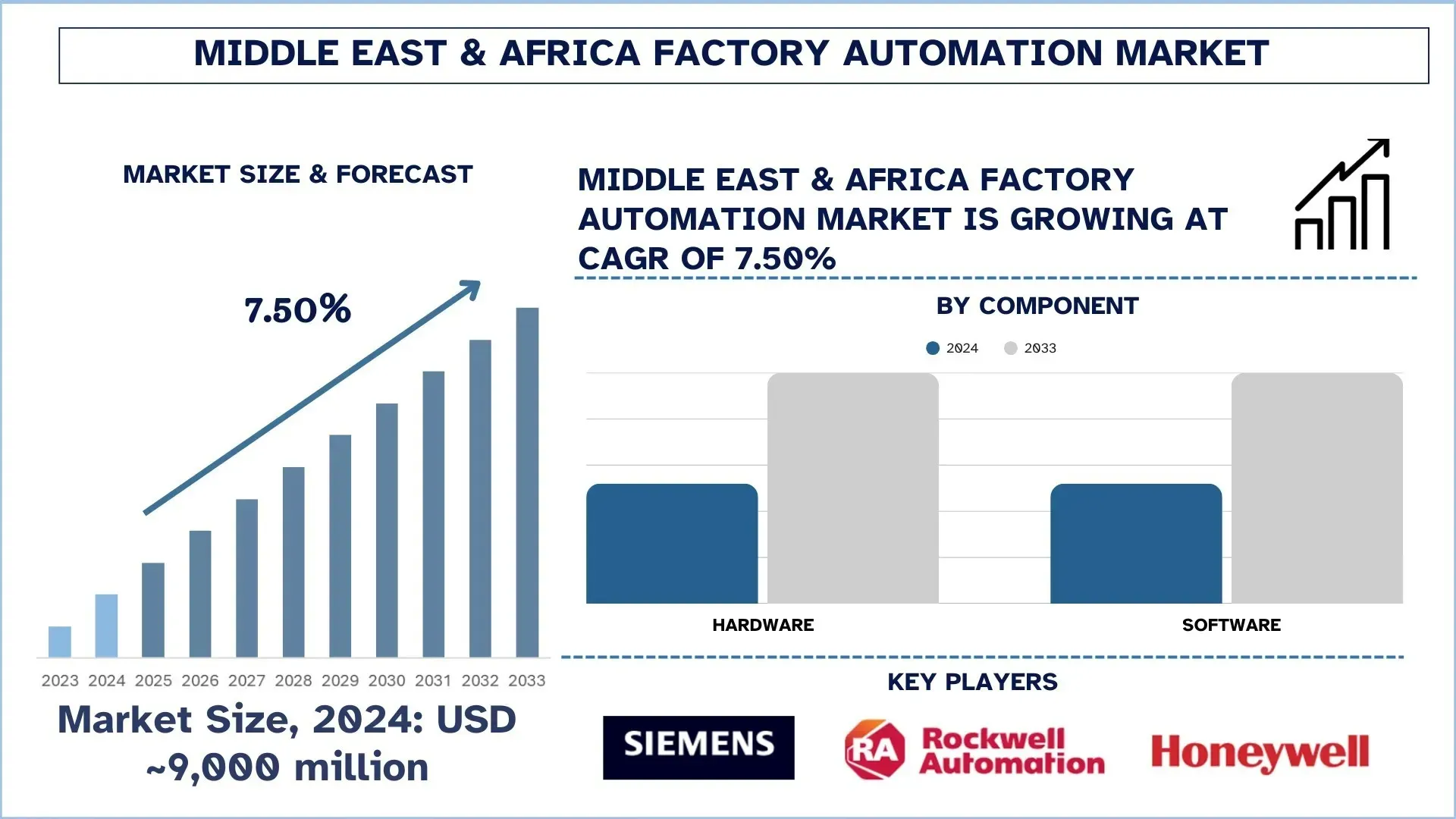
Middle East & Africa Factory Automation Market Size & Forecast
The Middle East & Africa Factory Automation Market was valued at USD 9,000 million in 2024 and is expected to grow at a strong CAGR of around 7.50% during the forecast period (2025- 2033F). Government-led industrial diversification & Incentives, and the Surge in EV & battery manufacturing, are key factors contributing to the market's rise.
Middle East & Africa Factory Automation Market Analysis
The factory automation market of the Middle East and Africa is developing with the rollout of a cluster that is focused on major industrial areas, economic cities, and export manufacturing centers. In the Gulf, the adoption is guided by the national agenda of diversification of industries, investments in new capacity, and the urgency to increase productivity and quality on the global level. Connected operations and robotics, and more powerful local ecosystems of integrators and service partners, are increasingly becoming the design of new build plants and brownfield upgrades. Africa has the best momentum when the manufacturing scale and process industries are implemented, and reliability, energy efficiency, and production stability are the priorities of automation. In both areas, demand is growing in hardware to software, data, and services, such as MES, condition monitoring, remote support, and cybersecurity, as companies are seeking quantifiable improvements in performance, and not a one-off technology pilot.
Middle East & Africa Factory Automation Market Trends
This section discusses the key market trends that are influencing the various segments of the Middle East & Africa Factory Automation market, as found by our team of research experts.
AI + robotics ecosystems adoption:
The ecosystems of AI and robots are becoming popular in the Middle East and Africa due to the shift of factory automation from one-off projects to scalability. Business, national, educational, and international technology providers are establishing common capacity by having research and development centers, robotics, pilot lines, and industry-specific accelerators. This ecosystem model reduces the distance between developing and deploying products and services by offering established reference architectures, regional integration skills, and operator, maintenance, and engineer training. Manufacturers are rapidly embracing machine vision to conduct inspection, intelligent robotics to pick and place and package, and AI-based analytics in order to anticipate downtime as well as stabilize quality. Local service hubs increase the speed of commissioning, after-sales power, and accessibility to spares and upgrades by plants. With time, these ecosystems also increase confidence in investing in automation by showing the quantifiable results of increased throughput, a reduction in defects, and safer processes, and building a better talent pipeline in the region.
Key Market Segmentation:
This section provides an analysis of the key trends in each segment of the Middle East & Africa Factory Automation market report, along with forecasts at the country and regional levels for 2025-2033.
The Hardware segment has shown promising growth in the Factory Automation Market.
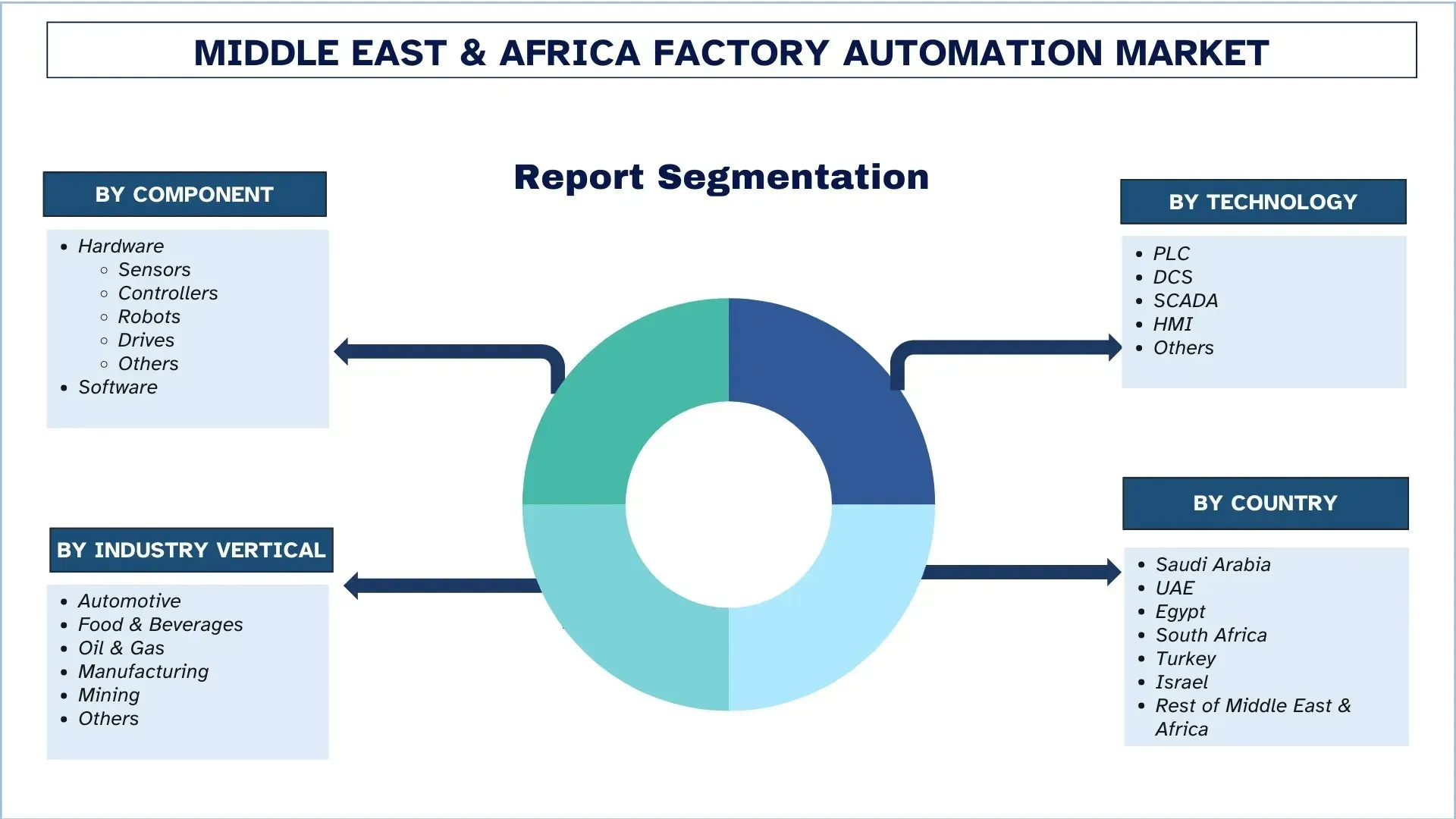
According to the component, the market of the Middle East and Africa Factory Automation can be divided into hardware and software. The hardware category has dominated the majority of the market share. This is very much fueled by further investment in the underlying automation equipment like industrial robots, programmable logic controllers, drives, sensors, machine vision, and safety systems, especially in new manufacturing plants and in new retrofits. A large number of end users continue to value the physical upgrades that have short-term benefits in terms of throughput, quality consistency, and safety of operations. Also, hardware acquisition is more readily defensible through capital spending budgets, and software integration can be postponed due to integration complexity, data preparation, and skills shortages. The demand for software is, however, on an increasing trend as plants seek to connect, to get performance analytics, to remotely monitor, so as to make maximum use of the hardware installed.
The PLC category held a significant share of the Middle East & Africa Factory Automation Market.
According to technology, the factory automation market in the Middle East and Africa is categorized into PLC, DCS, SCADA, HMI, and others, all applied to serve different operational needs. PLCs are very common in the discrete control of manufacturing lines because they are reliable and also very easy to program. DCS is usually used in processing industries, e.g., oil & gas, chemicals, and power, where continuous control and high availability are important. SCADA can be used to remotely monitor and supervise assets that are separated by quite broad geographical distances, such as pipelines, utilities, and water treatment plants. The HMI solutions are easy to look at and enable the operators to make improved decisions and minimize downtime. The other category comprises sensors, industrial networks, robotics, and MES that will facilitate wider Industry 4.0 projects.
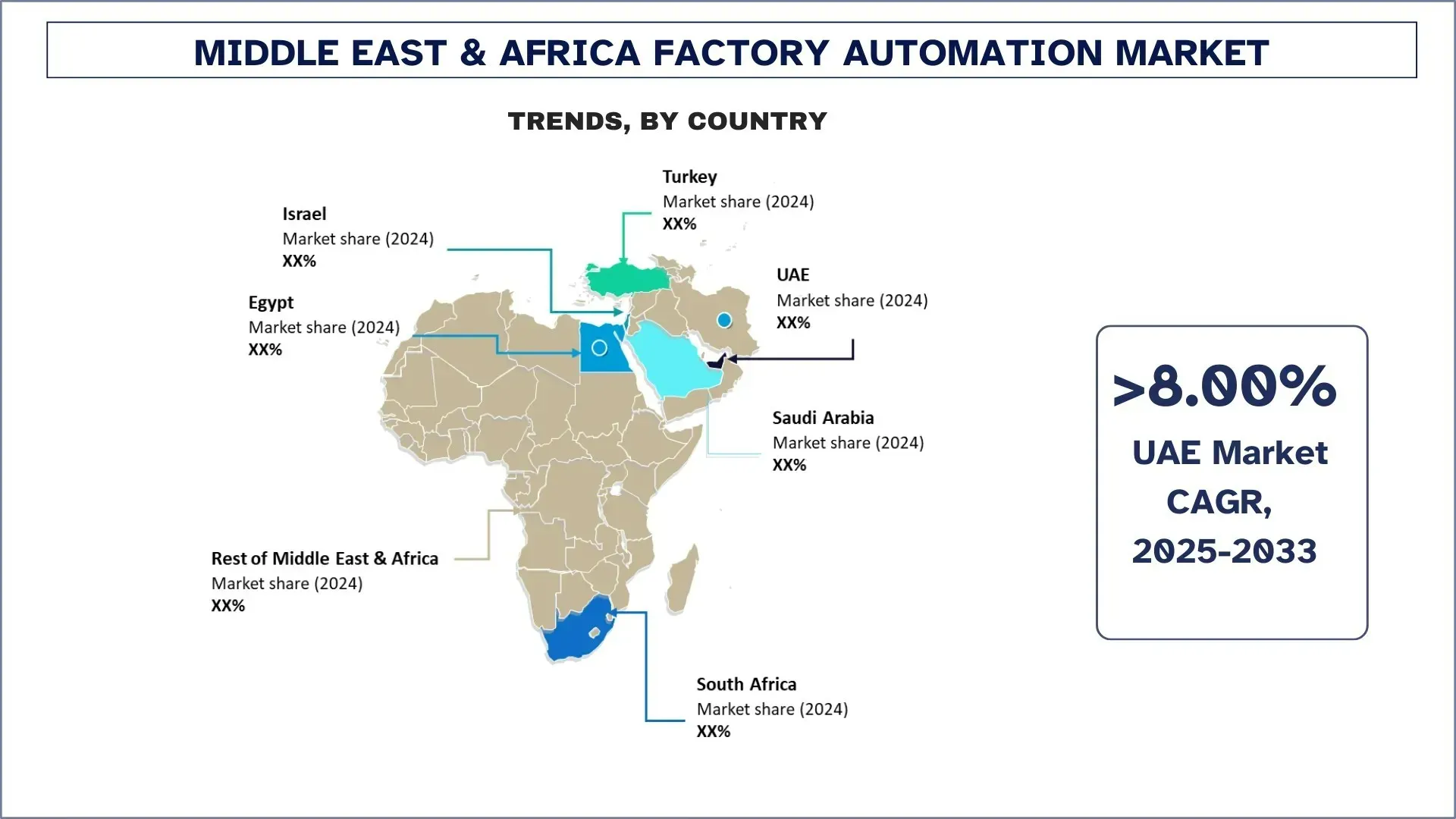
The UAE is expected to grow at a considerable rate during the forecast period.
The UAE factory automation market is growing at a fast rate, with manufacturers seeking greater productivity, quality that is consistent, operations that are more energy-efficient and safer, and supply chains that are more resilient. The robust state-supported industrial diversification, global logistics, and fast introduction of the Industry 4.0 technology have been the impetus for investing in robotics, world-class logistics, machine vision, and IIoT platforms in food and beverage, metals, pharmaceuticals, and electronics. As the country is considered to be the most rapidly growing industrial location in the Middle East & Africa region, the need for integrated automation and data-based maintenance solutions is increasing. Additionally, the country is also witnessing the surge of automation solutions providers. For instance, in 2025, Global electric solutions provider HIMEL entered into the UAE’s HVAC-focused industrial automation market. The company has introduced its flagship “I Love Control” Series for a line of smart industrial controls focused on the heating, ventilation, and air conditioning (HVAC) sector.
Middle East & Africa Factory Automation Industry Competitive Landscape:
The Middle East & Africa Factory Automation market is competitive, with several global and international market players. The key players are adopting different growth strategies to enhance their market presence, such as partnerships, agreements, collaborations, new product launches, geographical expansions, and mergers and acquisitions.
Top Middle East & Africa Factory Automation Companies
Some of the major players in the market are ABB Limited, Siemens AG, Yokogawa Electric Corporation, Rockwell Automation Inc., General Electric, Honeywell International Inc., Mitsubishi Electric Corporation, Omron Corporation, Saudi Controls Ltd, and Fanuc Corporation.
Middle East & Africa Factory Automation Market Report Coverage
Report Attribute | Details |
Base year | 2024 |
Forecast period | 2025-2033 |
Growth momentum | Accelerate at a CAGR of 7.50% |
Market size 2024 | USD 9,000 Million |
Country analysis | Saudi Arabia, UAE, Egypt, South Africa, Turkey, Israel, and the Rest of the Middle East & Africa |
Major contributing Country | Saudi Arabia is expected to dominate the market during the forecast period. |
Companies profiled | ABB Limited, Siemens AG, Yokogawa Electric Corporation, Rockwell Automation Inc., General Electric, Honeywell International Inc., Mitsubishi Electric Corporation, Omron Corporation, Saudi Controls Ltd, and Fanuc Corporation. |
Report Scope | Market Trends, Drivers, and Restraints; Revenue Estimation and Forecast; Segmentation Analysis; Demand and Supply Side Analysis; Competitive Landscape; Company Profiling |
Segments Covered | by Component, by Technology, by Industry Vertical, by Country |
Reasons to Buy the Middle East & Africa Factory Automation Market Report:
The study includes market sizing and forecasting analysis confirmed by authenticated key industry experts.
The report briefly reviews overall industry performance at a glance.
The report covers an in-depth analysis of prominent industry peers, primarily focusing on key business financials, type portfolios, expansion strategies, and recent developments.
Detailed examination of drivers, restraints, key trends, and opportunities prevailing in the industry.
The study comprehensively covers the market across different segments.
Deep dive Country-level analysis of the industry.
Customization Options:
The Middle East & Africa FACTORY AUTOMATION market can further be customized as per requirements or any other market segment. Besides this, UnivDatos understands that you may have your own business needs; hence, feel free to contact us to get a report that completely suits your requirements.
Table of Content
Research Methodology for the Middle East & Africa Factory Automation Market Analysis (2023-2033)
We analyzed the historical market, estimated the current market, and forecasted the future market of the Middle East & Africa Factory Automation market to assess its application in major countries. We conducted exhaustive secondary research to gather historical market data and estimate the current market size. To validate these insights, we carefully reviewed numerous findings and assumptions. Additionally, we conducted in-depth primary interviews with industry experts across the Factory Automation value chain. After validating market figures through these interviews, we used both top-down and bottom-up approaches to forecast the overall market size. We then employed market breakdown and data triangulation methods to estimate and analyze the market size of industry segments and sub-segments.
Market Engineering
We employed data triangulation techniques to finalize the overall market estimation and derive precise statistical numbers for each segment and sub-segment of the Middle East & Africa Factory Automation market. We split the data into several segments and sub-segments by analyzing various parameters and trends, by Component, by Technology, by Industry Vertical, and by country within the Middle East & Africa Factory Automation market.
The Main Objective of the Middle East & Africa Factory Automation Market Study
The study identifies current and future trends in the Middle East & African Factory Automation market, providing strategic insights for investors. It highlights Country-level market attractiveness, enabling industry participants to tap into untapped markets and gain a first-mover advantage. Other quantitative goals of the studies include:
Market Size Analysis: Assess the current forecast and market size of the Middle East & Africa Factory Automation market and its segments in terms of value (USD).
Middle East & Africa Factory Automation Market Segmentation: Segments in the study include areas by Component, by Technology, by Industry Vertical, and by
Regulatory Framework & Value Chain Analysis: Examine the regulatory framework, value chain, customer behavior, and competitive landscape of the Middle East & Africa Factory Automation industry.
Country Analysis: Conduct a detailed Country analysis for key areas such as Saudi Arabia, UAE, Egypt, South Africa, Turkey, Israel, and the Rest of the Middle East & Africa.
Company Profiles & Growth Strategies: Company profiles of the Middle East & Africa Factory Automation market and the growth strategies adopted by the market players to sustain the fast-growing market.
Frequently Asked Questions FAQs
Q1: What is the Middle East & Africa Factory Automation market’s current market size and growth potential?
The Middle East & Africa Factory Automation market was valued at 9,000 million in 2024 and is expected to grow at a CAGR of 7.50% during the forecast period (2025-2033).
Q2: Which segment has the largest share of the Middle East & Africa Factory Automation market by Component?
Hardware category has held a dominant market share as it is very much fueled by further investment in the underlying automation equipment, like industrial robots, programmable logic controllers, drives, sensors, machine vision, and safety systems, especially in new manufacturing plants and in new retrofits.
Q3: What are the driving factors for the growth of the Middle East & Africa Factory Automation market?
• Government-led industrial diversification & incentives: National industrial strategies, localization programs, and fiscal incentives are accelerating investments in automated production lines, modern control systems, and smart manufacturing upgrades across key sectors.
• Surge in EV & battery manufacturing: Expanding EV and battery value chains are increasing demand for high-precision robotics, machine vision, motion control, and advanced process automation to support quality, traceability, and scale.
Q4: What are the emerging technologies and trends in the Middle East & Africa Factory Automation market?
• AI + robotics ecosystems adoption: Regional ecosystems are forming around AI, robotics labs, pilot lines, and integrator networks, enabling faster deployments through reference architectures, local service hubs, and workforce training.
• Move toward IIoT, edge & predictive maintenance: Manufacturers are connecting machines and sensors to capture real-time data, process it at the edge for faster decisions, and apply predictive models to reduce unplanned downtime and improve asset performance.
Q5: What are the key challenges in the Middle East & Africa Factory Automation market?
• Industrial cybersecurity risks: Greater IT-OT connectivity increases exposure to cyber threats, making secure architecture, continuous monitoring, and compliance-driven controls essential to protect critical operations.
• Infrastructure and energy reliability issues in Africa region: Grid instability, connectivity constraints, and limited industrial infrastructure can disrupt operations and slow automation rollouts, requiring resilient power solutions and ruggedized deployments.
Q6: Which country dominates the Middle East & Africa Factory Automation market?
Saudi Arabia dominates the Middle East & Africa factory automation market, driven by Vision 2030 industrial diversification, large-scale manufacturing investments, smart industrial zones, and strong adoption of robotics, PLCs, and IIoT.
Q7: Who are the key players in the Middle East & Africa Factory Automation market?
Some of the top Factory Automation companies in the Middle East & Africa include:
• ABB Limited
• Siemens AG
• Yokogawa Electric Corporation
• Rockwell Automation Inc.
• General Electric
• Honeywell International Inc.
• Mitsubishi Electric Corporation
• Omron Corporation
• Saudi Controls Ltd
• Fanuc Corporation
Q8: What are the opportunities for companies within the Middle East & Africa Factory Automation market?
• Greenfield investments in the Middle East & Africa region: New industrial zones and greenfield plants create strong demand for end-to-end automation architectures, digital-first commissioning, and scalable smart factory platforms.
• Emergence as an export base in developing countries of the region: As select markets strengthen export-oriented manufacturing, automation adoption rises to meet global quality standards, traceability requirements, and cost competitiveness.
Q9: How are consumer preferences shaping product development in the Middle East & Africa Factory Automation market?
Consumer expectations for faster delivery, consistent quality, and greater product variety are pushing manufacturers to adopt flexible, automated production. Companies are designing lines with robotics, machine vision, and real-time control to enable rapid changeovers, improved traceability, and fewer defects, while controlling costs and meeting stricter safety and sustainability norms.
Related Reports
Customers who bought this item also bought





India IT and BPO Services Market: Current Analysis and Forecast (2026-2034)
Emphasis on Service Type (IT Services, BPO Services, Engineering & R&D Services); Outsourcing Type (Onshore, Offshore, Nearshore); Organization Size (Large Enterprises, SMEs); End-User Industry (BFSI, IT & Telecom, Healthcare, Retail & E-commerce, Manufacturing, Others); and Region/States

Gi-Fi Technology Market: Current Analysis and Forecast (2025-2033)
Emphasis on Product Type (Display Devices and Network Infrastructure Devices); Technology (System on chip and Integrated Circuit Chip); Application (Consumer Electronics, Commercial, and Networking); and Region/Country

DNA Data Storage Market: Current Analysis and Forecast (2026-2034)
Emphasis on Type (Cloud and On-Premises); Technology (Sequence-based DNA Data Storage and Structure-based DNA Data Storage); End-User (Government, Healthcare & Biotechnology, Media & Telecommunication, and Others); and Region/Country

Cloud Service Brokerage Market: Current Analysis and Forecast (2026-2034)
Emphasis on Service Type (Integration and Support, Automation and Orchestration, Billing and Provisioning, Migration and Customization, Security and Compliance, and Others); Platform (Internal Brokerage Enablement and External Brokerage Enablement); Deployment (Private, Public, and Hybrid); Enterprise Size (Large Enterprises, and Small & Medium-Sized Enterprises); End-Use (IT & Telecom, BFSI, Government & Public Sector, Healthcare, Consumer Goods & Retail, Manufacturing, Energy & Utilities, and Others); and Region/Country