Cloud Service Brokerage Market: Current Analysis and Forecast (2026-2034)
Emphasis on Service Type (Integration and Support, Automation and Orchestration, Billing and Provisioning, Migration and Customization, Security and Compliance, and Others); Platform (Internal Brokerage Enablement and External Brokerage Enablement); Deployment (Private, Public, and Hybrid); Enterprise Size (Large Enterprises, and Small & Medium-Sized Enterprises); End-Use (IT & Telecom, BFSI, Government & Public Sector, Healthcare, Consumer Goods & Retail, Manufacturing, Energy & Utilities, and Others); and Region/Country
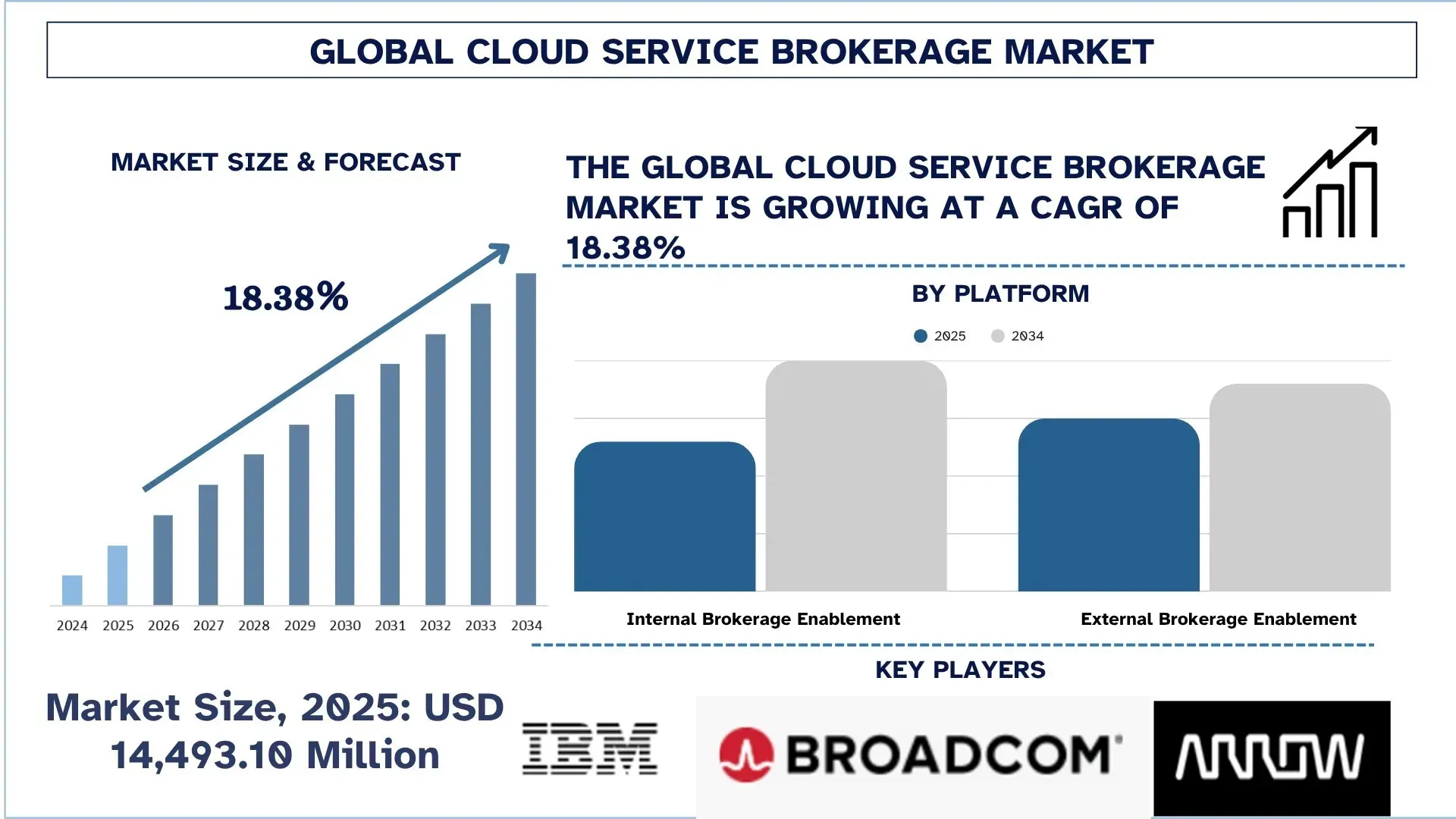
Global Cloud Service Brokerage Market Size & Forecast
The global Cloud Service Brokerage Market was valued at USD 14,493.10 million in 2025 and is expected to grow at a strong CAGR of around 18.38% during the forecast period (2026-2034F), driven by rising multi-cloud adoption, growing enterprise demand for cost optimization and governance, and the increasing need for centralized management of complex cloud environments.
Cloud Service Brokerage Market Analysis
Cloud Service Brokerage is a framework that allows businesses to easily coordinate and combine various cloud services, and it offers a centralized platform to acquire, utilize, and optimize various cloud services. It consists of a set of tools, processes, and services that are aimed at assisting enterprises in managing their cloud environments in a cost-effective, scalable, and secure way. CSBs help in the seamless flow of data, automation of workflows, and governance, besides allowing organizations to access the optimum solutions among the various cloud providers. These systems comprise cloud integration, optimization, and management mechanisms to maintain smooth operations within the various cloud environments.
The growing use of multi-cloud strategies, the growing requirement of cloud security and compliance management, and the growing trend of cloud migration across industries are the drivers of this growth. Also, market demand is driven by the fact that the hybrid cloud environment requires efficient cost management, optimization, and resource allocation. Innovations in AI-based cloud optimization tools, the rise of cloud-native applications, and the growing dependence on cloud-based platforms for business continuity and disaster recovery are other drivers in the market. For instance, on March 18, 2025, IBM successfully deployed a Cloud Service Brokerage platform to a large multinational retailer. It was a platform that combined multiple cloud services to offer seamless data transfer, workload automation, and cost optimization, which increased the efficiency of the operational processes of the retailer.
Global Cloud Service Brokerage Market Trends
This section discusses the key market trends that are influencing the various segments of the global Cloud Service Brokerage market, as found by our team of research experts.
Growth of Centralized Brokerage Platforms
The significant trend in the global Cloud Service Brokerage (CSB) market is the emergence of centralization solutions for managing multi-cloud and hybrid clouds. Such a centralization tool will be a universal portal that integrates disparate cloud computing, orchestration tools, billing systems, and governance policies into one platform, providing complete control over all aspects of cloud deployment and utilization. It will not only ensure transparency in the whole process but also allow enforcing security measures, ensuring compliance, monitoring cost management processes, and automating everything at the same time. A centralization solution will eliminate the formation of different silos within an enterprise, which has become crucial since businesses implement a multi-cloud strategy to avoid vendor lock-in and strengthen resilience. With the introduction of a unified dashboard, a single bill, and a coherent catalog of services, IT teams could make better decisions regarding cloud spending optimization and accelerated digital transformation. In December 2025, CloudBolt introduced a new Kubernetes cost allocation tool based on its Kubernetes right-sizing and FinOps technology that allows allocating cloud costs down to a single container. The issue of cost allocation was rather pressing, given that more than half of the Kubernetes user base cannot perform this task.
Cloud Service Brokerage Industry Segmentation
This section provides an analysis of the key trends in each segment of the global Cloud Service Brokerage market report, along with forecasts at the global, regional, and country levels for 2026-2034.
The Integration and Support segment held a significant share during the forecast period (2026-2034).
Based on the service type, the Cloud Service Brokerage (CSB) market is segmented into Integration and Support, Automation and Orchestration, Billing and Provisioning, Migration and Customization, Security and Compliance, and Others. In 2025, the Integration and Support segment held a significant share of the market. The Integration and Support services are the market drivers that offer smooth integration of other cloud services in multi-cloud and hybrid environments. The services allow businesses to effectively manage their cloud infrastructure, interoperability, and simplify the adoption of cloud services. As organizations continue to depend on a combination of cloud services, the integration services will be in demand as companies strive to scale their cloud environments to become more performance- and cost-effective. There is also a tremendous growth in the Automation and Orchestration services, which help businesses automate their workflows, optimize the allocation of resources, and enhance efficiency in the functioning of their cloud services. Also, the Security and Compliance segment is increasingly on the move as businesses seek more cloud security, risk management, and regulatory compliance services. With the cloud services market steadily growing, demand for these specialized brokerage services is likely to grow faster, and more innovation and development will occur in the CSB market.
The Internal Brokerage Enablement Segment Dominates the Global Cloud Service Brokerage Market.
Based on the platform, the Cloud Service Brokerage (CSB) market is segmented into Internal Brokerage Enablement and External Brokerage Enablement. In 2025, the Internal Brokerage Enablement segment held a dominant share of the market. Internal Brokerage Enablement services enable organizations to administer and streamline their cloud services within the organization, and a centralized system to use various cloud service providers and applications. The platform will aim at increasing efficiency in operations, governance, and cost management by offering businesses greater control over their cloud environments. The growing need to run a rich multi-cloud environment and ensure the internal communication flow has led to an increase in demand for internal brokerage solutions. On the other hand, the External Brokerage Enablement segment is gaining momentum, particularly when organizations desire to have the third-party operated cloud services to realize scalability, flexibility, and expertise. External brokers guide firms on their way through the various cloud service vendors offering best-of-breed solutions, and optimizing their cloud portfolios. The External Brokerage Enablement platform will continue to record a healthy growth as organizations are increasingly outsourcing specialized expertise, security, and compliance management, among others, in an effort to expand the CSB market.
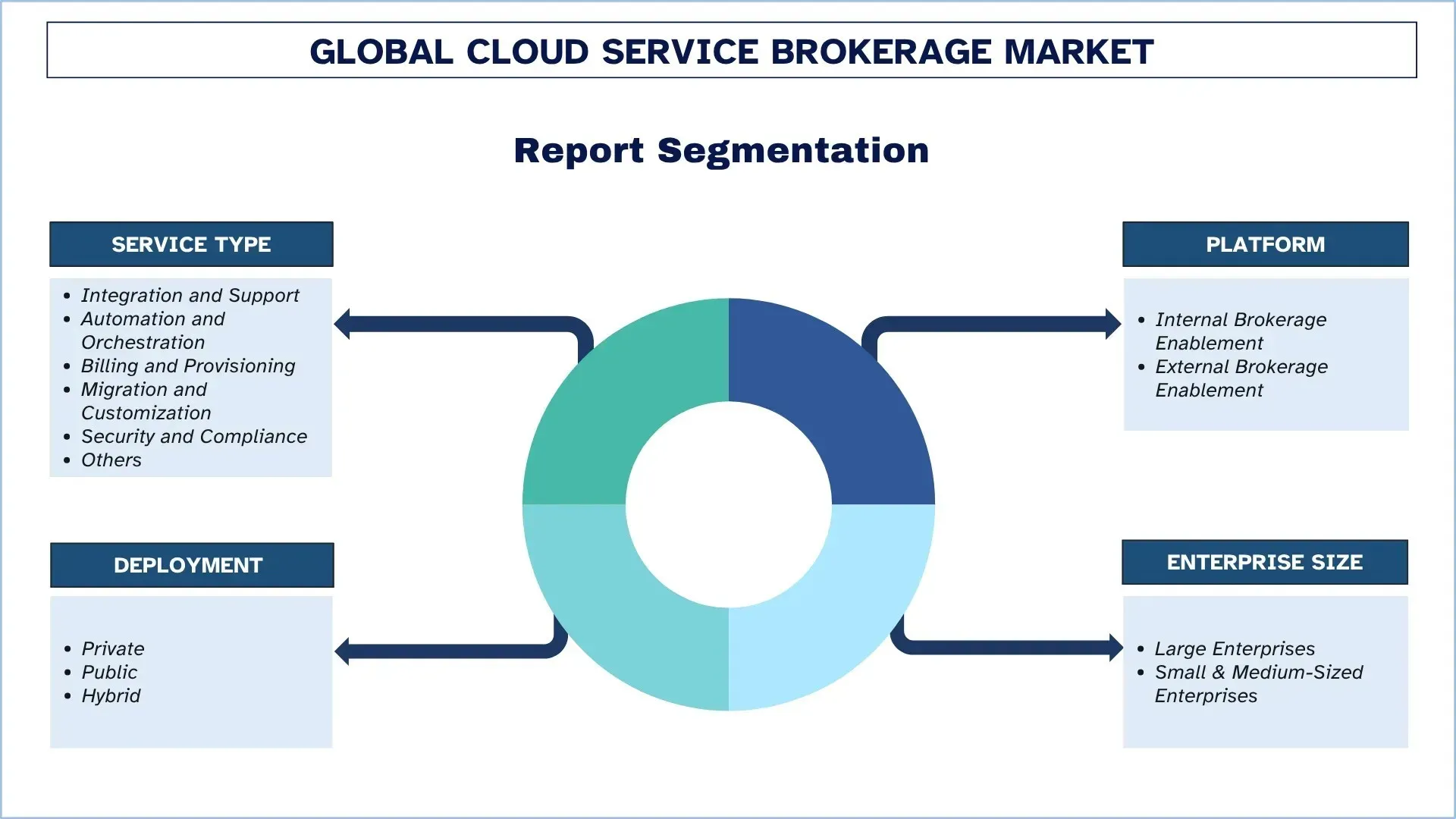
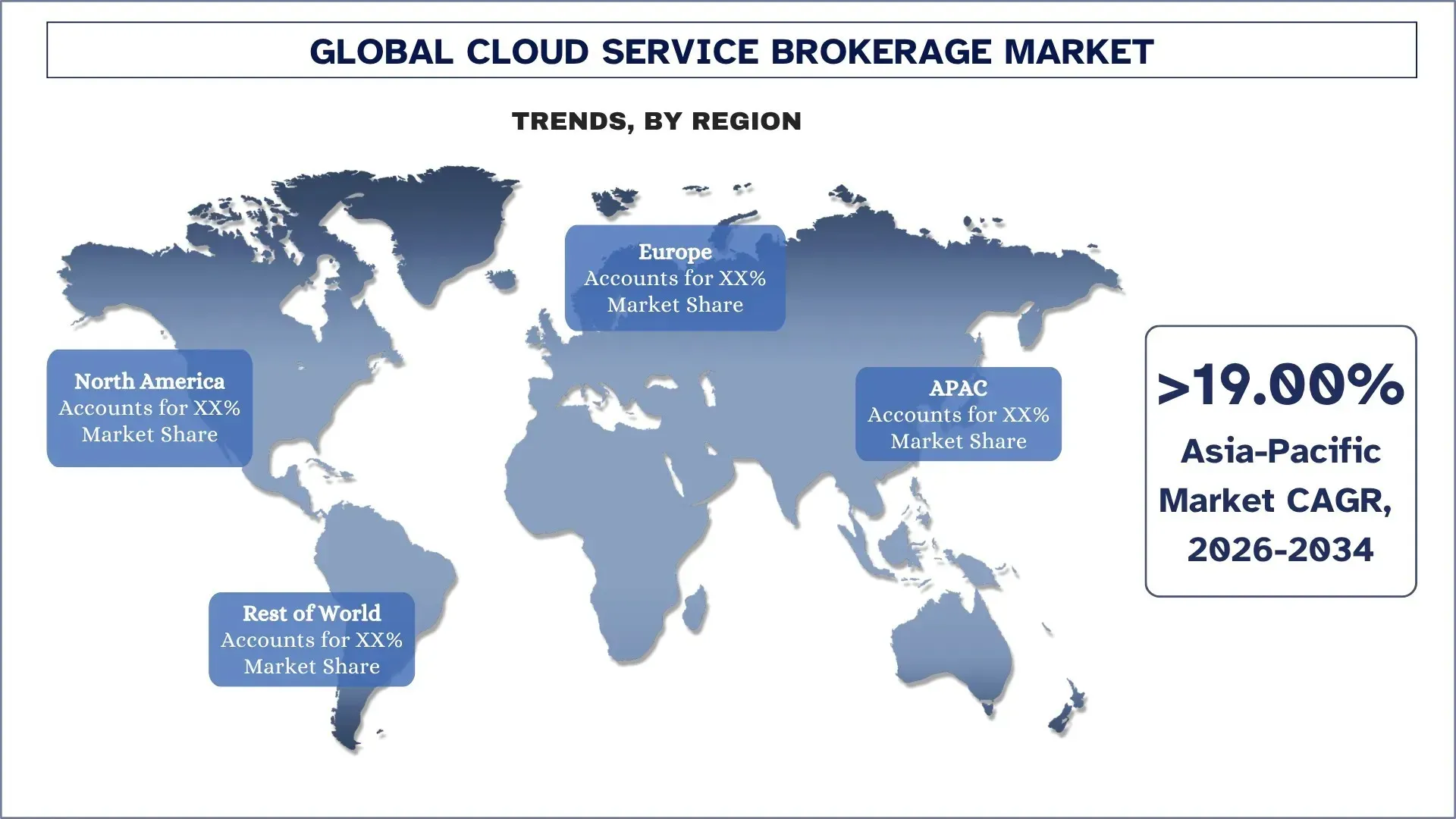
North America holds the largest market share in the global Cloud Service Brokerage market
The Cloud Service Brokerage market in 2025 is dominated by North America due to the early and ubiquitous use of cloud computing in the region, the presence of the major hyperscalers and managed service providers, and an increasing demand for multi-cloud and hybrid cloud management by enterprises. The growing emphasis of the region on cloud cost optimization, governance, compliance management, workload portability, and integration across multiple platforms is driving the growth of the market. In addition, the increase in the utilization of AI-powered cloud management solutions, high rates of digital transformation spending in BFSI institutions, healthcare facilities, retailers, and government agencies, and the ongoing investment in safe and scalable cloud ecosystems also contribute to the adoption of cloud service brokerage solutions. These aspects, along with an advanced IT infrastructure and high density of cloud-based innovation, still drive the market development. In 2025, industry research is also forecasting that North America will continue to be the largest regional market in cloud service brokerage up to 2030.
The United States held a dominant share of the North American cloud service brokerage Market in 2025
In the year 2025, the United States was the leader in the Cloud Service Brokerage market due to the presence of an advanced cloud ecosystem, the existence of high enterprise IT spending, and the need to have secure, interoperable, and scalable multi-cloud environments. Furthermore, the accelerated rate of digitalization in all industries, including BFSI, healthcare, retail, manufacturing, and government, is compelling service providers and enterprises to continuously develop cloud orchestration, automation, and service integration. The U.S is the engine of growth of the global market with a high concentration of hyperscalers, cloud consultants, managed service providers, and enterprise technology partnerships that keep the country leading in cloud service brokerage adoption.
Cloud Service Brokerage Industry Competitive Landscape
The global Cloud Service Brokerage market is competitive, with several global and international market players. The key players are adopting different growth strategies to enhance their market presence, such as partnerships, agreements, collaborations, geographical expansions, and mergers and acquisitions.
Top Cloud Service Brokerage Market Companies
Some of the major players in the market are IBM, Broadcom, Arrow Electronics, Inc., Fujitsu, DXC Technology Company, Wipro, Amazon Web Services, Inc., Infosys Limited, NTT Data, and TATA Consultancy Services Limited.
Recent Developments in the Cloud Service Brokerage Market
In December 2025, IBM agreed to acquire Confluent for USD 11 billion in order to enhance hybrid-cloud integration and real-time data streaming capabilities for enterprise AI. This will also improve data connectivity, governance, and automation across multicloud environments in support of brokerage-driven integration, orchestration, and cross-platform service delivery.
In December 2025, AWS and Google Cloud launched a private multicloud networking service that combines AWS Interconnect and Google Cross-Cloud Interconnect. It enables fast, secure, low-latency connections across different clouds, offering greater multicloud workload portability and improved data transfer, thereby helping cloud brokers support developed multi-provider architectures.
Global Cloud Service Brokerage Market Report Coverage
Details | |
Base year | 2025 |
Forecast period | 2026-2034 |
Growth momentum | Accelerate at a CAGR of 18.38% |
Market size 2025 | USD 14,493.10 million |
Regional analysis | North America, Europe, APAC, Rest of the World |
Major contributing region | The North America region is expected to dominate the market during the forecast period. |
Key countries covered | U.S., Canada, Germany, U.K., Spain, Italy, France, China, Japan, and India. |
Companies profiled | IBM, Broadcom, Arrow Electronics, Inc., Fujitsu, DXC Technology Company, Wipro, Amazon Web Services, Inc., Infosys Limited, NTT Data, and TATA Consultancy Services Limited |
Report Scope | Market Trends, Drivers, and Restraints; Revenue Estimation and Forecast; Segmentation Analysis; Demand and Supply Side Analysis; Competitive Landscape; Company Profiling |
Segments Covered | By Service Type, By Platform, By Deployment, By Enterprise Size, By End Use, and By Region/Country |
Reasons to Buy the Cloud Service Brokerage Market Report:
The study includes market sizing and forecasting analysis confirmed by authenticated key industry experts.
The report briefly reviews overall industry performance at a glance.
The report covers an in-depth analysis of prominent industry peers, primarily focusing on key business financials, type portfolios, expansion strategies, and recent developments.
Detailed examination of drivers, restraints, key trends, and opportunities prevailing in the industry.
The study comprehensively covers the market across different segments.
Deep dive regional level analysis of the industry.
Customization Options:
The global Cloud Service Brokerage Market can further be customized as per the requirements or any other market segment. Besides this, UnivDatos understands that you may have your own business needs; hence, feel free to contact us to get a report that completely suits your requirements.
Table of Content
Research Methodology for the Global Cloud Service Brokerage Market Analysis (2024-2034)
We analyzed the historical market, estimated the current market, and forecasted the future market of the global Cloud Service Brokerage market to assess its application in major regions worldwide. We conducted exhaustive secondary research to gather historical market data and estimate the current market size. To validate these insights, we carefully reviewed numerous findings and assumptions. Additionally, we conducted in-depth primary interviews with industry experts across the Cloud Service Brokerage value chain. After validating market figures through these interviews, we used both top-down and bottom-up approaches to forecast the overall market size. We then employed market breakdown and data triangulation methods to estimate and analyze the market size of industry segments and sub-segments.
Market Engineering
We employed the data triangulation technique to finalize the overall market estimation and derive precise statistical numbers for each segment and sub-segment of the global Cloud Service Brokerage market. We split the data into several segments and sub-segments by analyzing various parameters and trends, including service type, platform, deployment, enterprise size, end use, and regions within the global Cloud Service Brokerage market.
The Main Objective of the Global Cloud Service Brokerage Market Study
The study identifies current and future trends in the global Cloud Service Brokerage market, providing strategic insights for investors. It highlights regional market attractiveness, enabling industry participants to tap into untapped markets and gain a first-mover advantage. Other quantitative goals of the studies include:
- Market Size Analysis: Assess the current and forecast market size of the global Cloud Service Brokerage market and its segments in terms of value (USD).
- Cloud Service Brokerage Market Segmentation: Segments in the study include areas of service type, platform, deployment, enterprise size, end use, and region.
- Regulatory Framework & Value Chain Analysis: Examine the regulatory framework, value chain, customer behavior, and competitive landscape of the Cloud Service Brokerage industry.
- Regional Analysis: Conduct a detailed regional analysis for key areas such as Asia Pacific, Europe, North America, and the Rest of the World.
- Company Profiles & Growth Strategies: Company profiles of the Cloud Service Brokerage market and the growth strategies adopted by the market players to sustain the fast-growing market.
Frequently Asked Questions FAQs
Q1: What is the current market size and growth potential of the global cloud service brokerage market?
The global Cloud Service Brokerage market is valued at USD 14,493.10 million in 2025, driven by rising multi-cloud adoption, growing enterprise demand for cost optimization and governance, and the increasing need for centralized management of complex cloud environments.
Q2: Which segment has the largest share of the global cloud service brokerage market by Service Type?
The Integration and Support segment currently leads the market, supported by the growing need for seamless integration of multi-cloud and hybrid cloud environments, increasing demand for ongoing technical support and managed services, and the rising complexity of enterprise cloud infrastructures.
Q3: What are the driving factors for the growth of the global cloud service brokerage market?
Key growth drivers include the rising adoption of multi-cloud and hybrid cloud strategies, increasing demand for cloud cost optimization and governance, growing need for seamless integration and support services, and the rapid incorporation of AI and automation into cloud management platforms.
Q4: What are the emerging technologies and trends in the global Cloud Service Brokerage market?
Major trends include the growth of centralized brokerage platforms, rising adoption of AI-enabled cloud management solutions, increasing preference for multi-cloud orchestration, and stronger focus on automated cost optimization, governance, and compliance management across complex cloud environments.
Q5: What are the key challenges in the global Cloud Service Brokerage market?
Major challenges include data security and compliance concerns, integration complexity across diverse cloud platforms, limited interoperability among service providers, lack of standardization in service-level agreements, and difficulties in managing visibility, control, and cost optimization in multi-cloud environments.
Q6: Which region dominates the global Cloud Service Brokerage market?
North America dominates the market due to its early adoption of cloud technologies, strong presence of leading cloud service providers, and increasing demand for multi-cloud and hybrid cloud management solutions across enterprises.
Q7: Who are the key competitors in the global Cloud Service Brokerage market?
Top players in the Cloud Service Brokerage industry include:
• IBM
• Broadcom
• Arrow Electronics, Inc.
• Fujitsu
• DXC Technology Company
• Wipro
• Amazon Web Services, Inc.
• Infosys Limited
• NTT Data
• TATA Consultancy Services Limited
Q8: What opportunities are emerging for new entrants and technology providers in this market?
Growing investments in multi-cloud management, AI-enabled cloud optimization, cybersecurity and compliance solutions, and integrated cloud governance platforms are creating strong opportunities for cloud service brokers, managed service providers, system integrators, and software vendors.
Q9: How is digital transformation influencing cloud service brokerage?
Digital transformation is accelerating the adoption of multi-cloud and hybrid cloud environments, SaaS applications, and cloud-native business models, prompting organizations to move away from fragmented legacy IT systems and invest in centralized cloud management solutions.
Related Reports
Customers who bought this item also bought



India IT and BPO Services Market: Current Analysis and Forecast (2026-2034)
Emphasis on Service Type (IT Services, BPO Services, Engineering & R&D Services); Outsourcing Type (Onshore, Offshore, Nearshore); Organization Size (Large Enterprises, SMEs); End-User Industry (BFSI, IT & Telecom, Healthcare, Retail & E-commerce, Manufacturing, Others); and Region/States

Gi-Fi Technology Market: Current Analysis and Forecast (2025-2033)
Emphasis on Product Type (Display Devices and Network Infrastructure Devices); Technology (System on chip and Integrated Circuit Chip); Application (Consumer Electronics, Commercial, and Networking); and Region/Country

DNA Data Storage Market: Current Analysis and Forecast (2026-2034)
Emphasis on Type (Cloud and On-Premises); Technology (Sequence-based DNA Data Storage and Structure-based DNA Data Storage); End-User (Government, Healthcare & Biotechnology, Media & Telecommunication, and Others); and Region/Country
Cloud Service Brokerage Market: Current Analysis and Forecast (2026-2034)
Emphasis on Service Type (Integration and Support, Automation and Orchestration, Billing and Provisioning, Migration and Customization, Security and Compliance, and Others); Platform (Internal Brokerage Enablement and External Brokerage Enablement); Deployment (Private, Public, and Hybrid); Enterprise Size (Large Enterprises, and Small & Medium-Sized Enterprises); End-Use (IT & Telecom, BFSI, Government & Public Sector, Healthcare, Consumer Goods & Retail, Manufacturing, Energy & Utilities, and Others); and Region/Country