Gi-Fi Technology Market: Current Analysis and Forecast (2025-2033)
Emphasis on Product Type (Display Devices and Network Infrastructure Devices); Technology (System on chip and Integrated Circuit Chip); Application (Consumer Electronics, Commercial, and Networking); and Region/Country
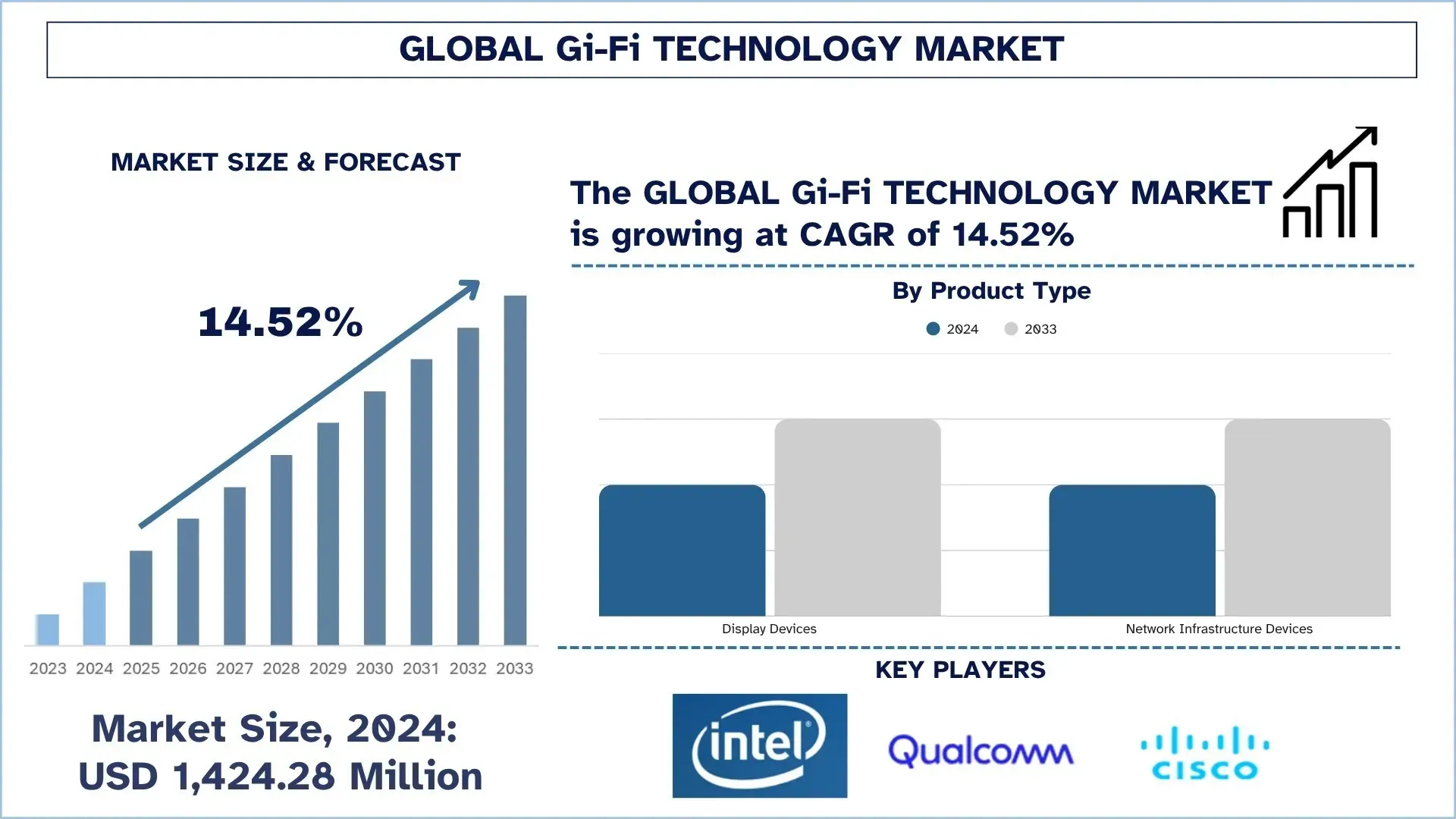
Global Gi-Fi Technology Market Size & Forecast
The Global Gi-Fi Technology Market was valued at USD 1,424.28 million in 2024 and is expected to grow at a CAGR of around 14.52% during the forecast period (2025–2033F), driven by the growing demand for high-speed data transfer, the increasing deployment of IoT devices, and the rising need for low-latency, high-bandwidth applications collectively represent major drivers of the global Gi-Fi technology market.
Gi-Fi Technology Market Analysis
Gi‑Fi (Gigabit Wireless Fidelity) is a term used to describe multi‑gigabit per second wireless links that operate mainly in the 60 GHz millimeter‑wave band to transfer data over short ranges (of up to ~10 m). It employs highly integrated millimeter‑wave transceivers built on a tiny CMOS chip to establish very fast, low‑latency connections, much faster than conventional Wi‑Fi and Bluetooth connections. This multi‑gigabit capability is vital in today's data‑driven society as activities such as 4K/8K video streaming, immersive augmented reality (AR) and virtual reality (VR) applications, cloud‑based services, and the Internet of Things (IoT) require rapid and reliable wireless data links. With the rise of smart appliances in residential, commercial, and industrial spaces, traditional wireless technologies are facing issues of crowding and interference. Gi‑Fi's short‑range communication capabilities make it a supplementary technology for new 5G and next‑generation networks, which are spurring its use in consumer electronics, networking equipment, and commercial settings.
Global Gi-Fi Technology Market Trends
This section discusses the key market trends that are influencing the various segments of the global Gi-Fi technology market, as found by our team of research experts.
Integration into Consumer Electronics
The integration of Gi-Fi technology into consumer electronics is a thing that is changing the market. This is happening because people need to transfer a lot of data fast over short distances. Sometimes traditional Wi-Fi is just not good enough for devices that need to do a lot of things at the same time. So companies are using 5G technology in consumer electronics to make this happen. The use of Gi-Fi technology in consumer electronics is very important because it helps devices work better when they need to transfer a lot of data. Gi-Fi technology is what makes it possible for devices to do things that require a lot of data to be transferred quickly. This has driven more widespread use in smartphones, tablets, smart TVs, laptops, and even new AR/VR headsets, to improve user experiences with fast and low‑latency wireless connectivity. Qualcomm's WiGig/60 GHz Wireless Enhancements for Consumer Devices. In March 2024, Qualcomm unveiled its FastConnect 7900 platform, which combines advanced support for 60 GHz WiGig with adaptive beamforming technology to enhance wireless connectivity for multi‑gigabit applications such as AR/VR and wireless docking. Gi‑Fi is being evaluated by consumer electronics companies to offer instant large file transfers and media streaming without wires and clogs, replacing Bluetooth and Wi‑Fi in device‑to‑device communication. This adoption is growing rapidly with the rise of smart homes and smart devices around the world, strengthening Gi‑Fi's role in the next‑generation wireless environment.
Gi-Fi Technology Industry Segmentation
This section provides an analysis of the key trends in each segment of the global Gi-Fi technology market report, along with forecasts at the global, regional, and country levels for 2025-2033.
The Network Infrastructure Devices Segment held the Largest Market Share in the Gi-Fi Technology Market.
Based on product type, the global Gi-Fi technology market is segmented into Display Devices and Network Infrastructure Devices. In 2024, the Network Infrastructure Devices segment of the Gi-Fi technology market is expected to account for the largest market share and maintain its leading position throughout the forecast period. This is largely due to the growing need for high-speed wireless communication, as such devices are crucial for facilitating rapid, high-quality data transfer in both consumer and enterprise networks. Also, the rapid adoption of IoT appliances, smart household tools, and applications with high data requirements, such as 4K streaming and cloud computing, is driving increased demand for suitable network infrastructure. With the market transitioning to 5G and beyond, Gi-Fi's ability to add value to technologies with ultra-high-speed, short-range connectivity is critical for the network infrastructure devices of the next generation of wireless networks.
The System-on-Chip (SoC) Segment held the Largest Market Share in the Gi-Fi Technology Market.
Based on technology, the global Gi-Fi technology market is segmented into System on Chip (SoC) and Integrated Circuit (IC) chips. In 2024, the System on Chip (SoC) segment is expected to account for the largest market share and maintain its leading position throughout the forecast period. This is mainly due to the growing need for small, energy-efficient products in mobile devices, wearables, and other Internet of Things applications. SoC is a combination of various components on a single chip, thus making it faster at processing data, smaller in form factor, and consuming less power, thereby providing major benefits in the emerging high-speed wireless communication market. Moreover, its dominance is further promoted by the large-scale adoption of SoC in smartphones, smart home devices, and consumer electronics.
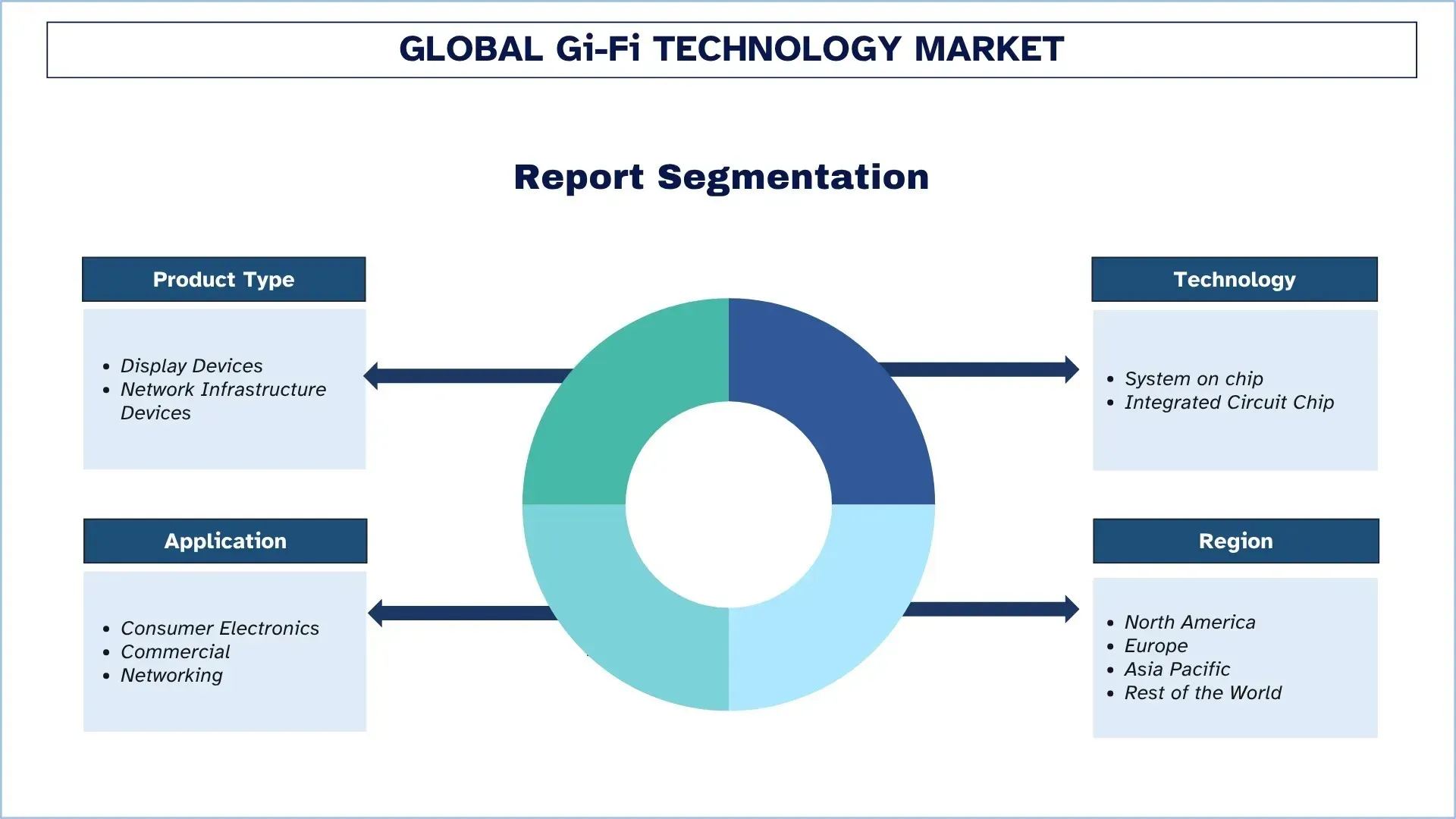
Asia Pacific Shows the Fastest Growth in the Global Gi-Fi Technology Market
The Asia Pacific Region records the highest growth rate in Gi-Fi technology markets following the steep increase in the use of smart devices, increased demand for high-speed wireless connectivity, and increased No. of IOT networks. Countries such as China, Japan, and South Korea are rapidly investing in smart cities, 5G, and consumer electronics. As per recent industry reports, it has been noted that China is at the forefront in terms of deployment regarding 5G and IoT, which will considerably increase the demand for Gi-Fi technology. Additionally, there is a growing trend from Japan and South Korea toward adopting Gi-Fi related to AR/VR applications, as well as smart home systems and automotive communication. Such a rapid increase in technological adoption proves Asia Pacific has great potential to be recognized as the fastest-growing market concerning Gi-Fi solutions, emphasizing that particular region's key role in transforming future high-speed short-range wireless communication.
China held a dominant Share of the Asia Pacific Gi-Fi Technology Market in 2024
The Chinese market for Gi-Fi technology is a high-growth market, considering the fact that China is driving the development of next-generation wireless communication technologies, IoT, smart cities, and 5G networks. China, being the largest consumer and manufacturer of electronic devices, is witnessing an increasing need to transfer data at high speed, especially in the fields of AR/VR, automotive communication, and consumer electronics. The technological advancements in the country related to the field of wireless communication are creating tremendous opportunities for the implementation and application of Gi-Fi technology. In the global market related to Gi-Fi technology, the country is witnessing tremendous growth and is becoming the most promising market, especially in the future related to short-range wireless connections, which are ultra-fast.
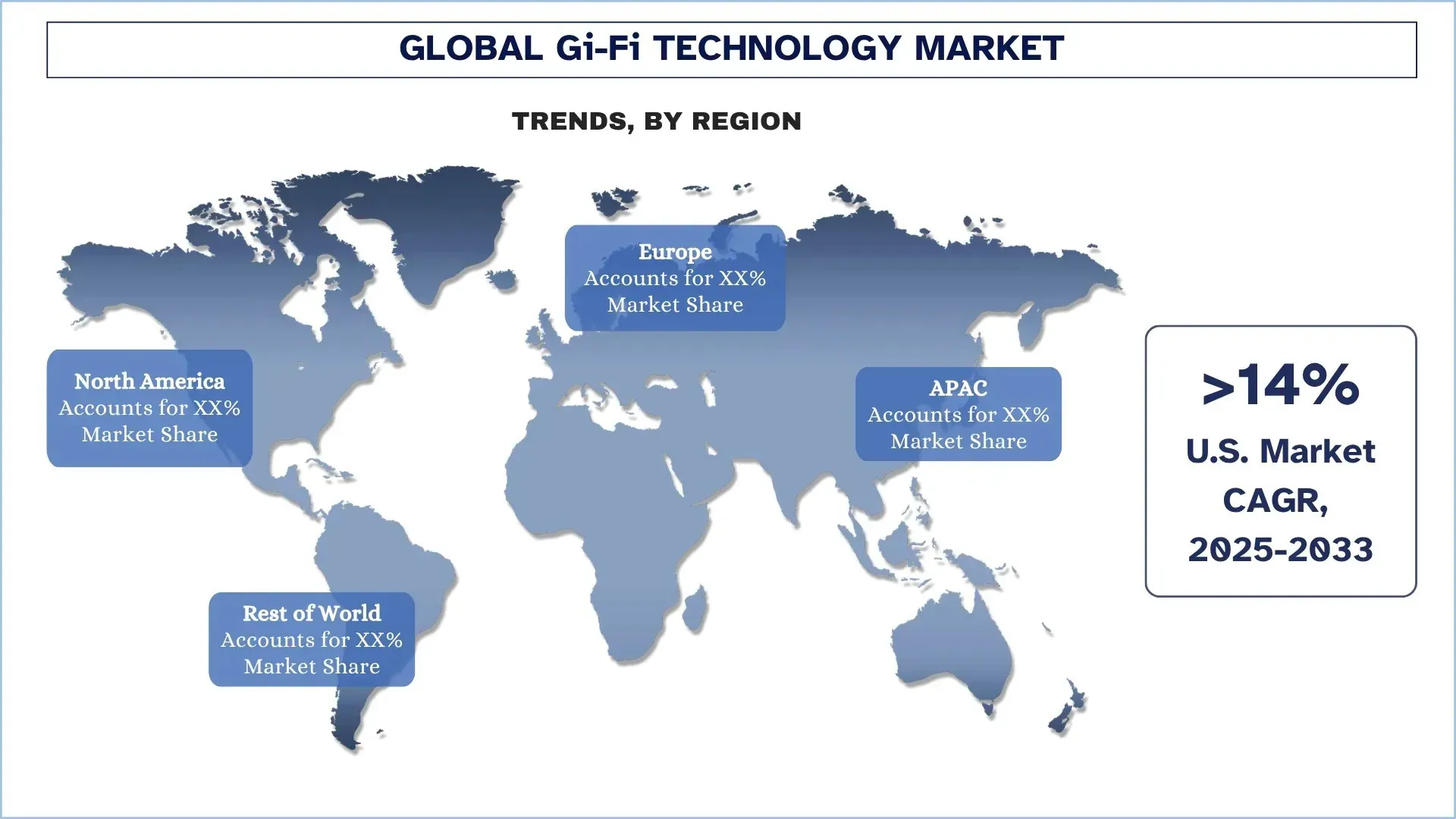
Gi-Fi Technology Industry Competitive Landscape
The global Gi-Fi technology market is competitive, with several global and international market players. The key players are adopting different growth strategies to enhance their market presence, such as partnerships, agreements, collaborations, new product launches, geographical expansions, and mergers and acquisitions.
Top Gi-Fi Technology Companies
Some of the major players in the market are Intel, Qualcomm Technologies, Inc., Cisco Systems, Inc., Broadcom, Marvell, Fujikura Ltd., Peraso Technologies Inc., Huawei Technologies Co., Ltd., Tensorcom, Inc. (A NantWorks™ Company), and Sivers Semiconductors AB.
Recent Developments in the Gi-Fi Technology Market
In March 2026, NVIDIA and Marvell Technology, Inc. announced a new partnership to link Marvell to the NVIDIA AI factory and AI-RAN ecosystem using NVIDIA NVLink Fusion™, giving customers building on NVIDIA architectures more flexibility and options in creating next-generation infrastructure. The two companies will also work together on silicon photonics. Further, NVIDIA has made a USD 2 billion investment in Marvell.
In March 2024, Qualcomm unveiled its FastConnect 7900 platform, which combines advanced support for 60 GHz WiGig with adaptive beamforming technology to enhance wireless connectivity for multi‑gigabit applications such as AR/VR and wireless docking.
Global Gi-Fi Technology Market Report Coverage
Details | |
Base year | 2024 |
Forecast period | 2025-2033 |
Growth momentum | Accelerate at a CAGR of 14.52% |
Market size 2024 | USD 1,424.28 Million |
Regional analysis | North America, Europe, APAC, Rest of the World |
Major contributing region | North America is expected to dominate the market during the forecast period. |
Key countries covered | U.S., Canada, Germany, U.K., Spain, Italy, France, China, Japan, and India |
Companies profiled | Intel, Qualcomm Technologies, Inc., Cisco Systems, Inc., Broadcom, Marvell, Fujikura Ltd., Peraso Technologies Inc., Huawei Technologies Co., Ltd., Tensorcom, Inc. (A NantWorks™ Company), and Sivers Semiconductors AB |
Report Scope | Market Trends, Drivers, and Restraints; Revenue Estimation and Forecast; Segmentation Analysis; Demand and Supply Side Analysis; Competitive Landscape; Company Profiling |
Segments Covered | By Product Type, By Technology, By Application, and By Region/Country |
Reasons to Buy the Gi-Fi Technology Market Report:
The study includes market sizing and forecasting analysis confirmed by authenticated key industry experts.
The report briefly reviews overall industry performance at a glance.
The report covers an in-depth analysis of prominent industry peers, primarily focusing on key business financials, type portfolios, expansion strategies, and recent developments.
Detailed examination of drivers, restraints, key trends, and opportunities prevailing in the industry.
The study comprehensively covers the market across different segments.
Deep dive regional-level analysis of the industry.
Customization Options:
The global Gi-Fi technology Market can further be customized as per the requirements or any other market segment. Besides this, UnivDatos understands that you may have your own business needs; hence, feel free to contact us to get a report that completely suits your requirements.
Table of Content
Research Methodology for the Global Gi-Fi Technology Market Analysis (2023-2033)
We analyzed the historical market, estimated the current market, and forecasted the future market of the global Gi-Fi technology market to assess its application in major regions worldwide. We conducted exhaustive secondary research to gather historical market data and estimate the current market size. To validate these insights, we carefully reviewed numerous findings and assumptions. Additionally, we conducted in-depth primary interviews with industry experts across the Gi-Fi technology value chain. After validating market figures through these interviews, we used both top-down and bottom-up approaches to forecast the overall market size. We then employed market breakdown and data triangulation methods to estimate and analyze the market size of industry segments and sub-segments.
Market Engineering
We employed the data triangulation technique to finalize the overall market estimation and derive precise statistical numbers for each segment and sub-segment of the global Gi-Fi technology market. We split the data into several segments and sub-segments by analyzing various parameters and trends, including product type, technology, application, and regions within the global Gi-Fi technology market.
The Main Objective of the Global Gi-Fi Technology Market Study
The study identifies current and future trends in the global Gi-Fi technology market, providing strategic insights for investors. It highlights regional market attractiveness, enabling industry participants to tap into untapped markets and gain a first-mover advantage. Other quantitative goals of the studies include:
Market Size Analysis: Assess the current market size and forecast the market size of the global Gi-Fi technology market and its segments in terms of value (USD).
Gi-Fi Technology Market Segmentation: Segments in the study include areas of product type, technology, application, and regions.
Regulatory Framework & Value Chain Analysis: Examine the regulatory framework, value chain, customer behavior, and competitive landscape of the Gi-Fi technology industry.
Regional Analysis: Conduct a detailed regional analysis for key areas such as Asia Pacific, Europe, North America, and the Rest of the World.
Company Profiles & Growth Strategies: Company profiles of the Gi-Fi technology market and the growth strategies adopted by the market players to sustain the fast-growing market.
Frequently Asked Questions FAQs
Q1: What is the global Gi-Fi technology current market size and its growth potential?
The global Gi-Fi technology market was valued at USD 1,424.28 million in 2024 and is expected to grow at a CAGR of 14.52% during the forecast period (2025-2033).
Q2: Which segment has the largest share of the global Gi-Fi technology market by Product Type?
The Network Infrastructure Devices segment of the Gi-Fi technology market is expected to account for the largest market share and maintain its leading position throughout the forecast period, driven by the growing need for high-speed wireless communication.
Q3: What are the driving factors for the growth of the global Gi-Fi technology market?
• Increasing Demand for Ultra‑High‑Speed Connectivity
• Smart Device & IoT Expansion
• Synergy with 5G and Next‑Gen Networks
Q4: What are the emerging technologies and trends in the global Gi-Fi technology market?
• Integration into Consumer Electronics
• Advanced Chip Development
Q5: What are the key challenges in the global Gi-Fi technology market?
• Limited Transmission Range
• Signal Attenuation and Blockage
Q6: Which region dominates the global Gi-Fi technology market?
North America currently dominates the global Gi-Fi technology market and is expected to behave in the same manner in the forecast period through technological innovation and adoption of next-gen wireless technologies.
Q7: Who are the key players in the global Gi-Fi technology market?
Top players in the Gi-Fi Technology industry include:
• Intel
• Qualcomm Technologies, Inc.
• Cisco Systems, Inc.
• Broadcom
• Marvell
• Fujikura Ltd.
• Peraso Technologies Inc.
• Huawei Technologies Co., Ltd.
• Tensorcom, Inc. (A NantWorks™ Company)
• Sivers Semiconductors AB
Q8: How does Gi-Fi technology contribute to enhancing wireless communication in consumer electronics?
Gi-Fi technology enhances wireless communication by enabling ultra-high-speed data transfer with low latency and minimal power consumption. It enables seamless connectivity between devices, supporting applications such as 4K/8K video streaming, AR/VR, and real-time data sharing, thereby improving user experiences across smartphones, laptops, smart TVs, and other smart devices.
Q9: What role does Gi-Fi technology play in the development of smart cities?
Gi-Fi technology is crucial for smart city development by providing fast, reliable, and energy-efficient wireless communication. It supports IoT networks, allowing for real-time data transfer across various smart devices and infrastructure, such as traffic management systems, smart lighting, and energy monitoring, thereby improving the overall efficiency and sustainability of urban environments.
Related Reports
Customers who bought this item also bought




India IT and BPO Services Market: Current Analysis and Forecast (2026-2034)
Emphasis on Service Type (IT Services, BPO Services, Engineering & R&D Services); Outsourcing Type (Onshore, Offshore, Nearshore); Organization Size (Large Enterprises, SMEs); End-User Industry (BFSI, IT & Telecom, Healthcare, Retail & E-commerce, Manufacturing, Others); and Region/States
Gi-Fi Technology Market: Current Analysis and Forecast (2025-2033)
Emphasis on Product Type (Display Devices and Network Infrastructure Devices); Technology (System on chip and Integrated Circuit Chip); Application (Consumer Electronics, Commercial, and Networking); and Region/Country

DNA Data Storage Market: Current Analysis and Forecast (2026-2034)
Emphasis on Type (Cloud and On-Premises); Technology (Sequence-based DNA Data Storage and Structure-based DNA Data Storage); End-User (Government, Healthcare & Biotechnology, Media & Telecommunication, and Others); and Region/Country

Cloud Service Brokerage Market: Current Analysis and Forecast (2026-2034)
Emphasis on Service Type (Integration and Support, Automation and Orchestration, Billing and Provisioning, Migration and Customization, Security and Compliance, and Others); Platform (Internal Brokerage Enablement and External Brokerage Enablement); Deployment (Private, Public, and Hybrid); Enterprise Size (Large Enterprises, and Small & Medium-Sized Enterprises); End-Use (IT & Telecom, BFSI, Government & Public Sector, Healthcare, Consumer Goods & Retail, Manufacturing, Energy & Utilities, and Others); and Region/Country