Southeast Asia ERP Software Market: Current Analysis and Forecast (2025-2033)
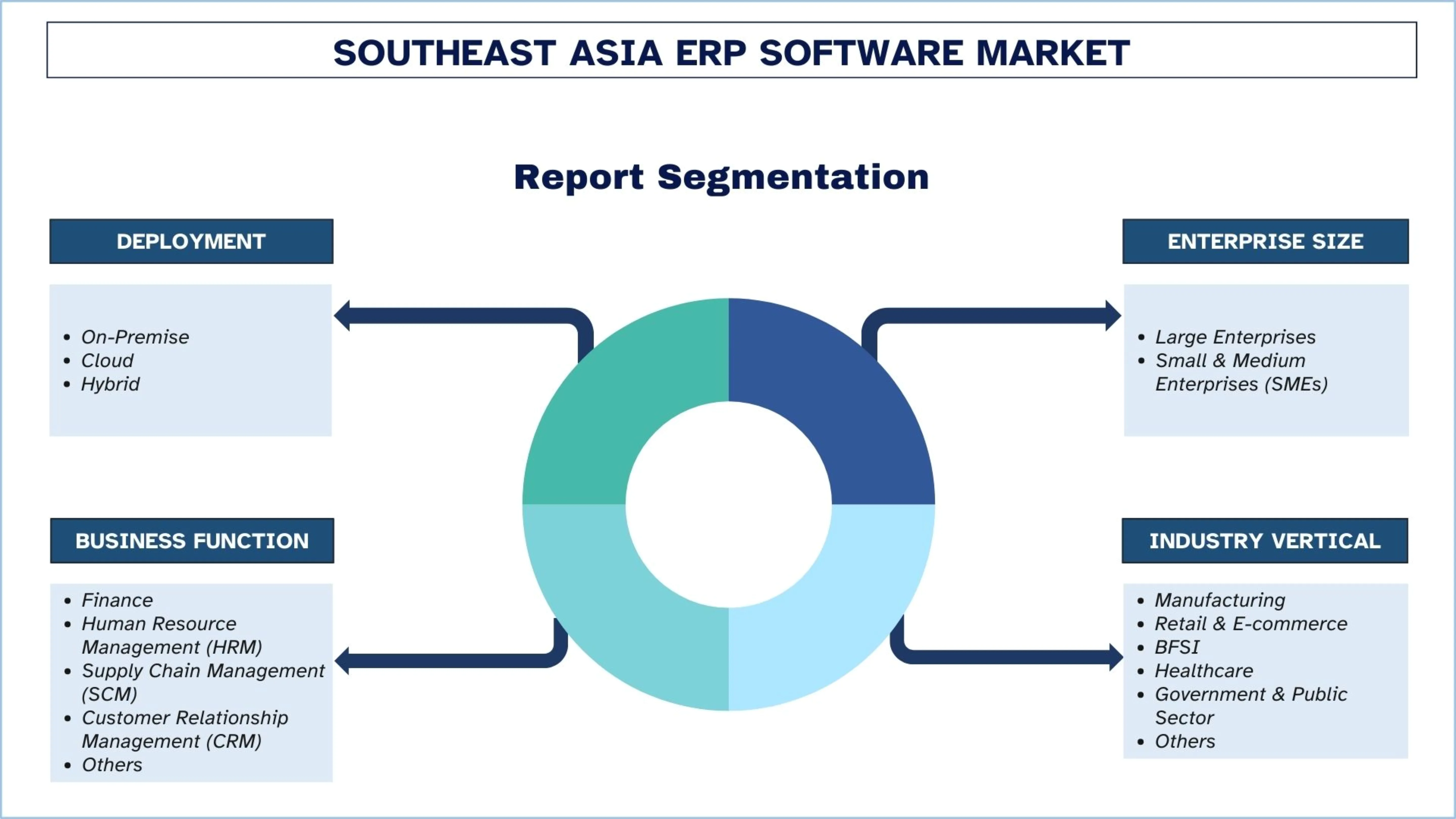
Emphasis on Deployment (On-Premise, Cloud, Hybrid); Enterprise Size (Large Enterprises, Small & Medium Enterprises (SMEs)); Business Function (Finance, Human Resource Management (HRM), Supply Chain Management (SCM), Customer Relationship Management (CRM), Others); Industry Vertical (Manufacturing, Retail & E-commerce, BFSI, Healthcare, Government & Public Sector, Others); and Country.
Southeast Asia ERP Software Market Size & Forecast
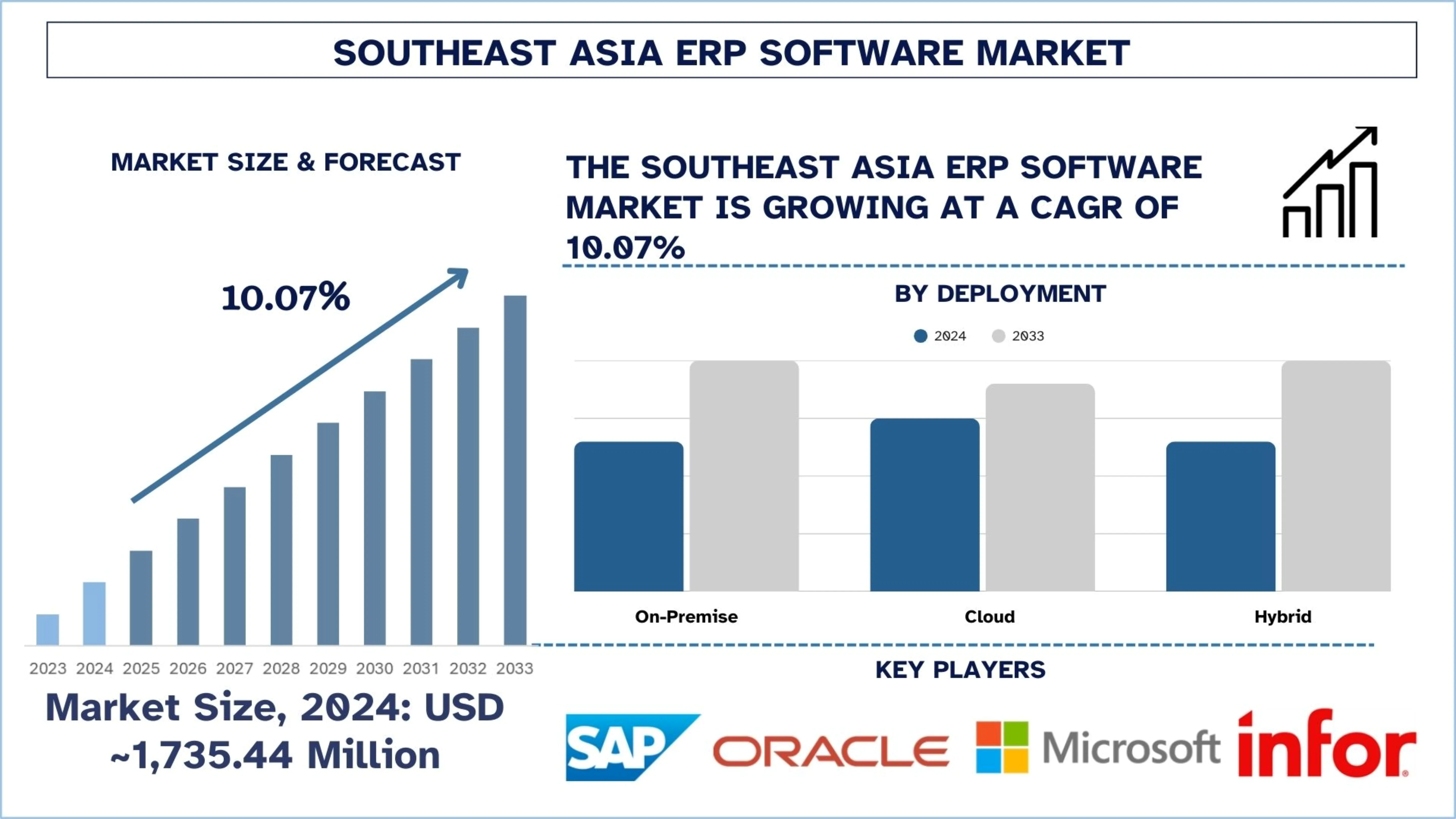
The Southeast Asia ERP Software Market was valued at ~USD 1,735.44 million in 2024 and is expected to grow at a strong CAGR of approximately 10.07% during the forecast period (2025-2033F), driven by the increasing adoption of cloud-based business solutions and integration of ERP with other enterprise technologies.
Southeast Asia ERP Software Market Analysis
ERP Software is an enterprise management system that enables organizations to manage the primary aspects of business, including finance, supply chain, human resources, and customer operations, on a single digital platform. It enables companies to streamline workflows, improve data accuracy, and support real-time decision-making across units.
The companies in Southeast Asia are adopting cloud-based enterprise resource planning systems to upgrade their infrastructure and drive market growth. The deployment of modular ERP solutions in many companies is designed to enable the implementation of functions such as finance, human resources, or supply chain management in stages. Adding to this, the companies are considering integrating ERP solutions with e-commerce systems, online payment systems, and customer relationship management tools to enhance an omnichannel experience. The growing focus on digital transformation and operational efficiency is prompting organizations to invest in scalable ERP architectures that can be extended to support long-term growth.
For example, on June 3, 2025, SAP announced the expansion of its SAP S/4HANA Cloud ERP Solution, public edition for retail, fashion, and vertical businesses to additional countries. Building on its successful general availability launch earlier this year, including Australia, India, New Zealand, and Singapore, the solution will be available in additional countries in the Asia Pacific region, including Indonesia, Malaysia, the Philippines, South Korea, and Thailand, in the second half of 2025.
Southeast Asia ERP Software Market Trends
This section discusses the key market trends that are influencing the various segments of the Southeast Asia ERP Software market, as found by our team of research experts.
Integration with AI, IoT, and Advanced Analytics
There is an increasing implementation of AI into ERP Software systems to augment the quality of streaming and gameplay in Southeast Asia. Applications of machine learning algorithms in video compression, dynamic resolution adjustment, and real-time prediction of network congestion are optimized. This will minimize the latency, buffering, and frame drops even in dynamic mobile and broadband networks. The use of AI-based optimization is of great significance to the field, given the geographic variability of network performance. With the expansion of ERP Software services offered by providers, AI stands out as a fundamental resource for delivering a consistent and responsive user experience and for managing infrastructure costs.
For example, on April 8, 2025, Oracle NetSuite, a cloud ERP system, announced a series of AI-powered capabilities and product updates across the suite to help organizations in Southeast Asia increase efficiency and take advantage of new opportunities. The latest innovations build on the comprehensive AI capabilities embedded in NetSuite and include new enterprise performance management and field service management functionality, advanced analytics capabilities, product localization, user experience enhancements, and expanded licensing options.
Southeast Asia ERP Software Industry Segmentation
This section provides an analysis of the key trends in each segment of the Southeast Asia ERP Software market, along with forecasts at the country level for 2025-2033.
The cloud ERP software market held the dominant share of the ERP Software market in 2024.
Based on deployment, the market is segmented into on-premise, cloud, and hybrid. Among these, the cloud ERP software market held the largest share in 2024. This is because companies are rapidly switching from offline infrastructure to scalable digital platform systems. ERP solutions that are based on the cloud save on initial IT spending and enable businesses to implement enterprise systems within a short time through flexible subscription programs. This usability will promote wider adoption among companies intent on economically effective, out-of-premises-based enterprise management systems. In November 2025, LG CNS entered into a strategic agreement with Indonesia’s Korindo Group to migrate the group’s core enterprise resource planning (ERP) from on-premises to cloud, accelerating its global expansion strategy. Under the agreement, LG CNS will migrate Korindo’s existing on-premises SAP ERP system to the cloud-based version SAP S/4HANA Cloud.
The finance segment held the largest share of the market in 2024.
Based on the business function, the market is segmented into Finance, Human Resource Management (HRM), Supply Chain Management (SCM), Customer Relationship Management (CRM), and others. Among these, the finance segment held the largest share of the market in 2024. The adoption of ERP systems depends heavily on their financial modules, as companies are interested in enhanced financial transparency and regulatory compliance. Also, ERP finance systems help companies automate accounting processes, support financial planning, and create real-time financial reports to support strategic decision-making. This functionality is pushing companies to deploy ERP solutions to enhance financial management and operational control. For example, on March 13, 2025, OCBC, Southeast Asia’s second-largest financial services group by assets, used Oracle Fusion Cloud Enterprise Resource Planning (ERP) to support its purpose to enable people and communities to realize their aspirations. With Oracle Cloud ERP, OCBC unified its global finance platform to increase efficiency and enhance decision-making, as it continues to strengthen its ASEAN-Greater China network.
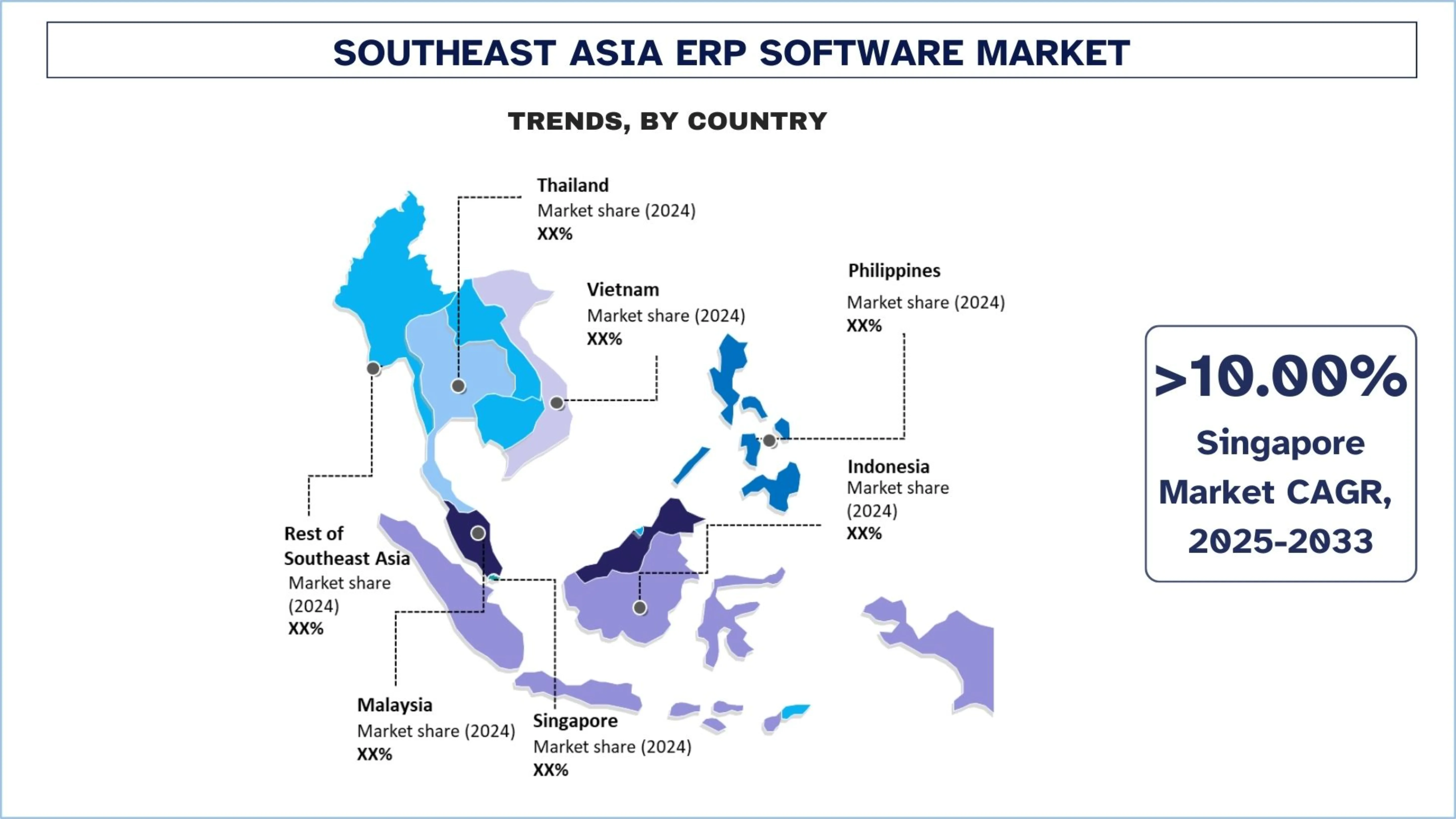
Singapore held a dominant share of the Southeast Asian ERP Software market in 2024
Singapore dominated the ERP software market in Southeast Asia, which is driven by strong digital infrastructure and a high rate of business technology adoption. The companies are actively adopting cloud-based ERP systems to optimize business processes, which enable improved financial management and supply chain optimization. Adding to this, the presence of multinational companies and regional headquarters also increases the rate of ERP uptake within the finance, manufacturing, retail, and logistics sectors. Also, the government's digital transformation drive and smart business ecosystems are prompting businesses to upgrade their enterprise systems. Moreover, the increased emphasis on automation and data-driven decision-making is driving demand for advanced ERP solutions in the Singaporean market.
For example, in February 2026, Singapore planned to switch to its new ERP 2 system for toll charges from 1 January 2027, which means all Singapore-registered motor vehicles will be required to have the On-Board Unit (OBU) installed ahead of the transition. The Land Transport Authority (LTA) revealed that more than 93 per cent of vehicles in Singapore (about 930,000 vehicles) have completed the OBU set-up.
Southeast Asia ERP Software Industry Competitive Landscape
The Southeast Asia ERP Software market is competitive, with several global and international market players. The key players are adopting different growth strategies to enhance their market presence, such as partnerships, agreements, collaborations, new product launches, geographical expansions, and mergers and acquisitions.
Top Southeast Asia ERP Software Companies
Some of the major players in the market are SAP SE, Oracle, Microsoft, Infor (Koch Industries), Epicor Software Corporation, Sage Group plc, IFS Aktiebolag, SYSPRO, HashMicro, and Ramco Systems (Ramco Group).
Recent Developments in the Southeast Asia ERP Software Market
On August 18, 2025, FPT joined the SAP PartnerEdge program as a Sell partner in selected countries in Southeast Asia, with an initial focus on Singapore, Malaysia, and Thailand. By leveraging SAP’s cloud platforms with FPT’s AI-driven expertise, this strategic expansion further strengthens FPT’s expertise in digital transformation, enabling enterprises to accelerate adoption, streamline operations, and unlock new growth across the region.
On April 28, 2023, SAP Southeast Asia (SEA) announced the launch of GROW with SAP, a new offering to help small and medium enterprises (SMEs) adopt cloud ERP that enables speed, predictability and continuous innovation, on the back of its SEA Partner Success Summit 2023, attended by over 300 partners across the region.
Southeast Asia ERP Software Market Report Coverage
Report Attribute | Details |
Base year | 2024 |
Forecast period | 2025-2033 |
Growth momentum | Accelerate at a CAGR of 10.07% |
Market size 2024 | ~USD 1,735.44 million |
Country analysis | Indonesia, Thailand, Philippines, Vietnam, Malaysia, Singapore, Rest of Southeast Asia |
Major contributing Country | Vietnam is expected to grow at the highest CAGR during the forecasted period. |
Companies profiled | SAP SE, Oracle, Microsoft, Infor (Koch Industries), Epicor Software Corporation, Sage Group plc, IFS Aktiebolag, SYSPRO, HashMicro, and Ramco Systems (Ramco Group). |
Report Scope | Market Trends, Drivers, and Restraints; Revenue Estimation and Forecast; Segmentation Analysis; Demand and Supply Side Analysis; Competitive Landscape; Company Profiling |
Segments Covered | By Deployment, By Enterprise Size, By Business Function, By Industry Vertical, By Country |
Reasons to Buy the Southeast Asia ERP Software Market Report:
The study includes market sizing and forecasting analysis confirmed by authenticated key industry experts.
The report briefly reviews overall industry performance at a glance.
The report covers an in-depth analysis of prominent industry peers, primarily focusing on key business financials, product portfolios, expansion strategies, and recent developments.
Detailed examination of drivers, restraints, key trends, and opportunities prevailing in the industry.
The study comprehensively covers the market across different segments.
Customization Options:
The Southeast Asia ERP Software market can further be customized as per requirements or any other market segment. Besides this, UnivDatos understands that you may have your own business needs; hence, feel free to contact us to get a report that completely suits your requirements.
Table of Content
Research Methodology for the Southeast Asia ERP Software Market Analysis (2023-2033)
We analyzed the historical market, estimated the current market, and forecasted the future market of the Southeast Asian ERP Software market to assess its application in major countries. We conducted exhaustive secondary research to gather historical market data and estimate the current market size. To validate these insights, we carefully reviewed numerous findings and assumptions. Additionally, we conducted in-depth primary interviews with industry experts across the Southeast Asian ERP Software value chain. After validating market figures through these interviews, we used both top-down and bottom-up approaches to forecast the overall market size. We then employed market breakdown and data triangulation methods to estimate and analyze the market size of industry segments and sub-segments.
Market Engineering
We employed the data triangulation technique to finalize the overall market estimation and derive precise statistical numbers for each segment and sub-segment of the Southeast Asia ERP Software market. We split the data into several segments and sub-segments by analyzing various parameters and trends, including deployment, enterprise size, business function, industry vertical, and country, within the Southeast Asian ERP Software market.
The Main Objective of the Southeast Asia ERP Software Market Study
The study identifies current and future trends in the Southeast Asia ERP Software market, providing strategic insights for investors. It highlights market attractiveness, enabling industry participants to tap into untapped markets and gain a first-mover advantage. Other quantitative goals of the studies include:
Market Size Analysis: Assess the current and forecast market size of the Southeast Asia ERP Software market and its segments in terms of value (USD).
Southeast Asia ERP Software Market Segmentation: Segments in the study include areas of deployment, enterprise size, business function, industry vertical, and country.
Regulatory Framework & Value Chain Analysis: Examine the regulatory framework, value chain, customer behavior, and competitive landscape of the Southeast Asia ERP Software industry.
Country Analysis: Conduct a detailed country analysis for key areas such as Indonesia, Thailand, the Philippines, Vietnam, Malaysia, Singapore, and the Rest of Southeast Asia.
Company Profiles & Growth Strategies: Company profiles of the Southeast Asia ERP Software market and the growth strategies adopted by the market players to sustain the fast-growing market.
Frequently Asked Questions FAQs
Q1: What is the Southeast Asia ERP Software market’s current market size and growth potential?
The Southeast Asia ERP Software market was valued at ~USD 1,735.44 million in 2024 and is projected to expand at a CAGR of 10.07% from 2025 to 2033. The market growth is driven by rapid digital transformation across enterprises, increasing cloud adoption, and rising demand for integrated enterprise management platforms.
Q2: Which segment has the largest share of the Southeast Asia ERP Software market by deployment?
The cloud ERP segment holds the largest share of the Southeast Asia ERP Software market. The companies are increasingly shifting from traditional on-premise systems to cloud-based ERP platforms due to their scalability, lower implementation costs, remote accessibility, and faster deployment capabilities. Cloud ERP is particularly gaining traction among small and medium enterprises (SMEs) looking to digitize operations efficiently.
Q3: What are the driving factors for the growth of the Southeast Asia ERP Software market?
The market is driven by rapid enterprise digitalization, growing demand for real-time data visibility, expansion of manufacturing and e-commerce sectors, and rising adoption of cloud-based business applications. Additionally, government initiatives promoting digital economies and Industry 4.0 adoption are encouraging enterprises to implement integrated ERP platforms to improve operational efficiency and productivity.
Q4: What are the emerging technologies and trends in the Southeast Asia ERP Software market?
Key trends shaping the market include cloud-native ERP platforms, AI-driven automation, integration with Internet of Things (IoT), advanced data analytics, and mobile ERP applications. Companies are also increasingly adopting modular ERP systems and industry-specific ERP solutions to support specialized business operations and improve scalability.
Q5: What are the key challenges in the Southeast Asia ERP Software market?
Key challenges include high implementation and customization costs, integration complexity with legacy systems, cybersecurity concerns, and a shortage of skilled ERP implementation professionals. In addition, resistance to organizational change during ERP adoption can slow down implementation timelines in some enterprises.
Q6: Which country dominates the Southeast Asia ERP Software market?
Singapore dominates the Southeast Asia ERP Software market due to its strong digital infrastructure, high technology adoption among enterprises, and the presence of regional headquarters of multinational companies. Government initiatives supporting digital innovation and smart business ecosystems are further accelerating ERP adoption in the country.
Q7: Who are the key players in the Southeast Asia ERP Software market?
Leading companies in the Southeast Asia ERP Software market include:
• SAP SE
• Oracle
• Microsoft
• Infor (Koch Industries)
• Epicor Software Corporation
• Sage Group plc
• IFS Aktiebolag
• SYSPRO
• HashMicro
• Ramco Systems (Ramco Group)
Q8: Which industries are driving ERP software adoption in Southeast Asia?
Industries such as manufacturing, retail & e-commerce, BFSI, healthcare, and government sectors are major adopters of ERP software in Southeast Asia. These sectors require integrated systems to manage complex operations such as supply chain management, financial planning, customer engagement, and workforce management.
Q9: Why are SMEs increasingly adopting ERP software in Southeast Asia?
SMEs are increasingly adopting ERP solutions to automate core business processes, improve operational efficiency, and gain better financial and inventory control. The availability of cloud-based ERP platforms with subscription pricing models has significantly reduced implementation costs, enabling smaller businesses to adopt enterprise-grade software solutions.
Related Reports
Customers who bought this item also bought
India IT and BPO Services Market: Current Analysis and Forecast (2026-2034)
Emphasis on Service Type (IT Services, BPO Services, Engineering & R&D Services); Outsourcing Type (Onshore, Offshore, Nearshore); Organization Size (Large Enterprises, SMEs); End-User Industry (BFSI, IT & Telecom, Healthcare, Retail & E-commerce, Manufacturing, Others); and Region/States

Gi-Fi Technology Market: Current Analysis and Forecast (2025-2033)
Emphasis on Product Type (Display Devices and Network Infrastructure Devices); Technology (System on chip and Integrated Circuit Chip); Application (Consumer Electronics, Commercial, and Networking); and Region/Country
DNA Data Storage Market: Current Analysis and Forecast (2026-2034)
Emphasis on Type (Cloud and On-Premises); Technology (Sequence-based DNA Data Storage and Structure-based DNA Data Storage); End-User (Government, Healthcare & Biotechnology, Media & Telecommunication, and Others); and Region/Country
Cloud Service Brokerage Market: Current Analysis and Forecast (2026-2034)
Emphasis on Service Type (Integration and Support, Automation and Orchestration, Billing and Provisioning, Migration and Customization, Security and Compliance, and Others); Platform (Internal Brokerage Enablement and External Brokerage Enablement); Deployment (Private, Public, and Hybrid); Enterprise Size (Large Enterprises, and Small & Medium-Sized Enterprises); End-Use (IT & Telecom, BFSI, Government & Public Sector, Healthcare, Consumer Goods & Retail, Manufacturing, Energy & Utilities, and Others); and Region/Country