Southeast Asia Narrow Band IoT Market: Current Analysis and Forecast (2025-2033)
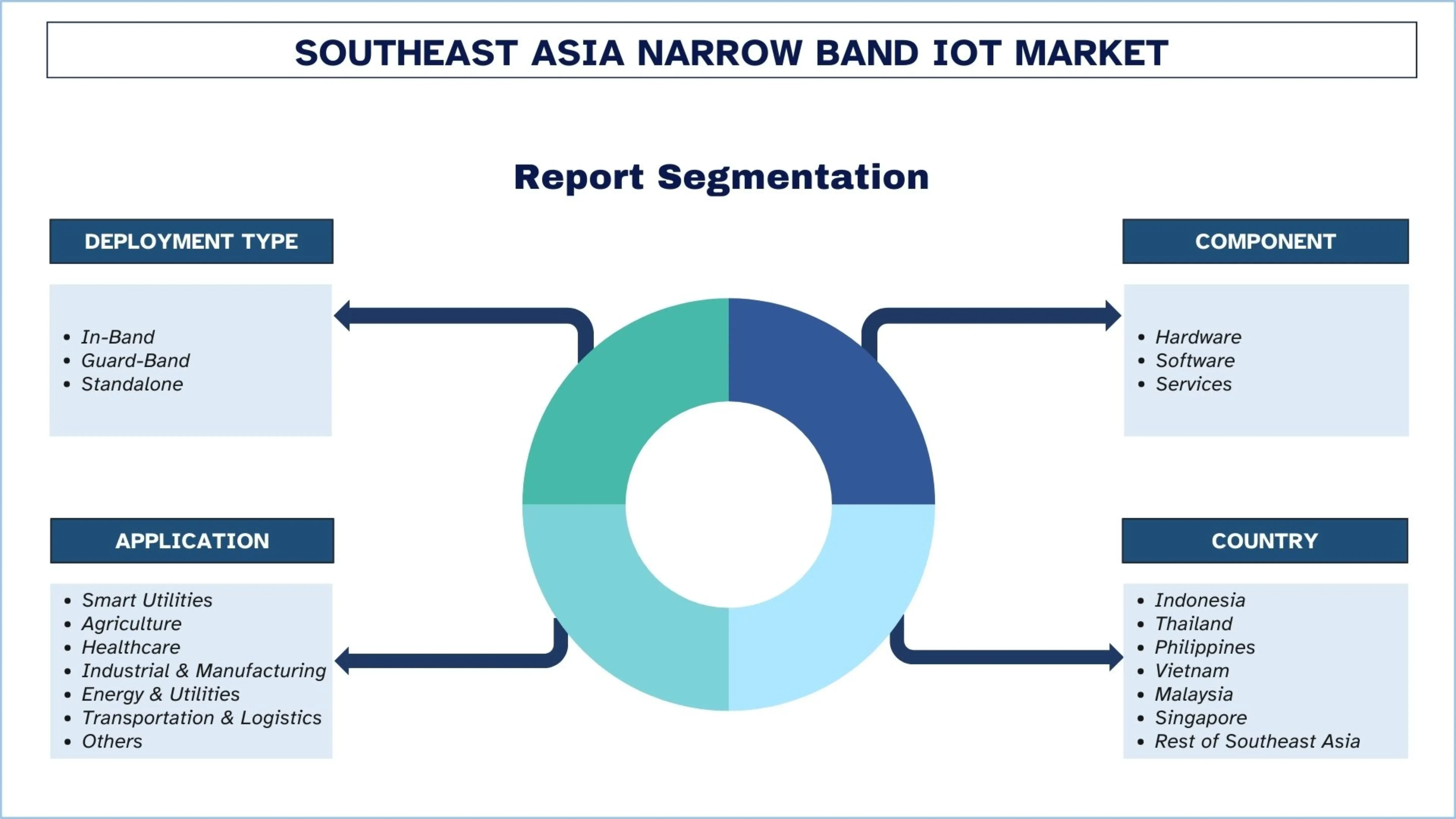
Emphasis on Deployment Type (In-Band, Guard-Band, Standalone); Component (Hardware, Software, Services); Application (Smart Utilities, Agriculture, Healthcare, Industrial & Manufacturing, Energy & Utilities, Transportation & Logistics, and Others); and Country.
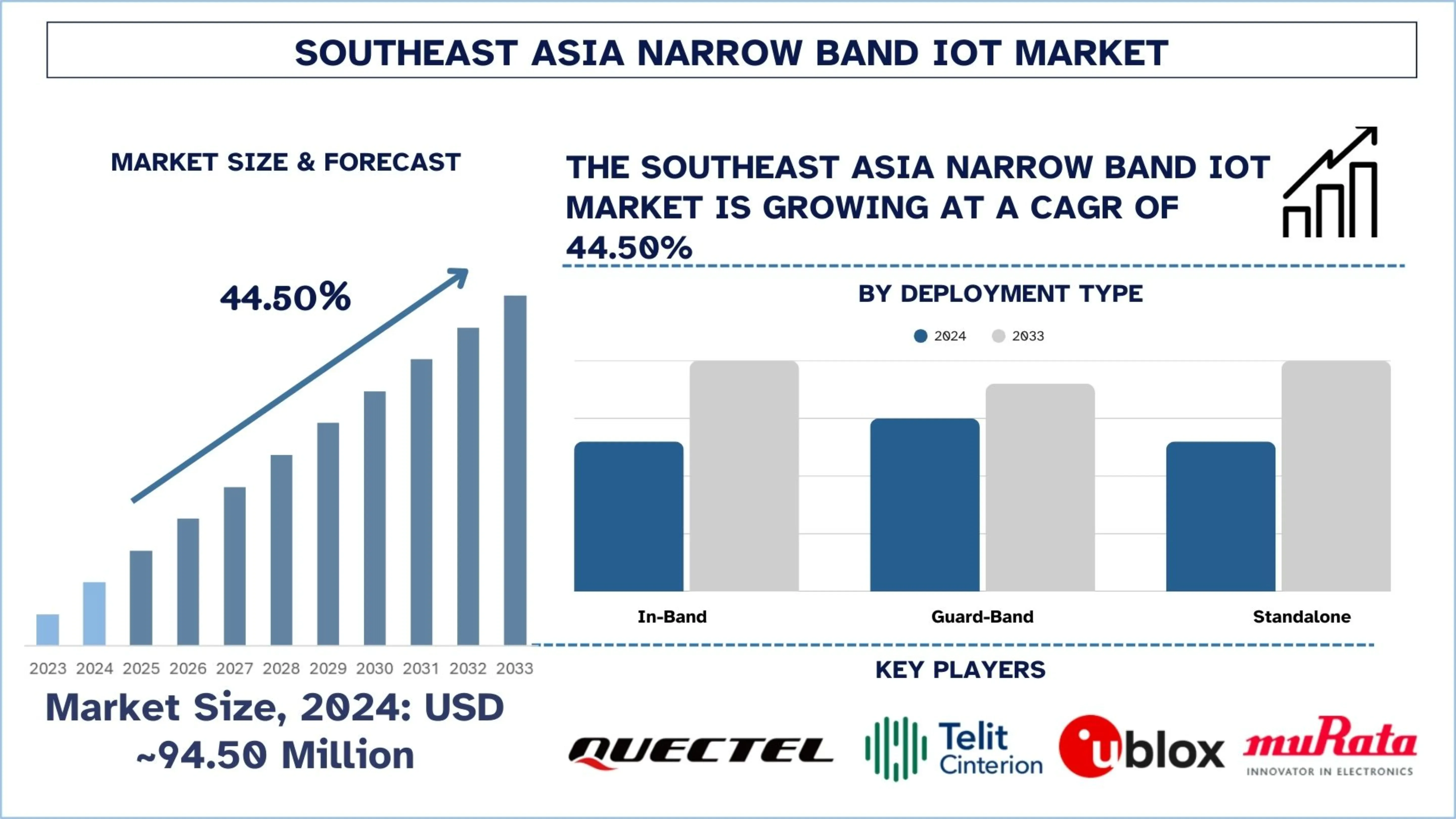
Southeast Asia Narrow Band IoT Market Size & Forecast
The Southeast Asia Narrow Band IoT Market was valued at ~USD 94.50 million in 2024 and is expected to grow at a strong CAGR of approximately 44.50% during the forecast period (2025-2033F), driven by the rising demand for low-cost, long-battery-life connectivity.
Southeast Asia Narrow Band IoT Market Analysis
Narrow Band IoT (NB-IoT) is a low-power wide-area cellular network designed to support a large number of devices with low data rates, long battery life, and deep indoor coverage. It is used on licensed spectrum and provides secure, reliable, deep indoor coverage.
To achieve growth in Southeast Asia, NB-IoT is widely used to support smart utilities, transportation and logistics monitoring, industrial asset monitoring, environmental sensing, and smart city infrastructure. Also, the companies and governments are implementing NB-IoT-based sensors and devices to enhance operational efficiency, provide real-time visibility, and minimize maintenance expenses. Moreover, the rising network, telecom-driven network expansion, and increasing enterprise demand are driving commercial deployments rather than pilot projects in urban and industrial clusters.
For example, on 27 May 2025, Quectel Wireless Solutions, a global IoT solutions provider, announced its participation in the CommunicAsia event held in Singapore, where it will showcase its comprehensive portfolio of IoT products and services designed to help customers build a smarter, more connected world. Offering full backward compatibility, it supports 4G, 3G, 2G, LTE Cat M, and NB-IoT networks, making it a versatile solution for a wide range of connectivity needs. Attendees will also be able to examine the full range of antennas, including combo and Global Navigation Satellite System (GNSS).
Southeast Asia Narrow Band IoT Market Trends
This section discusses the key market trends that are influencing the various segments of the Southeast Asia Narrow Band IoT market, as found by our team of research experts.
Shift from Pilot Projects to Commercial Rollouts
The transition from pilot projects to commercial implementations is becoming a trend in the NB-IoT market, with initial efforts demonstrating technical and economic feasibility. The companies and government departments are shifting towards mass-scale deployments of utilities, transport, and infrastructure. This shift is enabled by the increased network coverage, decreased prices of devices, and a better understanding of the payback. Moreover, the standardized solutions are also being facilitated through commercial rollouts as opposed to customized pilots. This is leading to NB-IoT being integrated into digital infrastructure plans long-term instead of being seen as an experimental technology.
Southeast Asia Narrow Band IoT Industry Segmentation
This section provides an analysis of the key trends in each segment of the Southeast Asia Narrow Band IoT market, along with forecasts at the country level for 2025-2033.
The guard-band narrow band IoT market held the dominant share of the Narrow Band IoT market in 2024.
Based on deployment type, the market is segmented into in-band, guard-band, and standalone. Among these, the guard-band narrow band IoT market held the largest share in 2024. The use of guard-band deployment speeds up the adoption of NB-IoT by enabling telecom operators to repurpose unused LTE spectrum, which costs far less to roll out and takes less time. This reduces barriers to entry for operators and enables them to commercialize NB-IoT services more quickly, directly benefiting module vendors, platform providers, and solution integrators. Through this, companies can rapidly roll out deployments in both urban and semi-urban locations without investing heavily in capital.
The transportation & logistics segment is expected to grow at a significant CAGR during the forecast period (2025-2033).
Based on the application, the market is segmented into smart utilities, agriculture, healthcare, industrial & manufacturing, energy & utilities, transportation & logistics, and others. Among these, the transportation & logistics segment is expected to grow at a significant CAGR during the forecast period (2025-2033). The use of NB-IoT is driven by high demand in transportation and logistics, such as asset tracking, fleet monitoring, cold-chain visibility, and container tracking. The low power consumption and deep coverage of NB-IoT are applicable in long-lived tracking products in ports, highways, and warehouses. This expands the company's growth to connectivity providers, device manufacturers, and analytics platforms. For example, on December 12, 2025, Vietnam approved a national project to accelerate the application of the Internet of Things (IoT) in smart transport, aiming to build a unified, safe, and efficient digital platform that strengthens transport management, operations, and data sharing across ministries and localities.
Singapore held a dominant share of the Southeast Asian Narrow Band IoT market in 2024
The rising adoption of NB-IoT in Singapore aligns closely with the country's Smart Nation initiative. The technology is widely implemented across smart utilities, transportation, urban infrastructure, and environmental monitoring. The widespread cellular coverage across the country and the highly developed digital infrastructure can enable massive-scale NB-IoT implementation, enabling a rapid transition from pilot projects to commercial implementation. Adding to this, the market has been propelled by clear regulatory guidance, early adoption of technology, and enterprise readiness to integrate IoT. Moreover, the demand for extremely reliable, low-power connectivity is growing among utilities and logistics operators seeking long-term operational efficiency. Furthermore, Singapore is a regional technology hub that promotes solution testing and cross-border expansion.

Southeast Asia Narrow Band IoT Industry Competitive Landscape
The Southeast Asia Narrow Band IoT market is competitive, with several global and international market players. The key players are adopting different growth strategies to enhance their market presence, such as partnerships, agreements, collaborations, new product launches, geographical expansions, and mergers and acquisitions.
Top Southeast Asia Narrow Band IoT Companies
Some of the major players in the market are Quectel Wireless Solutions Co., Ltd, Telit Cinterion, u-blox, Murata Manufacturing Co., Ltd., Nordic Semiconductor, MediaTek Inc., Qualcomm Technologies, Inc., Telefonaktiebolaget LM Ericsson, Nokia, and Nanjing ZTE software Co. Ltd. (ZTE Corporation).
Recent Developments in the Southeast Asia Narrow Band IoT Market
On November 27, 2025, Myriota, a global leader in space-enabled Internet of Things (IoT) connectivity, formally signed a Memorandum of Understanding (MoU) with Telkomsat, one of Indonesia’s satellite service providers, to bring its IoT connectivity and solutions platform to the region. This partnership paves the way for Myriota to offer its multi-band connectivity services and range of IoT enablement solutions in Indonesia, including the new HyperPulse 5G NTN service.
Southeast Asia Narrow Band IoT Market Report Coverage
Details | |
Base year | 2024 |
Forecast period | 2025-2033 |
Growth momentum | Accelerate at a CAGR of 44.50% |
Market size 2024 | ~USD 94.50 million |
Country analysis | Indonesia, Thailand, Philippines, Vietnam, Malaysia, Singapore, Rest of Southeast Asia |
Major contributing Country | Vietnam is expected to grow at the highest CAGR during the forecasted period. |
Companies profiled | Quectel Wireless Solutions Co., Ltd, Telit Cinterion, u-blox, Murata Manufacturing Co., Ltd., Nordic Semiconductor, MediaTek Inc., Qualcomm Technologies, Inc., Telefonaktiebolaget LM Ericsson, Nokia, and Nanjing ZTE software Co. Ltd. (ZTE Corporation). |
Report Scope | Market Trends, Drivers, and Restraints; Revenue Estimation and Forecast; Segmentation Analysis; Demand and Supply Side Analysis; Competitive Landscape; Company Profiling |
Segments Covered | By Deployment Type, By Component, By Application, By Country |
Reasons to Buy the Southeast Asia Narrow Band IoT Market Report:
The study includes market sizing and forecasting analysis confirmed by authenticated key industry experts.
The report briefly reviews overall industry performance at a glance.
The report covers an in-depth analysis of prominent industry peers, primarily focusing on key business financials, product portfolios, expansion strategies, and recent developments.
Detailed examination of drivers, restraints, key trends, and opportunities prevailing in the industry.
The study comprehensively covers the market across different segments.
Customization Options:
The Southeast Asia Narrow Band IoT Market can further be customized as per requirements or any other market segment. Besides this, UnivDatos understands that you may have your own business needs; hence, feel free to contact us to get a report that completely suits your requirements.
Table of Content
Research Methodology for the Southeast Asia Narrow Band IoT Market Analysis (2023-2033)
We analyzed the historical market, estimated the current market, and forecasted the future market of the Southeast Asian Narrow Band IoT market to assess its application in major countries. We conducted exhaustive secondary research to gather historical market data and estimate the current market size. To validate these insights, we carefully reviewed numerous findings and assumptions. Additionally, we conducted in-depth primary interviews with industry experts across the Southeast Asian Narrow Band IoT value chain. After validating market figures through these interviews, we used both top-down and bottom-up approaches to forecast the overall market size. We then employed market breakdown and data triangulation methods to estimate and analyze the market size of industry segments and sub-segments.
Market Engineering
We employed the data triangulation technique to finalize the overall market estimation and derive precise statistical numbers for each segment and sub-segment of the Southeast Asia Narrow Band IoT market. We split the data into several segments and sub-segments by analyzing various parameters and trends, including deployment type, component, application, and country within the Southeast Asian Narrow Band IoT market.
The Main Objective of the Southeast Asia Narrow Band IoT Market Study
The study identifies current and future trends in the Southeast Asia Narrow Band IoT market, providing strategic insights for investors. It highlights market attractiveness, enabling industry participants to tap into untapped markets and gain a first-mover advantage. Other quantitative goals of the studies include:
Market Size Analysis: Assess the current and forecast market size of the Southeast Asia Narrow Band IoT market and its segments in terms of value (USD).
Southeast Asia Narrow Band IoT Market Segmentation: Segments in the study include areas of deployment type, component, application, and country.
Regulatory Framework & Value Chain Analysis: Examine the regulatory framework, value chain, customer behavior, and competitive landscape of the Southeast Asia Narrow Band IoT industry.
Country Analysis: Conduct a detailed country analysis for key areas such as Indonesia, Thailand, the Philippines, Vietnam, Malaysia, Singapore, and the Rest of Southeast Asia.
Company Profiles & Growth Strategies: Company profiles of the Southeast Asia Narrow Band IoT market and the growth strategies adopted by the market players to sustain the fast-growing market.
Frequently Asked Questions FAQs
Q1: What is the Southeast Asia Narrow Band IoT market’s current market size and growth potential?
The Southeast Asia Narrow Band IoT market was valued at ~USD 94.50 million in 2024 and is projected to expand at a CAGR of 44.50% from 2025 to 2033. Strong adoption across smart utilities, transportation, and industrial applications is driving rapid expansion. Increasing cellular LPWAN coverage and falling device costs further strengthen long-term growth prospects.
Q2: Which segment has the largest share of the Southeast Asia Narrow Band IoT market by Deployment Type?
Guard-Band Narrow Band IoT holds the largest market share due to its ability to reuse unused LTE spectrum, enabling faster and more cost-efficient network rollouts. This deployment model is widely preferred by telecom operators for scaling commercial NB-IoT services. Its flexibility supports rapid adoption across urban and industrial environments.
Q3: What are the driving factors for the growth of the Southeast Asia Narrow Band IoT market?
Market growth is driven by rising IoT deployments, increasing smart city investments, and large-scale digitalization of utilities and infrastructure. Government-backed digital transformation initiatives and expanding cellular LPWAN networks are accelerating adoption. Additionally, demand for low-power, long-battery-life connectivity solutions continues to rise across industries.
Q4: What are the emerging technologies and trends in the Southeast Asia Narrow Band IoT market?
Key trends include the shift from pilot projects to commercial rollouts, growing adoption of multi-mode IoT modules, and deeper integration of NB-IoT with 5G networks. There is also increasing focus on energy-efficient device design and managed IoT services. Localization of solutions to meet country-specific regulatory needs is another notable trend.
Q5: What are the key challenges in the Southeast Asia Narrow Band IoT market?
Major challenges include fragmented regulatory frameworks across countries, competition from alternative LPWAN technologies, and high initial integration costs. Limited awareness among small and mid-sized enterprises also slows adoption. Dependence on telecom operator rollout timelines creates uneven market development across the region.
Q6: Which country dominates the Southeast Asia Narrow Band IoT market?
Singapore dominates the Southeast Asia Narrow Band IoT market due to its advanced telecom infrastructure, early nationwide NB-IoT deployment, and strong Smart Nation initiatives. High enterprise digital maturity and regulatory clarity further support large-scale commercial adoption. The country also acts as a regional innovation and deployment hub.
Q7: Who are the key players in the Southeast Asia Narrow Band IoT market?
Leading companies in the Southeast Asia Narrow Band IoT market include:
• Quectel Wireless Solutions Co., Ltd
• Telit Cinterion
• u-blox
• Murata Manufacturing Co., Ltd.
• Nordic Semiconductor
• MediaTek Inc.
• Qualcomm Technologies, Inc.
• Telefonaktiebolaget LM Ericsson
• Nokia
• Nanjing ZTE software Co. Ltd. (ZTE Corporation)
Q8: Which industries are adopting Narrow Band IoT the fastest in Southeast Asia?
Smart utilities, transportation and logistics, industrial manufacturing, and energy management are the fastest-adopting industries. These sectors benefit from NB-IoT’s low power consumption, wide coverage, and cost efficiency. Large-scale sensor deployments and asset tracking applications are key demand drivers.
Q9: How does Narrow Band IoT support digital transformation initiatives in Southeast Asia?
NB-IoT enables real-time monitoring, automation, and data-driven decision-making across infrastructure and industrial systems. Its ability to support massive device connectivity at low operating costs makes it ideal for regional digital transformation programs. Governments and enterprises use NB-IoT to modernize utilities, transportation, and urban services.
Related Reports
Customers who bought this item also bought


India IT and BPO Services Market: Current Analysis and Forecast (2026-2034)
Emphasis on Service Type (IT Services, BPO Services, Engineering & R&D Services); Outsourcing Type (Onshore, Offshore, Nearshore); Organization Size (Large Enterprises, SMEs); End-User Industry (BFSI, IT & Telecom, Healthcare, Retail & E-commerce, Manufacturing, Others); and Region/States

Gi-Fi Technology Market: Current Analysis and Forecast (2025-2033)
Emphasis on Product Type (Display Devices and Network Infrastructure Devices); Technology (System on chip and Integrated Circuit Chip); Application (Consumer Electronics, Commercial, and Networking); and Region/Country

DNA Data Storage Market: Current Analysis and Forecast (2026-2034)
Emphasis on Type (Cloud and On-Premises); Technology (Sequence-based DNA Data Storage and Structure-based DNA Data Storage); End-User (Government, Healthcare & Biotechnology, Media & Telecommunication, and Others); and Region/Country
Cloud Service Brokerage Market: Current Analysis and Forecast (2026-2034)
Emphasis on Service Type (Integration and Support, Automation and Orchestration, Billing and Provisioning, Migration and Customization, Security and Compliance, and Others); Platform (Internal Brokerage Enablement and External Brokerage Enablement); Deployment (Private, Public, and Hybrid); Enterprise Size (Large Enterprises, and Small & Medium-Sized Enterprises); End-Use (IT & Telecom, BFSI, Government & Public Sector, Healthcare, Consumer Goods & Retail, Manufacturing, Energy & Utilities, and Others); and Region/Country