Southeast Asia Data Center Cooling Market: Current Analysis and Forecast (2025-2033)
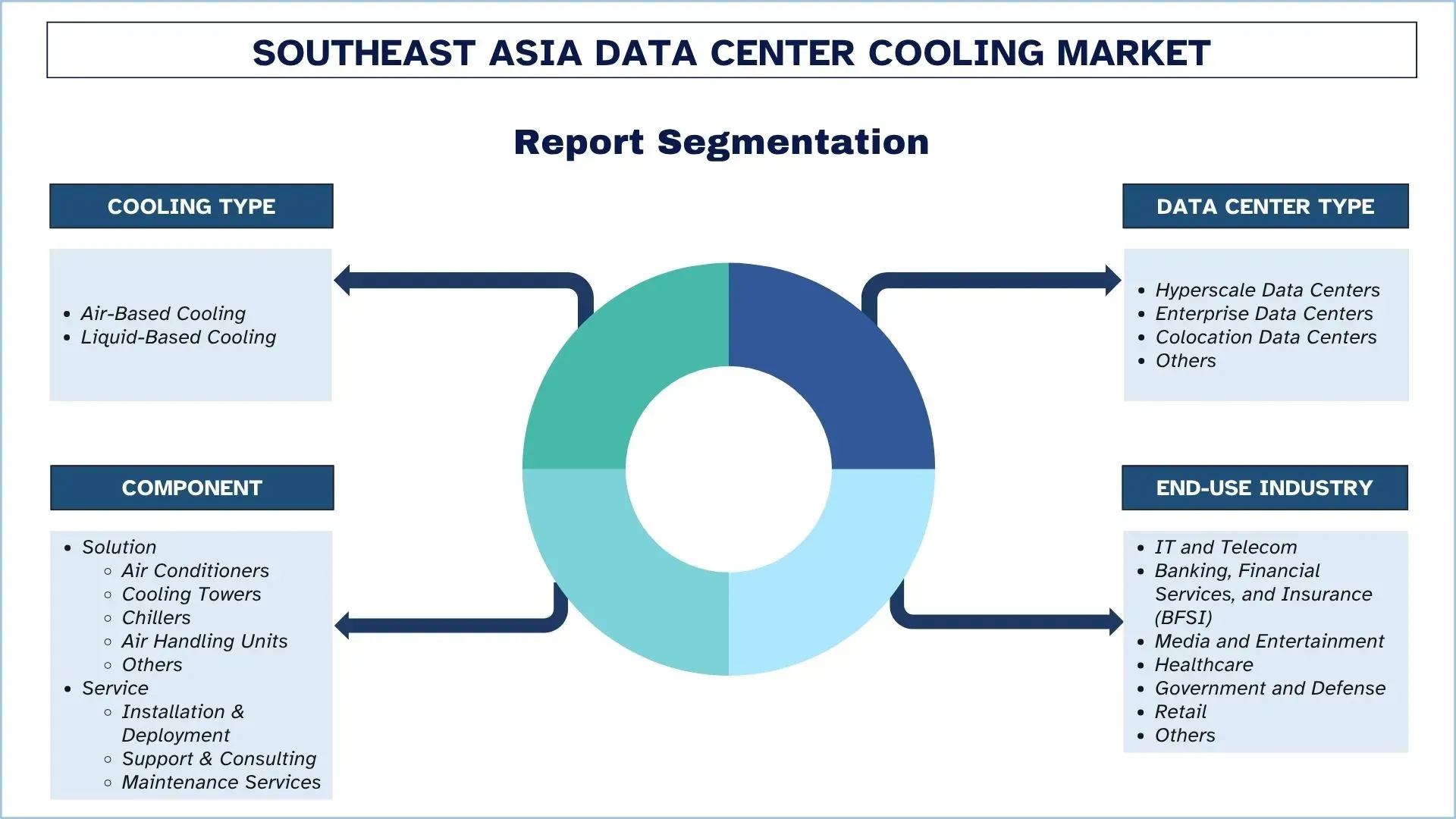
Emphasis on Cooling Type (Air-Based Cooling, Liquid-Based Cooling); Component (Solution {Air Conditioners, Precision Air Conditioners, Chillers, Air Handling Units, Others}, Service {Installation & Deployment, Support & Consulting, Maintenance Services}); Data Center Type (Hyperscale Data Centers, Enterprise Data Centers, Colocation Data Centers, Others); End-Use Industry (IT and Telecom, Banking, Financial Services, and Insurance (BFSI), Media and Entertainment, Healthcare, Government and Defense, Retail, Others); and Country.
Southeast Asia Data Center Cooling Market Size & Forecast
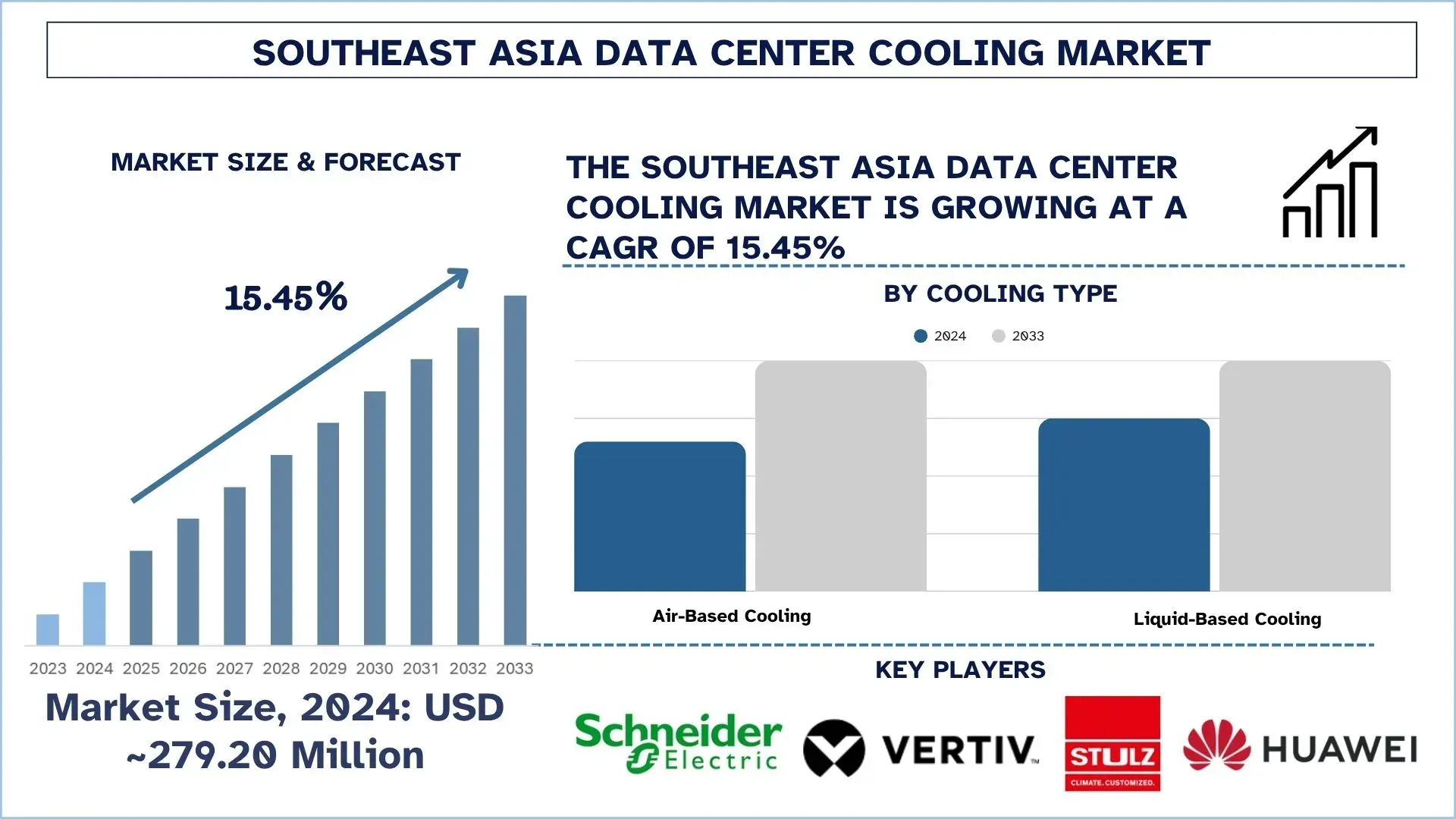
The Southeast Asia Data Center Cooling Market was valued at ~USD 279.20 million in 2024 and is expected to grow at a strong CAGR of approximately 15.45% during the forecast period (2025-2033F), driven by a growing adoption of high-density computing and AI workloads.
Southeast Asia Data Center Cooling Market Analysis
Data center cooling is the process of cooling equipment using air-based and liquid-based tools to remove heat produced by servers and IT-based devices, and maintaining the equipment within a safe operating temperature range with minimal energy usage and lower operational expenses.
In Southeast Asia, data center operators are adopting advanced cooling designs, such as liquid immersion and direct-to-chip cooling, to enhance efficiency and support high-density workloads. Furthermore, companies are developing modular cooling systems and AI-based surveillance measures, which can streamline real-time thermal control. Moreover, the increasing trend towards sustainable design involves utilizing eco-friendly refrigerants and renewable energy-powered cooling plants, aligning with local energy conservation requirements and carbon neutrality targets.
On October 9, 2025, Ecolab Inc. launched its 3D TRASAR™ Technology for Direct-to-Chip Liquid Cooling in the Southeast Asia market, with Singapore chosen as the launch stage during Data Center World Asia 2025. This first-in-market innovation represents a breakthrough in cooling high-performance computing systems and data centers. Ecolab’s new solution, 3D TRASAR Technology for Direct-to-Chip Liquid Cooling, helps protect data center servers by monitoring coolant health indicators in real-time, including temperature, pH, and flow rates. Ecolab now covers the entire data center cooling landscape.
Southeast Asia Data Center Cooling Market Trends
This section discusses the key market trends that are influencing the various segments of the Southeast Asia Data Center Cooling market, as found by our team of research experts.
Shift Toward Liquid and Immersion Cooling Systems
The rising shift in the market towards liquid and immersion cooling is progressively emerging amid the increased workload and heat output in the data centers. The systems are more efficient than traditional air cooling, particularly in high-density environments. Furthermore, companies are adopting them to reduce energy consumption, enhance thermal performance, and meet stricter sustainability requirements. This trend is now becoming the focus of new data centers in the region as the company relies on cloud services and artificial intelligence processing.
Southeast Asia Data Center Cooling Industry Segmentation
This section provides an analysis of the key trends in each segment of the Southeast Asia Data Center Cooling market, along with forecasts at the country level for 2025-2033.
The liquid-based cooling market is expected to grow at a significant CAGR during the forecast period (2025-2033).
Based on cooling type, the market is segmented into air-based cooling, liquid-based cooling. Among these, the liquid-based cooling market is expected to grow at a significant CAGR during the forecast period (2025-2033). The market is growing due to the liquid-based cooling, as data centers in Southeast Asia encounter increasing power densities and heat loads due to AI and cloud applications. This technology is more efficient and able to use less energy than traditional air cooling, which is ideal for the hyperscale environment. The increasing need for sustainable operations with low-PUE is increasing the pace of adoption of new and upgraded facilities. On 24 April 2025, ST Telemedia Global Data Centres (STT GDC), a leading data centre service provider in Asia, announced the launch of a direct-to-chip liquid cooling showcase at its flagship STT Bangkok 1 data centre facility. Showcasing advanced cooling technologies already supporting operational AI clusters, high-density racks, and live customers at Thailand’s first NVIDIA DGX-Ready data centre.
The hyperscale data centers market held a significant share of the market in 2024.
Based on data center type, the market is segmented into hyperscale data centers, enterprise data centers, colocation data centers, and others. Among these, the hyperscale data centers market held a significant share of the market in 2024. This is mainly due to the development of cloud service providers and international technology companies, which is facilitated by the growth of these industries. The massive capacity of these facilities demands an advanced and high-capacity cooling system to utilize heavy workloads. Therefore, due to the rising demand for digital services, hyperscale operators are driving the development of liquid-based and AI-based cooling innovations to ensure performance and sustainability. For example, on September 10, 2025, Vantage Data Centers secured a USD 1.6 billion investment in the APAC platform from GIC and Abu Dhabi Investment Authority (ADIA). The investment to support accelerated expansion in APAC, including the acquisition of a hyperscale data center campus in Johor, Malaysia, strengthens Vantage’s position as a market leader in Asia Pacific.
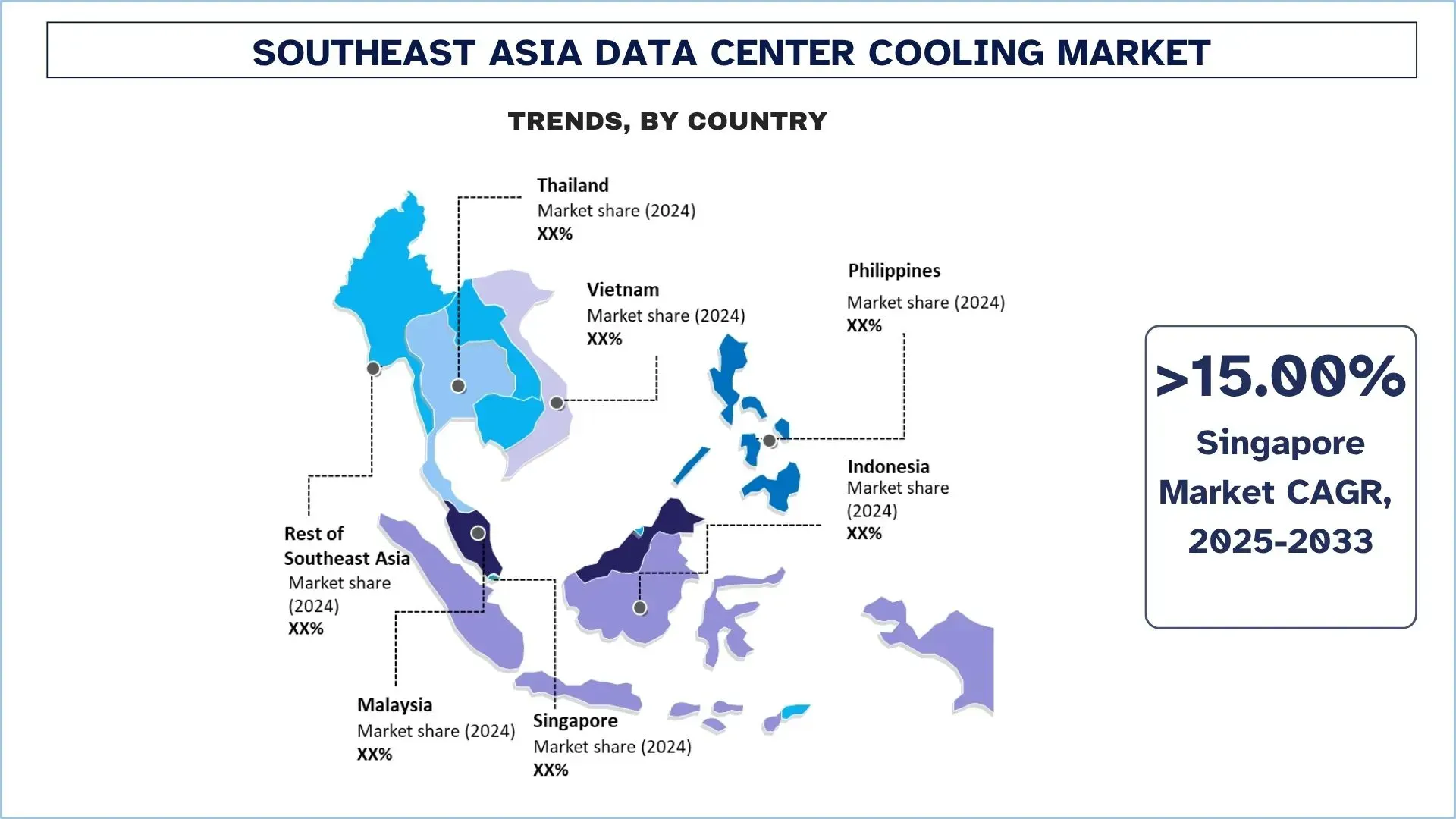
Singapore held a dominant share of the Southeast Asian Data Center Cooling market in 2024
The Southeast Asia data center cooling market is dominated by Singapore, a digital hub within the region, with a high concentration of hyperscale and colocation projects. The strict governmental rules on energy efficiency and sustainability are driving companies towards liquid and hybrid cooling systems. Further optimization of performance is achieved through continuous investments in green data centers and AI-based monitoring systems. Moreover, the country's high connectivity and favourable infrastructure policy make it a strategic market for innovative cooling.
For example, on July 10, 2025, BDx Data Centers (“BDx”), a leading carrier-neutral data center platform in Asia, launched Southeast Asia’s first hybrid quantum AI testbed in collaboration with Anyon Technologies, a global leader in large-scale quantum computing systems. The signing of the MoU legitimized the partnership, and the first hybrid quantum computer was deployed at the flagship site of BDx, SIN1, in Paya Lebar, Singapore. SIN1 also establishes a sustainability standard, as it increased its energy efficiency by 20 percent, including better cooling and intelligent automation. It has an automated digital twin that is the first of its kind in Singapore, optimizing energy and performance in real-time, and meets the standards of the Singapore Green Data Center Standards.
Southeast Asia Data Center Cooling Industry Competitive Landscape
The Southeast Asia Data Center Cooling market is competitive, with several global and international market players. The key players are adopting different growth strategies to enhance their market presence, such as partnerships, agreements, collaborations, new product launches, geographical expansions, and mergers and acquisitions.
Top Southeast Asia Data Center Cooling Companies
Some of the major players in the market are Schneider Electric, Vertiv Group Corp., STULZ Asia Hub Pte Ltd. (STULZ GMBH), Huawei Digital Power Technologies Co., Ltd. (Huawei Technologies Co., Ltd.), DAIKIN INDUSTRIES, Ltd., Johnson Controls, Alfa Laval AB, RITTAL Pte. Ltd. (Rittal GmbH & Co. KG) (Friedhelm Loh Group), Delta Electronics (Thailand) PCL. (Delta International Holding Limited B.V.), Danfoss.
Recent Developments in the Southeast Asia Data Center Cooling Market
On September 30, 2025, Carrier showcased QuantumLeap™, a comprehensive suite of purpose-built thermal management solutions for data centers, at Data Centre World Asia. QuantumLeap combines advanced liquid and air cooling, intelligent controls, and predictive service into one integrated platform. The solution is now available in Southeast Asia, offering operators stronger performance and lower energy use in tropical environments. Fueled by AI, Asia saw a record USD 20 billion in cross-border data center investments in 2024. The regional data center cooling market is projected to reach USD 7.3 billion by 2031.
On May 15, 2025, Equinix, Inc. inaugurated its first International Business Exchange (IBX) data center in Jakarta, a joint venture with PT Astra International Tbk (“Astra”). This high-performance data center, known as JK1, offers access to over 50 global and local network service providers and internet exchanges, creating a robust ecosystem that supports businesses expanding in Indonesia. JK1 incorporates sustainability into its design, leveraging innovative technologies such as Cooling Array and liquid cooling technology, ensuring efficient heat management for high-density and high-performance computer workloads such as AI.
Southeast Asia Data Center Cooling Market Report Coverage
Details | |
Base year | 2024 |
Forecast period | 2025-2033 |
Growth momentum | Accelerate at a CAGR of 15.45% |
Market size 2024 | ~USD 279.20 million |
Country analysis | Indonesia, Thailand, Philippines, Vietnam, Malaysia, Singapore, Rest of Southeast Asia |
Major contributing Country | Indonesia is expected to grow at the highest CAGR during the forecasted period. |
Companies profiled | Schneider Electric, Vertiv Group Corp., STULZ Asia Hub Pte Ltd. (STULZ GMBH), Huawei Digital Power Technologies Co., Ltd. (Huawei Technologies Co., Ltd.), DAIKIN INDUSTRIES, Ltd., Johnson Controls, Alfa Laval AB, RITTAL Pte. Ltd. (Rittal GmbH & Co. KG) (Friedhelm Loh Group), Delta Electronics (Thailand) PCL. (Delta International Holding Limited B.V.), Danfoss |
Report Scope | Market Trends, Drivers, and Restraints; Revenue Estimation and Forecast; Segmentation Analysis; Demand and Supply Side Analysis; Competitive Landscape; Company Profiling |
Segments Covered | By Cooling Type, By Component, By Data Center Type, By End-Use Industry, By Country |
Reasons to Buy the Southeast Asia Data Center Cooling Market Report:
The study includes market sizing and forecasting analysis confirmed by authenticated key industry experts.
The report briefly reviews overall industry performance at a glance.
The report covers an in-depth analysis of prominent industry peers, primarily focusing on key business financials, product portfolios, expansion strategies, and recent developments.
Detailed examination of drivers, restraints, key trends, and opportunities prevailing in the industry.
The study comprehensively covers the market across different segments.
Customization Options:
The Southeast Asia Data Center Cooling Market can further be customized as per requirements or any other market segment. Besides this, UnivDatos understands that you may have your own business needs; hence, feel free to contact us to get a report that completely suits your requirements.
Table of Content
Research Methodology for the Southeast Asia Data Center Cooling Market Analysis (2023-2033)
We analyzed the historical market, estimated the current market, and forecasted the future market of the Southeast Asian Data Center Cooling market to assess its application in major countries. We conducted exhaustive secondary research to gather historical market data and estimate the current market size. To validate these insights, we carefully reviewed numerous findings and assumptions. Additionally, we conducted in-depth primary interviews with industry experts across the Southeast Asian Data Center Cooling value chain. After validating market figures through these interviews, we used both top-down and bottom-up approaches to forecast the overall market size. We then employed market breakdown and data triangulation methods to estimate and analyze the market size of industry segments and sub-segments.
Market Engineering
We employed the data triangulation technique to finalize the overall market estimation and derive precise statistical numbers for each segment and sub-segment of the Southeast Asia Data Center Cooling market. We split the data into several segments and sub-segments by analyzing various parameters and trends, including cooling type, component, data center type, end-use industry, and country within the Southeast Asian Data Center Cooling market.
The Main Objective of the Southeast Asia Data Center Cooling Market Study
The study identifies current and future trends in the Southeast Asia Data Center Cooling market, providing strategic insights for investors. It highlights market attractiveness, enabling industry participants to tap into untapped markets and gain a first-mover advantage. Other quantitative goals of the studies include:
Market Size Analysis: Assess the current and forecast market size of the Southeast Asia Data Center Cooling market and its segments in terms of value (USD).
Southeast Asia Data Center Cooling Market Segmentation: Segments in the study include areas of cooling type, component, data center type, end-use industry, and country.
Regulatory Framework & Value Chain Analysis: Examine the regulatory framework, value chain, customer behavior, and competitive landscape of the Southeast Asia Data Center Cooling industry.
Country Analysis: Conduct a detailed country analysis for key areas such as Indonesia, Thailand, the Philippines, Vietnam, Malaysia, Singapore, and the Rest of Southeast Asia.
Company Profiles & Growth Strategies: Company profiles of the Southeast Asia Data Center Cooling market and the growth strategies adopted by the market players to sustain in the fast-growing market.
Frequently Asked Questions FAQs
Q1: What is the Southeast Asia Data Center Cooling market’s current market size and growth potential?
The Southeast Asia Data Center Cooling market was valued at ~USD 279.20 million in 2024 and is projected to expand at a CAGR of 15.45% from 2025 to 2033. Growth is fueled by rising hyperscale investments, high-density computing adoption, and the rapid expansion of cloud and colocation facilities across Singapore, Indonesia, Malaysia, Vietnam, and the Philippines.
Q2: Which segment has the largest share of the Southeast Asia Data Center Cooling market by cooling type?
Liquid-based cooling systems currently dominate the market, driven by the region’s shift toward high-density AI workloads, improved energy efficiency, and the ability to significantly reduce Power Usage Effectiveness (PUE) in hot and humid climates.
Q3: What are the driving factors for the growth of the Southeast Asia Data Center Cooling market?
Key drivers include hyperscale data-center expansion, increased cloud adoption, rising rack power densities, sustainability mandates, and strong enterprise digitalization across BFSI, telecom, retail, and government sectors. The region’s tropical climate further accelerates demand for efficient cooling technologies.
Q4: What are the emerging technologies and trends in the Southeast Asia Data Center Cooling market?
Major trends shaping the market include the rise of liquid and immersion cooling, deployment of modular cooling units, AI-driven cooling automation, and adoption of sustainable practices like heat reuse and renewable-assisted cooling.
Q5: What are the key challenges in the Southeast Asia Data Center Cooling market?
Challenges include high upfront investment requirements, a limited skilled workforce for advanced cooling systems, power-supply constraints in emerging markets, complex regulatory approvals, and heat-load management issues due to increasing rack densities.
Q6: Which country dominates the Southeast Asia Data Center Cooling market?
Singapore remains the regional leader due to its advanced digital ecosystem, strong data-center presence, sustainability roadmap, and ongoing investments from global hyperscalers and colocation providers.
Q7: Who are the key players in the Southeast Asia Data Center Cooling market?
Leading companies in the Southeast Asia Data Center Cooling market include:
• Schneider Electric
• Vertiv Group Corp.
• STULZ Asia Hub Pte Ltd. (STULZ GMBH)
• Huawei Digital Power Technologies Co., Ltd. (Huawei Technologies Co., Ltd.)
• DAIKIN INDUSTRIES, Ltd.
• Johnson Controls
• Alfa Laval AB
• RITTAL Pte. Ltd. (Rittal GmbH & Co. KG) (Friedhelm Loh Group)
• Delta Electronics (Thailand) PCL. (Delta International Holding Limited B.V.)
• Danfoss
Q8: What investment opportunities exist in the Southeast Asia data center cooling space?
Investors can capitalize on high-growth segments such as liquid cooling, immersion cooling, AI-driven thermal management software, and retrofit modernization projects. Rapid cloud expansion and 5G rollout create strong multi-year investment visibility.
Q9: How are sustainability and energy efficiency influencing data center cooling strategies in Southeast Asia?
Operators are adopting low-PUE cooling designs, renewable-assisted chillers, heat-reuse systems, and eco-friendly refrigerants to meet regional energy regulations and corporate ESG targets. Green data centers are increasingly becoming a core requirement for hyperscale investors.
Related Reports
Customers who bought this item also bought
India IT and BPO Services Market: Current Analysis and Forecast (2026-2034)
Emphasis on Service Type (IT Services, BPO Services, Engineering & R&D Services); Outsourcing Type (Onshore, Offshore, Nearshore); Organization Size (Large Enterprises, SMEs); End-User Industry (BFSI, IT & Telecom, Healthcare, Retail & E-commerce, Manufacturing, Others); and Region/States
Gi-Fi Technology Market: Current Analysis and Forecast (2025-2033)
Emphasis on Product Type (Display Devices and Network Infrastructure Devices); Technology (System on chip and Integrated Circuit Chip); Application (Consumer Electronics, Commercial, and Networking); and Region/Country
DNA Data Storage Market: Current Analysis and Forecast (2026-2034)
Emphasis on Type (Cloud and On-Premises); Technology (Sequence-based DNA Data Storage and Structure-based DNA Data Storage); End-User (Government, Healthcare & Biotechnology, Media & Telecommunication, and Others); and Region/Country
Cloud Service Brokerage Market: Current Analysis and Forecast (2026-2034)
Emphasis on Service Type (Integration and Support, Automation and Orchestration, Billing and Provisioning, Migration and Customization, Security and Compliance, and Others); Platform (Internal Brokerage Enablement and External Brokerage Enablement); Deployment (Private, Public, and Hybrid); Enterprise Size (Large Enterprises, and Small & Medium-Sized Enterprises); End-Use (IT & Telecom, BFSI, Government & Public Sector, Healthcare, Consumer Goods & Retail, Manufacturing, Energy & Utilities, and Others); and Region/Country