Middle East & Africa Data Center Cooling Market: Current Analysis and Forecast (2025-2033)
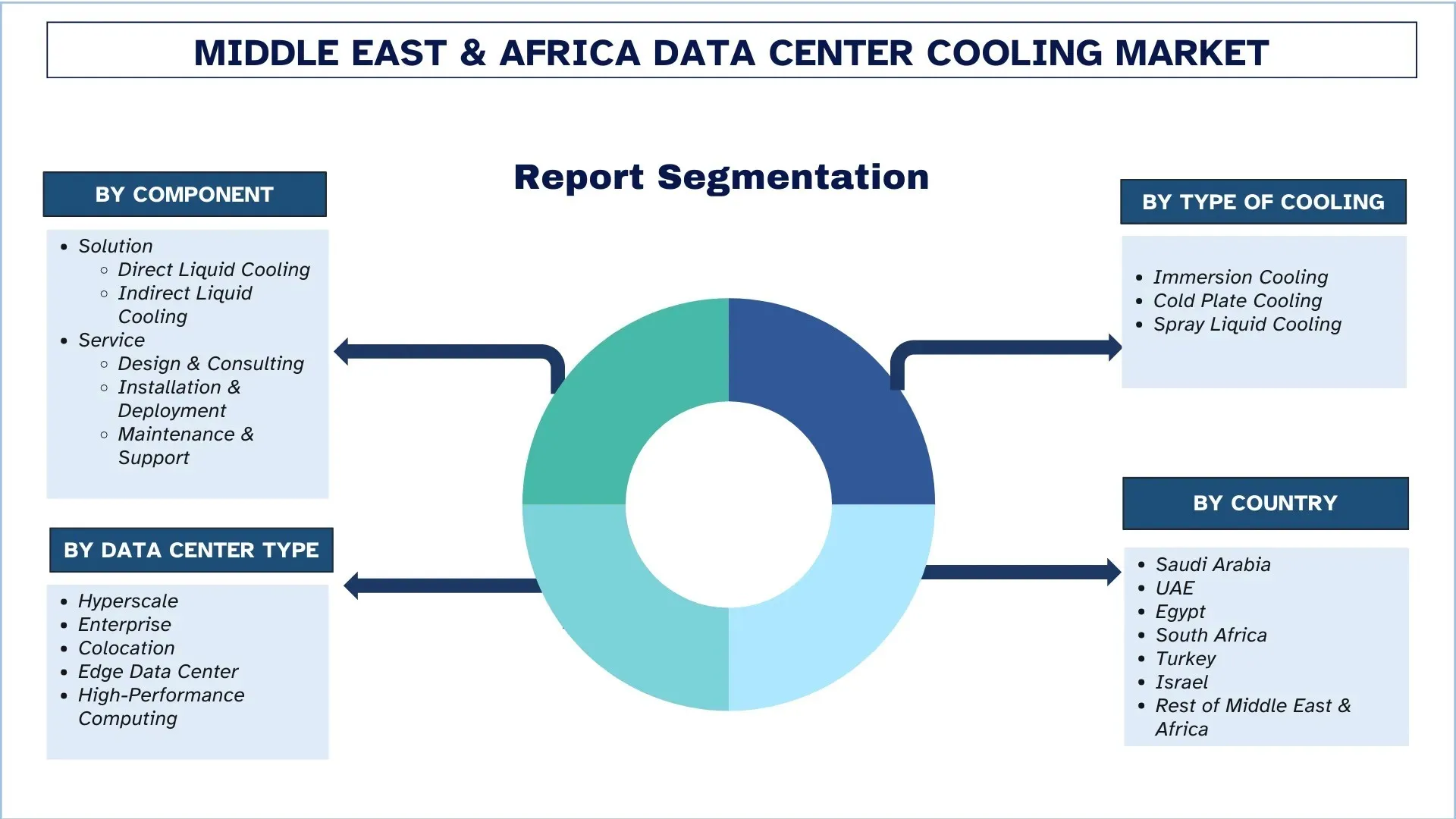
Emphasis By Component (Solutions( Direct Liquid Cooling, Indirect Liquid Cooling), Services (Design & Consulting, Installation & Deployment, and Maintenance & Support)), By Type of Cooling (Immersion Cooling, Cold Plate Cooling, and Spray Liquid Cooling), By Data Center Type ( Hyperscale, Enterprise, Colocation, Edge Data Center, and High-Performance Computing), By Country (Saudi Arabia, UAE, Egypt, South Africa, Turkey, Israel, and the Rest of Middle East & Africa)
Middle East & Africa Data Center Cooling Market Size & Forecast
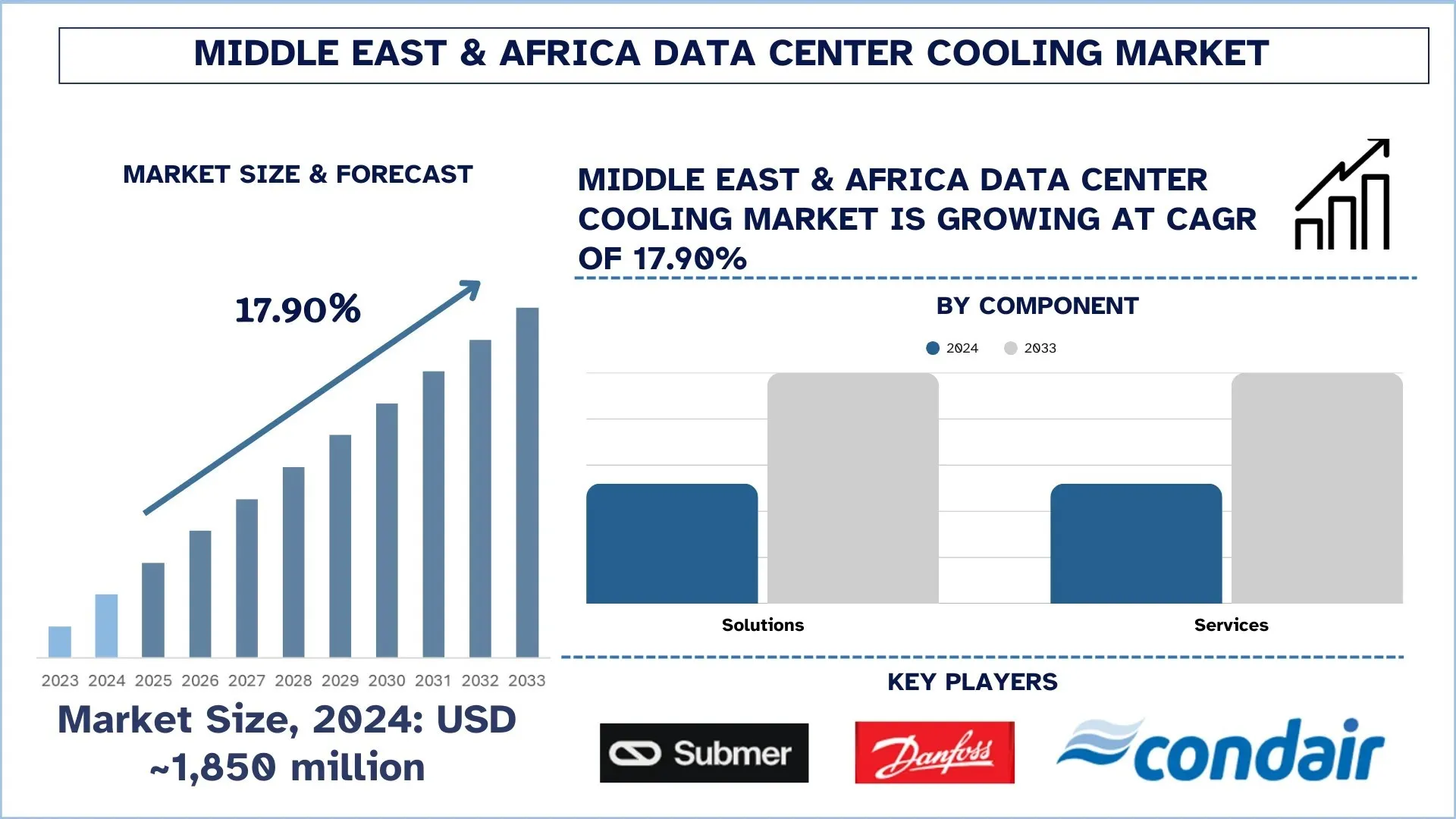
The Middle East & Africa Data Center Cooling Market was valued at USD 1,850 million in 2024 and is expected to grow at a strong CAGR of around 17.90% during the forecast period (2025- 2033F). Wave of new data centers and higher rack densities, Extreme temperatures, and expensive energy are some of the key factors that have supported the market rise.
Middle East & Africa Data Center Cooling Market Analysis
The data center cooling market in the Middle East and Africa is growing steadily as cloud providers, telecommunications operators, governments, and companies accelerate investments in digital infrastructure. New hyperscale campuses, regional colocation hubs, and edge facilities are being built in the Gulf, South Africa, and major metros in Africa. Concurrently, the high ambient temperatures and increasing rack power densities are putting the focus of data center design on cooling. The operators are no longer content to use the basic comfort cooling but instead continue to shift to purpose-built systems capable of sustaining thermal stability, managing the energy expenses, and supporting future AI and high-performance demands.
Middle East & Africa Data Center Cooling Market Trends
This section discusses the key market trends that are influencing the various segments of the Middle East & Africa Data Center Cooling market, as found by our team of research experts.
Migration from legacy air-only cooling to hybrid and liquid solutions:
In the Middle East / Africa, data centre operators are slowly abandoning the old methods of air cooling in a room-based system for the more hybrid and liquid-assisted architectures. Older CRAC/CRAH systems, intended to support the lower rack densities, find it challenging to handle the current AI, cloud, and virtualization demands without resulting in hot spots or increasing energy consumption. Operators are in turn adopting in-row cooling, rear-door cooling, selective liquid cooling like direct-to-chip cooling, etc., in high-density zones. These non-standard forms enable the facilities to use a combination of performance, risk, and cost-performance- standard racks can still be used, but liquid can be placed where thermal loads occur most. The switch is more efficient in terms of PUE, higher rack density potential, and better thermal reliability, putting data centers in a position to increase in size as the regional digital and AI workloads expand.
Key Market Segmentation:
This section provides an analysis of the key trends in each segment of the Middle East & Africa Data Center Cooling market report, along with forecasts at the country and regional levels for 2025-2033.
The Solutions segment has shown promising growth in the Data Center Cooling Market.
According to the component, the Middle East & Africa data center cooling market is split between solutions and services. Among them, the solutions segment is the biggest requirement in revenue at the moment due to the massive investment in chillers, CRAH/CRAC units, in-row cooling, containment, and control systems in new hyperscale and colocation centres. Physical cooling infrastructure is most commonly a priority in greenfield construction and large expansions, as it has a direct effect on IT capacity, reliability, and PUE. Moreover, routine upgrades and technological changes to accommodate higher rack densities are further enhancing the prevailing solutions at the expense of pure service-based revenues, while design, integration, and maintenance services are increasingly in demand.
The Immersion Cooling category held a significant share of the Middle East & Africa Data Center Cooling Market.
The Middle East & Africa data center cooling market is divided into immersion cooling, cold plate cooling, and spray liquid cooling, based on the type of cooling. AI and high-performance workloads are coming under the focus of immersion cooling, as it can manage extremely high heat densities and use less energy. Incremental upgrades are under consideration to be implemented on existing facilities with cold plate solutions because they are easier to integrate into a traditional rack layout. Spray liquid cooling is also more niche; however, it is important to have a high degree of control over localized cooling and a small volume of space.
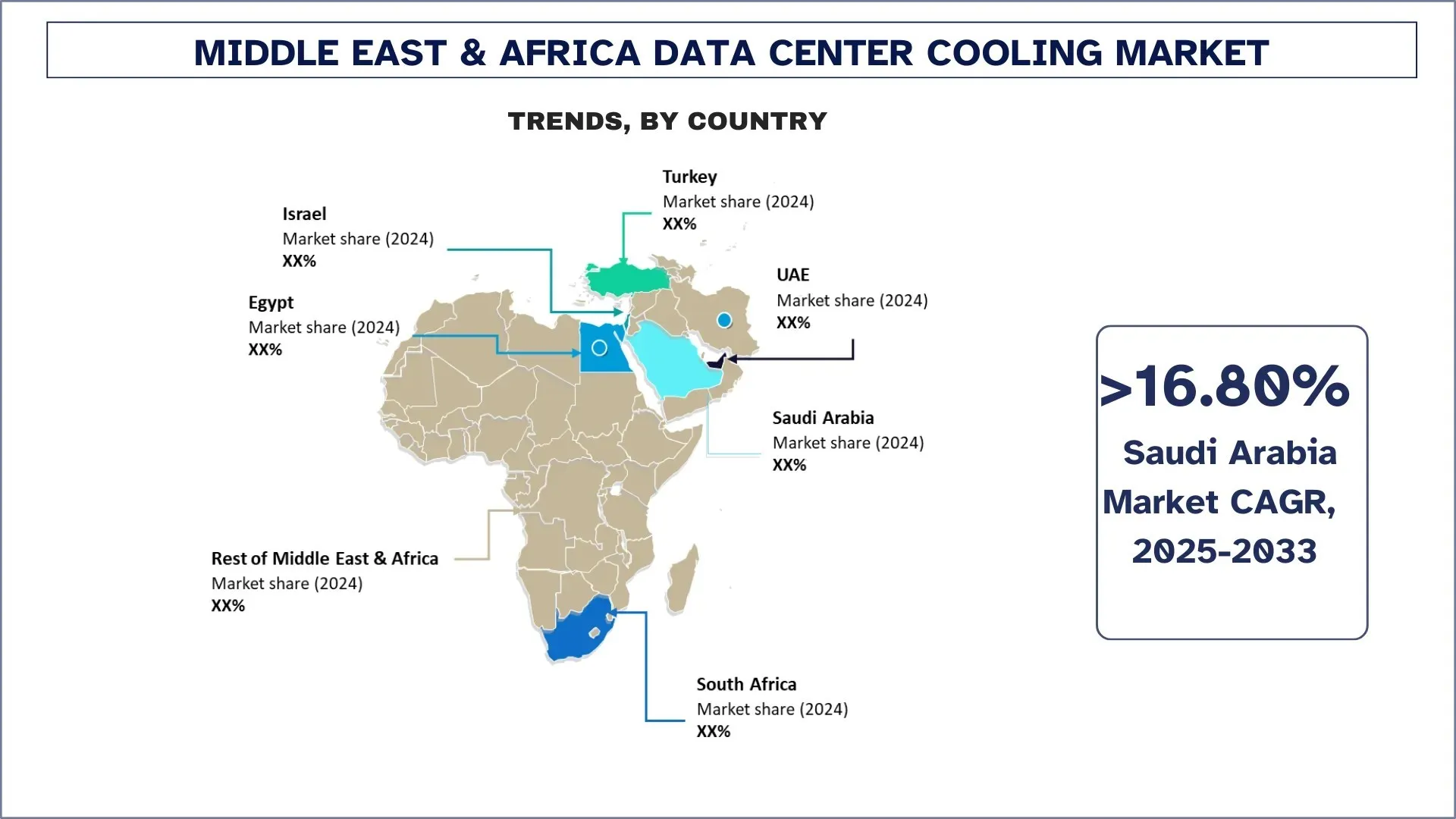
Saudi Arabia is expected to grow at a considerable rate during the forecast period.
The market of data center cooling in Saudi Arabia is thriving at an impressive pace due to the massive investments in clouds, Digital Vision 2030, and the construction of hyperscale campuses and colocation centers. Very high ambient temperatures necessitate efficient, robust cooling to be a design consideration, and thus, there is a need to have high-tech chiller plants, indirect evaporative cooling, close-coupled cooling, and complex controls. Cloud providers, telecom operators, and government bodies are also investing in new facilities within Riyadh, Jeddah, NEOM, and others, typically with the aim of achieving low PUE and good ESG scores. This presents beneficial opportunities to technology suppliers, engineering companies, and high-efficiency and hybrid cooling service providers.
Middle East & Africa Data Center Cooling Industry Competitive Landscape:
The Middle East & Africa Data Center Cooling market is competitive, with several global and international market players. The key players are adopting different growth strategies to enhance their market presence, such as partnerships, agreements, collaborations, new product launches, geographical expansions, and mergers and acquisitions.
Top Middle East & Africa Data Center Cooling Companies
Some of the major players in the market are Submer, Schneider Electric, Danfoss, CoolIT Systems, NTT Ltd, Dell, Vertiv Group Corp., Asetek, Johnson Controls, and Carrier.
Middle East & Africa Data Center Cooling Market Report Coverage
Report Attribute | Details |
Base year | 2024 |
Forecast period | 2025-2033 |
Growth momentum | Accelerate at a CAGR of 17.90% |
Market size 2024 | USD 1,850 Million |
Country analysis | Saudi Arabia, UAE, Egypt, South Africa, Turkey, Israel, and the Rest of the Middle East & Africa |
Major contributing Country | Saudi Arabia is expected to dominate the market during the forecast period. |
Companies profiled | Submer, Schneider Electric, Danfoss, CoolIT Systems, NTT Ltd, Dell, Vertiv Group Corp., Asetek, Johnson Controls, and Carrier. |
Report Scope | Market Trends, Drivers, and Restraints; Revenue Estimation and Forecast; Segmentation Analysis; Demand and Supply Side Analysis; Competitive Landscape; Company Profiling |
Segments Covered | by Component, by Type of Cooling, by Data Center Type, by Country |
Reasons to Buy the Middle East & Africa Data Center Cooling Market Report:
The study includes market sizing and forecasting analysis confirmed by authenticated key industry experts.
The report briefly reviews overall industry performance at a glance.
The report covers an in-depth analysis of prominent industry peers, primarily focusing on key business financials, type portfolios, expansion strategies, and recent developments.
Detailed examination of drivers, restraints, key trends, and opportunities prevailing in the industry.
The study comprehensively covers the market across different segments.
Deep dive Country-level analysis of the industry.
Customization Options:
The Middle East & Africa DATA CENTER COOLING market can further be customized as per requirements or any other market segment. Besides this, UnivDatos understands that you may have your own business needs; hence, feel free to contact us to get a report that completely suits your requirements.
Table of Content
Research Methodology for the Middle East & Africa Data Center Cooling Market Analysis (2023-2033)
We analyzed the historical market, estimated the current market, and forecasted the future market of the Middle East & Africa Data Center Cooling market to assess its application in major countries. We conducted exhaustive secondary research to gather historical market data and estimate the current market size. To validate these insights, we carefully reviewed numerous findings and assumptions. Additionally, we conducted in-depth primary interviews with industry experts across the Data Center Cooling value chain. After validating market figures through these interviews, we used both top-down and bottom-up approaches to forecast the overall market size. We then employed market breakdown and data triangulation methods to estimate and analyze the market size of industry segments and sub-segments.
Market Engineering
We employed data triangulation techniques to finalize the overall market estimation and derive precise statistical numbers for each segment and sub-segment of the Middle East & Africa Data Center Cooling market. We split the data into several segments and sub-segments by analyzing various parameters and trends, by Component, by Type of Cooling, by Data Center Type, and by country within the Middle East & Africa Data Center Cooling market.
The Main Objective of the Middle East & Africa Data Center Cooling Market Study
The study identifies current and future trends in the Middle East & African Data Center Cooling market, providing strategic insights for investors. It highlights Country-level market attractiveness, enabling industry participants to tap into untapped markets and gain a first-mover advantage. Other quantitative goals of the studies include:
Market Size Analysis: Assess the current forecast and market size of the Middle East & Africa Data Center Cooling market and its segments in terms of value (USD).
Middle East & Africa Data Center Cooling Market Segmentation: Segments in the study include areas by Component, by Type of Cooling, by Data Center Type, and by
Regulatory Framework & Value Chain Analysis: Examine the regulatory framework, value chain, customer behavior, and competitive landscape of the Middle East & Africa Data Center Cooling industry.
Country Analysis: Conduct a detailed Country analysis for key areas such as Saudi Arabia, UAE, Egypt, South Africa, Turkey, Israel, and the Rest of the Middle East & Africa.
Company Profiles & Growth Strategies: Company profiles of the Middle East & Africa Data Center Cooling market and the growth strategies adopted by the market players to sustain the fast-growing market.
Frequently Asked Questions FAQs
Q1: What is the Middle East & Africa Data Center Cooling market’s current market size and growth potential?
The Middle East & Africa Data Center Cooling Market was valued at 1,850 million in 2024 and is expected to grow at a CAGR of 17.90% during the forecast period (2025-2033).
Q2: Which segment has the largest share of the Middle East & Africa Data Center Cooling market by Component?
The solutions segment is the largest revenue driver at the moment due to massive investments in chillers, CRAH/CRAC units, in-row cooling, containment, and control systems in new hyperscale and colocation centres.
Q3: What are the driving factors for the growth of the Middle East & Africa Data Center Cooling market?
• Wave of new data centers and higher rack densities: Rapid rollout of hyperscale, colocation, and edge facilities across the region is sharply increasing installed IT capacity and average rack power density. This is elevating cooling from a basic support function to a strategic investment area, driving demand for more advanced and scalable cooling solutions.
• Extreme temperatures and expensive energy: Harsh climatic conditions and rising electricity tariffs in many MEA countries make efficient cooling essential to ensure uptime and control operating costs. Operators are therefore investing in high-performance, energy-efficient cooling systems that can reliably operate in very high ambient temperatures while improving PUE.
Q4: What are the emerging technologies and trends in the Middle East & Africa Data Center Cooling market?
• Migration from legacy air-only cooling to hybrid and liquid solutions: Data centers are gradually replacing traditional room-based CRAC/CRAH systems with in-row, rear-door, and liquid-assisted cooling—such as direct-to-chip or immersion—for high-density zones. These hybrid architectures allow operators to balance cost, risk, and performance while supporting AI and other heat-intensive workloads.
• Stronger focus on efficiency and sustainability: Cooling strategies are increasingly being evaluated on lifecycle energy use, water footprint, and ESG impact, not just capex. This is driving adoption of high-efficiency chillers, advanced controls, containment, free-cooling/adiabatic designs where climate allows, and closer integration with renewable power and water-conservation measures.
Q5: What are the key challenges in the Middle East & Africa Data Center Cooling market?
• Infrastructure constraints: power and water: Limited or unstable grid capacity in some markets, along with water scarcity in several parts of the region, constrain the choice and scalability of cooling technologies. These factors can complicate the deployment of power- and water-intensive systems and increase both capital and operating risks.
• High upfront cost and shortage of specialized skills: Advanced cooling solutions—especially liquid and hybrid systems—often require significant initial investment and specialized engineering expertise. A limited pool of skilled designers, integrators, and maintenance professionals in parts of MEA can slow project execution and raise concerns about long-term reliability and support.
Q6: Which country dominates the Middle East & Africa Data Center Cooling market?
The market of data center cooling in Saudi Arabia is thriving at an impressive pace due to the massive investments in clouds, digital vision 2030, and the construction of hyperscale campuses and colocation centers.
Q7: Who are the key players in the Middle East & Africa Data Center Cooling market?
Some of the top Data Center Cooling companies in the Middle East & Africa include:
• Submer
• Schneider Electric
• Danfoss
• CoolIT Systems
• NTT Ltd
• Dell
• Vertiv Group Corp.
• Asetek
• Johnson Controls
• Carrier
Q8: What are the opportunities for companies within the Middle East & Africa Data Center Cooling market?
• High-efficiency design, build, and retrofit projects: The rapid rollout of hyperscale and colocation facilities, alongside the modernization of legacy enterprise data centers, creates strong demand for optimized cooling designs.
• Deployment of next-generation cooling technologies: Growing AI and high-density workloads open the door for liquid cooling, immersion systems, rear-door heat exchangers, and other advanced solutions.
Q9: How are consumer preferences shaping product development in the Middle East & Africa Data Center Cooling market?
Consumer preferences in the Middle East & Africa data center cooling market are steering product development toward high-efficiency, low-PUE, and environmentally sustainable solutions. Operators increasingly demand scalable, AI-ready, and hybrid cooling systems that balance performance, cost-effectiveness, and compliance with evolving ESG and regulatory standards.
Related Reports
Customers who bought this item also bought
India IT and BPO Services Market: Current Analysis and Forecast (2026-2034)
Emphasis on Service Type (IT Services, BPO Services, Engineering & R&D Services); Outsourcing Type (Onshore, Offshore, Nearshore); Organization Size (Large Enterprises, SMEs); End-User Industry (BFSI, IT & Telecom, Healthcare, Retail & E-commerce, Manufacturing, Others); and Region/States
Gi-Fi Technology Market: Current Analysis and Forecast (2025-2033)
Emphasis on Product Type (Display Devices and Network Infrastructure Devices); Technology (System on chip and Integrated Circuit Chip); Application (Consumer Electronics, Commercial, and Networking); and Region/Country
DNA Data Storage Market: Current Analysis and Forecast (2026-2034)
Emphasis on Type (Cloud and On-Premises); Technology (Sequence-based DNA Data Storage and Structure-based DNA Data Storage); End-User (Government, Healthcare & Biotechnology, Media & Telecommunication, and Others); and Region/Country
Cloud Service Brokerage Market: Current Analysis and Forecast (2026-2034)
Emphasis on Service Type (Integration and Support, Automation and Orchestration, Billing and Provisioning, Migration and Customization, Security and Compliance, and Others); Platform (Internal Brokerage Enablement and External Brokerage Enablement); Deployment (Private, Public, and Hybrid); Enterprise Size (Large Enterprises, and Small & Medium-Sized Enterprises); End-Use (IT & Telecom, BFSI, Government & Public Sector, Healthcare, Consumer Goods & Retail, Manufacturing, Energy & Utilities, and Others); and Region/Country