Micro Mobility Data Analytics Market: Current Analysis and Forecast (2026-2034)
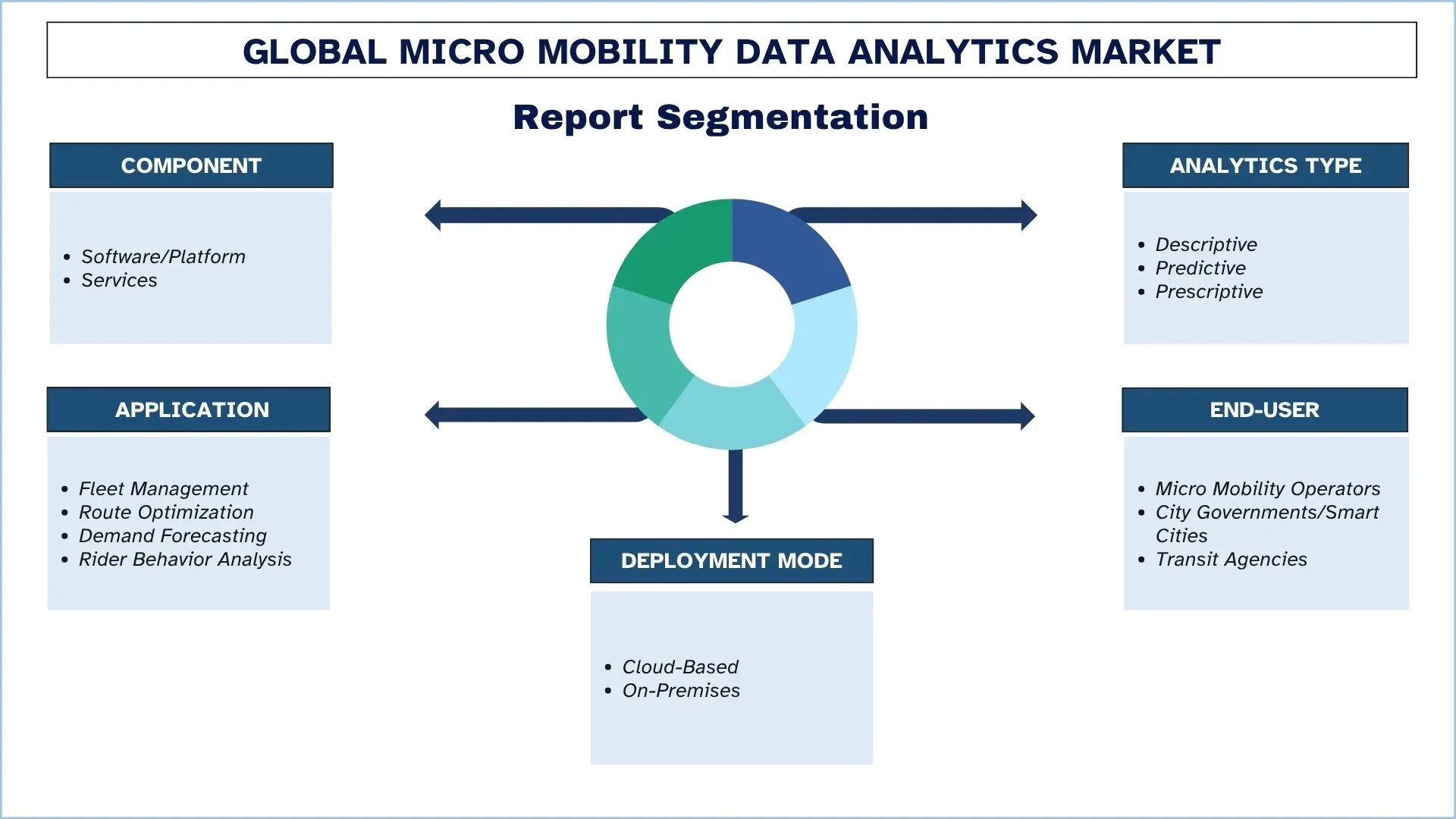
Emphasis on Component (Software / Platform, Services); Analytics Type (Descriptive, Predictive, Prescriptive); Application (Fleet Management, Route Optimization, Demand Forecasting, Rider Behavior Analysis); End-User (Micro Mobility Operators, City Governments/Smart Cities, Transit Agencies); Deployment Mode (Cloud-Based, On-Premises); and Region/Country

Global Micro Mobility Data Analytics Market Size & Forecast
The global Micro Mobility Data Analytics Market was valued at around USD 2,943.4 million in 2025 and is expected to grow at a strong CAGR of around 19.6% during the forecast period (2026-2034F), driven by the rapid growth of shared micro-mobility fleets and increasing demand for real-time analytics solutions.
Micro Mobility Data Analytics Market Analysis
Micro Mobility Data Analytics entails gathering and processing massive volumes of mobility from short-haul shared transportation. This data allows the stakeholders to track the usage trends, demand trends, minimize the operational costs, and enhance user experience. The market integrates IoT, cloud computing, and AI-driven predictive tools to provide actionable information to smart mobility planning.
Global Micro Mobility Data Analytics Market Trends
This section discusses the key market trends that are influencing the various segments of the global Micro Mobility Data Analytics market, as found by our team of research experts.
Growing Demand for AI and Machine Learning Integration.
Implementation of artificial intelligence (AI) and machine learning (ML) in micro-mobility analytics is becoming an important trend in the market. Such technologies are capable of anticipatory and prescriptive knowledge, including demand forecasting, route optimization, and predictive maintenance. Consequently, AI-based analytics is becoming an increasingly important part of the contemporary mobility ecosystem as operators have an opportunity to tackle the issues of operational difficulties proactively, enhance service quality, and optimize fleet use.
Micro Mobility Data Analytics Industry Segmentation
This section provides an analysis of the key trends in each segment of the global Micro Mobility Data Analytics market report, along with forecasts at the global, regional, and country levels for 2026-2034.
The Software/Platform Segment Dominates the Global Micro Mobility Data Analytics Market
Based on the component category, the market is categorized into software/platform and services. The software/platform category is dominating the market. This is mainly because these platforms collect, merge, and present data from different places. They allow for vehicle tracking, trend spotting, and operational efficiency, which is why analytics solutions are in demand. When these platforms are put into use, the market will grow. More people will rely on digital tools to get useful information.
The Descriptive Segment Dominates the Global Micro Mobility Data Analytics Market.
Based on the analytics type category, the market is segmented into descriptive, predictive, and prescriptive. Among these, the descriptive category is expected to grow significantly during the forecast period. Descriptive analytics summarize historical data on ridership, trip durations, and peak usage periods. It is a market driver that generates the basic understanding that will aid operators in knowing the trends, as well as the better utilization of the fleet and lessening the operational inefficiencies. It can be the starting point for stakeholders who progress to more predictive and prescriptive analytics.
The Asia-Pacific region is the fastest-growing region in the Global Micro Mobility Data Analytics Market
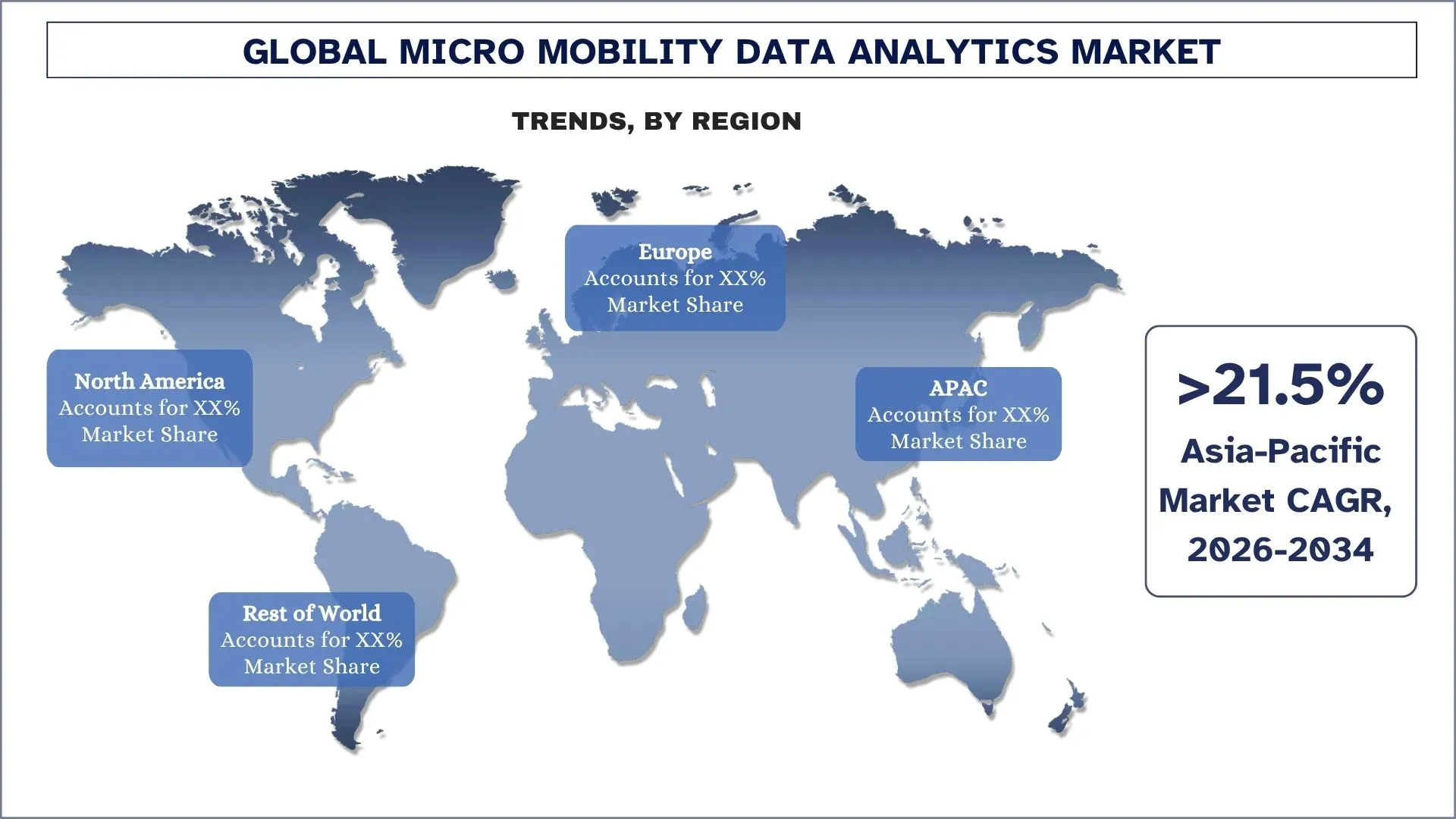
The Asia-Pacific market is rapidly expanding due to urbanization, rising population density, and the expansion of smart city initiatives in countries such as India and South Korea. Moreover, governments and commercial operators are investing significant funds in IoT fleets, mobility data solutions, and AI-based analytics applications to optimize vehicle allocation and make commuting more convenient. Increasing environmental issues and a move towards sustainable urban transport further boost the market adoption in the area.
China held a Dominant share of the Asia-Pacific Micro Mobility Data Analytics Market in 2025
China signifies one of the largest micro mobility data analytics markets globally, driven by mass adoption of e-bikes, e-scooters, and shared mobility solutions in cities like Beijing, Shanghai, and Shenzhen. Also, the rising advanced data collection infrastructure, real-time fleet monitoring, and predictive analytics are widely used to efficiently manage high-density urban mobility. Moreover, the government initiatives supporting sustainable urban transport and smart city frameworks create significant growth potential for analytics solution providers in China.
Micro Mobility Data Analytics Industry Competitive Landscape
The global Micro Mobility Data Analytics market is competitive, with several global and international market players. The key players are adopting different growth strategies to enhance their market presence, such as partnerships, agreements, collaborations, geographical expansions, and mergers and acquisitions.
Top Micro Mobility Data Analytics Market Companies
Some of the major players in the market are Joyride Technologies, Movatic Inc., TIER-Dott, Lime (Neutron Holdings, Inc.), Bird (Third Lane Mobility Inc.), Superpedestrian, Inc. (SURF Beyond Group), Ridepanda, Bolt Technology OÜ, Helbiz (micromobility.com, Inc.), and Moovit Inc. (Intel Corporation).
Recent Developments in the Micro Mobility Data Analytics Market
In 2025, VisionEdgeOne acquired Barcelona-based Inurba Mobility, including its fleet of 18,000 bikes, to strengthen long-term city contracts and operational analytics capabilities. The acquisition allows enhanced data-driven decision-making for fleet deployment and service planning.
In 2025, Nextbike Group took full control of Nextbike Polska, expanding its regional operations and integrating analytics capabilities to enhance fleet monitoring, predictive maintenance, and urban mobility planning.
In 2025, Cooltra Group purchased Kleta Mobility’s Barcelona bike operations to expand its connected fleet and integrate analytics solutions, improving operational oversight, usage insights, and predictive maintenance planning.
Global Micro Mobility Data Analytics Market Report Coverage
Report Attribute | Details |
Base year | 2025 |
Forecast period | 2026-2034 |
Growth momentum | Accelerate at a CAGR of 19.6% |
Market size 2025 | USD 2,943.4 million |
Regional analysis | North America, Europe, APAC, Rest of the World |
Major contributing region | The North America region is expected to dominate the market during the forecast period. |
Key countries covered | U.S., Canada, Germany, U.K., Spain, Italy, France, China, Japan, and India. |
Companies profiled | Joyride Technologies, Movatic Inc., TIER-Dott, Lime (Neutron Holdings, Inc.), Bird (Third Lane Mobility Inc.), Superpedestrian, Inc. (SURF Beyond Group), Ridepanda, Bolt Technology OÜ, Helbiz (micromobility.com, inc.), and Moovit Inc. (Intel Corporation) |
Report Scope | Market Trends, Drivers, and Restraints; Revenue Estimation and Forecast; Segmentation Analysis; Demand and Supply Side Analysis; Competitive Landscape; Company Profiling |
Segments Covered | By Component, By Analytics Type, By Application, By End-User, By Deployment Mode, and By Region/Country |
Reasons to Buy the Micro Mobility Data Analytics Market Report:
The study includes market sizing and forecasting analysis confirmed by authenticated key industry experts.
The report briefly reviews overall industry performance at a glance.
The report covers an in-depth analysis of prominent industry peers, primarily focusing on key business financials, type portfolios, expansion strategies, and recent developments.
Detailed examination of drivers, restraints, key trends, and opportunities prevailing in the industry.
The study comprehensively covers the market across different segments.
Deep dive regional-level analysis of the industry.
Customization Options:
The global Micro Mobility Data Analytics market can further be customized as per the requirements or any other market segment. Besides this, UnivDatos understands that you may have your own business needs; hence, feel free to contact us to get a report that completely suits your requirements.
Table of Content
Research Methodology for the Global Micro Mobility Data Analytics Market Analysis (2024-2034)
We analyzed the historical market, estimated the current market, and forecasted the future market of the global Micro Mobility Data Analytics market to assess its application in major regions worldwide. We conducted exhaustive secondary research to gather historical market data and estimate the current market size. To validate these insights, we carefully reviewed numerous findings and assumptions. Additionally, we conducted in-depth primary interviews with industry experts across the Micro Mobility Data Analytics value chain. After validating market figures through these interviews, we used both top-down and bottom-up approaches to forecast the overall market size. We then employed market breakdown and data triangulation methods to estimate and analyze the market size of industry segments and sub-segments.
Market Engineering
We employed the data triangulation technique to finalize the overall market estimation and derive precise statistical numbers for each segment and sub-segment of the global Micro Mobility Data Analytics market. We split the data into several segments and sub-segments by analyzing various parameters and trends, including component, analytics type, application, end-user, deployment mode, and regions within the global Micro Mobility Data Analytics market.
The Main Objective of the Global Micro Mobility Data Analytics Market Study
The study identifies current and future trends in the global Micro Mobility Data Analytics market, providing strategic insights for investors. It highlights regional market attractiveness, enabling industry participants to tap into untapped markets and gain a first-mover advantage. Other quantitative goals of the studies include:
Market Size Analysis: Assess the current and forecast market size of the global Micro Mobility Data Analytics market and its segments in terms of value (USD).
Micro Mobility Data Analytics Market Segmentation: Segments in the study include areas of component, analytics type, application, end-user, deployment mode, and region.
Regulatory Framework & Value Chain Analysis: Examine the regulatory framework, value chain, customer behavior, and competitive landscape of the Micro Mobility Data Analytics industry.
Regional Analysis: Conduct a detailed regional analysis for key areas such as Asia Pacific, Europe, North America, and the Rest of the World.
Company Profiles & Growth Strategies: Company profiles of the Micro Mobility Data Analytics market and the growth strategies adopted by the market players to sustain the fast-growing market.
Frequently Asked Questions FAQs
Q1: What is the global Micro Mobility Data Analytics market’s current market size and growth potential?
The global Micro Mobility Data Analytics market was valued at USD 2,943.4 million in 2025 and is expected to grow at a CAGR of around 19.6% from 2025 to 2033. This growth is driven by rising urban congestion, which is pushing cities to adopt data-driven mobility management systems.
Q2: Which segment has the largest share of the global Micro Mobility Data Analytics market by Component category?
Software/Platform holds the largest share in the global micro mobility data analytics market by providing centralized fleet management, real-time analytics, predictive maintenance, and data-driven decision-making capabilities for operators and cities.
Q3: What are the driving factors for the growth of the global Micro Mobility Data Analytics market?
The market growth is driven by increasing urbanization, rising adoption of shared e-bikes and e-scooters, the need for efficient fleet management, and the growing demand for real-time data analytics to optimize operations, reduce costs, and enhance rider experience. Additionally, partnerships between operators and tech providers, as well as advancements in AI and IoT, are further accelerating market adoption.
Q4: What are the emerging technologies and trends in the global Micro Mobility Data Analytics market?
Emerging technologies include AI-powered predictive analytics, IoT-enabled fleet monitoring, cloud-based analytics platforms, and real-time mobility dashboards. Key trends involve consolidation of micromobility operators, integration of multi-modal transportation data, adoption of AI for predictive maintenance and demand forecasting, and partnerships with city authorities for smart mobility solutions.
Q5: What are the key challenges in the global Micro Mobility Data Analytics market?
Major challenges include data privacy concerns, fragmented regulatory frameworks across regions, high operational costs for fleet deployment, lack of standardization in data formats, and the complexity of integrating multi-operator and multi-modal mobility data. Limited infrastructure in emerging markets and dependency on accurate IoT sensors also pose hurdles.
Q6: Which region dominates the global Micro Mobility Data Analytics market?
North America currently dominates the market due to the high adoption of connected micromobility fleets, advanced analytics infrastructure, supportive government policies, and the presence of major operators leveraging real-time data for operational efficiency.
Q7: Who are the key competitors in the global Micro Mobility Data Analytics market?
Top players in the Micro Mobility Data Analytics industry include:
• Joyride Technologies
• Movatic Inc.
• TIER-Dott
• Lime (Neutron Holdings, Inc.)
• Bird (Third Lane Mobility Inc.)
• Superpedestrian, Inc. (SURF Beyond Group)
• Ridepanda
• Bolt Technology OÜ
• Helbiz (micromobility.com, inc.)
• Moovit Inc. (Intel Corporation)
Q8: What are the key revenue generation strategies in the Micro Mobility Data Analytics market?
Revenue is primarily generated through subscription-based software/platform offerings for fleet operators, licensing of predictive analytics and AI tools, fleet optimization consulting services, partnerships with municipalities for urban mobility insights, and integration of IoT-enabled sensors and dashboards into operator fleets. Monetization also comes from multi-operator data aggregation services and mobility-as-a-service (MaaS) platforms.
Q9: What investment opportunities exist in the global Micro Mobility Data Analytics market?
Investment opportunities exist in AI-powered predictive analytics, IoT-enabled fleet management solutions, cloud-based analytics platforms, multi-modal data aggregation, real-time mobility dashboards, and analytics for urban planning. Early-stage investments in micromobility startups with strong analytics capabilities and strategic partnerships with city governments or large fleet operators also present high-growth potential.
Related Reports
Customers who bought this item also bought





Micro Mobility Data Analytics Market: Current Analysis and Forecast (2026-2034)
Emphasis on Component (Software / Platform, Services); Analytics Type (Descriptive, Predictive, Prescriptive); Application (Fleet Management, Route Optimization, Demand Forecasting, Rider Behavior Analysis); End-User (Micro Mobility Operators, City Governments/Smart Cities, Transit Agencies); Deployment Mode (Cloud-Based, On-Premises); and Region/Country

Middle East & Africa Automotive Composites Market: Current Analysis and Forecast (2025-2033)
Emphasis By Material Type (Carbon Fiber Composites, Glass Fiber Composites, Natural Fiber Composites, Hybrid Composites, and Others), by Vehicle Type (Passenger Cars, Light Commercial Vehicles, Heavy Commercial Vehicles, Electric Vehicles, and Others), By End-User (OEM and Aftermarket), By Country (Saudi Arabia, UAE, Egypt, South Africa, Turkey, Israel, and the Rest of Middle East & Africa)

Southeast Asia Two-wheeler E-Axle Market: Current Analysis and Forecast (2025-2033)
Emphasis on Type (Hub Motor E-Axle, Mid Drive E-Axle, Integrated E-Axle); Application (Electric Scooters, Electric Motorcycles, Cargo & Delivery Bikes, Shared Mobility Fleets); and Country.

Truck Trailer Landing Gear Market: Current Analysis and Forecast (2025-2033)
Emphasis on Operation (Manual Truck Landing Gear and Automatic Truck Landing Gear); Lifting Capacity (Less Than 20,000 LBS, 20,000 LBS to 50,000 LBS, and More than 50,000 LBS); Sales Channel (OEM and Aftermarket); and Region/Country