Southeast Asia Two-wheeler E-Axle Market: Current Analysis and Forecast (2025-2033)
Emphasis on Type (Hub Motor E-Axle, Mid Drive E-Axle, Integrated E-Axle); Application (Electric Scooters, Electric Motorcycles, Cargo & Delivery Bikes, Shared Mobility Fleets); and Country.
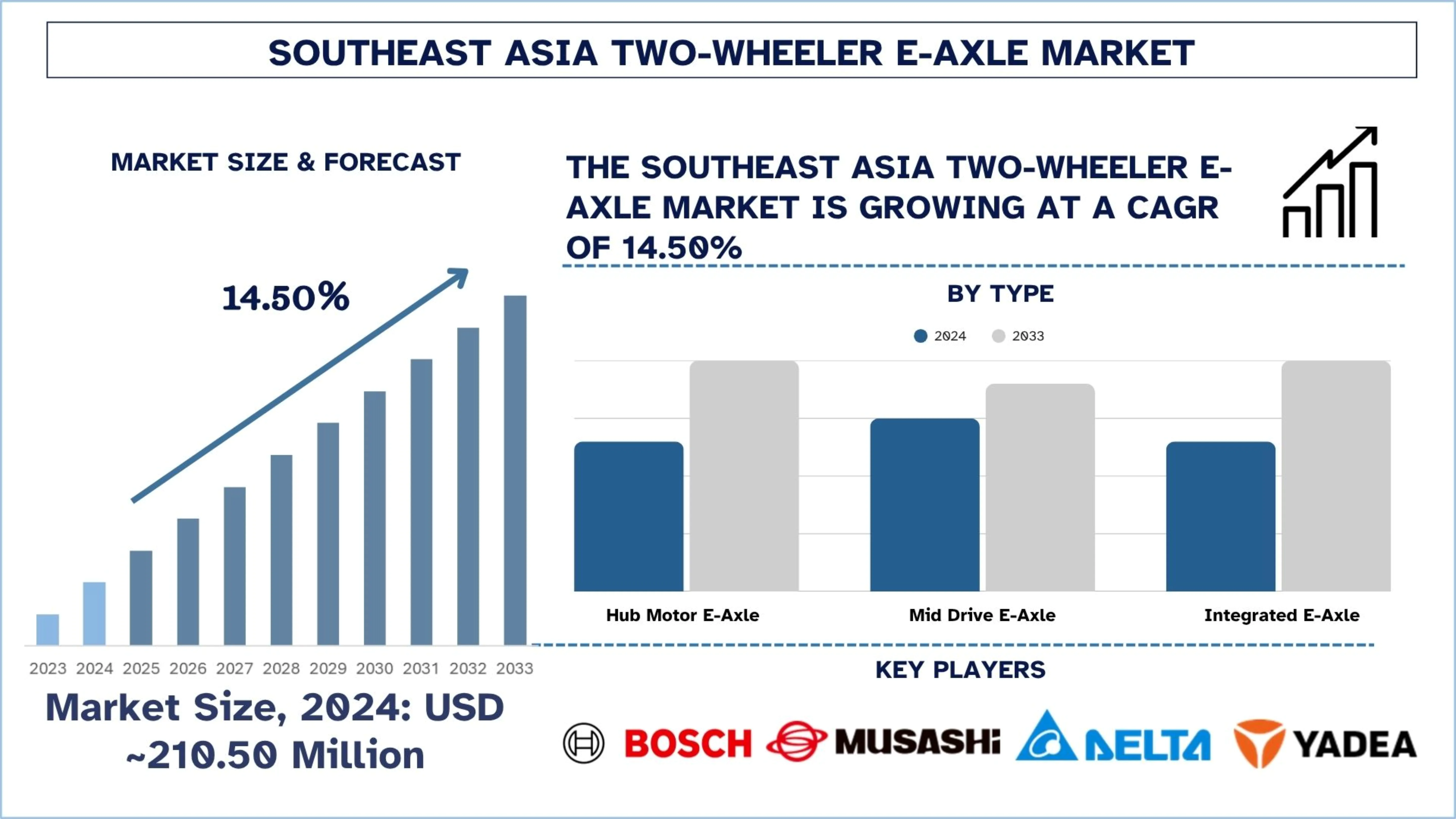
Southeast Asia Two-wheeler E-Axle Market Size & Forecast
The Southeast Asia Two-wheeler E-Axle market was valued at ~USD 210.50 million in 2024 and is expected to grow at a strong CAGR of around 14.50% during the forecast period (2025-2033F), driven by rising electric scooter demand, supportive EV manufacturing policies.
Southeast Asia Two-wheeler E-Axle Market Analysis
A two-wheeler e-axle is an electric propulsion drive system that integrates the electric motor, transmission, and power control components into a compact propulsion system for e-two-wheelers. It provides direct power to the wheel or axle assembly, enhancing drivetrain efficiency, reducing mechanical losses, and making the vehicle's design compact.
In Southeast Asia, manufacturers are moving towards compact integrated drivetrain architectures to enhance vehicle efficiency, minimize the number of components, and decentralize electric mobility assembly. The market players are moving away from traditional hub motor systems toward integrated e-axle systems, which combine the motor, inverter, and reduction gear into a single unit to enhance thermal efficiency and torque output. Also, the production strategies are based on expanding local assembly, battery-swapping, developing a modular platform and motor electronics, and sourcing controllers from suppliers. Moreover, urban scooter platforms, commercial delivery fleets, and shared mobility applications are the best areas for adoption, with lightweight design, reduced maintenance, and fleet economies directly benefiting deployment economics and implementation speed. For example, on 10 February 2026, VinFast announced its entry into Indonesia's e-scooter market through the signing of a Memorandum of Understanding (MoU) with strategic dealers in the country. The milestone marks a significant step in VinFast's international expansion of its electric two-wheeler business and reaffirms the Company's long-term commitment to one of Southeast Asia's largest and most dynamic motorcycle markets.
Southeast Asia Two-wheeler E-Axle Market Trends
This section discusses the key market trends that are influencing the various segments of the Southeast Asia Two-wheeler E-Axle market, as found by our team of research experts.
Expansion of Battery Swapping Infrastructure for Two-Wheelers
Indonesia is an emerging hotbed of growth because of its high number of motorcycles, the sensitivity of the fuel cost, and the government-endorsed EV industrialization plan. The country is strongly encouraging localized EV production by enforcing localization, tax incentives, and investment support for the manufacturing of electric vehicles, and this demand directly raises the level of demand for electric drive components such as e-axles. The presence of large urban delivery networks, ride-hailing fleets, is establishing robust volume demand for efficient and robust electric two-wheelers with consistent torque output. To limit the reliance on imports, manufacturers are looking at more local assembly of drive units to comply with local content requirements. The growth in battery-swapping systems and commercial fleet electrification is also enhancing the adoption of integrated e-axle systems in the future.
For example, on July 29, 2025, Helios Climate (“HC”), Africa’s premier climate-focused investment platform, in partnership with the Private Infrastructure Development Group (PIDG), announced a landmark investment in SUN Mobility, a global leader in energy infrastructure and battery swapping solutions for electric vehicles.
The investment round brings the total capital raised by the company over the past year to approximately $135 million. This significant capital infusion will drive the launch of Africa’s largest battery swapping network and continue to fuel SUN Mobility’s domestic growth.
Southeast Asia Two-wheeler E-Axle Industry Segmentation
This section provides an analysis of the key trends in each segment of the Southeast Asia Two-wheeler E-Axle market, along with forecasts at the country level for 2025-2033.
The hub motor e-axle market dominated the market share in 2024.
Based on type, the market is segmented into hub motor e-axle, mid drive e-axle, and integrated e-axle. Among these, the hub motor e-axle market held the dominant share in 2024. The adoption of hub motor e-axle systems is leading to the development of a market in Southeast Asia due to their affordability and a mechanically simple end-to-end solution to a specific scooter that meets the pricing constraints of mass-market electric scooters. Their simple maintenance and direct wheel attachment make them very appealing for high-volume city mobility models. Moreover, it contributes to the rapid deployment of products and to more companies adopting the cheaper two-wheeler electric segments.
The cargo & delivery bikes segment is expected to grow with a significant CAGR during the forecast period (2025-2033).
Based on application, the Southeast Asian Two-wheeler E-Axle market is segmented into electric scooters, electric motorcycles, cargo & delivery bikes, and shared mobility fleets. Among these, the cargo & delivery bikes segment is expected to grow at a significant CAGR during the forecast period (2025-2033). The cargo and delivery bikes are set to become one of the key growth drivers, as logistics operators are starting to switch to electric last-mile delivery fleets to minimize operating expenses and enhance delivery efficiency. Also, the constant daily use of vehicles necessitates robust e-axle systems that maintain constant torque output and require less servicing. This business use is increasing the size of procurements and motivating suppliers of electric axles to develop heavier-load designs. According to Southeast Asia Development Solutions (SEADS), on 14 January 2025, almost 250 million motorcycles and other light motorized vehicles cruise through Southeast Asia’s streets, accounting for around 80% of all vehicles in the region. These two and three-wheeler vehicles are popular across the region for a reason: they are affordable and widely available.
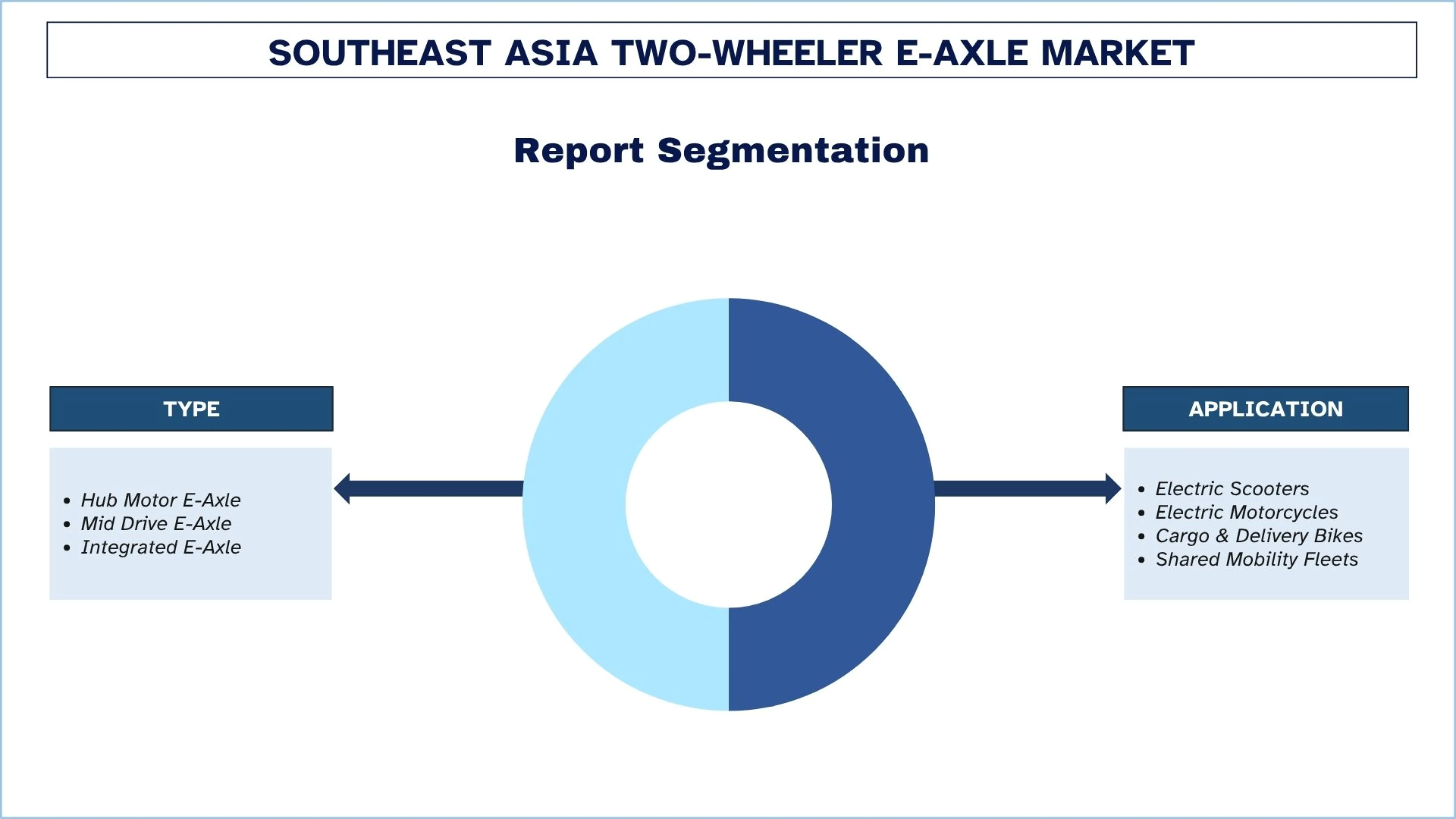
Indonesia held a dominant share of the Southeast Asian Two-wheeler E-Axle market in 2024
Indonesia held a dominant share of the market because of its high number of motorcycles, the sensitivity of the fuel cost, and the government-endorsed EV industrialization plan. The country is strongly encouraging localized EV production by enforcing localization requirements, offering tax incentives, and providing investment support for the manufacturing of electric vehicles, thereby directly increasing demand for electric drive components such as e-axles. The presence of large urban delivery networks and ride-hailing fleets is driving demand for efficient, reliable electric two-wheelers with consistent torque output. To reduce reliance on imports, manufacturers are looking to increase the local assembly of drive units to meet local content requirements. The growth in battery-swapping systems and commercial fleet electrification is also enhancing the adoption of integrated e-axle systems in the future.
Southeast Asia Two-wheeler E-Axle Industry Competitive Landscape
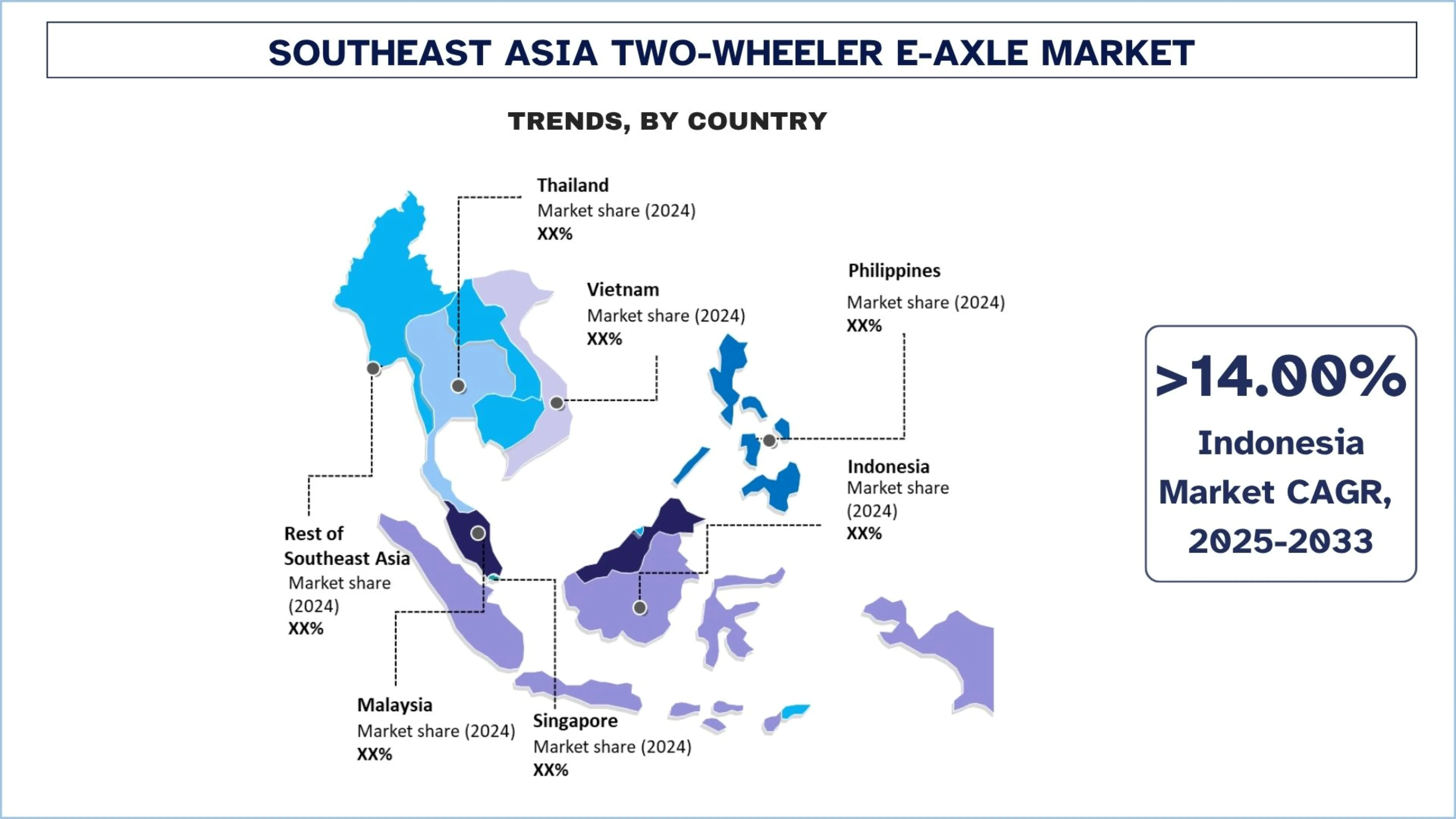
The Southeast Asia Two-wheeler E-Axle market is competitive, with several global and international market players. The key players are adopting different growth strategies to enhance their market presence, such as partnerships, agreements, collaborations, new product launches, geographical expansions, and mergers and acquisitions.
Top Southeast Asia Two-wheeler E-Axle Companies
Some of the major players in the market are Robert Bosch GmbH, Musashi Seimitsu Industry Co., Ltd., Delta Electronics, Inc., Toyota Tsusho Corporation, Yamaha Motor Co., Ltd., Astemo, Ltd., Yadea Technology Group Co.,Ltd., JK Fenner, and Others.
Recent Developments in the Southeast Asia Two-wheeler E-Axle Market
On October 2, 2024, Yamaha Motor Co., Ltd. announced its partnership in the development of a new electric sports coupe, referred to as 'Project V,' being led by Caterham EVo Limited, a UK-based subsidiary of VT Holdings Co., Ltd. (headquartered in Nagoya, Aichi Prefecture). The collaboration aims to advance the project toward mass production and commercialization. Yamaha Motor is independently developing the e-axle, a key component of the electric powertrain, and will supply its trial model for the prototype. In vehicle motion control, we will also provide technologies and expertise to realize "Caterham Powered by Yamaha Motor."
Southeast Asia Two-wheeler E-Axle Market Report Coverage
Report Attribute | Details |
Base year | 2024 |
Forecast period | 2025-2033 |
Growth momentum | Accelerate at a CAGR of 14.50% |
Market size 2024 | ~USD 210.50 Million |
Country analysis | Indonesia, Thailand, Philippines, Vietnam, Malaysia, Singapore, Rest of Southeast Asia |
Major contributing Country | Vietnam is expected to grow at the highest CAGR during the forecasted period. |
Companies profiled | Robert Bosch GmbH, Musashi Seimitsu Industry Co., Ltd., Delta Electronics, Inc., Toyota Tsusho Corporation, Yamaha Motor Co., Ltd., Astemo, Ltd., Yadea Technology Group Co.,Ltd., JK Fenner, and Others |
Report Scope | Market Trends, Drivers, and Restraints; Revenue Estimation and Forecast; Segmentation Analysis; Demand and Supply Side Analysis; Competitive Landscape; Company Profiling |
Segments Covered | By Type, By Application, By Country |
Reasons to Buy the Southeast Asia Two-wheeler E-Axle Market Report:
The study includes market sizing and forecasting analysis confirmed by authenticated key industry experts.
The report briefly reviews overall industry performance at a glance.
The report covers an in-depth analysis of prominent industry peers, primarily focusing on key business financials, product portfolios, expansion strategies, and recent developments.
Detailed examination of drivers, restraints, key trends, and opportunities prevailing in the industry.
The study comprehensively covers the market across different segments.
Customization Options:
The Southeast Asia Two-wheeler E-Axle market can further be customized as per requirements or any other market segment. Besides this, UnivDatos understands that you may have your own business needs; hence, feel free to contact us to get a report that completely suits your requirements.
Table of Content
Research Methodology for the Southeast Asia Two-wheeler E-Axle Market Analysis (2023-2033)
We analyzed the historical market, estimated the current market, and forecasted the future market of the Southeast Asian Two-wheeler E-Axle market to assess its application in major countries. We conducted exhaustive secondary research to gather historical market data and estimate the current market size. To validate these insights, we carefully reviewed numerous findings and assumptions. Additionally, we conducted in-depth primary interviews with industry experts across the Southeast Asian Two-wheeler E-Axle value chain. After validating market figures through these interviews, we used both top-down and bottom-up approaches to forecast the overall market size. We then employed market breakdown and data triangulation methods to estimate and analyze the market size of industry segments and sub-segments.
Market Engineering
We employed the data triangulation technique to finalize the overall market estimation and derive precise statistical numbers for each segment and sub-segment of the Southeast Asia Two-wheeler E-Axle market. We split the data into several segments and sub-segments by analyzing various parameters and trends, including type, application, and country within the Southeast Asian Two-wheeler E-Axle market.
The Main Objective of the Southeast Asia Two-wheeler E-Axle Market Study
The study identifies current and future trends in the Southeast Asia Two-wheeler E-Axle market, providing strategic insights for investors. It highlights market attractiveness, enabling industry participants to tap into untapped markets and gain a first-mover advantage. Other quantitative goals of the studies include:
Market Size Analysis: Assess the current and forecast market size of the Southeast Asia Two-wheeler E-Axle market and its segments in terms of value (USD).
Southeast Asia Two-wheeler E-Axle Market Segmentation: Segments in the study include areas of type, application, and country.
Regulatory Framework & Value Chain Analysis: Examine the regulatory framework, value chain, customer behavior, and competitive landscape of the Southeast Asia Two-wheeler E-Axle industry.
Country Analysis: Conduct a detailed country analysis for key areas such as Indonesia, Thailand, the Philippines, Vietnam, Malaysia, Singapore, and the Rest of Southeast Asia.
Company Profiles & Growth Strategies: Company profiles of the Southeast Asia Two-wheeler E-Axle market and the growth strategies adopted by the market players to sustain in the fast-growing market.
Frequently Asked Questions FAQs
Q1: What is the Southeast Asia Two-wheeler E-Axle market’s current market size and growth potential?
The Southeast Asia Two-wheeler E-Axle market was valued at ~USD 210.50 Million in 2024 and is projected to expand at a CAGR of 14.50% from 2025 to 2033. This growth is being driven by rising adoption of electric two-wheelers, rapid electrification of urban mobility, expansion of battery-swapping, and increasing local production of electric drivetrain components across major ASEAN economies.
Q2: Which segment has the largest share of the Southeast Asia Two-wheeler E-Axle market by Type?
The Hub Motor E-Axle currently holds the largest market share due to its cost-efficiency, compact design, and low maintenance requirements, making it highly suitable for electric scooters and urban mobility vehicles. It is widely adopted across high-volume electric two-wheeler models because it reduces drivetrain complexity and supports affordable vehicle pricing in price-sensitive Southeast Asian markets.
Q3: What are the driving factors for the growth of the Southeast Asia Two-wheeler E-Axle market?
Key growth drivers include rising electric scooter demand, supportive EV manufacturing policies, expansion of battery-swapping infrastructure, increasing fuel cost pressure, and rapid growth of last-mile delivery fleets. Localization of electric vehicle component manufacturing and the shift toward integrated drivetrain systems are also accelerating adoption across both consumer and commercial vehicle segments.
Q4: What are the emerging technologies and trends in the Southeast Asia Two-wheeler E-Axle market?
The market is witnessing increasing adoption of integrated e-axle systems, including compact 3-in-1 architectures combining motor, controller, and reduction gear. Manufacturers are also focusing on lightweight drivetrain design, improved thermal efficiency, modular battery compatibility, and higher torque configurations for delivery-focused electric two-wheelers.
Q5: What are the key challenges in the Southeast Asia Two-wheeler E-Axle market?
Key challenges include high dependence on imported semiconductors, magnets, and controller components, cost pressure in mass-market scooter segments, limited drivetrain standardization, and uneven EV regulations across Southeast Asian countries. Supply chain concentration in external component markets also creates pricing and sourcing risks for regional manufacturers.
Q6: Which country dominates the Southeast Asia Two-wheeler E-Axle market?
Indonesia currently leads the market due to its large two-wheeler population, strong EV policy support, localization targets, and rapidly expanding electric mobility ecosystem. Large-scale fleet electrification, urban delivery demand, and domestic manufacturing investments are strengthening drivetrain demand nationwide.
Q7: Who are the key players in the Southeast Asia Two-wheeler E-Axle market?
Leading companies in the Southeast Asia Two-wheeler E-Axle market include:
• Robert Bosch GmbH
• Musashi Seimitsu Industry Co., Ltd.
• Delta Electronics, Inc.
• Toyota Tsusho Corporation
• Yamaha Motor Co., Ltd.
• Astemo, Ltd.
• Yadea Technology Group Co.,Ltd.
• JK Fenner
• Others
Q8: What investment opportunities are emerging in the Southeast Asia Two-wheeler E-Axle market?
Investment opportunities are expanding in localized motor assembly, controller manufacturing, integrated e-axle production, and battery-compatible drivetrain platforms as Southeast Asian countries strengthen domestic EV supply chains. Investors are increasingly targeting high-growth areas such as delivery fleet electrification, modular drive systems, and component localization, where long-term volume demand is supported by policy incentives and rising urban electric mobility adoption.
Q9: How is competitive intensity evolving in the Southeast Asia Two-wheeler E-Axle market?
Competitive intensity is increasing as drivetrain suppliers, electric two-wheeler manufacturers, and component integrators expand regional production and technology partnerships to secure market share. Companies are focusing on cost-efficient integrated drive units, localized sourcing strategies, and performance upgrades to differentiate offerings in a market where affordability, durability, and supply chain control are becoming critical competitive factors.
Related Reports
Customers who bought this item also bought


Micro Mobility Data Analytics Market: Current Analysis and Forecast (2026-2034)
Emphasis on Component (Software / Platform, Services); Analytics Type (Descriptive, Predictive, Prescriptive); Application (Fleet Management, Route Optimization, Demand Forecasting, Rider Behavior Analysis); End-User (Micro Mobility Operators, City Governments/Smart Cities, Transit Agencies); Deployment Mode (Cloud-Based, On-Premises); and Region/Country

Middle East & Africa Automotive Composites Market: Current Analysis and Forecast (2025-2033)
Emphasis By Material Type (Carbon Fiber Composites, Glass Fiber Composites, Natural Fiber Composites, Hybrid Composites, and Others), by Vehicle Type (Passenger Cars, Light Commercial Vehicles, Heavy Commercial Vehicles, Electric Vehicles, and Others), By End-User (OEM and Aftermarket), By Country (Saudi Arabia, UAE, Egypt, South Africa, Turkey, Israel, and the Rest of Middle East & Africa)
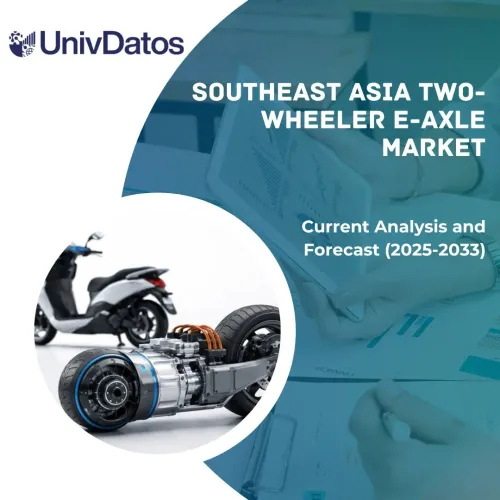
Southeast Asia Two-wheeler E-Axle Market: Current Analysis and Forecast (2025-2033)
Emphasis on Type (Hub Motor E-Axle, Mid Drive E-Axle, Integrated E-Axle); Application (Electric Scooters, Electric Motorcycles, Cargo & Delivery Bikes, Shared Mobility Fleets); and Country.
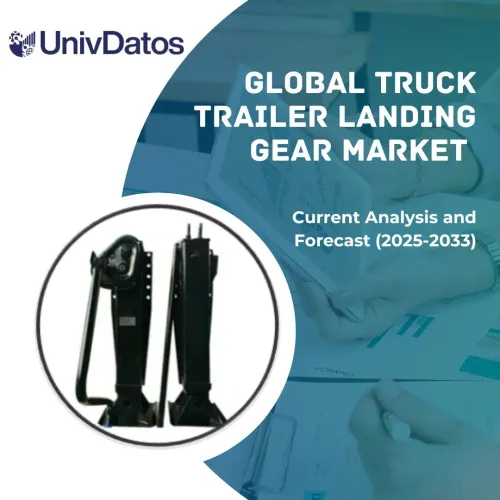
Truck Trailer Landing Gear Market: Current Analysis and Forecast (2025-2033)
Emphasis on Operation (Manual Truck Landing Gear and Automatic Truck Landing Gear); Lifting Capacity (Less Than 20,000 LBS, 20,000 LBS to 50,000 LBS, and More than 50,000 LBS); Sales Channel (OEM and Aftermarket); and Region/Country