Middle East & Africa Automotive Composites Market: Current Analysis and Forecast (2025-2033)
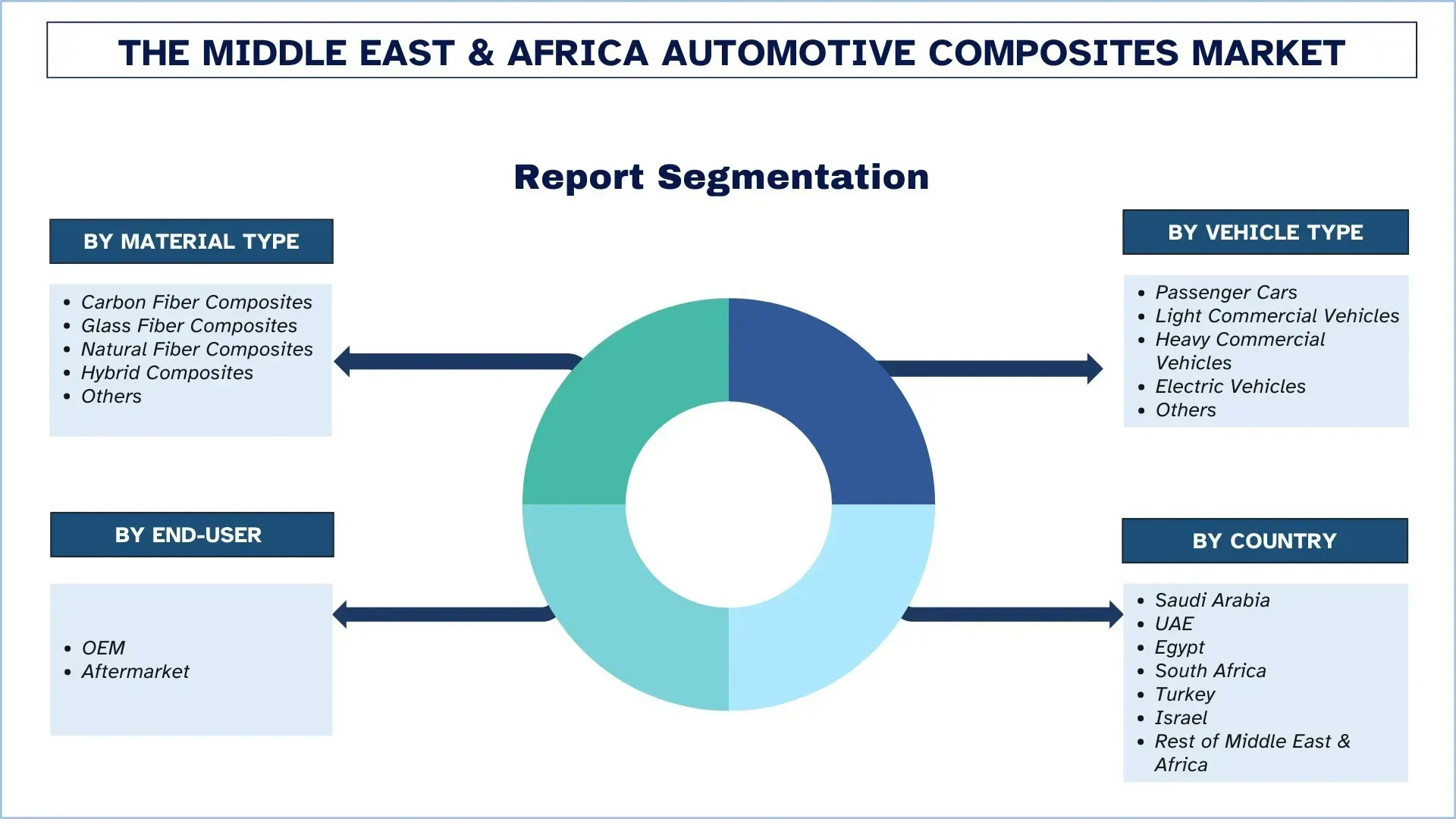
Emphasis By Material Type (Carbon Fiber Composites, Glass Fiber Composites, Natural Fiber Composites, Hybrid Composites, and Others), by Vehicle Type (Passenger Cars, Light Commercial Vehicles, Heavy Commercial Vehicles, Electric Vehicles, and Others), By End-User (OEM and Aftermarket), By Country (Saudi Arabia, UAE, Egypt, South Africa, Turkey, Israel, and the Rest of Middle East & Africa)

Middle East & Africa Automotive Composites Market Size & Forecast
The Middle East & Africa Automotive Composites Market was valued at USD 1,200 million in 2024 and is expected to grow at a strong CAGR of around 5.50% during the forecast period (2025- 2033F). Rising demand for lightweight vehicle architecture and the expansion of regional automotive manufacturing ecosystems are some of the key factors that have supported the market rise.
Middle East & Africa Automotive Composites Market Analysis
There is a developing tendency to use Automotive Composites in the Middle East and Africa since the world needs lightweight, durable, and fuel-efficient cars for commercial and specialized use. In states with difficult geographies, poor infrastructure, and growing urbanization trends, Automotive Composites present a competitive edge by means of lessening the automobile mass, boosting fuel efficiency, and expanding the cargo ability. Such materials are being used more in the logistics fleets, passenger cars, and utility cars that can traverse through tough climatic conditions and unpaved roads. Moreover, the governments and the private operators are now becoming interested in composite-based vehicles to facilitate trade within the region, transporting in cases of emergencies, and to provide mobility to industries. With the increasing investment in transportation infrastructure and regional connectivity, the market of Automotive Composites will continue to expand in size, as they are cost-effective and efficient in their operation.
In 2025, Hyundai Motor Manufacturing Middle East (HMMME), a joint venture between PIF and Hyundai Motor Company, opened a new car manufacturing facility in King Salman Automotive Cluster within King Abdullah Economic City (KAEC). The facility will roll out its first vehicles by the fourth quarter of 2026 with a total annual production of 50,000 vehicles.
Middle East & Africa Automotive Composites Market Trends
This section discusses the key market trends that are influencing the various segments of the Middle East & Africa Automotive Composites market, as found by our team of research experts.
Development of hybrid and multifunctional composite materials:
Hybrid composites refer to a composite that integrates various kinds of fibers, e.g., glass, carbon, and natural fibers, into one material structure to give the best balance of strength, weight reduction, and affordability. This strategy will enable manufacturers to increase the performance of the mechanisms without increasing the total material expenses, and this is very appealing to the automotive market in the Middle East and Africa. Moreover, multifunctional composites are also being developed to offer other features like better thermal stability, resistance to corrosion, reduction of vibrations, and a higher level of durability. These high-tech materials allow automakers to combine a number of performance advantages in one part, decreasing the complexity of the part and manufacturing processes. With the modernized automotive design, the evolution of such hybrid composite solutions is becoming one of the trends prominently taking concepts of innovation and efficiency in the local automotive industry.
Key Market Segmentation:
This section provides an analysis of the key trends in each segment of the Middle East & Africa Automotive Composites market, along with forecasts at the country and regional levels for 2025-2033.
The Glass Fiber Composites category has shown promising growth in the Automotive Composites Market.
The Middle East Africa Automotive Composites market has its segments based on material type, which includes carbon fiber composites, glass fiber, natural fiber composites, hybrid composites, and so on. Among them, the glass fiber category has commanded a large market share due to such factors as the affordability, the simplicity of production, and the broader use in structural as well as semi-structural automotive parts. Also, the glass fiber composites can provide a good balance between strength, weight reduction, and durability, hence can be used in producing vehicles in the mass market. This is further enhanced by the fact that they are very resistant to corrosion and extreme environmental conditions, thus making their usage in the region, especially in places where temperatures are extreme, and whose environments are a challenge to operate in.
The Passenger Cars category held a significant share of the Middle East & Africa Automotive Composites Market.
The Middle East & Africa Automotive Composites market is divided into the following segments based on the type of vehicle, namely: Passenger Cars, Light Commercial Vehicles, Heavy Commercial Vehicles, Electric Vehicles, and others. Among them, the passenger car segment has been occupying a strong market share. The main factor that has led to this domination is the increasing demand for fuel-efficient and lightweight cars by urban consumers. The rise in disposable income, high rate of urbanization, and the rising need to have more attractive and better-performing vehicles are also serving to facilitate the use of composites in passenger vehicles. Also, the manufacturers are incorporating composite materials to comply with the changing emission standards and enhance safety standards, thus increasing the use of composite materials in different passenger vehicle models in the area.
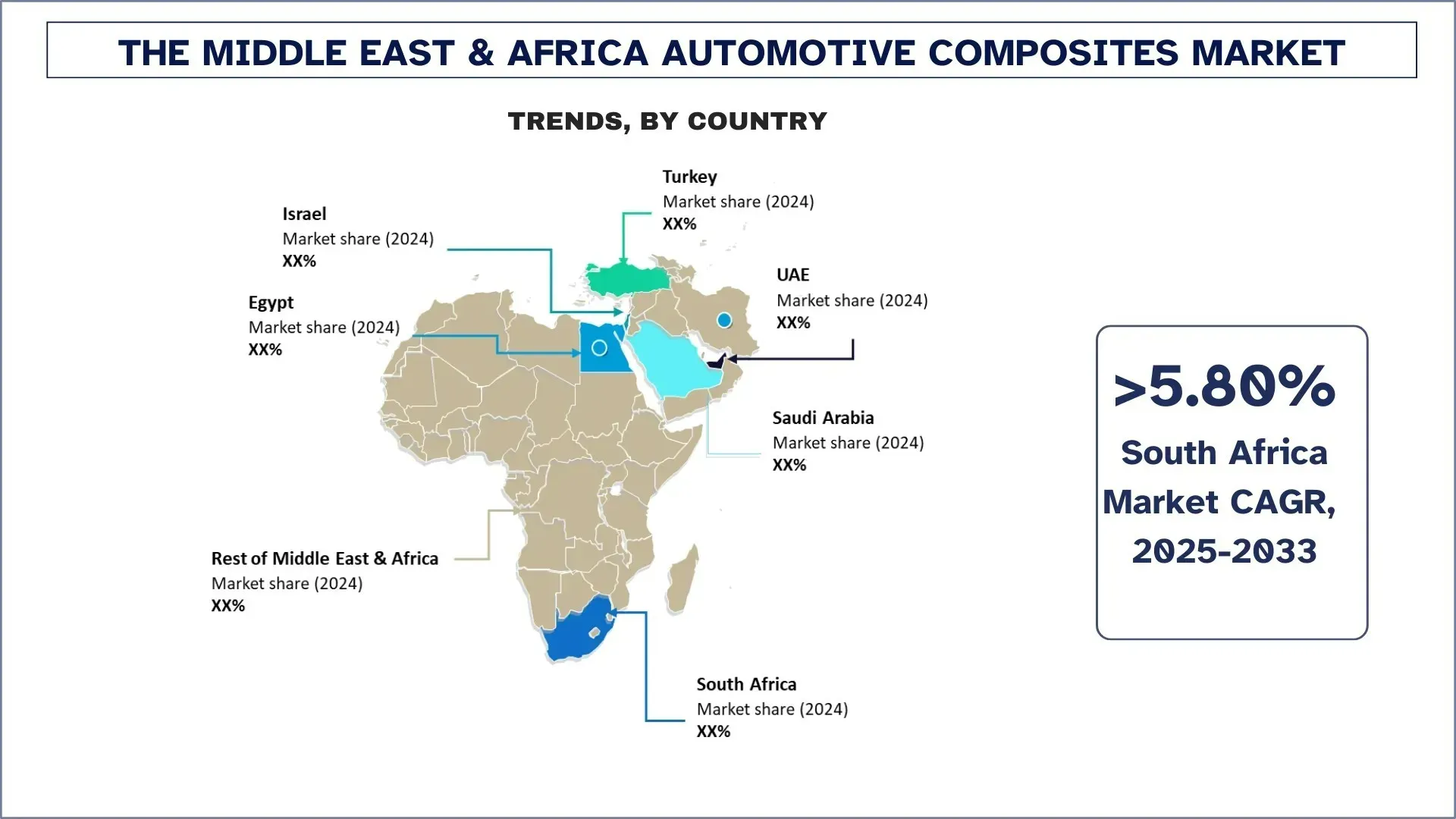
South Africa is expected to grow at a considerable rate during the forecast period.
The South African market of automotive composites is recording a consistent growth that has been enabled by the well-established automotive manufacturing base and the high export orientation in the country. The nation is a major manufacturing center of major car makers in the world, and thus, the use of lightweight and high-performance composite materials is greatly encouraged to meet international standards. The growing demand for fuel-efficient vehicles and the transition to electric mobility are also contributing factors to the growth of the market. Moreover, the local production capacities are being upgraded due to favorable government policies and investments in the development of industries. As an increasing number of people are paying more attention to cost-effectiveness, durability, and sustainability, South Africa is still making inroads in the automotive composite market in the region.
In 2024, Wekaba, a prominent manufacturer of medium to high-volume CNC machine automation components, announced it would open an automotive manufacturing plant in South Africa with a total cost of USD 1.5 million (R25 million).
Middle East & Africa Automotive Composites Industry Competitive Landscape:
The Middle East & Africa Automotive Composites market is competitive, with several global and international market players. The key players are adopting different growth strategies to enhance their market presence, such as partnerships, agreements, collaborations, new product launches, geographical expansions, and mergers and acquisitions.
Top Middle East & Africa Automotive Composites Companies
Some of the major players in the market are SGL Carbon SE, Toray Industries, Inc., Teijin Limited, Owens Corning, Mitsubishi Chemical Corporation, Hexcel Corporation, UFP Technologies, Inc., Solvay SA, BASF SE, and SABIC.
Middle East & Africa Automotive Composites Market Report Coverage
Report Attribute | Details |
Base year | 2024 |
Forecast period | 2025-2033 |
Growth momentum | Accelerate at a CAGR of 5.50% |
Market size 2024 | USD 1,200 Million |
Country analysis | Saudi Arabia, UAE, Egypt, South Africa, Turkey, Israel, and the Rest of the Middle East & Africa |
Major contributing Country | Saudi Arabia is expected to dominate the market during the forecast period. |
Companies profiled | SGL Carbon SE, Toray Industries, Inc., Teijin Limited, Owens Corning, Mitsubishi Chemical Corporation, Hexcel Corporation, UFP Technologies, Inc., Solvay SA, BASF SE, and SABIC. |
Report Scope | Market Trends, Drivers, and Restraints; Revenue Estimation and Forecast; Segmentation Analysis; Demand and Supply Side Analysis; Competitive Landscape; Company Profiling |
Segments Covered | by Material Type, by Vehicle Type, by End-User, by Country |
Reasons to Buy the Middle East & Africa Automotive Composites Market Report:
The study includes market sizing and forecasting analysis confirmed by authenticated key industry experts.
The report briefly reviews overall industry performance at a glance.
The report covers an in-depth analysis of prominent industry peers, primarily focusing on key business financials, type portfolios, expansion strategies, and recent developments.
Detailed examination of drivers, restraints, key trends, and opportunities prevailing in the industry.
The study comprehensively covers the market across different segments.
Deep dive Country-level analysis of the industry.
Customization Options:
The Middle East & Africa Automotive Composites market can be customized as per requirements or any other market segment. Besides this, UnivDatos understands that you may have your own business needs; hence, feel free to contact us to get a report that completely suits your requirements.
Table of Content
Research Methodology for the Middle East & Africa Automotive Composites Market Analysis (2023-2033)
We analyzed the historical market, estimated the current market, and forecasted the future market of the Middle East & Africa Automotive Composites market to assess its application in major countries. We conducted exhaustive secondary research to gather historical market data and estimate the current market size. To validate these insights, we carefully reviewed numerous findings and assumptions. Additionally, we conducted in-depth primary interviews with industry experts across the Automotive Composites value chain. After validating market figures through these interviews, we used both top-down and bottom-up approaches to forecast the overall market size. We then employed market breakdown and data triangulation methods to estimate and analyze the market size of industry segments and sub-segments.
Market Engineering
We employed data triangulation techniques to finalize the overall market estimation and derive precise statistical numbers for each segment and sub-segment of the Middle East & Africa Automotive Composites market. We split the data into several segments and sub-segments by analyzing various parameters and trends, by Material Type, by Vehicle Type, by End-User, and by country within the Middle East & Africa Automotive Composites market.
The Main Objective of the Middle East & Africa Automotive Composites Market Study
The study identifies current and future trends in the Middle East & African Automotive Composites market, providing strategic insights for investors. It highlights Country-level market attractiveness, enabling industry participants to tap into untapped markets and gain a first-mover advantage. Other quantitative goals of the studies include:
Market Size Analysis: Assess the current forecast and market size of the Middle East & Africa Automotive Composites market and its segments in terms of value (USD).
Middle East & Africa Automotive Composites Market Segmentation: Segments in the study include areas by Material Type, by Vehicle Type, by End-User, and by
Regulatory Framework & Value Chain Analysis: Examine the regulatory framework, value chain, customer behavior, and competitive landscape of the Middle East & Africa Automotive Composites industry.
Country Analysis: Conduct a detailed Country analysis for key areas such as Saudi Arabia, UAE, Egypt, South Africa, Turkey, Israel, and the Rest of the Middle East & Africa.
Company Profiles & Growth Strategies: Company profiles of the Middle East & Africa Automotive Composites market and the growth strategies adopted by the market players to sustain the fast-growing market.
Frequently Asked Questions FAQs
Q1: What is the Middle East & Africa Automotive Composites market’s current market size and growth potential?
The Middle East & Africa Automotive Composites market was valued at 1,200 million in 2024 and is expected to grow at a CAGR of 5.50% during the forecast period (2025-2033).
Q2: Which segment has the largest share of the Middle East & Africa Automotive Composites market by Material Type?
The glass fiber category has commanded a large market share due to such factors as the affordability, the simplicity of production, and the broader use in structural as well as semi-structural automotive parts.
Q3: What are the driving factors for the growth of the Middle East & Africa Automotive Composites market?
• Rising demand for lightweight vehicle architecture: The growing emphasis on fuel efficiency and emission reduction is driving the adoption of automotive composites, as they significantly reduce vehicle weight while maintaining structural strength and performance.
• Expansion of regional automotive manufacturing ecosystems: Increasing investments in local automotive production and assembly facilities across the region are boosting the demand for composite materials, supported by improving supply chains and industrial capabilities.
Q4: What are the emerging technologies and trends in the Middle East & Africa Automotive Composites market?
• Development of hybrid and multifunctional composite materials: Manufacturers are focusing on advanced composites that combine multiple material properties, offering enhanced strength, durability, and thermal performance for diverse automotive applications.
• Shift toward sustainable and recyclable composite solutions: There is a growing focus on eco-friendly materials, including bio-based and recyclable composites, to align with global sustainability goals and regulatory requirements.
Q5: What are the key challenges in the Middle East & Africa Automotive Composites market?
• High cost of advanced composite materials: The relatively higher cost of carbon fiber and other advanced composites compared to conventional materials limits their widespread adoption, particularly in cost-sensitive vehicle segments.
• Limited technical expertise and processing infrastructure: The lack of specialized skills and advanced manufacturing facilities in certain parts of the region poses challenges in large-scale production and efficient utilization of composite materials.
Q6: Which country dominates the Middle East & Africa Automotive Composites market?
The demand for lightweight and fuel-efficient cars is on the increase, as well as rising passenger and commercial vehicle demand in Saudi Arabia, which are some of the factors that have assisted Saudi Arabia in emerging as a dominating market.
Q7: Who are the key players in the Middle East & Africa Automotive Composites market?
Some of the top Automotive Composites companies in the Middle East & Africa include:
• SGL Carbon SE
• Toray Industries, Inc.
• Teijin Limited
• Owens Corning
• Mitsubishi Chemical Corporation
• Hexcel Corporation
• UFP Technologies, Inc.
• Solvay SA
• BASF SE
• SABIC
Q8: What are the opportunities for companies within the Middle East & Africa Automotive Composites market?
• Localization of composite component production: Increasing focus on developing local manufacturing capabilities presents significant opportunities for reducing import dependency and production costs. Regional governments and industry players are encouraging domestic production through investments and partnerships, which can strengthen supply chains and improve material accessibility.
• Growing demand from luxury, motorsport, and customization segments: The rising interest in high-performance, premium, and customized vehicles is creating strong demand for advanced composite materials. These segments require lightweight, high-strength, and aesthetically flexible materials, enabling manufacturers to offer innovative designs and superior performance features.
Q9: How are consumer preferences shaping product development in the Middle East & Africa Automotive Composites market?
Consumer preferences in the Middle East and Africa are increasingly focused on fuel efficiency, durability, and premium vehicle aesthetics, prompting manufacturers to adopt advanced automotive composites. This shift is driving innovation in lightweight, sustainable, and high-performance materials for enhanced driving experience.
Related Reports
Customers who bought this item also bought




Micro Mobility Data Analytics Market: Current Analysis and Forecast (2026-2034)
Emphasis on Component (Software / Platform, Services); Analytics Type (Descriptive, Predictive, Prescriptive); Application (Fleet Management, Route Optimization, Demand Forecasting, Rider Behavior Analysis); End-User (Micro Mobility Operators, City Governments/Smart Cities, Transit Agencies); Deployment Mode (Cloud-Based, On-Premises); and Region/Country
Middle East & Africa Automotive Composites Market: Current Analysis and Forecast (2025-2033)
Emphasis By Material Type (Carbon Fiber Composites, Glass Fiber Composites, Natural Fiber Composites, Hybrid Composites, and Others), by Vehicle Type (Passenger Cars, Light Commercial Vehicles, Heavy Commercial Vehicles, Electric Vehicles, and Others), By End-User (OEM and Aftermarket), By Country (Saudi Arabia, UAE, Egypt, South Africa, Turkey, Israel, and the Rest of Middle East & Africa)
Southeast Asia Two-wheeler E-Axle Market: Current Analysis and Forecast (2025-2033)
Emphasis on Type (Hub Motor E-Axle, Mid Drive E-Axle, Integrated E-Axle); Application (Electric Scooters, Electric Motorcycles, Cargo & Delivery Bikes, Shared Mobility Fleets); and Country.
Truck Trailer Landing Gear Market: Current Analysis and Forecast (2025-2033)
Emphasis on Operation (Manual Truck Landing Gear and Automatic Truck Landing Gear); Lifting Capacity (Less Than 20,000 LBS, 20,000 LBS to 50,000 LBS, and More than 50,000 LBS); Sales Channel (OEM and Aftermarket); and Region/Country