Oil Breather Tank Market: Current Analysis and Forecast (2025-2033)
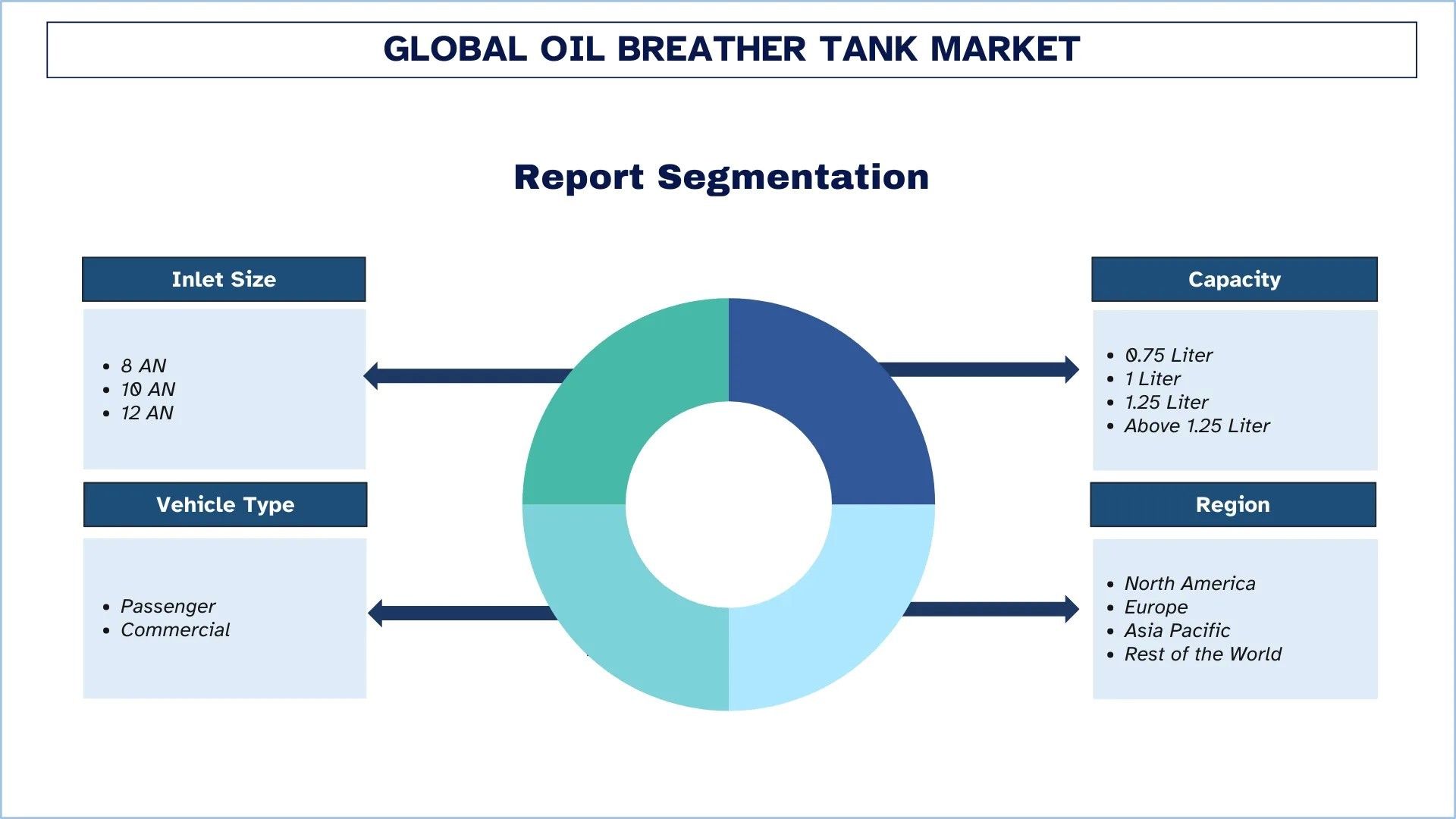
Emphasis on Inlet Size (8 AN, 10 AN, and 12 AN); Capacity (0.75 Liter, 1 Liter, 1.25 Liter, and Above 1.25 Liter); Vehicle Type (Passenger and Commercial); and Region/Country
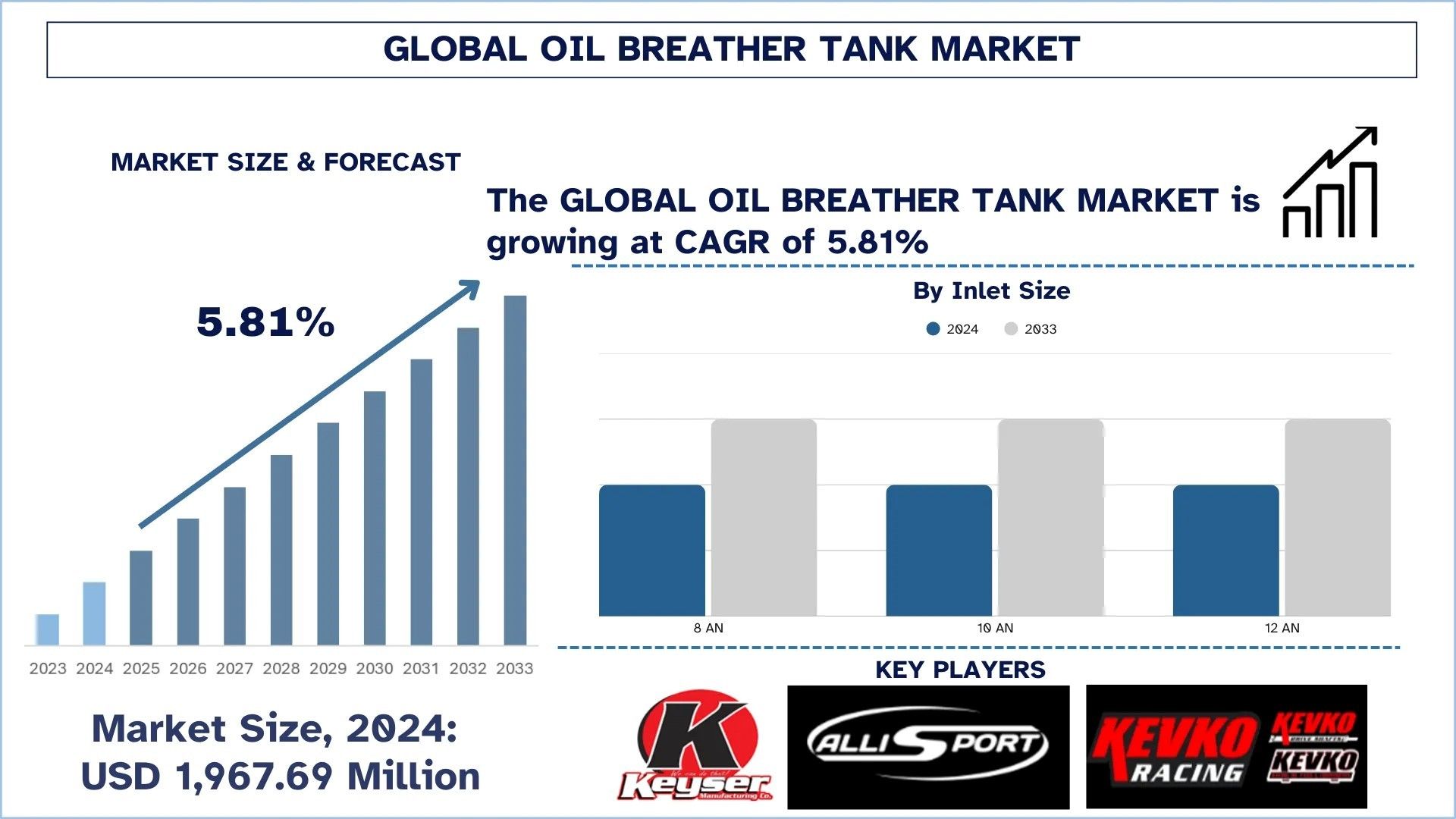
Global Oil Breather Tank Market Size & Forecast
The Global Oil Breather Tank Market was valued at USD 1,967.69 million in 2024 and is expected to grow at a CAGR of around 5.81% during the forecast period (2025–2033F), driven by rising adoption of turbocharged engines, stricter emission and durability expectations, and the need to control crankcase pressure while reducing oil-mist carryover to protect intake, turbo, and aftertreatment systems.
Oil Breather Tank Market Analysis
The oil breather tank market is projected to experience steady growth throughout the forecast period due to increased demand to control crankcase pressure and reduce oil-mist carryover in smaller, more powerful engines. It is facilitated by the greater use of turbocharged gasoline and diesel engines, and by tougher new emission and durability requirements that have rendered clean crankcase ventilation more significant than previously. With OEMs and fleet operators seeking to minimize oil use, avoid seal leakage, and preserve turbochargers and aftertreatment systems against contamination, oil breacher tanks are being evaluated as a viable option for oil-air separation that does not require significant redesign. Moreover, technological advancements in materials and internal design, such as multi-stage baffles, coalescing media, cyclone-like separation, and improved drain-back paths that impose less restriction while enhancing capture potential, boost market growth in the long term. Polymers and corrosion-resistant alloys have become high-temperature materials, and manufacturers are using better seals and packaging to address the challenging thermal and chemical conditions and to fit into smaller engine bays. These advancements address long-standing issues such as sludge buildup, condensation, and freezing in cold weather, as well as the variability in performance at different speeds and loads, and help standardize performance as platforms become increasingly differentiated on a region-by-region and regulation-by-regulation basis.
Global Oil Breather Tank Market Trends
This section discusses the key market trends that are influencing the various segments of the global oil breather tank market, as found by our team of research experts.
Shift Toward Higher-Efficiency Separation Architectures
The adoption of more efficient oil-air separation designs is becoming a major trend in the world oil breather tank market. A more common use of a breather system is the replacement or supplement of traditional open breather systems or plain catch cans, with more engineered separation stages that more effectively trap fine oil aerosols whilst maintaining crankcase restriction low, as turbocharged engines today are more susceptible to pressure and intake contamination. This is speeding up due to the ability to enhance residence time and droplet capture by better baffle geometry, coalescing filter media, and cyclonic/inertial separation, which assist in preventing a reduction of oil carryover into the intake tract, and allow cleaner operation during stop-start driving, towing, and sustained high-load duty cycles. Large suppliers are also actively productizing these more performance-oriented solutions; indeed, the ProVent2 crankcase ventilation systems of MANN+HUMMEL are packaged with integrated oil separation for engine sizes both large and small, emphasizing the oil separation of blow-by gases as smart. Furthermore, the heavy-duty crankcase ventilation proposed by MANN+HUMMEL boasts 90%+ droplet separation at high efficiency using special media, similar to how filtration-grade coalescing technologies are gaining popularity. With OEMs seeking durability and emissions performance, and aftermarket users requiring cleaner intake paths with boosted performance, multi-stage, media-assisted, and cyclone-based designs are likely to continue gaining popularity.
Oil Breather Tank Industry Segmentation
This section provides an analysis of the key trends in each segment of the global oil breather tank market report, along with forecasts at the global, regional, and country levels for 2025-2033.
The 10 AN Segment held the Largest Market Share in the Oil Breather Tank Market.
Based on inlet size, the global oil breather tank market is segmented into 8 AN, 10 AN, and 12 AN. In 2024, the 10 AN segment is anticipated to hold the largest market share and maintain its dominance throughout the forecast period. This is mostly because 10 AN offers a good balance between crankcase flow capacity and packaging feasibility, making it the choice for fitment in many turbocharged street cars, light commercial platforms, and performance cars with moderate-to-heavy blow-by volume but limited engine-bay space. Its capacity to sustain steady ventilation with less restriction than smaller lines, without the routing complexity and cost overhead of larger diameters, is most useful when OEM-style integrations are desired and when upgrades are aimed at reliability and driving characteristics. Also, the increased availability of compatible fittings, hoses, and bulkhead connectors and serviceable filter media around the 10 AN standard enhances the flexibility of installation and is faster to adopt across many engine architectures and duty cycles.
The 1 Liter Segment held the Largest Market Share in the Oil Breather Tank Market.
Based on capacity, the global oil breather tank market is segmented into 0.75 Liter, 1 Liter, 1.25 Liter, and above 1.25 Liter. In 2024, the 1 Liter segment is anticipated to hold the largest market share and maintain its dominance throughout the forecast period. The reason is that 1-liter breather tanks provide a good balance between oil-mist separation volume and practical size; hence, most passenger vehicles and light commercial vehicles, as well as a wide diversity of turbocharged engines where blow-by is common but not excessive, are well accommodated by 1-liter breather tanks. 1-liter designs can minimize carryover, provide sufficient internal residence time to cool the vapor and form bubbles, be easily implemented in reduced engine bays without being oversized, and generally be easily mounted even in smaller engine bays whilst being easy to service. The 1-liter products also have standardized ports, internal baffles or coalescing media, and dependable drain-back or drain-valve options, which enhance flexibility in fitting and are more likely to be adopted by both OEM-oriented installers and aftermarket users who place more emphasis on the day-to-day repeatability of performance.
Asia Pacific Dominated the Global Oil Breather Tank Market
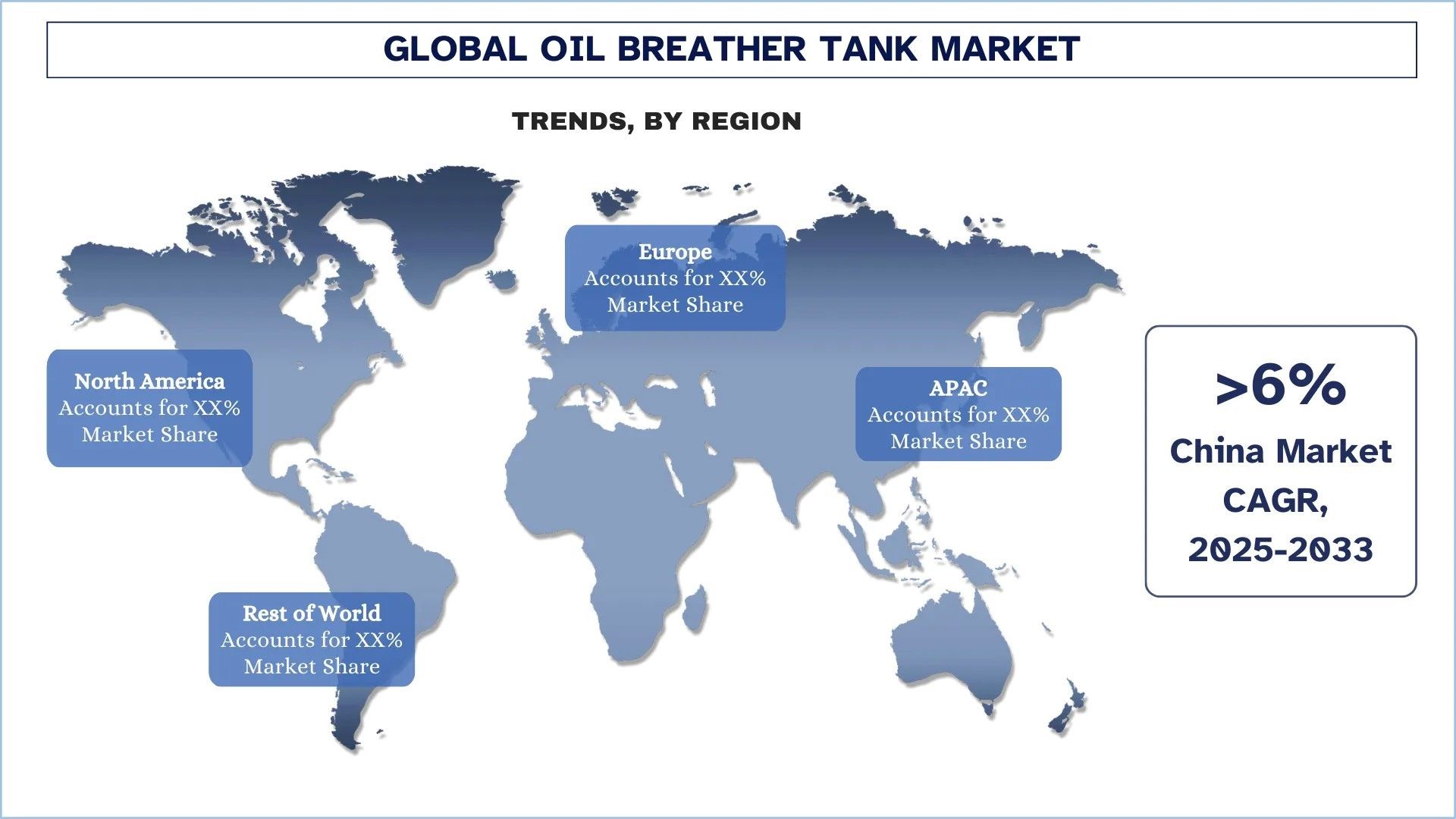
Asia-Pacific leads the market and is expected to remain a key revenue-generating region over the forecast period, supported by its scale in passenger and commercial vehicle production, a large installed base of two-wheelers and small-displacement turbo platforms in several countries, and a broad manufacturing ecosystem for engine components and fluid-management hardware. The growing focus on cleaner, more stable engine operation, through the minimization of oil-aerosol carryover and hydrocarbon-related losses via the crankcase ventilation pathway, is being achieved through progressive emissions regimes across Asia-Pacific, including the implementation of China 6 and BS VI in India. Concurrently, most APAC vehicle programs are based on reduced-displacement, turbocharged engines to achieve the efficiency and performance criteria, which usually increase blow-by sensitivity during boost and render low-restriction, high-efficiency separation and vent routing more desirable in the context of long-term durability and intake cleanliness. Combined with the technical and regulatory pressures, the pace of regional service networks and increasing awareness of maintenance support increased OEM fitment and stimulated replacement and upgrade demand for serviceable, more-efficient oil breather tanks, both in mainstream and performance-focused use.
China held a dominant Share of the Asia Pacific Oil Breather Tank Market in 2024
The oil breather tank market in China is growing as OEMs and aftermarket customers seek improved crankcase ventilation for turbocharged gasoline engines, high-output diesel engines, and hybrid range-extenders in passenger cars, light commercial, and heavy-duty truck engines. Tighter emission requirements, longer oil-drain periods, and increased fleet uptime demands are driving greater use of more efficient oil-air separation to mitigate intake foulage, intercooler pollution, and particulate loading in the aftertreatment. The large community of performance and off-road modification in China also supports demand, as catch cans and breather tanks are used to contain blow-by during sustained boost and high-RPM conditions.
Oil Breather Tank Industry Competitive Landscape
The global oil breather tank market is competitive, with several global and international market players. The key players are adopting different growth strategies to enhance their market presence, such as partnerships, agreements, collaborations, new product launches, geographical expansions, and mergers and acquisitions.
Top Oil Breather Tank Companies
Some of the major players in the market are Keyser Manufacturing, AlliSport Ltd., Kevko Racing, Peterson Fluid Systems (Specialty Products Company), Fluid Power Engineers, Moroso Performance Products, Holley Performance Products, Inc, and others.
Recent Developments in the Oil Breather Tank Market
In November 2025, Parker Hannifin announced a definitive agreement to acquire Filtration Group for USD 9.25 billion, expanding its filtration portfolio. The combined platform is expected to strengthen cross-selling and bundled offerings across filtration categories, including reservoir breathers, vent/breather filtration, and crankcase ventilation solutions, particularly in the aftermarket.
In February 2024, Eaton announced an expansion of its tank-mounted vent breather portfolio with the BR series for mobile and stationary hydraulic applications, designed to help protect hydraulic oil from moisture and particulate contamination. This represents a product-line expansion in the oil reservoir breather segment within industrial and mobile hydraulics, a key part of the broader oil breather tank value chain.
Global Oil Breather Tank Market Report Coverage
Report Attribute | Details |
Base year | 2024 |
Forecast period | 2025-2033 |
Growth momentum | Accelerate at a CAGR of 5.81% |
Market size 2024 | USD 1,967.69 Million |
Regional analysis | North America, Europe, APAC, Rest of the World |
Major contributing region | Asia Pacific is expected to dominate the market during the forecast period. |
Key countries covered | U.S., Canada, Germany, U.K., Spain, Italy, France, China, Japan, and India |
Companies profiled | Keyser Manufacturing, AlliSport Ltd., Kevko Racing, Peterson Fluid Systems (Specialty Products Company), Fluid Power Engineers, Moroso Performance Products, Holley Performance Products, Inc. |
Report Scope | Market Trends, Drivers, and Restraints; Revenue Estimation and Forecast; Segmentation Analysis; Demand and Supply Side Analysis; Competitive Landscape; Company Profiling |
Segments Covered | By Inlet Size, By Capacity, By Vehicle Type, and By Region/Country |
Reasons to Buy the Oil Breather Tank Market Report:
The study includes market sizing and forecasting analysis confirmed by authenticated key industry experts.
The report briefly reviews overall industry performance at a glance.
The report covers an in-depth analysis of prominent industry peers, primarily focusing on key business financials, type portfolios, expansion strategies, and recent developments.
Detailed examination of drivers, restraints, key trends, and opportunities prevailing in the industry.
The study comprehensively covers the market across different segments.
Deep dive regional-level analysis of the industry.
Customization Options:
The Global Oil Breather Tank Market can further be customized as per the requirements or any other market segment. Besides this, UnivDatos understands that you may have your own business needs; hence, feel free to contact us to get a report that completely suits your requirements.
Table of Content
Research Methodology for the Global Oil Breather Tank Market Analysis (2023-2033)
We analyzed the historical market, estimated the current market, and forecasted the future market of the global oil breather tank market to assess its application in major regions worldwide. We conducted exhaustive secondary research to gather historical market data and estimate the current market size. To validate these insights, we carefully reviewed numerous findings and assumptions. Additionally, we conducted in-depth primary interviews with industry experts across the oil breather tank value chain. After validating market figures through these interviews, we used both top-down and bottom-up approaches to forecast the overall market size. We then employed market breakdown and data triangulation methods to estimate and analyze the market size of industry segments and sub-segments.
Market Engineering
We employed the data triangulation technique to finalize the overall market estimation and derive precise statistical numbers for each segment and sub-segment of the global oil breather tank market. We split the data into several segments and sub-segments by analyzing various parameters and trends, including inlet size, capacity, vehicle type, and regions within the global oil breather tank market.
The Main Objective of the Global Oil Breather Tank Market Study
The study identifies current and future trends in the global oil breather tank market, providing strategic insights for investors. It highlights regional market attractiveness, enabling industry participants to tap into untapped markets and gain a first-mover advantage. Other quantitative goals of the studies include:
Market Size Analysis: Assess the current market size and forecast the market size of the global oil breather tank market and its segments in terms of value (USD).
Oil Breather Tank Market Segmentation: Segments in the study include areas of inlet size, capacity, vehicle type, and regions.
Regulatory Framework & Value Chain Analysis: Examine the regulatory framework, value chain, customer behavior, and competitive landscape of the oil breather tank industry.
Regional Analysis: Conduct a detailed regional analysis for key areas such as Asia Pacific, Europe, North America, and the Rest of the World.
Company Profiles & Growth Strategies: Company profiles of the oil breather tank market and the growth strategies adopted by the market players to sustain the fast-growing market.
Frequently Asked Questions FAQs
Q1: What is the global oil breather tank current market size and its growth potential?
The global oil breather tank market was valued at USD 1,967.69 million in 2024 and is expected to grow at a CAGR of 5.81% during the forecast period (2025-2033).
Q2: Which segment has the largest share of the global oil breather tank market by Inlet Size?
The 10 AN segment is expected to lead the market throughout the forecast period, as it offers an optimal balance of crankcase flow capacity and compact packaging, making it well-suited for turbocharged street cars, light commercial platforms, and performance vehicles.
Q3: What are the driving factors for the growth of the global oil breather tank market?
• Rising turbocharged and downsized engines
• Stricter emissions and durability expectations
• Fleet focuses on uptime and total cost of ownership
Q4: What are the emerging technologies and trends in the global oil breather tank market?
• Shift toward higher-efficiency separation architectures
• Growth of performance and retrofit demand
Q5: What are the key challenges in the global oil breather tank market?
• Packaging and integration constraints
• Maintenance and clogging risks
Q6: Which region dominates the global oil breather tank market?
Asia-Pacific is anticipated to dominate the market, holding the largest share, supported by high vehicle production volumes, expanding parc and service networks, and increasing emphasis on efficient crankcase ventilation performance across mass-market and commercial applications.
Q7: Who are the key players in the global oil breather tank market?
Some of the key companies include:
• Keyser Manufacturing
• AlliSport Ltd.
• Kevko Racing
• Peterson Fluid Systems (Specialty Products Company)
• Fluid Power Engineers
• Moroso Performance Products
• Holley Performance Products, Inc.
• Others
Q8: How does turbocharging and higher specific power density affect demand for oil breather tanks?
• Higher Blow-By Volumes: Boosted engines generate more crankcase pressure that needs stable venting.
• Packaging Constraints: Compact engine bays favor optimized can sizing and common AN fitments (e.g., 10 AN).
• Performance Reliability: Better pressure control helps prevent leaks, smoking, and power loss under load.
Q9: How do aftermarket performance trends and a culture of customization shape purchasing behavior for oil breather tanks?
• Growth in Bolt-On Mods: Enthusiasts adopt catch cans during tuning, turbo kits, and track prep.
• Brand and Build Quality Focus: Buyers prioritize baffling efficiency, fittings, and heat resistance.
• Channel Expansion: E-commerce and installer networks accelerate product reach and replacement cycles.
Related Reports
Customers who bought this item also bought





Micro Mobility Data Analytics Market: Current Analysis and Forecast (2026-2034)
Emphasis on Component (Software / Platform, Services); Analytics Type (Descriptive, Predictive, Prescriptive); Application (Fleet Management, Route Optimization, Demand Forecasting, Rider Behavior Analysis); End-User (Micro Mobility Operators, City Governments/Smart Cities, Transit Agencies); Deployment Mode (Cloud-Based, On-Premises); and Region/Country

Middle East & Africa Automotive Composites Market: Current Analysis and Forecast (2025-2033)
Emphasis By Material Type (Carbon Fiber Composites, Glass Fiber Composites, Natural Fiber Composites, Hybrid Composites, and Others), by Vehicle Type (Passenger Cars, Light Commercial Vehicles, Heavy Commercial Vehicles, Electric Vehicles, and Others), By End-User (OEM and Aftermarket), By Country (Saudi Arabia, UAE, Egypt, South Africa, Turkey, Israel, and the Rest of Middle East & Africa)

Southeast Asia Two-wheeler E-Axle Market: Current Analysis and Forecast (2025-2033)
Emphasis on Type (Hub Motor E-Axle, Mid Drive E-Axle, Integrated E-Axle); Application (Electric Scooters, Electric Motorcycles, Cargo & Delivery Bikes, Shared Mobility Fleets); and Country.

Truck Trailer Landing Gear Market: Current Analysis and Forecast (2025-2033)
Emphasis on Operation (Manual Truck Landing Gear and Automatic Truck Landing Gear); Lifting Capacity (Less Than 20,000 LBS, 20,000 LBS to 50,000 LBS, and More than 50,000 LBS); Sales Channel (OEM and Aftermarket); and Region/Country