- Home
- About Us
- Industry
- Services
- Reading
- Contact Us
Egress Gateway Market: Current Analysis and Forecast (2025-2033)
Emphasis on Deployment Type (On-Premises, Cloud-Based, and Hybrid); Application (Financial Services, Healthcare, Manufacturing, Retail, Government, and Others); and Region/Country
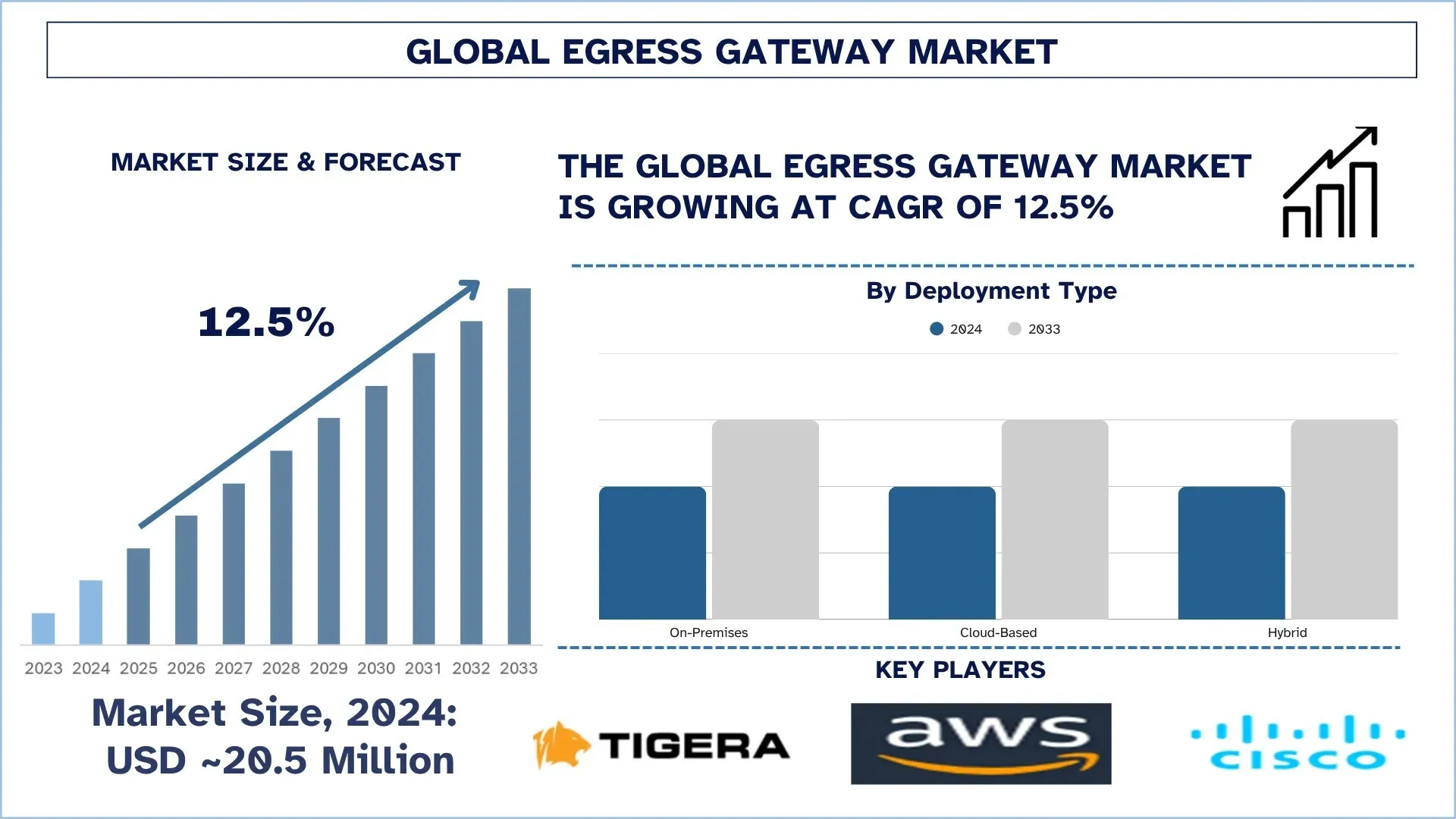
Global Egress Gateway Market Size & Forecast
The global egress gateway market was valued at USD ~20.5 million in 2024 and is expected to grow at a strong CAGR of around 12.5% during the forecast period (2025-2033F), driven by the growing adoption of Zero Trust security frameworks across enterprises, stringent data privacy regulations, and the acceleration of digital transformation initiatives across various industries.
Egress Gateway Market Analysis
Egress gateways are instrumental in auditing and logging all outbound traffic in Kubernetes clusters. They provide detailed visibility into the traffic’s nature, destination, and quantity, which is important for security and operational auditing. This information is important for troubleshooting issues and performing forensic analysis in case of a security incident. Logs generated by these gateways are integrated with Security Information and Event Management (SIEM) systems, improving the overall security posture by allowing for real-time monitoring and alerting based on traffic anomalies. The global egress gateway market is experiencing substantial growth, driven by the increasing demand for advanced outbound network security and data loss prevention. Organizations are more frequently deploying egress gateways to monitor and manage data leaving corporate networks, ensuring compliance with privacy laws such as GDPR, HIPAA, and CCPA. The increase in cyber threats, ransomware, and insider risks has further heightened the need for intelligent traffic inspection and secure policy enforcement tools. The rising adoption of cloud platforms and hybrid work setups has expanded the enterprise attack surface, thereby driving the demand for egress controls. With the rapid digital transformation across various industries, the market is set for rapid growth, especially in sectors like BFSI, healthcare, and government, where data integrity and compliance are essential.
Global Egress Gateway Market Trends
This section discusses the key market trends that are influencing the various segments of the global egress gateway market, as found by our team of research experts.
Adoption of Zero-Trust Architecture
The adoption of Zero-Trust Architecture (ZTA) has become one of the most significant trends, driven by the rise in hybrid work, cloud expansion, and advanced cyberattacks. The core principle of ZTA, “never trust, always verify,” requires that every user, device, and network request be continuously authenticated, whether it comes from inside or outside an organization’s boundaries. Governments worldwide are adopting this approach. For instance, in January 2025, CISA released updated federal guidance to speed up ZTA adoption under the National Cybersecurity Strategy, focusing on micro-segmentation, identity management, and secure access controls. Additionally, in June 2025, NIST released 19 practical Zero-Trust implementation models, offering structured pathways for organizations to transition from outdated architectures. These initiatives drive the growth of the egress gateway market by increasing the need for strong outbound traffic monitoring, improved policy enforcement, and prevention of data loss within Zero-Trust frameworks.
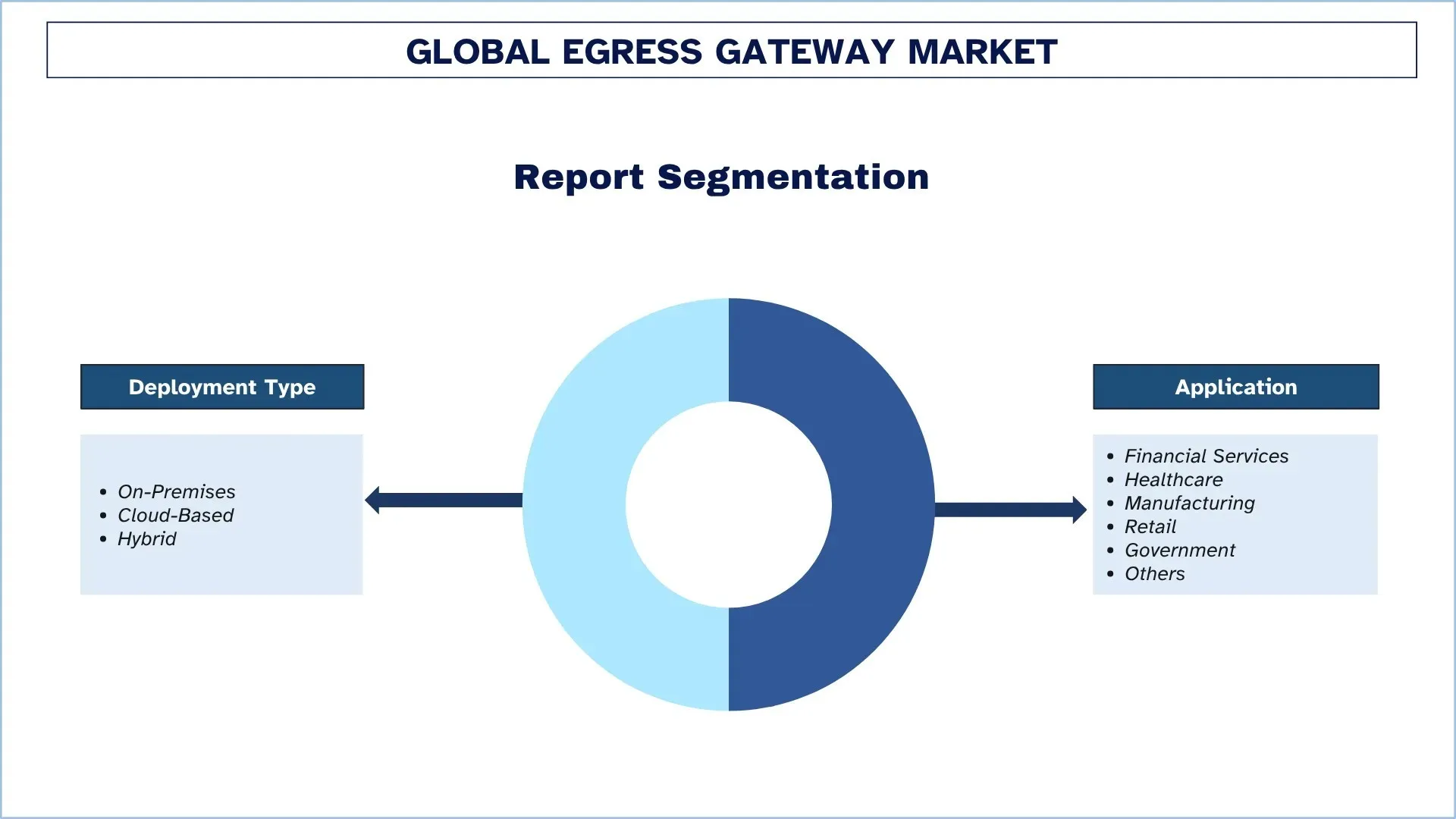
Egress Gateway Industry Segmentation
This section provides an analysis of the key trends in each segment of the global egress gateway market report, along with forecasts at the global, regional, and country levels for 2025-2033.
The On-Premises Segment Dominates the Global Egress Gateway Market
Based on the deployment type, the market is categorized into on-premises, cloud-based, and hybrid. Among these, the on-premises segment leads the egress gateway market because of its strong control, security, and compliance advantages. Companies, especially in industries like BFSI, healthcare, and government, prefer on-premises deployment to maintain direct oversight of sensitive outbound traffic and to comply with strict data protection rules such as GDPR, HIPAA, and PCI DSS. This approach allows organizations to easily integrate with existing network infrastructure, including firewalls and VPNs, while reducing latency and supporting high performance for critical applications, thereby strengthening their position in the market. Furthermore, on-premises gateways provide greater transparency, customization, and trust, allowing companies to control their data independently, eliminating the need for third-party cloud providers. In addition, the shift in the market from traditional network security hardware has also made on-premises deployment the preferred option for early adopters, thereby fueling market growth.
The Financial Services Segment Dominates the Global Egress Gateway Market.
Based on the application category, the market is categorized into financial services, healthcare, manufacturing, retail, government, and others. Among these, the financial services segment holds the largest market share. The egress gateway market is driven by its strict security, compliance, and data privacy requirements. Banks, insurance companies, and financial institutions handle large amounts of sensitive customer and transactional data, making them prime targets for cyberattacks and data breaches. These gateways provide vital outbound traffic monitoring, data loss prevention (DLP), and policy enforcement, guaranteeing secure information flow across networks, fueling market growth. Regulatory standards like PCI DSS, GDPR, and SOX also mandate strict control over data transfer, highlighting the demand for egress security solutions. Furthermore, the increasing adoption of hybrid and multi-cloud infrastructures in the financial sector raises demand for egress gateways to manage secure connectivity and ensure compliance across distributed network environments. With growing digital banking, fintech integration, and real-time payment systems, financial organizations rely heavily on egress gateways to safeguard data integrity, prevent insider threats, and ensure trust in digital financial operations.
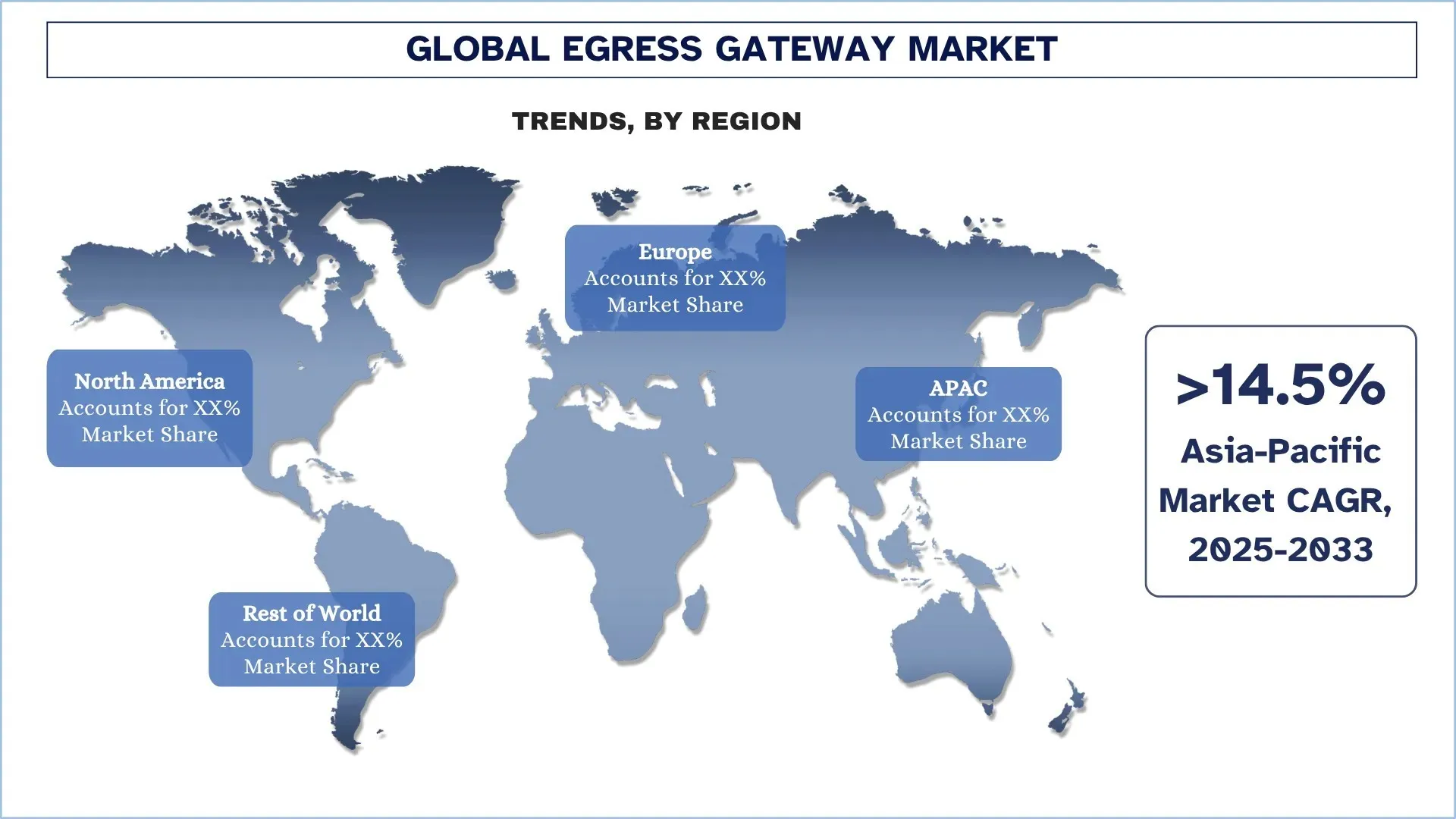
North America holds the largest market share in the global egress gateway market
North America holds the largest share of the egress gateway market because of major cybersecurity providers like Cisco Systems, Palo Alto Networks, Fortinet, and Zscaler, along with early adoption of advanced network security solutions. High awareness of data protection, widespread cloud adoption, and strict regulations such as HIPAA, CCPA, and GLBA have increased the use of egress gateways across various industries, fueling market growth. Furthermore, the region’s emphasis on financial institutions, technology firms, and government agencies increases demand for robust outbound traffic control and compliance management, thereby fueling market growth. Rising investments in cybersecurity infrastructure, digital transformation initiatives, and a strong remote workforce further improve the region's market position.
The U.S. held a Dominant share of the North America Egress Gateway Market in 2024
The U.S. holds the largest market share of the egress gateway market because of its well-established digital infrastructure and early adoption of secure, cloud-centric architectures. The country’s high digital access, extensive enterprise IT spending, and increasing dependence on cloud-based applications have increased the demand for smart egress gateways. With a rapidly evolving threat landscape, American organizations prioritize outbound data security to protect intellectual property and customer information. Furthermore, strong federal and state-level cybersecurity initiatives, such as the National Cybersecurity Strategy and CISA-led frameworks, encourage proactive adoption of egress control technologies. The presence of diverse industries ranging from finance and healthcare to defense and technology creates a steady demand for advanced egress gateways that ensure compliance, visibility, and operational continuity. Growing investments in R&D and partnerships among the government, private sector, and defense industry are further improving the country's market position.
Egress Gateway Industry Competitive Landscape
The global Egress gateway market is competitive, with several global and international market players. The key players are adopting different growth strategies to enhance their market presence, such as partnerships, agreements, collaborations, geographical expansions, and mergers and acquisitions.
Top Egress Gateway Market Companies
Some of the major players in the market are Tigera, Inc., Amazon Web Services, Inc., Cisco Systems, Inc., Zscaler, Inc., IBM, Netskope, Google LLC., Cloudflare, Inc., Tetrate.io, and Akamai Technologies.
Recent Developments in the Egress Gateway Market
In July 2024, KnowBe4 acquired Egress Software Technologies, a leader in adaptive cloud email & outbound data protection. The move strengthens KnowBe4’s position as a comprehensive AI-driven human-risk cybersecurity platform by integrating Egress’s advanced email security capabilities.
In November 2023, Egress announced its partnership with CrowdStrike Falcon to enhance protection against cloud email threats driven by human risk. The collaboration combines Egress’ adaptive security and risk-based threat detection with CrowdStrike’s identity and endpoint intelligence, providing real-time insights to prevent targeted attacks.
Global Egress Gateway Market Report Coverage
Report Attribute | Details |
Base year | 2024 |
Forecast period | 2025-2033 |
Growth momentum | Accelerate at a CAGR of 12.5% |
Market size 2024 | USD ~20.5 million |
Regional analysis | North America, Europe, APAC, Rest of the World |
Major contributing region | The North America region is expected to dominate the market during the forecast period. |
Key countries covered | U.S., Canada, Germany, U.K., Spain, Italy, France, China, Japan, and India. |
Companies profiled | Tigera, Inc., Amazon Web Services, Inc., Cisco Systems, Inc., Zscaler, Inc., IBM, Netskope, Google LLC., Cloudflare, Inc., Tetrate.io, and Akamai Technologies. |
Report Scope | Market Trends, Drivers, and Restraints; Revenue Estimation and Forecast; Segmentation Analysis; Demand and Supply Side Analysis; Competitive Landscape; Company Profiling |
Segments Covered | By Deployment Type, By Application, and By Region/Country |
Reasons to Buy the Egress Gateway Market Report:
The study includes market sizing and forecasting analysis confirmed by authenticated key industry experts.
The report briefly reviews overall industry performance at a glance.
The report covers an in-depth analysis of prominent industry peers, primarily focusing on key business financials, type portfolios, expansion strategies, and recent developments.
Detailed examination of drivers, restraints, key trends, and opportunities prevailing in the industry.
The study comprehensively covers the market across different segments.
Deep dive regional level analysis of the industry.
Customization Options:
The global Egress gateway market can further be customized as per the requirements or any other market segment. Besides this, UnivDatos understands that you may have your own business needs; hence, feel free to contact us to get a report that completely suits your requirements.
Table of Content
Research Methodology for the Global Egress Gateway Market Analysis (2023-2033)
We analyzed the historical market, estimated the current market, and forecasted the future market of the global egress gateway market to assess its application in major regions worldwide. We conducted exhaustive secondary research to gather historical market data and estimate the current market size. To validate these insights, we carefully reviewed numerous findings and assumptions. Additionally, we conducted in-depth primary interviews with industry experts across the egress gateway value chain. After validating market figures through these interviews, we used both top-down and bottom-up approaches to forecast the overall market size. We then employed market breakdown and data triangulation methods to estimate and analyze the market size of industry segments and sub-segments.
Market Engineering
We employed the data triangulation technique to finalize the overall market estimation and derive precise statistical numbers for each segment and sub-segment of the global egress gateway market. We split the data into several segments and sub-segments by analyzing various parameters and trends, including deployment type, application, and regions within the global egress gateway market.
The Main Objective of the Global Egress Gateway Market Study
The study identifies current and future trends in the global egress gateway market, providing strategic insights for investors. It highlights regional market attractiveness, enabling industry participants to tap into untapped markets and gain a first-mover advantage. Other quantitative goals of the studies include:
Market Size Analysis: Assess the current and forecast market size of the global egress gateway market and its segments in terms of value (USD).
Egress Gateway Market Segmentation: Segments in the study include areas of deployment type, application, and region.
Regulatory Framework & Value Chain Analysis: Examine the regulatory framework, value chain, customer behavior, and competitive landscape of the egress gateway industry.
Regional Analysis: Conduct a detailed regional analysis for key areas such as Asia Pacific, Europe, North America, and the Rest of the World.
Company Profiles & Growth Strategies: Company profiles of the egress gateway market and the growth strategies adopted by the market players to sustain the fast-growing market.
Frequently Asked Questions FAQs
Q1: What is the global egress gateway market’s current market size and growth potential?
As of 2024, the global egress gateway market is valued at USD ~20.5 million and is projected to grow at an impressive CAGR of 12.5% from 2025 to 2033. This strong growth is driven by increasing cybersecurity investments, rising cloud adoption, and the need for secure outbound traffic management across enterprise networks.
Q2: Which segment has the largest share of the global egress gateway market by deployment type category?
The on-premises segment holds the largest share of the global egress gateway. Enterprises prefer on-premises solutions for their enhanced data control, security customization, and compliance with stringent data governance regulations, especially in highly regulated sectors such as finance and government.
Q3: What are the driving factors for the growth of the global egress gateway market?
Top growth drivers of the egress gateway market include:
• Rising cybersecurity risks and data-exfiltration threats.
• The expansion of hybrid and remote work models necessitates secure access.
• Stringent data-protection and compliance regulations (GDPR, HIPAA, etc.).
Q4: What are the emerging technologies and trends in the global egress gateway market?
Emerging trends in the egress gateway market include:
• The adoption of Zero-Trust Architecture (ZTA) for continuous verification and secure access.
• Increasing integration of AI, automation, and predictive analytics in threat detection.
• Growing demand from financial services and cloud-based enterprises for data-loss prevention and compliance management.
Q5: What are the key challenges in the global egress gateway market?
Key challenges in the egress gateway market include:
• Established Alternative Security Solutions: The presence of integrated cybersecurity platforms like SASE, next-generation firewalls, and CASBs reduces the demand for standalone egress gateways, as these solutions often include outbound traffic monitoring capabilities.
• Implementation Complexity: Deploying egress gateways across hybrid and multi-cloud environments can be complex and resource-intensive, requiring specialized expertise for integration with existing network, compliance, and identity systems.
Q6: Which region dominates the global egress gateway market?
North America dominates the global egress gateway market, driven by the presence of major cybersecurity vendors (Cisco, Palo Alto Networks, Zscaler), high regulatory standards, and rapid Zero-Trust adoption. The region’s strong investment in cloud infrastructure and data protection initiatives continues to drive market growth.
Q7: Who are the key competitors in the global egress gateway market?
Top players in the egress gateway industry include:
• Tigera, Inc.
• Amazon Web Services, Inc.
• Cisco Systems, Inc.
• Zscaler, Inc.
• IBM
• Netskope
• Google LLC.
• Cloudflare, Inc.
• Tetrate.io
• Akamai Technologies
Q8: How does an egress gateway improve enterprise network security and data compliance?
Egress gateways strengthen enterprise cybersecurity by inspecting, filtering, and controlling outbound traffic to prevent data leakage, malware exfiltration, and unauthorized access. They also help organizations maintain compliance with regulations such as GDPR, HIPAA, and PCI DSS by providing detailed audit trails and enforcing policies.
Q9: What industries are adopting egress gateway solutions most rapidly?
The BFSI, healthcare, government, and IT & telecom sectors are the fastest adopters of egress gateway solutions. These industries handle large volumes of sensitive data and face stringent compliance demands, driving the need for secure and automated outbound traffic management.
Related Reports
Customers who bought this item also bought



Emphasis By Type (Saas Escrow, Technology Escrow, Domain Name Escrow, Others), By Agreement (Single Beneficiary and Multiple Beneficiary), by End User (Escrow for Software Customers and Escrow for Software Suppliers/Developer), By Country (Saudi Arabia, UAE, Egypt, South Africa, Turkey, Israel, and the Rest of Middle East & Africa)
March 10, 2026

Cloud FinOps Market: Current Analysis and Forecast (2025-2033)
Emphasis on Components (Solutions and Services); Deployment Model (Public Cloud, Private Cloud, and Hybrid Cloud); Organization Size (Large Enterprises and Small & Medium Enterprises {SME's}); Application (Cost Management & Optimization, Budgeting & Forecasting, Reporting & Analytics, Workload Management & Optimization, Cost Allocation & Chargeback, and Others); End-Use Industry (BFSI, IT & Telecom, Retail & E-Commerce, Healthcare, Manufacturing, Media & Entertainment, Government & Public Sector, and Others); and Region/Country
March 8, 2026

Emphasis on Platform Type (Order & Inventory Management Platforms, Delivery Orchestration Platforms, Automated Picking Optimization Platforms, and Workforce & Task Scheduling Platforms); Fulfillment Model (Hyperlocal Fulfillment, Regional Dark Store Fulfillment, and Micro-fulfillment Center Integration); Delivery Mode (On-Demand Delivery, Scheduled Delivery, and Batch / Route-Optimized Delivery); End-User (E-commerce & Quick-Commerce Companies, Grocery Chains, Retailers, and Third-Party Logistics Providers (3PLs)), and Region/Country
February 8, 2026