- Home
- About Us
- Industry
- Services
- Reading
- Contact Us
Nootropic Food Ingredients Market: Current Analysis and Forecast (2025-2033)
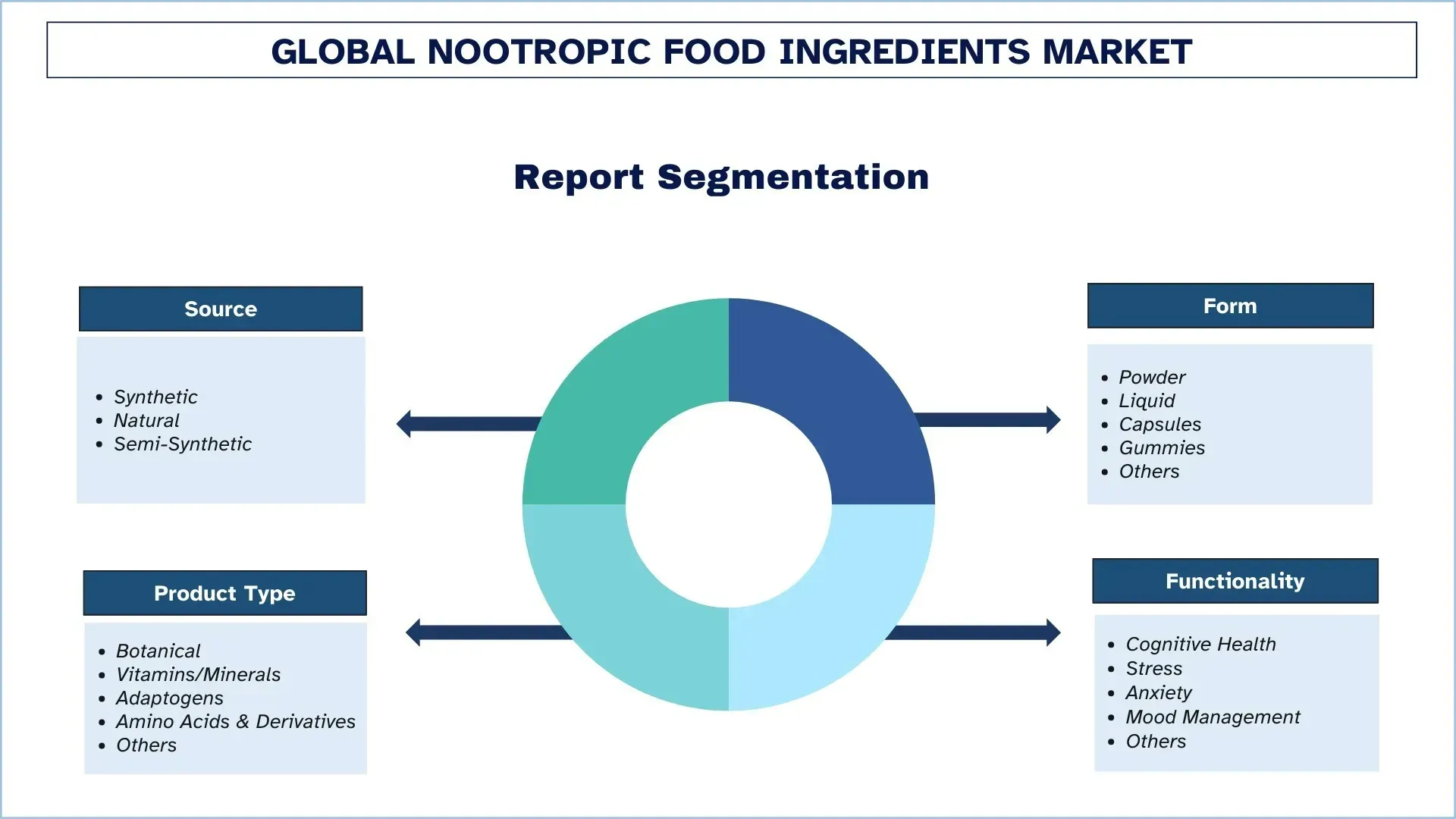
Emphasis on Source (Synthetic, Natural, and Semi-Synthetic); Product Type (Botanical, Vitamins/Minerals, Adaptogens, Amino Acids & Derivatives, and Others); Form (Powder, Liquid, Capsules, Gummies, and Others); Functionality (Cognitive Health, Stress, Anxiety, Mood Management, and Others); and Region/Country
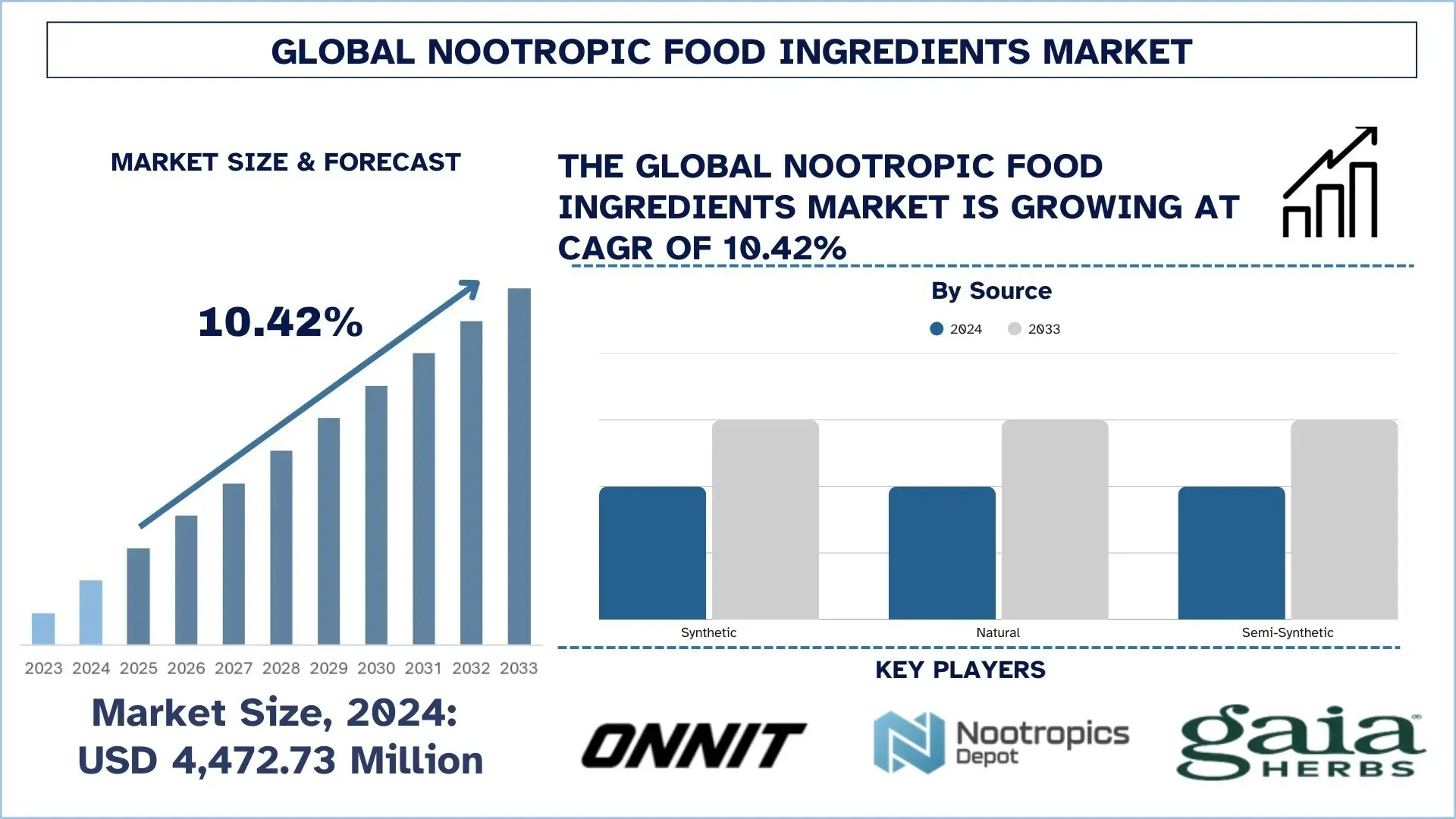
Global Nootropic Food Ingredients Market Size & Forecast
The Global Nootropic Food Ingredients Market was valued at USD 4,472.73 million in 2024 and is expected to grow at a steady CAGR of around 10.42% during the forecast period (2025-2033F), driven by rising consumer focus on cognitive health, preventive wellness, stress management, and demand for convenient functional foods and beverages is driving growth in the global nootropic food ingredients market.
Nootropic Food Ingredients Market Analysis
The nootropic food ingredients market is showing rapid growth driven by increasing consumer interest in cognitive health, stress reduction, and preventive wellness. There is a growing demand for functional foods and beverages that enhance focus, memory, and mood worldwide. Botanical ingredients dominate the market, favored for their natural, plant-based qualities, while scientifically formulated compounds are becoming more popular for specific benefits. Furthermore, the rising product innovation is leading to formulations tailored for focus, relaxation, and emotional stability. For instance, in October 2023, Nutrition21 launched nooLVL, a non-stimulant nootropic ingredient designed to improve focus, memory, and mental performance, supporting innovation and functional product development in the growing cognitive health market. In addition, trends toward personalization, digital health, and clean-label options are influencing purchasing decisions and strategic alliances, while research investments are boosting innovation, competitiveness, and long-term growth prospects worldwide.
Global Nootropic Food Ingredients Market Trends
This section discusses the key market trends that are influencing the various segments of the global nootropic food ingredients market, as found by our team of research experts.
Increased Personalization
The nootropic food ingredients market is transformed by the rising demand for personalized solutions, as consumers seek products tailored to their cognitive and emotional needs. Instead of preferring generic brain-health items, individuals look for specific benefits like improved focus, memory, stress relief, or mood stability, depending on their lifestyle and daily challenges. For instance, in August 2025, Adapt Drinks introduced mushroom-infused beverages with targeted functions such as FOCUS and RELAX, aimed at supporting particular mental wellness needs. Additionally, advances in digital tools and increased awareness of wellness are driving the development of customized formulations, positioning personalized cognitive nutrition as an important direction for future product development and growth.
Nootropic Food Ingredients Industry Segmentation
This section provides an analysis of the key trends in each segment of the global nootropic food ingredients market report, along with forecasts at the global, regional, and country levels for 2025-2033.
The Natural Segment Dominates the Global Nootropic Food Ingredients Market
Based on the source, the market is categorized into synthetic, natural, and semi-synthetic. The natural segment holds the largest market share in the nootropic food ingredient market in 2024. This is attributed to consumers' preference for plant-based, food-based, or other natural ingredients. In addition, natural products are associated with consumers through a sense of safety, fewer side effects, and better long-term health outcomes, which contribute to market growth. Clean-label trends influence this preference, with shoppers opting for simple, recognizable ingredient names on labels. Furthermore, major traditional medicines have long used herbal remedies for brain health, thereby building trust. Also, food and beverage brands find it easier to market natural cognitive ingredients as part of a healthy lifestyle, thereby further promoting market growth.
The Botanical Segment Dominates the Global Nootropic Food Ingredients Market.
Based on the product type, the market is categorized into botanical, vitamins/minerals, adaptogens, amino acids & derivatives, and others. In 2024, the botanical segment holds the largest share of the nootropic food ingredient market because they carry a long history of traditional use and strong consumer trust. Herbs like ginkgo, bacopa, and ginseng are largely used for supporting memory and mental clarity, making them popular in functional foods and beverages. However, adaptogens are experiencing the fastest growth as modern consumers face rising stress, burnout, and mental fatigue. Ingredients such as ashwagandha and rhodiola appeal to those seeking stress resilience alongside cognitive performance, positioning adaptogens as multifunctional solutions that address both mental focus and emotional balance.
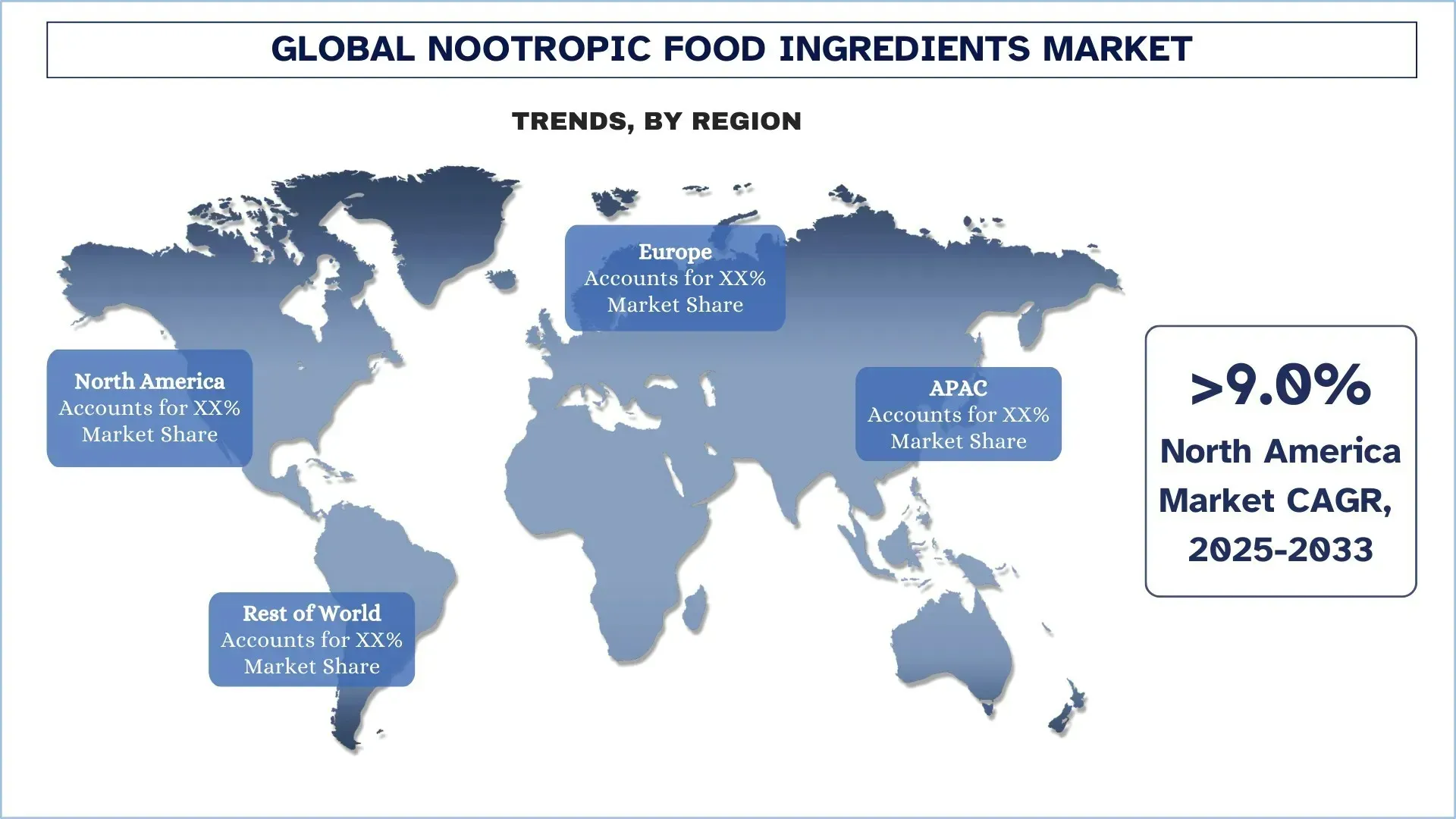
North America holds the largest market share in the global nootropic food ingredients market
North America holds the largest share of the nootropic food ingredient market in 2024, owing to rising consumer awareness of brain health and a willingness to spend on products that support memory, focus, and mental energy. Also, access to advanced healthcare, high disposable incomes, and a strong interest in preventive nutrition fuel the demand in the market. Adding to this, the functional foods, beverages, and supplements are widely available through retail and online channels. Furthermore, ingredient innovation and marketing are strong in the region, with companies frequently launching new products. Moreover, regulatory frameworks that support health claims help companies communicate benefits, making North America the largest market for nootropic food ingredients.
U.S. held a Dominant share of the Asia-Pacific Nootropic Food Ingredients Market in 2024
The U.S. holds the dominant share of the nootropic food ingredient market in North America due to its vast and mature health and wellness market, in which consumers are highly engaged in seeking cognitive support solutions. In addition, the growing number of research and clinical studies on nootropic ingredients enhances their credibility and consumer acceptance. American consumers show a high interest in functional foods and supplements marketed for stress relief, focus, and mental performance. Moreover, widespread retail distribution and e-commerce make these products readily available. Furthermore, the companies are increasingly investing heavily in marketing and education, thereby boosting awareness and demand and enhancing the country's leadership in markets.
Nootropic Food Ingredients Industry Competitive Landscape
The global nootropic food ingredients market is competitive, with several global and international market players. The key players are adopting different growth strategies to enhance their market presence, such as partnerships, agreements, collaborations, geographical expansions, and mergers and acquisitions.
Top Nootropic Food Ingredients Market Companies
Some of the major players in the market include Onnit Labs, Inc. (Unilever), Nootropics Depot, Gaia Herbs, Natural Stacks, Nutra Coast, Arjuna Natural, TruBrain, Verdure Sciences, NooCube, and Performance Lab USA Corp.
Recent Developments in the Nootropic Food Ingredients Market
In January 2026, Entheon Biomedical completed a business combination agreement to acquire Nutravisor, executed a reverse takeover, and expanded its nutraceutical and cognitive product portfolio.
In November 2024, OmniActive Health Technologies acquired ENovate Biolife, adding clinically studied botanical ingredient assets to expand its health ingredient offerings globally.
In March 2024, Nektium reformulated its nootropic ingredient as Zynamite S, making a water-soluble version designed for functional beverages and improved cognitive energy drinks.
Global Nootropic Food Ingredients Market Report Coverage
Report Attribute | Details |
Base year | 2024 |
Forecast period | 2025-2033 |
Growth momentum | Accelerate at a CAGR of 10.42% |
Market size 2024 | USD 4,472.73 million |
Regional analysis | North America, Europe, APAC, Rest of the World |
Major contributing region | The North America region is expected to dominate the market during the forecast period. |
Key countries covered | U.S., Canada, Germany, U.K., Spain, Italy, France, China, Japan, and India. |
Companies profiled | Onnit Labs, Inc. (Unilever), Nootropics Depot, Gaia Herbs, Natural Stacks, Nutra Coast, Arjuna Natural, TruBrain, Verdure Sciences, NooCube, and Performance Lab USA Corp. |
Report Scope | Market Trends, Drivers, and Restraints; Revenue Estimation and Forecast; Segmentation Analysis; Demand and Supply Side Analysis; Competitive Landscape; Company Profiling |
Segments Covered | By Source, By Product Type, By Form, Functionality, and By Region/Country |
Reasons to Buy the Nootropic Food Ingredients Market Report:
The study includes market sizing and forecasting analysis confirmed by authenticated key industry experts.
The report briefly reviews overall industry performance at a glance.
The report covers an in-depth analysis of prominent industry peers, primarily focusing on key business financials, type portfolios, expansion strategies, and recent developments.
Detailed examination of drivers, restraints, key trends, and opportunities prevailing in the industry.
The study comprehensively covers the market across different segments.
Deep dive regional level analysis of the industry.
Customization Options:
The global nootropic food ingredients market can further be customized as per the requirements or any other market segment. Besides this, UnivDatos understands that you may have your own business needs; hence, feel free to contact us to get a report that completely suits your requirements.
Table of Content
Research Methodology for the Global Nootropic Food Ingredients Market Analysis (2023-2033)
We analyzed the historical market, estimated the current market, and forecasted the future market of the global nootropic food ingredients market to assess its application in major regions worldwide. We conducted exhaustive secondary research to gather historical market data and estimate the current market size. To validate these insights, we carefully reviewed numerous findings and assumptions. Additionally, we conducted in-depth primary interviews with industry experts across the nootropic food ingredients value chain. After validating market figures through these interviews, we used both top-down and bottom-up approaches to forecast the overall market size. We then employed market breakdown and data triangulation methods to estimate and analyze the market size of industry segments and sub-segments.
Market Engineering
We employed the data triangulation technique to finalize the overall market estimation and derive precise statistical numbers for each segment and sub-segment of the global nootropic food ingredients market. We split the data into several segments and sub-segments by analyzing various parameters and trends, including source, product type, form, functionality, and regions within the global Nootropic food ingredients market.
The Main Objective of the Global Nootropic Food Ingredients Market Study
The study identifies current and future trends in the global nootropic food ingredients market, providing strategic insights for investors. It highlights regional market attractiveness, enabling industry participants to tap into untapped markets and gain a first-mover advantage. Other quantitative goals of the studies include:
- Market Size Analysis: Assess the current and forecast market size of the global nootropic food ingredients market and its segments in terms of value (USD).
- Nootropic Food Ingredients Market Segmentation: Segments in the study include areas of source, product type, form, functionality, and region.
- Regulatory Framework & Value Chain Analysis: Examine the regulatory framework, value chain, customer behavior, and competitive landscape of the nootropic food ingredients industry.
- Regional Analysis: Conduct a detailed regional analysis for key areas such as Asia Pacific, Europe, North America, and the Rest of the World.
- Company Profiles & Growth Strategies: Company profiles of the nootropic food ingredients market and the growth strategies adopted by the market players to sustain the fast-growing market.
Frequently Asked Questions FAQs
Q1: What is the current size of the global nootropic food ingredients market, and what is its growth potential?
As of 2024, the global nootropic food ingredients market was valued at approximately USD 4,472.73 million and is projected to grow at a CAGR of 10.42% from 2025 to 2033, driven by rising demand for cognitive wellness and functional nutrition.
Q2: Which segment has the largest share of the global nootropic food ingredients market by source?
Natural nootropic ingredients hold the largest market share, supported by growing consumer preference for plant-based, clean-label, and minimally processed cognitive health solutions.
Q3: What are the driving factors for the growth of the global nootropic food ingredients market?
Top growth drivers of the nootropic food ingredients market include:
• Increasing Emphasis on Proactive Wellness and Self-Care
• Increasing Demand for Plant-Based and Clean-Label Ingredients
• Development of On-the-Go Delivery Format
Q4: What are the emerging technologies and trends in the global nootropic food ingredients market?
Emerging trends in the nootropic food ingredients market include:
• Increased Personalization
• Technological Progress in Brain–Gut Axis Formulations
Q5: What are the key challenges in the global nootropic food ingredients market?
Key challenges in the global nootropic food ingredients market are:
• Raw Material Price Fluctuation
• Limited Clinical Evidence for Emerging Nootropics
Q6: Which region dominates the global nootropic food ingredients market?
North America dominates the global market due to strong consumer awareness of cognitive health, high demand for dietary supplements, and a well-established functional food industry.
Q7: Who are the key competitors in the global nootropic food ingredients market?
Top players in the Nootropic food ingredients industry include:
• Onnit Labs, Inc. (Unilever)
• Nootropics Depot
• Gaia Herbs
• Natural Stacks
• Nutra Coast
• Arjuna Natural
• TruBrain
• Verdure Sciences
• NooCube
• Performance Lab USA Corp
Q8: What regulatory frameworks are influencing the global nootropic food ingredients market?
The market is shaped by evolving regulations related to functional foods, dietary supplements, health claims, and novel ingredients. Compliance with FDA, EFSA, and other regional authorities is critical, especially for cognitive health claims, ingredient safety validation, and labeling transparency.
Q9: Which application areas are creating the most revenue opportunities in the nootropic food ingredients market?
High-growth application areas include functional beverages, cognitive wellness supplements, fortified snacks, and medical nutrition. Demand is especially strong in products targeting focus, stress management, memory support, and mood enhancement.
Related Reports
Customers who bought this item also bought


Dehydrated Culinary Herbs Market: Current Analysis and Forecast (2025-2033)
Emphasis on Product Type (Basil, Oregano, Rosemary, Thyme, Sage, Parsley, Mint, Cilantro, and Others); Form (Whole, Powdered, and Flakes); Application (Food Processing, Restaurants & Foodservice, Household, Nutraceuticals, and Others); Distribution Channel (Supermarkets/Hypermarkets, Specialty Food Stores, Online Retail, and Others); and Region/Country
February 5, 2026