- Home
- About Us
- Industry
- Services
- Reading
- Contact Us
Tensiometer Market: Current Analysis and Forecast (2025-2033)
Emphasis on Type (Standard, Digital, High-Capacity, Mini, and Others); End-Use (Agriculture, Greenhouses, Research, Precision Farming, Environmental Monitoring, Civil Engineering, and Others); and Region/Country
Global Tensiometer Market Size & Forecast
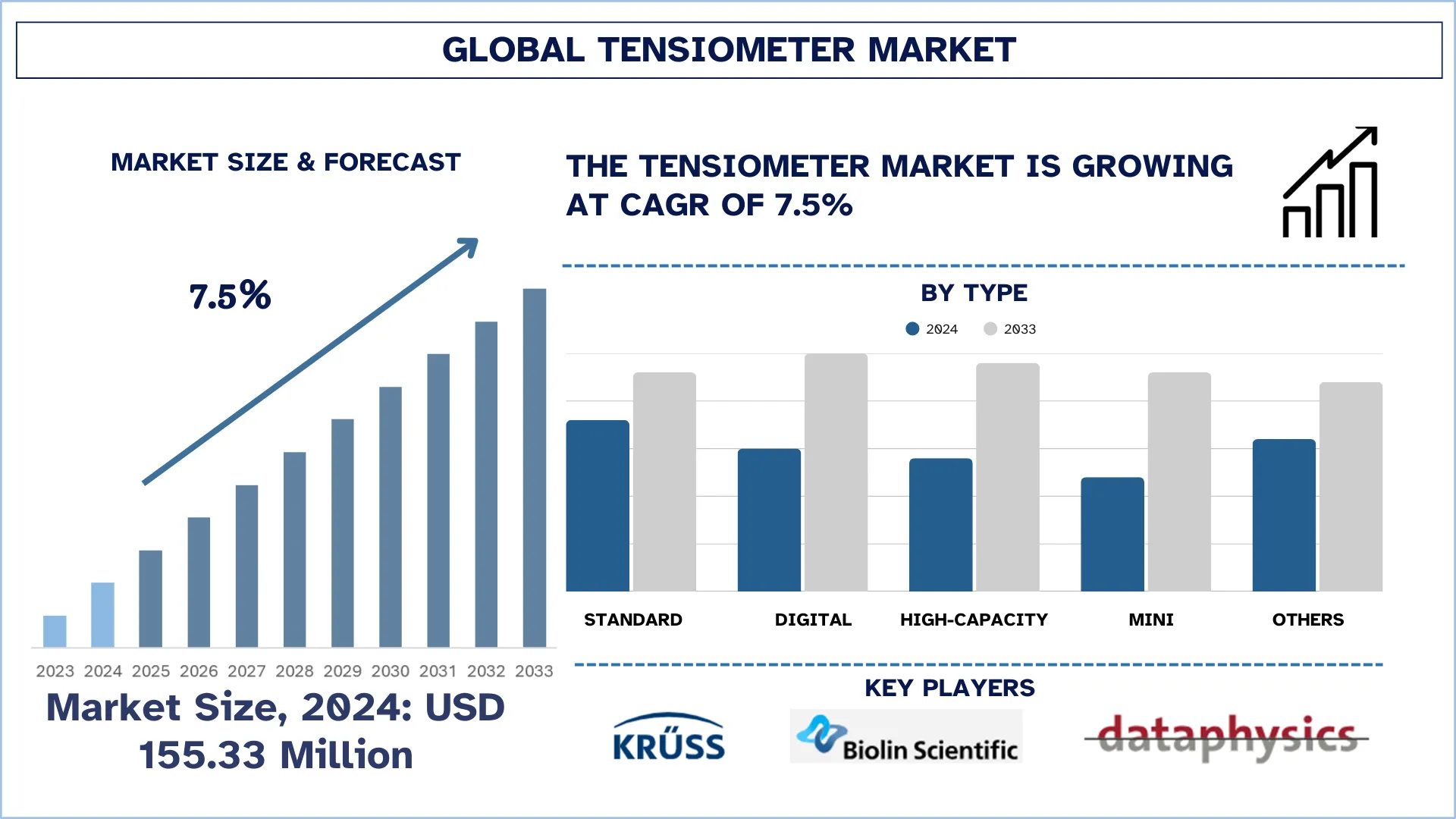
The Global Tensiometer Market was valued at USD 155.33 million in 2024 and is expected to grow at a strong CAGR of around 7.5% during the forecast period (2025-2033F), driven by rising demand for surface and interfacial tension measurements across pharmaceuticals, chemicals, and research laboratories worldwide.
Global Tensiometer Market Analysis
A tensiometer is a scientific measuring device used to measure soil water tension, which indicates how tightly water is bound in the soil. It consists of a porous ceramic cup, a pressure gauge or digital sensor, and a water-filled tube. When placed in soil, it flows in or out of the device depending on the soil's moisture content, creating a detectable vacuum. Tensiometers are mainly used in agricultural, horticultural, environmental, and soil science to aid in proper irrigation management. With greater emphasis on efficient water use, the implementation of precision agriculture, and increased interest in sustainable agriculture, the tensiometer market is expanding. Also, the growing water scarcity and climate fluctuations are prompting farmers to use accurate soil moisture sensors to optimize irrigation.
Global Tensiometer Market Trends
This section discusses the key market trends that are influencing the various segments of the global tensiometer market, as found by our team of research experts.
Shift toward Automated and Computer-Controlled Tensiometers
Automated and computer-controlled tensiometers are becoming a major trend in the tensiometer market, due to the high levels of accuracy, efficiency, and convenience. Such sophisticated systems reduce human error through force control, data acquisition, and analysis, ensuring repeatable, uniform outcomes. Additionally, connection to software allows real-time monitoring, storage in a digital format, and high-end data analytics, which is especially useful in data used in research and quality control. Moreover, automated tensiometers save time and reduce operator dependency, increasing their use in high-throughput manufacturing and current laboratory settings, facilitating their further adoption.
Tensiometer Industry Segmentation
This section provides an analysis of the key trends in each segment of the global tensiometer market report, along with forecasts at the global, regional, and country levels for 2025-2033.
The Digital Tensiometers Segment Dominates the Global Tensiometer Market
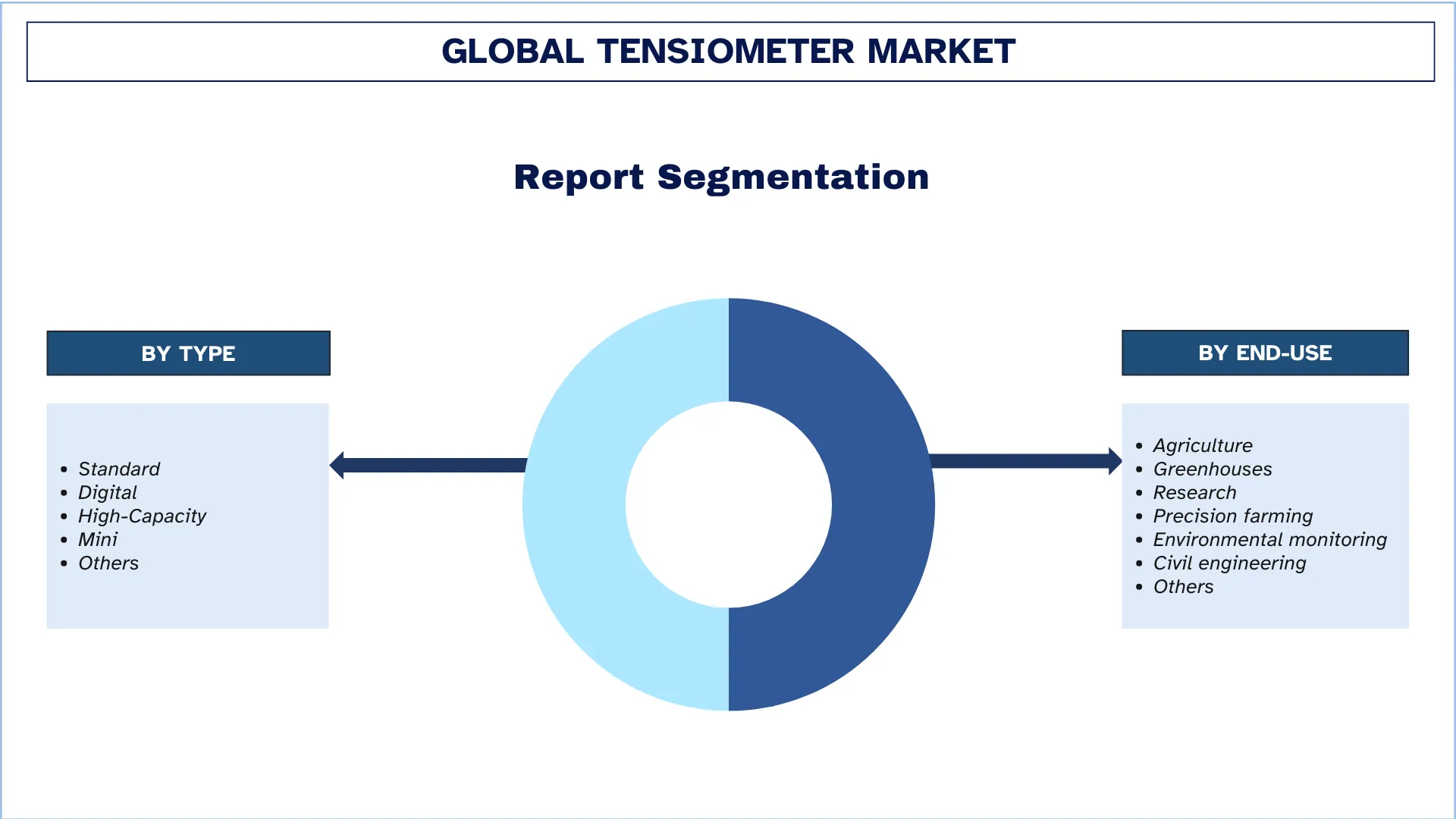
Based on the type category, the market is categorized into standard, digital, high-capacity, mini, and others. Among these, the digital tensiometer component has the highest market share because it offers real-time data display, ease of use, compatibility with precision agriculture systems, and the rising popularity of intelligence-based agriculture. The agribusinesses and farmers are more interested in digital devices to monitor soil moisture and control irrigation, which leads to their supremacy. Moreover, in the future, digital tensiometers, especially IoT-enabled and smart versions, are expected to grow fastest, supported by advancements in sensor technology, rising demand for data-driven farming practices, and increasing focus on resource efficiency in agriculture.
The Agriculture Segment Dominates the Global Tensiometer Market.
Based on the end-use category, the market is segmented into agriculture, greenhouses, research, precision farming, environmental monitoring, civil engineering, and others. Among these, the agriculture sector has the largest market share as tensiometers are extensively used in conventional and commercial farming to determine irrigation timing, moisture levels in the soil, and to optimize crop yields. Due to the large-scale agricultural activities, intensive farming during the year has always resorted to soil moisture monitoring to boost water consumption efficiency and avoid crop stress to meet the predominant demand. However, in the future, the precision farming segment is expected to grow fastest as farmers increasingly adopt data-driven, automated solutions, integrating tensiometers with IoT, remote sensing, and smart irrigation systems. This trend of precision agriculture is in line with the sustainability objectives, due to which this segment is growing rapidly.
The Asia-Pacific region is the fastest-growing region in the Global Tensiometer Market
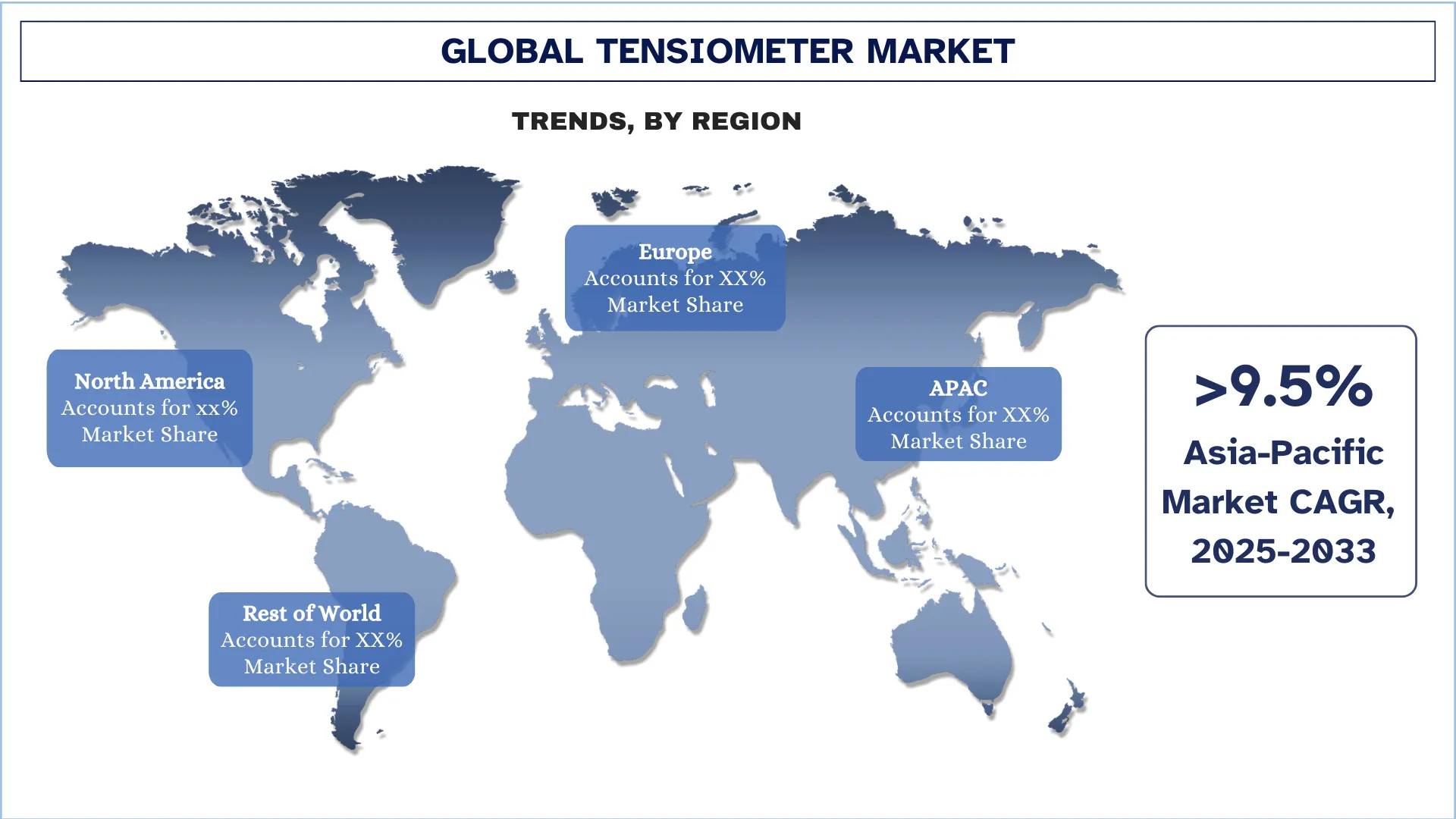
The fastest-growing region for the global tensiometers market is the Asia-Pacific region because of fast industrialization, growing manufacturing processes, and investment in research and laboratory facilities. The demand for the accurate measurement of the surface as well as interfacial tension is being propelled by the strong growth of the pharmaceutical, chemicals, food processing, and material science sectors. Also, the increase in scholarly research and the overall spread of quality control measures in various industries contribute to the market growth. Due to relatively cheap production, the availability of skilled workers, and the growing use of sophisticated analytical tools, APAC countries are enjoying economical production. Positive governmental efforts and the increasing understanding of automation also increase the growth of the regional market.
China held a Dominant share of the Asia-Pacific Tensiometer Market in 2024
China dominated the Asia-Pacific tensiometers market because it has a large industrial sector and the presence of chemicals, pharmaceuticals, petrochemicals, and material industries, which are in need of surface tension measurements. The nation has a good system of laboratories, increased research and development, and considerable domestic manufacturing of analytical equipment, reducing reliance on imports. The demand is further supported by a high investment in quality control in all the manufacturing domains and the increased use of automated laboratory equipment. Also, China has an economic manufacturing ecosystem, a ready supply of technical workforce, and ongoing improvement of research facilities, which have made it the largest contributor to the Asia-Pacific region.
Tensiometer Industry Competitive Landscape
The global tensiometer market is competitive, with several global and international market players. The key players are adopting different growth strategies to enhance their market presence, such as partnerships, agreements, collaborations, geographical expansions, and mergers and acquisitions.
Top Tensiometer Market Companies
Some of the major players in the market are KRÜSS GmbH, Biolin Scientific AB, DataPhysics Instruments GmbH, METER Group, Inc., SoilMoisture Equipment Corp., Irrometer Company, Inc., Delta-T Devices Limited, Spectrum Technologies, Campbell Scientific, Inc., and SITA Messtechnik GmbH.
Recent Developments in the Tensiometer Market
In February 2025, Biolin Scientific introduced the Attension Theta Wafer optical tensiometer module, expanding its surface science measurement portfolio. The company launched a new module to deliver high-precision contact angle and surface tension analysis tailored for wafer and advanced-material applications, reinforcing its commitment to innovative analytical solutions in research and industrial settings.
In December 2024, DataPhysics Instruments expanded its product portfolio by launching the MBP 200 Bubble Pressure Tensiometer. The stationary laboratory instrument was introduced to enable highly precise measurement of dynamic surface tension in liquids, supporting applications such as high-speed inkjet printing and spray processes.
Global Tensiometer Market Report Coverage
Details | |
Base year | 2024 |
Forecast period | 2025-2033 |
Growth momentum | Accelerate at a CAGR of 7.5% |
Market size 2024 | USD 155.33 million |
Regional analysis | North America, Europe, APAC, Rest of the World |
Major contributing region | The North America region is expected to dominate the market during the forecast period. |
Key countries covered | U.S., Canada, Germany, U.K., Spain, Italy, France, China, Japan, and India. |
Companies profiled | KRÜSS GmbH, Biolin Scientific AB, DataPhysics Instruments GmbH, METER Group, Inc., SoilMoisture Equipment Corp., Irrometer Company, Inc., Delta-T Devices Limited, Spectrum Technologies, Campbell Scientific, Inc., and SITA Messtechnik GmbH. |
Report Scope | Market Trends, Drivers, and Restraints; Revenue Estimation and Forecast; Segmentation Analysis; Demand and Supply Side Analysis; Competitive Landscape; Company Profiling |
Segments Covered | By Type, By End-Use, and By Region/Country |
Reasons to Buy the Tensiometer Market Report:
The study includes market sizing and forecasting analysis confirmed by authenticated key industry experts.
The report briefly reviews overall industry performance at a glance.
The report covers an in-depth analysis of prominent industry peers, primarily focusing on key business financials, type portfolios, expansion strategies, and recent developments.
Detailed examination of drivers, restraints, key trends, and opportunities prevailing in the industry.
The study comprehensively covers the market across different segments.
Deep dive regional-level analysis of the industry.
Customization Options:
The global tensiometer market can further be customized as per the requirements or any other market segment. Besides this, UnivDatos understands that you may have your own business needs; hence, feel free to contact us to get a report that completely suits your requirements.
Table of Content
Research Methodology for the Global Tensiometer Market Analysis (2023-2033)
We analyzed the historical market, estimated the current market, and forecasted the future market of the global tensiometer market to assess its application in major regions worldwide. We conducted exhaustive secondary research to gather historical market data and estimate the current market size. To validate these insights, we carefully reviewed numerous findings and assumptions. Additionally, we conducted in-depth primary interviews with industry experts across the tensiometer value chain. After validating market figures through these interviews, we used both top-down and bottom-up approaches to forecast the overall market size. We then employed market breakdown and data triangulation methods to estimate and analyze the market size of industry segments and sub-segments.
Market Engineering
We employed the data triangulation technique to finalize the overall market estimation and derive precise statistical numbers for each segment and sub-segment of the global tensiometer market. We split the data into several segments and sub-segments by analyzing various parameters and trends, including type, end-use, and regions within the global tensiometer market.
The Main Objective of the Global Tensiometer Market Study
The study identifies current and future trends in the global tensiometer market, providing strategic insights for investors. It highlights regional market attractiveness, enabling industry participants to tap into untapped markets and gain a first-mover advantage. Other quantitative goals of the studies include:
Market Size Analysis: Assess the current and forecast market size of the global tensiometer market and its segments in terms of value (USD).
Tensiometer Market Segmentation: Segments in the study include areas of type, end-use, and region.
Regulatory Framework & Value Chain Analysis: Examine the regulatory framework, value chain, customer behavior, and competitive landscape of the tensiometer industry.
Regional Analysis: Conduct a detailed regional analysis for key areas such as Asia Pacific, Europe, North America, and the Rest of the World.
Company Profiles & Growth Strategies: Company profiles of the tensiometer market and the growth strategies adopted by the market players to sustain the fast-growing market.
Frequently Asked Questions FAQs
Q1: What is the global tensiometer market’s current market size and growth potential?
As of 2024, the global tensiometer market size is USD 155.33 million. The market is projected to grow at a strong CAGR of 7.5% between 2025 and 2033, driven by rising demand for surface and interfacial tension measurement across pharmaceuticals, chemicals, and research laboratories worldwide.
Q2: Which segment has the largest share of the global tensiometer market by type category?
The digital tensiometer segment dominates the global market due to its high accuracy, ease of use, automation capabilities, and widespread adoption in advanced research and quality control applications.
Q3: What are the driving factors for the growth of the global tensiometer market?
Top growth drivers of the tensiometer market include:
• Increased R&D spending by academic and industrial research institutions
• Technological advancements
• Increasing use in environmental and oil & gas research applications
Q4: What are the emerging technologies and trends in the global tensiometer market?
Emerging trends in the tensiometer market include:
• Shift toward automated and computer-controlled tensiometers
• Growing emphasis on multi-functional instruments offering combined measurement capabilities
Q5: What are the key challenges in the global tensiometer market?
Key challenges in the tensiometer market include:
• High cost of advanced tensiometer systems
• Limited awareness in developing regions about advanced surface analysis techniques
Q6: Which region dominates the global tensiometer market?
North America dominates the global tensiometer market due to strong R&D infrastructure, high adoption of advanced laboratory instruments, and the presence of leading pharmaceutical, biotechnology, and chemical companies.
Q7: Who are the key competitors in the global tensiometer market?
Top players in the tensiometer industry include:
• KRÜSS GmbH
• Biolin Scientific AB
• DataPhysics Instruments GmbH
• METER Group, Inc.
• SoilMoisture Equipment Corp.
• Irrometer Company, Inc.
• Delta-T Devices Limited
• Spectrum Technologies
• Campbell Scientific, Inc.
• SITA Messtechnik GmbH
Q8: How is technological innovation expected to impact the future competitiveness of the tensiometer market?
Technological innovations such as automation, digital integration, enhanced data analytics, and multi-functional measurement capabilities are expected to significantly improve efficiency and accuracy, creating competitive advantages for manufacturers and influencing long-term market growth.
Q9: What growth strategies should manufacturers and investors adopt to gain a competitive edge in the global tensiometer market?
Manufacturers and investors should focus on advancing automation, expanding application-specific product portfolios, strengthening distribution networks in emerging markets, and investing in R&D-driven innovation. Strategic partnerships, after-sales service enhancement, and compliance with global quality standards can further support long-term market competitiveness and revenue growth.
Related Reports
Customers who bought this item also bought



Waste-Fibre Trays Market: Current Analysis and Forecast (2025-2033)
Emphasis on Material (Recycled Paper Pulp, Agricultural Residue Fiber, Corrugated Waste Fiber, Mixed Cellulose Composites, and Others); Tray Type (Food and Produce Trays, Industrial Component Trays, Electronics Trays, Consumer Goods Trays, and Others); Application (Food Packaging, Industrial Packaging, Electronics Protection, Retail Packaging, and Others); and Region/Country
February 6, 2026

Nanofiber Membrane Market: Current Analysis and Forecast (2025-2033)
Emphasis on Product Type (Polymeric Nanofiber Membranes, Ceramic Nanofiber Membranes, Carbon Nanofiber Membranes, and Others); Application (Water & Wastewater Treatment, Air Filtration, Medical & Healthcare, Chemical Processing, and Others); End-User (Industrial, Commercial, Residential, and Others); and Region/Country
February 6, 2026