Africa Lithium-Ion Battery Market: Current Analysis and Forecast (2025-2033)
Emphasis By Product Type (Lithium-Cobalt Oxide (LCO), Lithium Iron Phosphate (LiFePO4), Lithium Nickel Cobalt Aluminum Oxide (NCA), Lithium Manganese Oxide (LMO), Lithium Titanate (LTO), And Lithium Nickel Manganese Cobalt (NMC)), By Application (Consumer Electronics, Automotive, Energy Storage, Industrial, And Medical Devices), By Country (Egypt, South Africa, Nigeria, Uganda, Kenya, Rest of Africa)
Africa Lithium-Ion Battery Market Size & Forecast
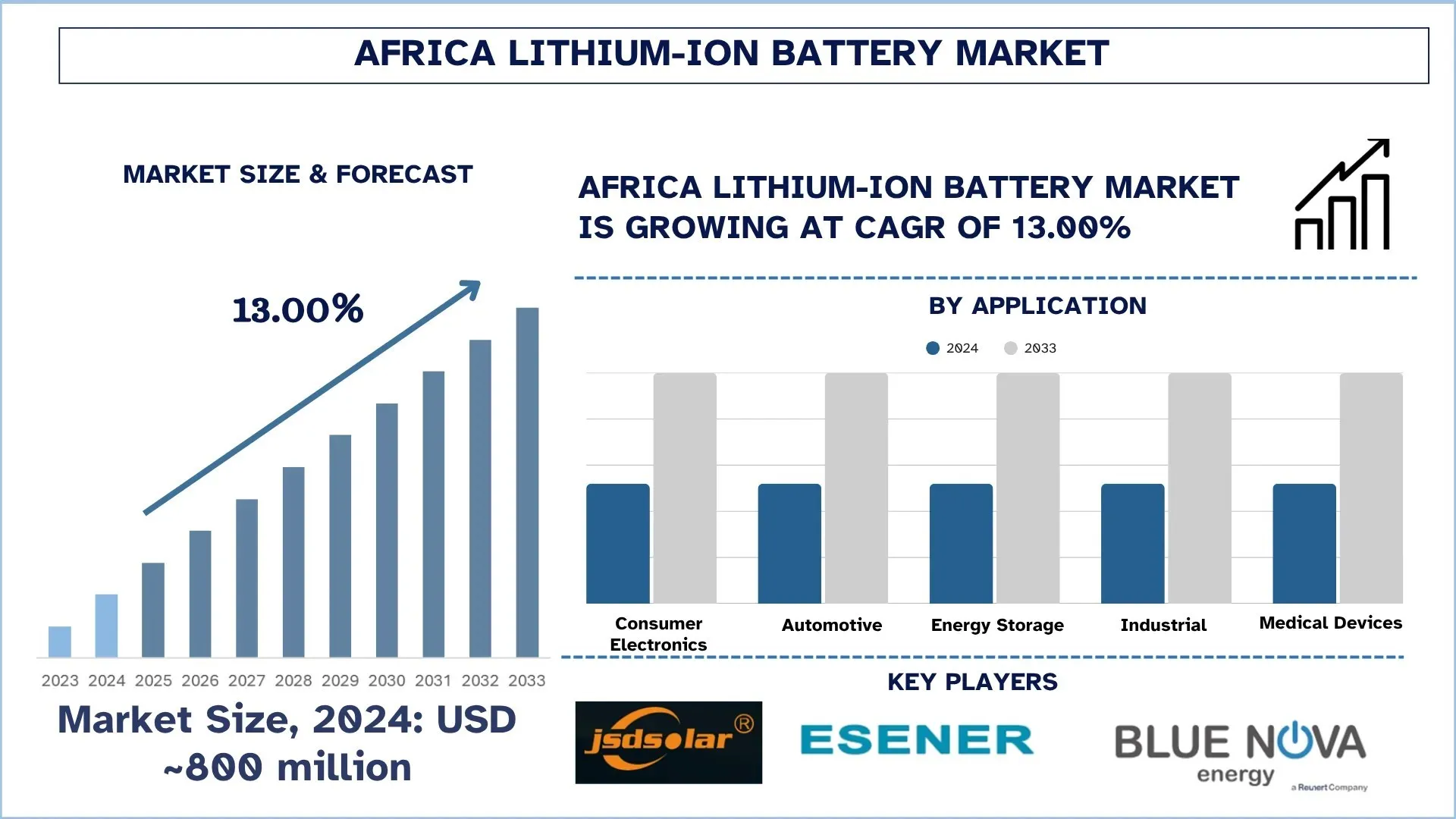
The Africa Lithium-Ion Battery Market was valued at USD 800 million in 2024 and is expected to grow at a strong CAGR of around 13.00% during the forecast period (2025- 2033F). The growing demand for electric vehicles is leading the growth of automotive batteries, and the Rise in BESS for a renewable energy project are some of the key factors that have led to the market rise.
Africa Lithium-Ion Battery Market Analysis
The lithium-ion battery market in Africa is under healthy growth, due to the rising concern of the continent with a clean energy shift, electric mobility, and industrialization. The swift growth of adopting renewable energy, mostly solar and wind energy, is leading to the necessity of an efficient system of energy storage. African nations such as South Africa, Morocco, and Kenya are launching ambitious electrification programs to improve access to energy and reduce reliance on fossil fuels. Increased investments by both the local and international players are enhancing the manufacturing capabilities of domestic batteries. In addition, accessibility of key raw materials like lithium, cobalt, and manganese in the respective countries, such as the Democratic Republic of Congo and Zimbabwe, gives a great base for the development of localized value chains.
Africa Lithium-Ion Battery Market Trends
This section discusses the key market trends that are influencing the various segments of the Africa Lithium-Ion Battery market, as found by our team of research experts.
Localization of Battery Value Chains:
Localization of battery value chains is one important trend that is defining the development of the African automotive lithium-ion battery market. Countries are investing more in local mining, treatment, and production plants with ready access to raw materials, including lithium, cobalt, manganese, and graphite, and plenty of them across the continent. To increase the local production capacity, governments and other investors are collaborating by establishing regional giga factories, research facilities, and recycling centers to enhance local production capacity. This is a localized method that is not only able to help in job creation and transfer of technology but also enhances the security and sustainability of the chain of supplies. Africa is becoming a competitive player in the global electric mobility and clean energy industries by developing integrated value chains between the mining of minerals and the assembly of their batteries.
Key Market Segmentation:
This section provides an analysis of the key trends in each segment of the Africa Lithium-Ion Battery market report, along with forecasts at the country and regional levels for 2025-2033.
The Lithium Iron Phosphate (LiFePO4) segment has shown promising growth in the Lithium-Ion Battery Market.
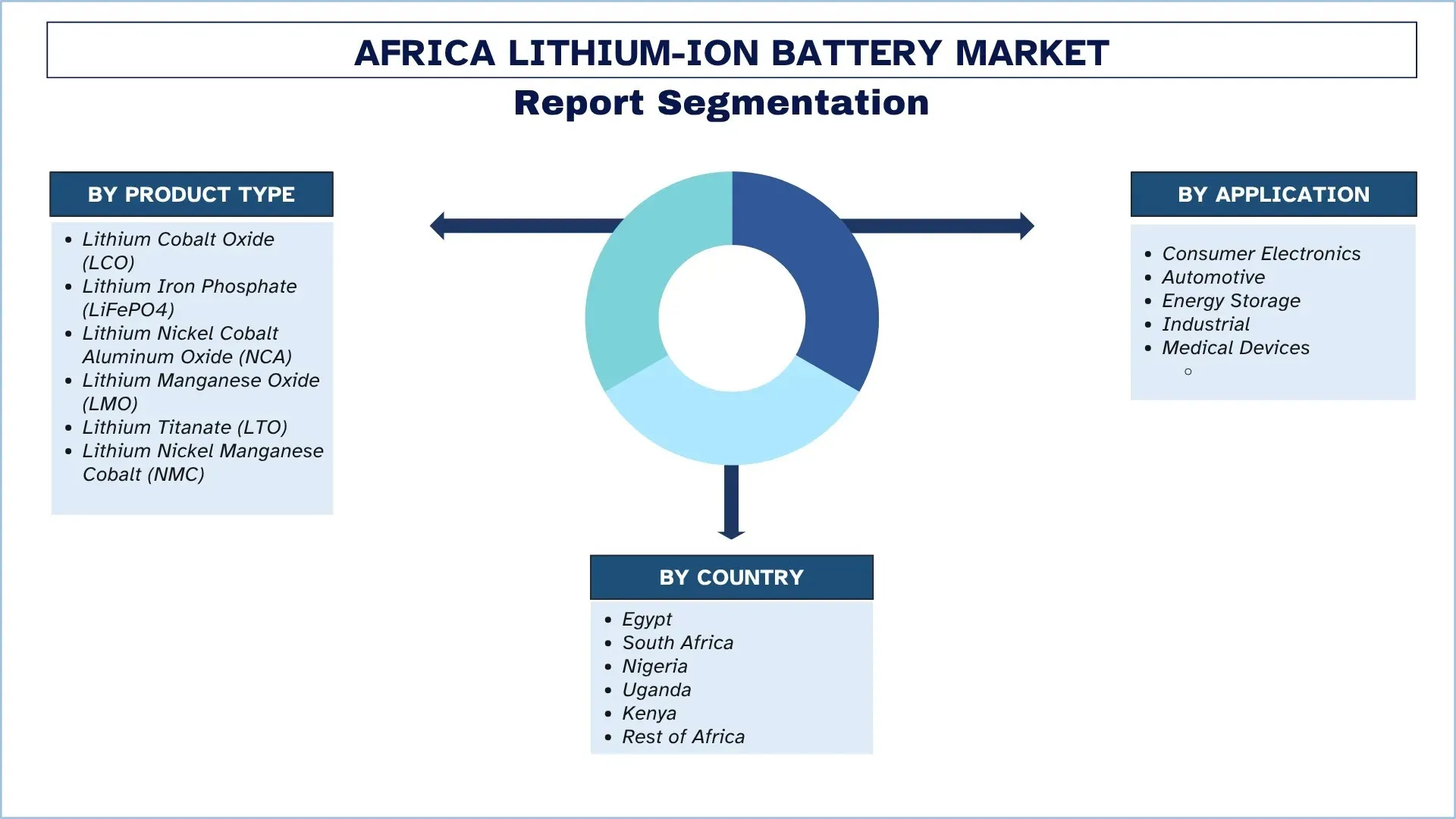
By product type, the Africa lithium-ion battery market is segmented into lithium-cobalt oxide (LCO), Lithium Iron Phosphate (LiFePO4), Lithium Nickel Cobalt Aluminum Oxide (NCA), Lithium Manganese Oxide (LMO), Lithium Titanate (LTO), and Lithium Nickel Manganese Cobalt (NMC). Among those, the Lithium Iron Phosphate (LiFePO4) segment has taken a huge portion of the African market for lithium-ion batteries. The main reasons why this dominates are that it has a greater thermal stability, cycle life, and increased safety over other chemistries, which are therefore very applicable in electric vehicles, renewable energy storage, and backup power system applications. LiFePO4 batteries are also much cheaper to maintain and to run, which fits the needs of Africa to focus on affordable and sustainable energy solutions. They can also work effectively in hot weather and in adverse environmental conditions, thus enhancing their implementation in areas with hot climates. Also, the increased manufacturing of affordable electric mobility and solar power systems has increased the demand for LiFePO4 batteries, which have become the choice of batteries in the African automotive and industrial sectors.
The automotive category held a significant share of the African Lithium-Ion Battery Market.
Based on Application, the African lithium-ion battery market is segmented into consumer electronics, automotive, energy storage, industrial, and medical devices. The automotive segment has held a notable market share of the African market with regard to lithium-ion batteries. This is led by the increasing use of electric vehicles (EVs) on the continent, which is backed by government policies to embrace sustainable transportation and minimize carbon emissions. The demand for automotive lithium-ion batteries has also been boosted by the rising investments in EV infrastructure, including charging stations and local assembly plants of vehicles. Also, market penetration has been enhanced after the increasing supply of low-cost electric two and three-wheeled vehicles for urban mobility. This high energy density, extended lifespan, and rapid charge characteristics of lithium ion batteries make them the most suitable choice in the automotive industry, which has ensured their top of the hierarchy in the battery market in Africa.
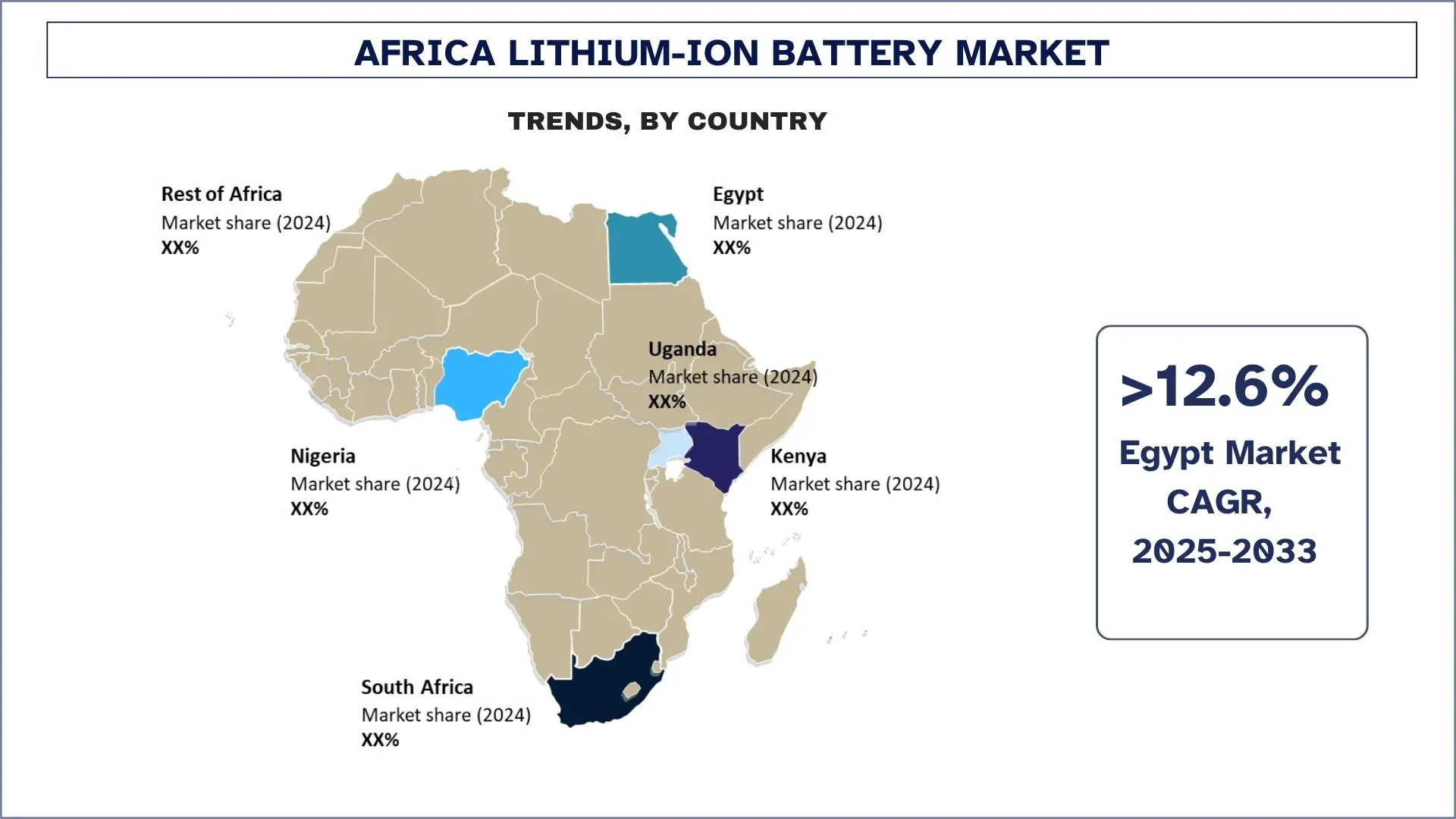
Egypt is expected to grow at a considerable rate during the forecast period.
The market of the Egyptian lithium-ion battery is experiencing a high growth rate due to increasing adoption of renewable energy, electric mobility, and the electrification of industries in Egypt. The strategic plans of Egypt, as set out in the Vision 2030 structure, focus on adopting clean energy, cutting down on carbon gases, and improving energy efficiency, and all these are contributing to the growth of energy storage systems that are highly advanced. The growing installation of solar and wind power projects is putting a high demand on lithium-ion battery reliability to serve grid stability and off-grid requirements. In addition, the government has been supporting the production of electric vehicles and charging systems, which enhances the growth of the market. It is also empowering domestic capabilities through international cooperation and investments in local assembly and research of batteries. As urbanization, energy consumption, and environmental consciousness increase, Egypt has an opportunity to become a regional center of lithium-ion battery production, innovation, and long-term energy storage solutions. In July 2025, AMEA Power announced the completion of Egypt’s first-ever utility-scale Battery Energy Storage System facility in Aswan Governorate in Cairo. The BESS has a capacity of 300 MWh, connected with the company's newly made solar power plant of capacity 500 MWh.
Africa Lithium-Ion Battery Industry Competitive Landscape:
The Africa Lithium-Ion Battery market is competitive, with several global and international market players. The key players are adopting different growth strategies to enhance their market presence, such as partnerships, agreements, collaborations, new product launches, geographical expansions, and mergers and acquisitions.
Top Africa Lithium-Ion Battery Companies
Some of the major players in the market are JSDSolar, CTG EYIL PVT LTD, ESENER, Potensa (Pty) Ltd, Revov, Hanchu Energy SA, SolarMD, Freedom Won (Pty) Ltd, Blue Nova Energy (Pty) Ltd, and IG3N (Pty) Ltd.
Africa Lithium-Ion Battery Market Report Coverage
Report Attribute | Details |
Base year | 2024 |
Forecast period | 2025-2033 |
Growth momentum | Accelerate at a CAGR of 13.00% |
Market size 2024 | USD 800 Million |
Country analysis | Egypt, South Africa, Nigeria, Uganda, Kenya, and the Rest of Africa |
Major contributing Country | Egypt is expected to dominate the market during the forecast period. |
Companies profiled | JSDSolar, CTG EYIL PVT LTD, ESENER, Potensa (Pty) Ltd, Revov, Hanchu Energy SA, SolarMD, Freedom Won (Pty) Ltd, Blue Nova Energy (Pty) Ltd, and IG3N (Pty) Ltd |
Report Scope | Market Trends, Drivers, and Restraints; Revenue Estimation and Forecast; Segmentation Analysis; Demand and Supply Side Analysis; Competitive Landscape; Company Profiling |
Segments Covered | by Product Type, by Application, by Country |
Reasons to Buy the Africa Lithium-Ion Battery Market Report:
The study includes market sizing and forecasting analysis confirmed by authenticated key industry experts.
The report briefly reviews overall industry performance at a glance.
The report covers an in-depth analysis of prominent industry peers, primarily focusing on key business financials, type portfolios, expansion strategies, and recent developments.
Detailed examination of drivers, restraints, key trends, and opportunities prevailing in the industry.
The study comprehensively covers the market across different segments.
Deep dive Country-level analysis of the industry.
Customization Options:
The Africa Lithium-Ion Battery Market can further be customized as per requirements or any other market segment. Besides this, UnivDatos understands that you may have your own business needs; hence, feel free to contact us to get a report that completely suits your requirements.
Table of Content
Research Methodology for the Africa Lithium-Ion Battery Market Analysis (2023-2033)
We analyzed the historical market, estimated the current market, and forecasted the future market of the Africa Lithium-Ion Battery market to assess its application in major countries. We conducted exhaustive secondary research to gather historical market data and estimate the current market size. To validate these insights, we carefully reviewed numerous findings and assumptions. Additionally, we conducted in-depth primary interviews with industry experts across the Lithium-Ion Battery value chain. After validating market figures through these interviews, we used both top-down and bottom-up approaches to forecast the overall market size. We then employed market breakdown and data triangulation methods to estimate and analyze the market size of industry segments and sub-segments.
Market Engineering
We employed data triangulation techniques to finalize the overall market estimation and derive precise statistical numbers for each segment and sub-segment of the Africa Lithium-Ion Battery market. We split the data into several segments and sub-segments by analyzing various parameters and trends, by Product Type, by Application, and by country within the Africa Lithium-Ion Battery market.
The Main Objective of the Africa Lithium-Ion Battery Market Study
The study identifies current and future trends in the African Lithium-Ion Battery market, providing strategic insights for investors. It highlights Country-level market attractiveness, enabling industry participants to tap into untapped markets and gain a first-move advantage. Other quantitative goals of the studies include:
Market Size Analysis: Assess the current forecast and market size of the Africa Lithium-Ion Battery market and its segments in terms of value (USD).
Africa Lithium-Ion Battery Market Segmentation: Segments in the study include areas by Product Type, by Application, and by
Regulatory Framework & Value Chain Analysis: Examine the regulatory framework, value chain, customer behavior, and competitive landscape of the Africa Lithium-Ion Battery industry.
Country Analysis: Conduct a detailed Country analysis for key areas such as Egypt, South Africa, Nigeria, Uganda, Kenya, and the Rest of Africa.
Company Profiles & Growth Strategies: Company profiles of the Africa Lithium-Ion Battery market and the growth strategies adopted by the market players to sustain the fast-growing market.
Frequently Asked Questions FAQs
Q1: What is the Africa Lithium-Ion Battery market’s current market size and growth potential?
The Africa Lithium-Ion Battery market was valued at 800 million in 2024 and is expected to grow at a CAGR of 13.00% during the forecast period (2025-2033).
Q2: Which segment has the largest share of the Africa Lithium-Ion Battery market by Product Type?
The Lithium Iron Phosphate (LiFePO4) segment has taken a huge portion of the African market. The main reasons why this dominates are that it has a greater thermal stability, cycle life, and increased safety over other chemistries, which are therefore very applicable in electric vehicles, renewable energy storage, etc.
Q3: What are the driving factors for the growth of the Africa Lithium-Ion Battery market?
• Growing Demand for Electric Vehicles (EVs): The increasing adoption of electric vehicles across Africa is significantly driving the growth of automotive batteries. As EV sales rise, the need for efficient, durable lithium-ion batteries expands, further stimulating market growth.
• Rise in Battery Energy Storage Systems (BESS) for Renewable Energy Projects: The growing emphasis on renewable energy sources, such as solar and wind, is propelling the demand for Battery Energy Storage Systems (BESS). These systems store energy generated by renewables, ensuring a reliable energy supply even when production is intermittent.
Q4: What are the emerging technologies and trends in the Africa Lithium-Ion Battery market?
• Localization of Battery Value Chains: A key trend in the African lithium-ion battery market is the localization of production and supply chains. African countries are increasingly focusing on establishing local manufacturing plants and regional gigafactories to process raw materials and produce batteries domestically, reducing reliance on imports.
• Technological Shifts Toward LFP and Sodium-Ion Batteries: Advances in battery technology are evident with the growing adoption of Lithium Iron Phosphate (LFP) and sodium-ion batteries. These batteries offer advantages like cost efficiency, thermal stability, and a more sustainable approach, which aligns with Africa's push toward clean energy and sustainability.
Q5: What are the key challenges in the Africa Lithium-Ion Battery market?
• Infrastructure and Logistics Constraints: Weak infrastructure, including inadequate transportation networks and unreliable energy grids, presents a major challenge. The lack of efficient logistics systems hinders the smooth flow of materials and finished products, delaying the market’s expansion.
• High Initial Costs and Financing Barriers: The high upfront costs of setting up lithium-ion battery manufacturing plants and renewable energy systems pose a financial challenge. Additionally, limited access to affordable financing, coupled with high perceived risks, makes it difficult for investors to support large-scale projects.
Q6: Which country dominates the Africa Lithium-Ion Battery market?
The market of the Egyptian lithium-ion battery is experiencing a high growth rate due to increasing adoption of renewable energy, electric mobility, and the electrification of industries in Egypt.
Q7: Who are the key players in the Africa Lithium-Ion Battery market?
Some of the top Lithium-Ion Battery companies in Africa include:
• JSDSolar
• CTG EYIL PVT LTD
• ESENER
• Potensa (Pty) Ltd
• Revov
• Hanchu Energy SA
SolarMD
• Freedom Won (Pty) Ltd
• Blue Nova Energy (Pty) Ltd
• IG3N (Pty) Ltd
Q8: What are the opportunities for companies within the Africa Lithium-Ion Battery market?
• Increasing Government Investments in Lithium-Ion Battery Projects: Governments across Africa are ramping up investments in the lithium-ion battery market, recognizing the potential for economic growth and energy security. These investments are being directed towards building manufacturing capabilities, encouraging local production, and promoting the development of infrastructure necessary for large-scale battery production. This also helps in creating jobs, advancing technology, and reducing reliance on imports, positioning Africa as a key player in the global energy storage market.
• Partnerships for Energy Access and Off-Grid Storage Solutions: Collaborations between governments, private sector players, and international organizations are driving innovations in energy access. Partnerships aimed at expanding off-grid solar and storage solutions are enabling rural and underserved communities to access reliable electricity. Battery storage, integrated with solar power, offers a practical solution for regions facing unreliable grid access, unlocking significant potential for growth in the African energy sector.
Q9: How are consumer preferences shaping product development in the Africa Lithium-Ion Battery market?
Consumer preferences in the Africa Lithium-Ion Battery market are driving product development towards more affordable, durable, and sustainable energy solutions. There is a growing demand for batteries with longer lifespans, higher efficiency, and compatibility with renewable energy systems, especially in off-grid areas.
Related Reports
Customers who bought this item also bought
India Decarbonization HVAC Market: Current Analysis and Forecast (2026-2034)
Emphasis on Product Type (Heating Equipment, Ventilation Equipment, Air Conditioning Equipment, Others); Decarbonization Type (Direct, Indirect); Capacity (Up to 5 Tons, 5-20 Tons, Above 20 Tons); End User (Commercial Buildings, Residential Buildings, Industrial Facilities, Healthcare Facilities, Data Centers, Others); and Region/States

Midstream Oil & Gas Filtration Market: Current Analysis and Forecast (2026-2034)
Emphasis on Filter Technology (Coalescer Filters, Cartridge Filters, Mechanical Filters, Bag Filters, Particulate Filters, Activated Carbon Filters, Strainers, and Others); by Application (Gas Processing Plants, Compression Stations, Storage And Distribution, Pipeline Transportation, LNG Processing, and Others); by Filtration Stage (Oil Filtration and Gas Filtration), by End User (Refineries and Petrochemical Industry), and Region/Country
Hydrogen-Powered Hospital Backup Systems Market: Current Analysis and Forecast (2026-2034)
Emphasis on System Type (Portable, Stationary, Hybrid); Power Capacity (Below 100 kW, 100–500 kW, and Above 500 kW); End-User (Public Hospitals, Private Hospitals, Specialty Hospitals, and Emergency Care Facilities); and Region/Country
Wind LiDAR Market: Current Analysis and Forecast (2025-2033)
Emphasis on Product Type (Vertical Profiling Wind LiDAR, Ground-Based Wind LiDAR, Nacelle-Mounted Wind LiDAR, Airborne Wind LiDAR, and Others); Component (Sensor, Navigator, Laser, and Others); Location (Onshore and Offshore); Application (Wind Power, Meteorology & Environment, and Aviation); and Region/Country