Southeast Asia Medical Wearable Devices Market: Current Analysis and Forecast (2025-2033)
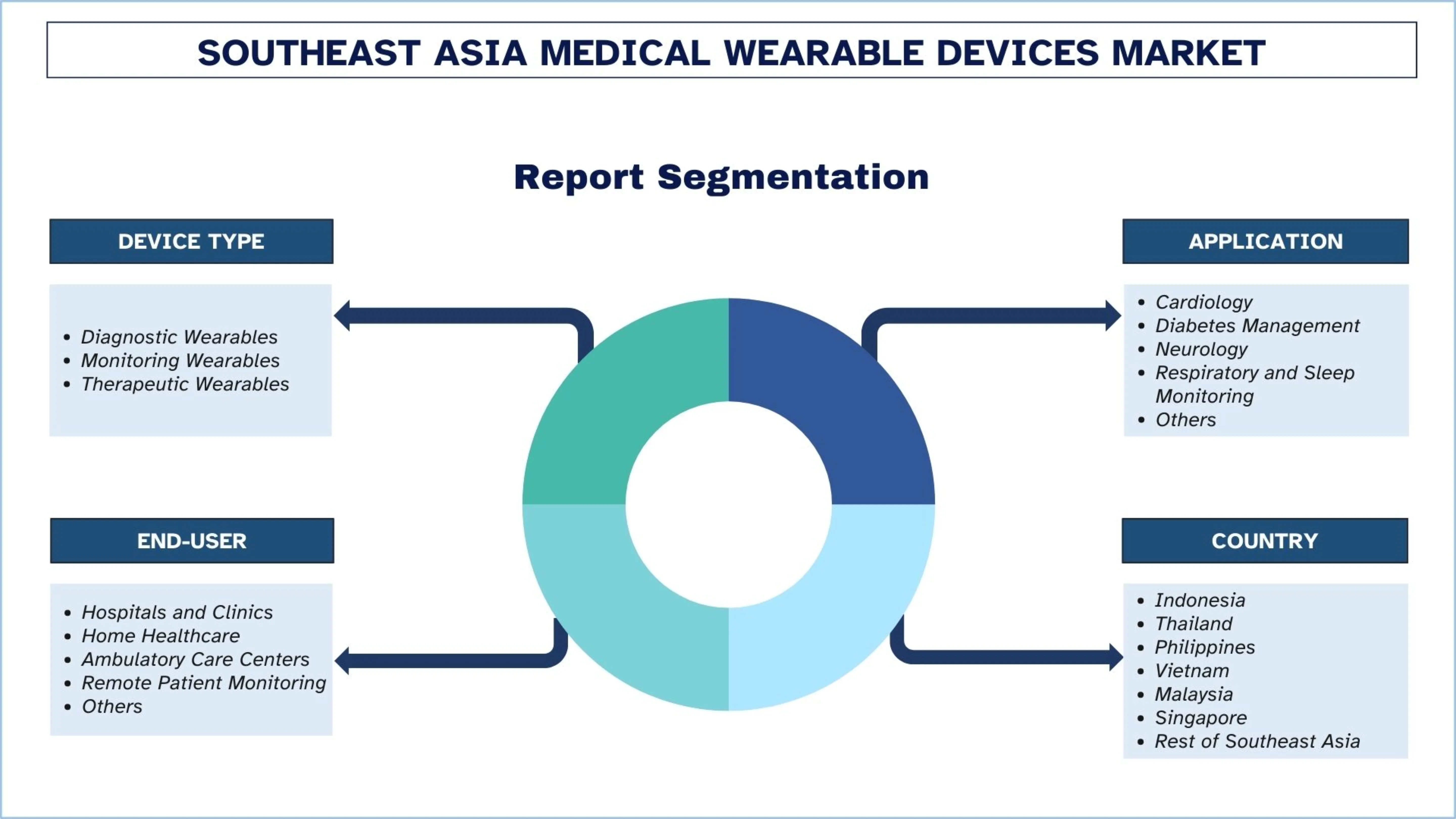
Emphasis on Device Type (Diagnostic Wearables, Monitoring Wearables, Therapeutic Wearables); Application (Cardiology, Diabetes Management, Neurology, Respiratory and Sleep Monitoring, Others); End-User (Hospitals and Clinics, Home Healthcare, Ambulatory Care Centers, Remote Patient Monitoring, Others); and Country.
Southeast Asia Medical Wearable Devices Market Size & Forecast
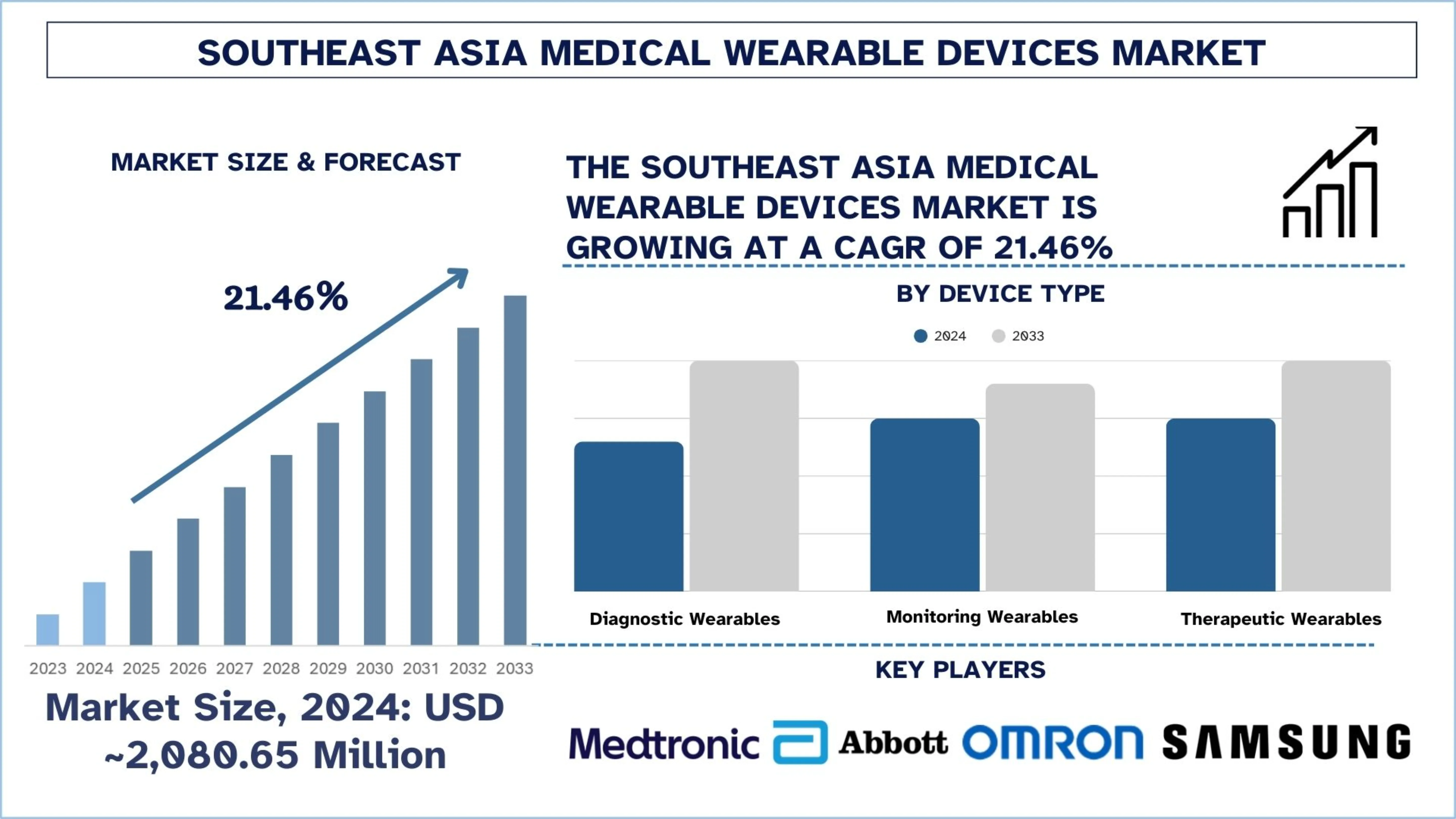
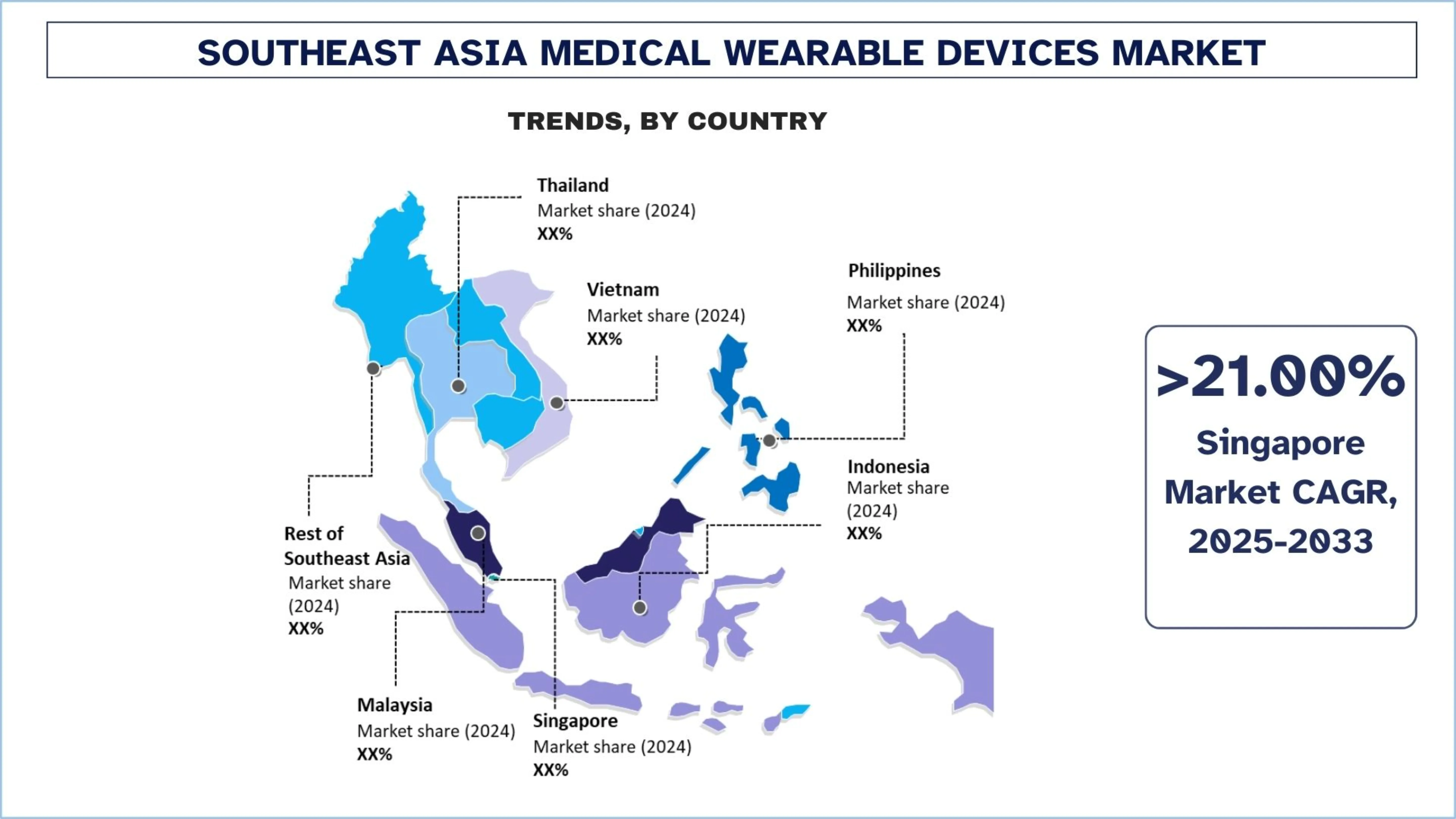
The Southeast Asia Medical Wearable Devices Market was valued at ~USD 2,080.65 million in 2024 and is expected to grow at a strong CAGR of approximately 21.46% during the forecast period (2025-2033F), driven by the rising prevalence of chronic diseases and an aging population.
Southeast Asia Medical Wearable Devices Market Analysis
Medical wearable devices are electronic, sensor-based products worn on the body to monitor, diagnose, or assist in the real-time management of health conditions. These devices capture physiological data and transmit it to healthcare systems to facilitate continuous clinical monitoring and decision-making.
The adoption of medical wearable devices in Southeast Asia is focused on increasing their integration with cloud-based platforms, telehealth ecosystems, and hospital information systems to facilitate continuous remote monitoring and drive growth. Manufacturers and service providers are targeting localized product customization, low cost, and mobile-first interoperability to accommodate diverse healthcare infrastructures in the region. Additionally, partnerships with healthcare providers to incorporate wearables into chronic disease management initiatives, home healthcare models, and post-discharge monitoring pathways can be considered implementation strategies. Further, data analytics and AI-sensitive insights are being included to promote clinical value, enhance treatment adherence, and demonstrate quantifiable health outcomes, which contribute to broader acceptance by the physician and payer.
On December 10, 2025, the Singapore-MIT Alliance for Research and Technology (SMART), Massachusetts Institute of Technology’s (MIT) research enterprise in Singapore, launched a new collaborative research project – Wearable Imaging for Transforming Elderly Care (WITEC). The Wearable Imaging for Transforming Elderly Care (WITEC) collaborative research project aims to develop the world’s first wearable ultrasound imaging system for continuous, real-time monitoring and personalized diagnosis of chronic conditions such as hypertension and heart failure.
Southeast Asia Medical Wearable Devices Market Trends
This section discusses the key market trends that are influencing the various segments of the Southeast Asia Medical Wearable Devices market, as found by our team of research experts.
Growing Use of Cloud-based Health Data Platforms
The trend toward cloud-based health data platforms is a primary development in Southeast Asia's medical wearable devices market, as more healthcare providers are moving toward centralized, scalable data management systems. Cloud solutions enable easy storage, analysis, and sharing of large datasets of real-time patient data collected by wearables. This supports ongoing monitoring, remote consultation, and expeditious clinical decision-making in both hospitals and homes. Moreover, the rise of cloud integration enhances the interoperability of devices, telehealth platforms, and hospital information systems. With the growth in both data accessibility and analytics capabilities, cloud-based ecosystems are emerging as a fundamental enabler of wearable adoption in the region.
Southeast Asia Medical Wearable Devices Industry Segmentation
This section provides an analysis of the key trends in each segment of the Southeast Asia Medical Wearable Devices market, along with forecasts at the country level for 2025-2033.
The monitoring wearable devices market held the dominant share of the Medical Wearable Devices market in 2024.
Based on device type, the market is segmented into diagnostic wearables, monitoring wearables, and therapeutic wearables. Among these, the monitoring wearable devices market held the largest share in 2024. This is mainly due to its providing real-time monitoring of key health indicators like heart rate, blood pressure, and glucose levels. Their capacity to reduce hospitalizations and support long-term disease management makes them highly appealing to healthcare providers and payers. With improved clinical acceptance, companies are rapidly expanding monitoring-targeted product lines to meet increased demand in both home care and telehealth environments. For example, on March 31, 2023, Dexcom is the global leader in real-time continuous glucose monitoring (CGM) for people with diabetes and launched its Dexcom G6 CGM System in Singapore, targeted toward diabetes patients from the ages of two years and older, including pregnant women. Dexcom G6 uses a small, wearable sensor and transmitter to continuously measure and send glucose levels wirelessly to a receiver or compatible smart device, enabling patients to receive real-time glucose data without the need to prick their finger.
The cardiology segment held the largest share in 2024 of the medical wearable devices market.
Based on the application, the market is segmented into cardiology, diabetes management, neurology, respiratory and sleep monitoring, and others. Among these, the cardiology segment held the dominant share of the Southeast Asia Medical Wearable Devices market in 2024. The market growth is propelled by cardiology applications because of the high cases of cardiovascular diseases and the necessity to diagnose the disease in its early stages and constantly monitor the heart. The heart rhythm monitors and wearable ECGs help in preventive care and follow-up after the treatment process, enhancing clinical outcomes. This high clinical interest prompts companies to focus on cardiology-related innovations and regulatory clearances, thereby expediting their use in Southeast Asia. For instance, on September 29, 2023, Cardiovascular diseases account for 3.9 million deaths in the WHO South-East Asia Region every year, a quarter of all deaths from noncommunicable diseases (NCDs), with most of them being preventable.
Singapore held a dominant share of the Southeast Asian Medical Wearable Devices market in 2024
Singapore is a key driver of the medical wearable device market in Southeast Asia, thanks to its highly advanced healthcare sector and effective regulatory environment. Digital health has gained traction in the country, positioning it as an early adopter and enabling faster adoption of wearable devices in clinical workflows and remote patient monitoring programs. Adding to this, the high levels of per-capita healthcare spending and government support for healthcare innovation contribute to faster adoption. Singapore also has a regional testing and commercialization centre, which allows companies to test technologies before expanding to other regions. Therefore, the high-quality data infrastructure and physician acceptance are contributing to long-term market growth.
For example, on October 8, 2025, Apple Watch introduced a hypertension notification feature in Singapore that alerts users when signs of chronic high blood pressure (hypertension) are detected. These notifications provide users with valuable insights into their health as it relates to this widespread condition by simply wearing their Apple Watch, enabling them to begin potentially lifesaving behavioural changes or start treatment to reduce their risk of serious, long-term health events.
Southeast Asia Medical Wearable Devices Industry Competitive Landscape
The Southeast Asia Medical Wearable Devices market is competitive, with several global and international market players. The key players are adopting different growth strategies to enhance their market presence, such as partnerships, agreements, collaborations, new product launches, geographical expansions, and mergers and acquisitions.
Top Southeast Asia Medical Wearable Devices Companies
Some of the major players in the market are Medtronic, Abbott, Omron Corporation, SAMSUNG, Koninklijke Philips N.V., Google (Alphabet Inc.), Garmin Ltd., Apple Inc., Aevice Health Pte Ltd., Huawei Device Co., Ltd.
Recent Developments in the Southeast Asia Medical Wearable Devices Market
In November 2024, Singapore's Health Promotion Board partnered with several technology companies to pilot programmes that aim to promote self-health management by delivering data-driven, personalised recommendations for preventing and managing chronic diseases. The Health Promotion Board is piloting two preventative health programmes with Google and Abbott involving 6,000 Singaporeans.
Southeast Asia Medical Wearable Devices Market Report Coverage
Report Attribute | Details |
Base year | 2024 |
Forecast period | 2025-2033 |
Growth momentum | Accelerate at a CAGR of 21.46% |
Market size 2024 | ~USD 2,080.65 million |
Country analysis | Indonesia, Thailand, Philippines, Vietnam, Malaysia, Singapore, Rest of Southeast Asia |
Major contributing Country | Vietnam is expected to grow at the highest CAGR during the forecasted period. |
Companies profiled | Medtronic, Abbott, Omron Corporation, SAMSUNG, Koninklijke Philips N.V., Google (Alphabet Inc.), Garmin Ltd., Apple Inc., Aevice Health Pte Ltd., Huawei Device Co., Ltd. |
Report Scope | Market Trends, Drivers, and Restraints; Revenue Estimation and Forecast; Segmentation Analysis; Demand and Supply Side Analysis; Competitive Landscape; Company Profiling |
Segments Covered | By Device Type, By Application, By End-User, By Country |
Reasons to Buy the Southeast Asia Medical Wearable Devices Market Report:
The study includes market sizing and forecasting analysis confirmed by authenticated key industry experts.
The report briefly reviews overall industry performance at a glance.
The report covers an in-depth analysis of prominent industry peers, primarily focusing on key business financials, product portfolios, expansion strategies, and recent developments.
Detailed examination of drivers, restraints, key trends, and opportunities prevailing in the industry.
The study comprehensively covers the market across different segments.
Customization Options:
The Southeast Asia Medical Wearable Devices market can further be customized as per requirements or any other market segment. Besides this, UnivDatos understands that you may have your own business needs; hence, feel free to contact us to get a report that completely suits your requirements.
Table of Content
Research Methodology for the Southeast Asia Medical Wearable Devices Market Analysis (2023-2033)
We analyzed the historical market, estimated the current market, and forecasted the future market of the Southeast Asian Medical Wearable Devices market to assess its application in major countries. We conducted exhaustive secondary research to gather historical market data and estimate the current market size. To validate these insights, we carefully reviewed numerous findings and assumptions. Additionally, we conducted in-depth primary interviews with industry experts across the Southeast Asian Medical Wearable Devices value chain. After validating market figures through these interviews, we used both top-down and bottom-up approaches to forecast the overall market size. We then employed market breakdown and data triangulation methods to estimate and analyze the market size of industry segments and sub-segments.
Market Engineering
We employed the data triangulation technique to finalize the overall market estimation and derive precise statistical numbers for each segment and sub-segment of the Southeast Asia Medical Wearable Devices market. We split the data into several segments and sub-segments by analyzing various parameters and trends, including device type, application, end-user, and country within the Southeast Asian Medical Wearable Devices market.
The Main Objective of the Southeast Asia Medical Wearable Devices Market Study
The study identifies current and future trends in the Southeast Asia Medical Wearable Devices market, providing strategic insights for investors. It highlights market attractiveness, enabling industry participants to tap into untapped markets and gain a first-mover advantage. Other quantitative goals of the studies include:
Market Size Analysis: Assess the current and forecast market size of the Southeast Asia Medical Wearable Devices market and its segments in terms of value (USD).
Southeast Asia Medical Wearable Devices Market Segmentation: Segments in the study include areas of device type, application, end-user, and country.
Regulatory Framework & Value Chain Analysis: Examine the regulatory framework, value chain, customer behavior, and competitive landscape of the Southeast Asia Medical Wearable Devices industry.
Country Analysis: Conduct a detailed country analysis for key areas such as Indonesia, Thailand, the Philippines, Vietnam, Malaysia, Singapore, and the Rest of Southeast Asia.
Company Profiles & Growth Strategies: Company profiles of the Southeast Asia Medical Wearable Devices market and the growth strategies adopted by the market players to sustain the fast-growing market.
Frequently Asked Questions FAQs
Q1: What is the Southeast Asia Medical Wearable Devices market’s current market size and growth potential?
The Southeast Asia Medical Wearable Devices market was valued at ~USD 2,080.65 million in 2024 and is projected to expand at a CAGR of 21.46% from 2025 to 2033. The rising prevalence of chronic diseases is driving strong growth, the rapid adoption of remote patient monitoring solutions, increased healthcare digitalization, and expanding investments in connected and preventive healthcare technologies across the region.
Q2: Which segment has the largest share of the Southeast Asia Medical Wearable Devices market by device type?
Monitoring wearables dominate the Southeast Asia medical wearable devices market due to their widespread use in continuous heart rate monitoring, glucose tracking, blood pressure monitoring, and activity-based health assessment. Their strong adoption across hospitals, home healthcare settings, and telehealth platforms supports sustained demand across both urban and emerging markets.
Q3: What are the driving factors for the growth of the Southeast Asia Medical Wearable Devices market?
Market growth is driven by the rising burden of chronic diseases, the expanding aging population, the increasing adoption of home-based and remote healthcare models, and high smartphone and internet penetration. Additionally, government initiatives supporting digital health, growing awareness of preventive care, and improving the affordability of wearable technologies are accelerating adoption across Southeast Asia.
Q4: What are the emerging technologies and trends in the Southeast Asia Medical Wearable Devices market?
Key trends include growing use of cloud-based health data platforms, integration of AI and advanced analytics, increasing adoption of multi-parameter medical wearables, and rising interoperability with hospital information systems. There is also a visible shift from consumer-focused wearables to clinically validated, medical-grade devices supporting long-term disease management.
Q5: What are the key challenges in the Southeast Asia Medical Wearable Devices market?
Major challenges include fragmented regulatory frameworks across countries, limited reimbursement coverage for wearable devices, data privacy and cybersecurity concerns, and high upfront device costs. In addition, lack of standardized clinical validation in emerging markets can slow adoption among healthcare providers.
Q6: Which country dominates the Southeast Asia Medical Wearable Devices market?
Singapore dominates the Southeast Asia medical wearable devices market due to its advanced healthcare infrastructure, strong regulatory framework, early adoption of digital health technologies, and high healthcare expenditure. The country also serves as a regional innovation and commercialization hub for medical technologies.
Q7: Who are the key players in the Southeast Asia Medical Wearable Devices market?
Leading companies in the Southeast Asia Medical Wearable Devices market include:
• Medtronic
• Abbott
• Omron Corporation
• SAMSUNG
• Koninklijke Philips N.V.
• Google (Alphabet Inc.)
• Garmin Ltd.
• Apple Inc.
• Aevice Health Pte Ltd.
• Huawei Device Co., Ltd.
Q8: Which application segment is expected to grow at the highest CAGR in the Southeast Asia Medical Wearable Devices market?
The diabetes management segment is expected to witness the highest growth rate due to increasing diabetes prevalence, rising adoption of continuous glucose monitoring systems, and growing focus on long-term disease management through connected healthcare solutions.
Q9: What opportunities exist for new entrants and investors in the Southeast Asia Medical Wearable Devices market?
Key opportunities include targeting underserved rural and semi-urban populations, developing affordable and localized wearable solutions, integrating AI-driven analytics, and partnering with telehealth and healthcare providers. The rapid digitalization of healthcare and rising demand for preventive care make Southeast Asia an attractive market for long-term investment.
Related Reports
Customers who bought this item also bought

Intramedullary Nail Leg Lengthening Market: Current Analysis and Forecast (2025-2033)
Emphasis on Technology (Magnetically Controlled Intramedullary Lengthening Nails, Motorized Intramedullary Lengthening Nails, Mechanical Intramedullary Lengthening Nails); Indication (Medical/Reconstructive Indication, Cosmetic/Stature Lengthening); Bone Type (Femoral Lengthening Nails, Tibial Lengthening Nails); End-use (Hospitals, Specialty Orthopedic Clinics, Other); and Region/Country
Non-Invasive Intracranial Pressure Monitoring Devices Market: Current Analysis and Forecast (2025-2033)
Emphasis on Technology (MRI/CT, Optic Nerve Sheath Diameter (ONSD) Ultrasound, Transcranial Doppler (TCD), Near-Infrared Spectroscopy (NIRS), and Others); Applications (Traumatic Brain Injury, Meningitis, Stroke, Intracerebral Hemorrhage, and Others); End-User (Hospitals & ICUs, Neurology Clinics, Ambulance & Emergency Services, Home Care Settings, and Others); and Region/Country
Southeast Asia Blood Glucose Monitoring Market: Current Analysis and Forecast (2025-2033)
Emphasis on Product Type (Self-Monitoring Blood Glucose (SMBG) Systems, {Glucometers, Testing Strips, Lancets & Lancing Devices}, Continuous Glucose Monitoring (CGM) Systems, {Sensors, Transmitters, Receivers}); Application (Diabetes Management, Health & Wellness Monitoring, Others); End-User (Hospitals & Clinics, Home-Care Settings, Diagnostic Centers, Others); and Country.
Middle East & Africa Laparoscopic Devices Market: Current Analysis and Forecast (2025-2033)
Emphasis By Product (Energy Systems, Robot-Assisted Systems, Laparoscopes, Insufflation Devices, Suction Devices and Access Devices), by Application (General Surgery, Colorectal Surgery, Bariatric Surgery, Gynaecological Surgery, Others), By End-User (Hospitals & Clinics and Ambulatory Surgical ), By Country (Saudi Arabia, UAE, Egypt, South Africa, Turkey, Israel, and the Rest of Middle East & Africa)