- Home
- About Us
- Industry
- Services
- Reading
- Contact Us
Non-Invasive Intracranial Pressure Monitoring Devices Market: Current Analysis and Forecast (2025-2033)
Emphasis on Technology (MRI/CT, Optic Nerve Sheath Diameter (ONSD) Ultrasound, Transcranial Doppler (TCD), Near-Infrared Spectroscopy (NIRS), and Others); Applications (Traumatic Brain Injury, Meningitis, Stroke, Intracerebral Hemorrhage, and Others); End-User (Hospitals & ICUs, Neurology Clinics, Ambulance & Emergency Services, Home Care Settings, and Others); and Region/Country
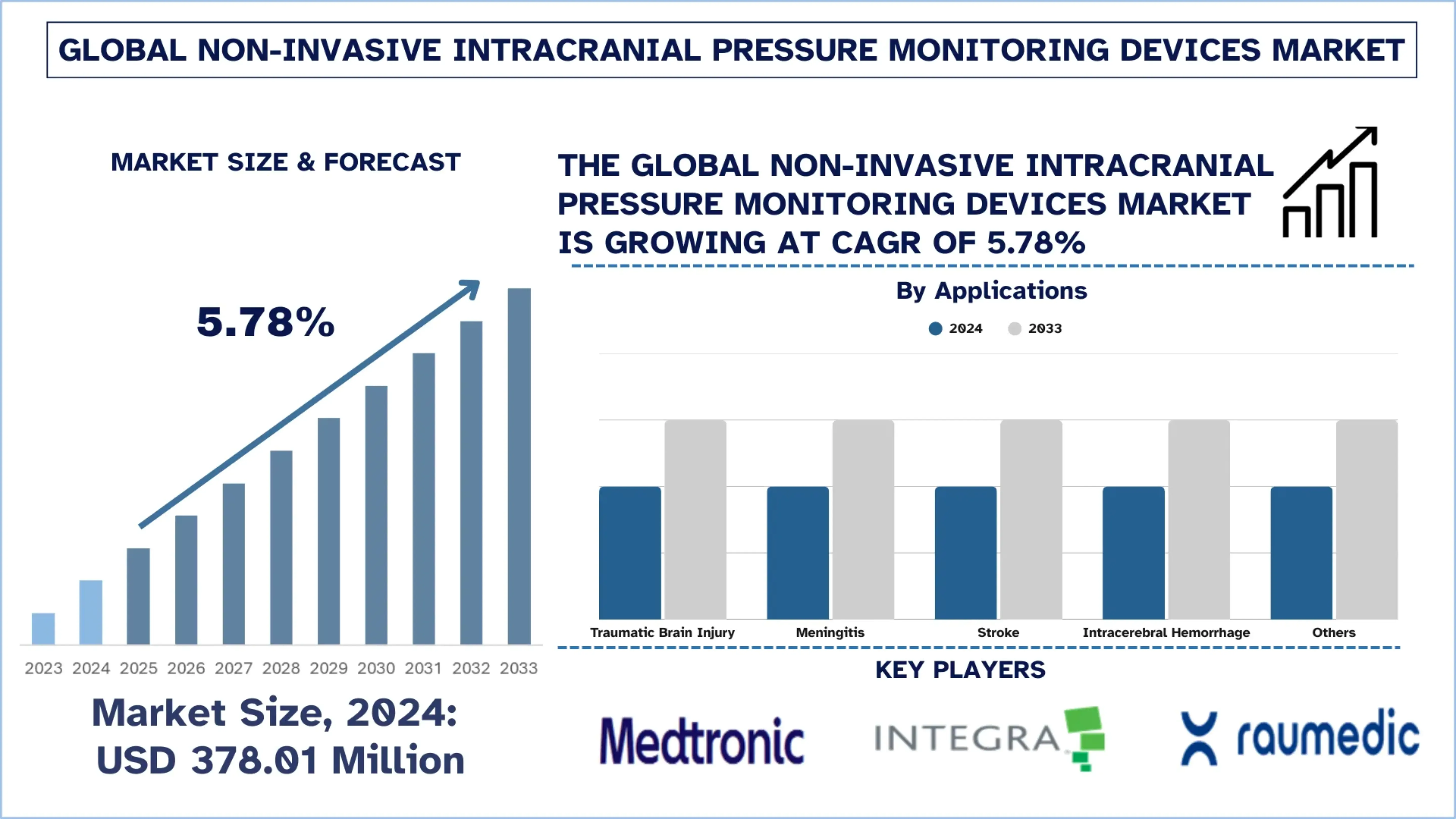
Global Non-invasive Intracranial Pressure Monitoring Devices Market Size & Forecast
The global Non-Invasive Intracranial Pressure Monitoring Devices Market was valued at USD 378.01 million in 2024 and is expected to grow at a strong CAGR of around 5.78% during the forecast period (2025-2033F), driven by rising neurological disorders, improving healthcare infrastructure, increasing road accidents, growing awareness, and expanding access to advanced monitoring technologies.
Non-invasive Intracranial Pressure Monitoring Devices Market Analysis
The non-invasive intracranial pressure monitoring devices market is experiencing steady growth due to the rising cases of neurological disorders and traumatic brain injuries worldwide. For example, the Alzheimer's Association reports that roughly 6.9 million Americans aged 65 and older were living with Alzheimer's dementia in 2024. This highlights the increasing burden of neurological diseases. In addition, the growing demand for safer alternatives to invasive monitoring methods is encouraging healthcare providers to adopt non-invasive technologies. Furthermore, the accuracy and reliability of these devices are improving through technological advancements in ultrasound, optical sensors, and artificial intelligence. Along with this, the market is supported by increased healthcare investments and the expansion of critical care infrastructure. Moreover, hospitals and emergency care units are increasingly using these technologies for early diagnosis and patient monitoring. As awareness of neurological health rises, the demand for effective, non-invasive monitoring solutions is expected to increase.
Global Non-invasive Intracranial Pressure Monitoring Devices Market Trends
This section discusses the key market trends that are influencing the various segments of the global non-invasive intracranial pressure monitoring devices market, as found by our team of research experts.
The Integration of Artificial Intelligence and Machine Learning into Monitoring Devices
The incorporation of AI and machine learning into non-invasive intracranial pressure (ICP) monitoring devices is a major trend in the market. These technologies enable systems to analyze complex physiological data and detect patterns indicative of changes in intracranial pressure. For example, in September 2024, Mount Sinai Health System researchers created an AI-driven tool that predicts intracranial pressure using physiological data, potentially providing safer, non-invasive monitoring and earlier clinical intervention. On the contrary, AI-driven algorithms can improve the accuracy of intracranial pressure estimation by processing signals obtained from ultrasound, optical, or other non-invasive methods. Moreover, machine learning models can help clinicians predict neurological decline and facilitate prompt clinical interventions. As digital healthcare continues to evolve, the incorporation of AI-powered analytics is expected to improve diagnostic capabilities and optimize patient monitoring strategies.
Non-invasive Intracranial Pressure Monitoring Devices Industry Segmentation
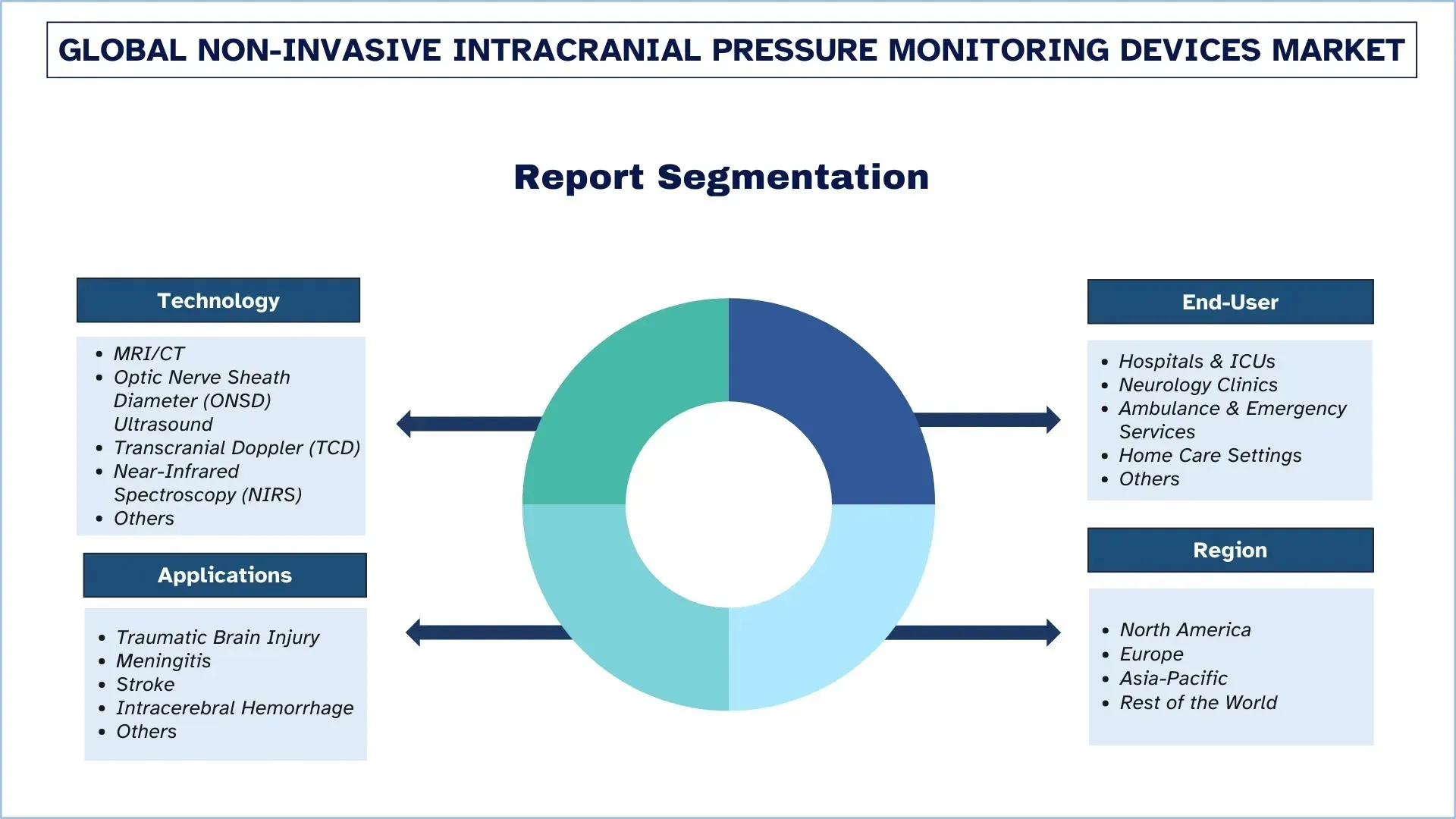
This section provides an analysis of the key trends in each segment of the global non-invasive intracranial pressure monitoring devices market report, along with forecasts at the global, regional, and country levels for 2025-2033.
The MRI/CT Segment Dominates the Global Non-invasive Intracranial Pressure Monitoring Devices Market
Based on technology, the market is categorized into MRI/CT, optic nerve sheath diameter (ONSD) ultrasound, transcranial doppler (TCD), near-infrared spectroscopy (NIRS), and others. In 2024, MRI and CT dominated the non-invasive intracranial pressure monitoring market. This is due to their widespread availability, high diagnostic accuracy, and regular use in neurological emergencies. These imaging techniques help identify structural brain problems, such as bleeding, swelling, and midline shift, which are associated with increased intracranial pressure. For instance, according to the National Library of Medicine, in 2023, approximately 93 million computed tomography (CT) examinations were performed on 62 million patients annually in the United States. However, optic nerve sheath diameter (ONSD) ultrasound is experiencing the fastest growth because it offers fast bedside evaluation, lower cost, and portability compared with other imaging techniques. Moreover, rising adoption in emergency departments, intensive care units, and pre-hospital settings, and growing clinical evidence supporting its effectiveness in estimating intracranial pressure, are driving rapid global market expansion.
Traumatic Brain Injury Segment Dominates the Global Non-invasive Intracranial Pressure Monitoring Devices Market.
Based on the applications, the market is categorized into traumatic brain injury, meningitis, stroke, intracerebral hemorrhage, and others. Traumatic brain injury holds the largest share of the non-invasive intracranial pressure monitoring market because of its high global prevalence and frequent occurrence from road accidents, falls, and sports injuries. For instance, according to the National Safety Council, 4.4 million people were treated in emergency departments for injuries involving sports and recreational equipment in 2024. This highlights the notable risk of traumatic injuries that may lead to traumatic brain injury and increase the need for intracranial pressure monitoring technologies. In addition, patients with severe traumatic brain injury often require continuous intracranial pressure assessment to prevent complications and improve clinical outcomes. As a result, healthcare providers widely use monitoring technologies in emergency and critical care settings. However, intracerebral hemorrhage is expected to witness the fastest growth, driven by the growing incidence of stroke, aging populations, and increasing awareness regarding early diagnosis and monitoring of brain pressure changes associated with hemorrhagic stroke and related neurological complications.
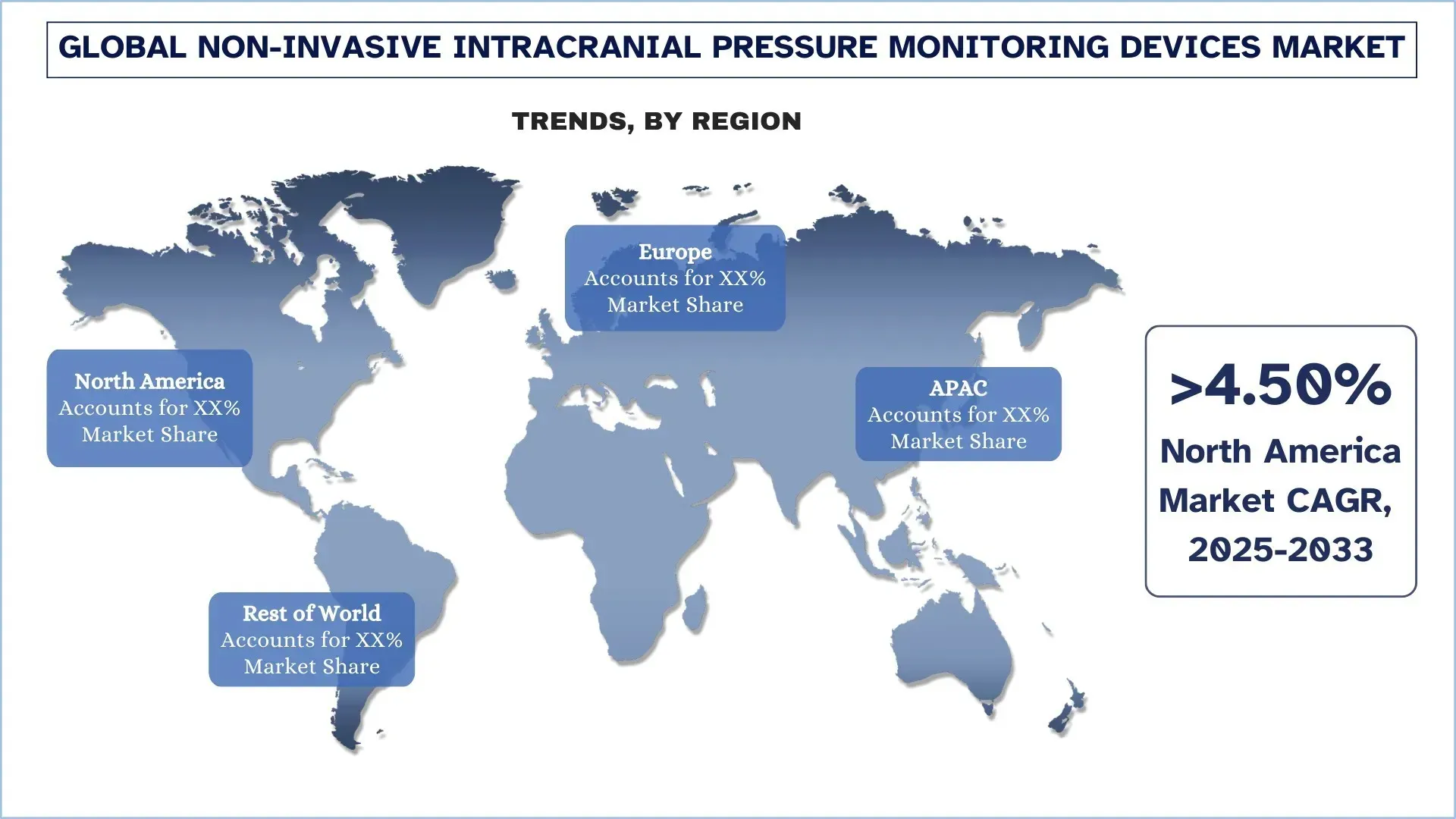
North America holds the largest market share in the global non-invasive intracranial pressure monitoring devices market
In 2024, North America holds the largest share of the non-invasive intracranial pressure monitoring devices market, mainly because of its modern healthcare infrastructure and widespread use of advanced medical technologies. The region benefits from prominent medical device manufacturers and well-established hospitals that feature sophisticated neuromonitoring systems. Along with this, the high cases of traumatic brain injuries, stroke, and neurological disorders increase the demand for effective brain monitoring solutions. Furthermore, favorable reimbursement policies, significant healthcare expenditure, and continuous investments in research and development further support market growth. On the contrary, rising awareness among healthcare professionals about early diagnosis and patient safety contributes to the strong regional market dominance.
The U.S. held a Dominant share of the North America Non-invasive Intracranial Pressure Monitoring Devices Market in 2024
The U.S. dominates the non-invasive intracranial pressure monitoring devices market. This is largely because of its well-established trauma care systems and extensive network of specialized neurological treatment centers. Each year, the country sees a significant number of traumatic brain injuries and strokes, which in turn fuels the need for effective brain monitoring technologies. For instance, according to the Brain Injury Association of America, nearly 2.9 million children and adults in the United States sustain traumatic brain injuries annually, and at least 5.3 million people live with a TBI-related disability, highlighting the strong need for neurological monitoring technologies. Along with this, early adoption of innovative medical devices and strong collaboration between research institutions and healthcare providers support technological advancements. Additionally, government support for neurological research, an increase in clinical trials, and strong regulatory pathways for medical device approvals drive the widespread use of non-invasive intracranial pressure monitoring solutions.
Non-invasive Intracranial Pressure Monitoring Devices Industry Competitive Landscape
The global non-invasive intracranial pressure monitoring devices market is competitive, with several global and international market players. The key players are adopting different growth strategies to enhance their market presence, such as partnerships, agreements, collaborations, geographical expansions, and mergers and acquisitions.
Top Non-invasive Intracranial Pressure Monitoring Devices Market Companies
Some of the major players in the market are Medtronic, Integra LifeSciences Corporation, RAUMEDIC AG, brain4care, Luciole Medical AG, Rimed Ltd., Shenzhen Delica Medical Equipment Co., Ltd. (Delica Medical), NeuroWave Systems Inc., Cadwell Industries Inc., and Atys Medical.
Recent Developments in the Non-invasive Intracranial Pressure Monitoring Devices Market
- In February 2025, Children's National Hospital collaborated with Compremium AG to develop pediatric non-invasive pressure monitoring technologies and accelerate clinical research and commercialization of advanced medical devices.
- In August 2024, Aesculap, Inc. received FDA Breakthrough Device Designation for the M.scio system, a telemetric technology designed to enable continuous intracranial pressure monitoring for hydrocephalus patients.
- In January 2024, Medtronic received FDA approval for the Percept RC rechargeable neurostimulator with BrainSense technology, enabling clinicians to capture brain signals and personalize deep brain stimulation therapy.
Global Non-invasive Intracranial Pressure Monitoring Devices Market Report Coverage
Details | |
Base year | 2024 |
Forecast period | 2025-2033 |
Growth momentum | Accelerate at a CAGR of 5.78% |
Market size 2024 | USD 378.01 million |
Regional analysis | North America, Europe, APAC, Rest of the World |
Major contributing region | The Asia-Pacific region is expected to grow the market during the forecast period. |
Key countries covered | U.S., Canada, Germany, U.K., Spain, Italy, France, China, Japan, and India. |
Companies profiled | Medtronic, Integra LifeSciences Corporation, RAUMEDIC AG, brain4care, Luciole Medical AG, Rimed Ltd., Shenzhen Delica Medical Equipment Co., Ltd. (Delica Medical), NeuroWave Systems Inc., Cadwell Industries Inc., and Atys Medical. |
Report Scope | Market Trends, Drivers, and Restraints; Revenue Estimation and Forecast; Segmentation Analysis; Demand and Supply Side Analysis; Competitive Landscape; Company Profiling |
Segments Covered | By Technology, By Applications, By End-User, and By Region/Country |
Reasons to Buy the Non-invasive Intracranial Pressure Monitoring Devices Market Report:
- The study includes market sizing and forecasting analysis confirmed by authenticated key industry experts.
- The report briefly reviews overall industry performance at a glance.
- The report covers an in-depth analysis of prominent industry peers, primarily focusing on key business financials, type portfolios, expansion strategies, and recent developments.
- Detailed examination of drivers, restraints, key trends, and opportunities prevailing in the industry.
- The study comprehensively covers the market across different segments.
- Deep dive regional level analysis of the industry.
Customization Options:
The global non-invasive intracranial pressure monitoring devices market can further be customized as per the requirements or any other market segment. Besides this, UnivDatos understands that you may have your own business needs; hence, feel free to contact us to get a report that completely suits your requirements.
Table of Content
Research Methodology for the Global Non-invasive Intracranial Pressure Monitoring Devices Market Analysis (2023-2033)
We analyzed the historical market, estimated the current market, and forecasted the future market of the global non-invasive intracranial pressure monitoring devices market to assess its application in major regions worldwide. We conducted exhaustive secondary research to gather historical market data and estimate the current market size. To validate these insights, we carefully reviewed numerous findings and assumptions. Additionally, we conducted in-depth primary interviews with industry experts across the non-invasive intracranial pressure monitoring devices value chain. After validating market figures through these interviews, we used both top-down and bottom-up approaches to forecast the overall market size. We then employed market breakdown and data triangulation methods to estimate and analyze the market size of industry segments and sub-segments.
Market Engineering
We employed the data triangulation technique to finalize the overall market estimation and derive precise statistical numbers for each segment and sub-segment of the global non-invasive intracranial pressure monitoring devices market. We split the data into several segments and sub-segments by analyzing various parameters and trends, including technology, applications, end-user, and region within the global non-invasive intracranial pressure monitoring devices market.
The Main Objective of the Global Non-invasive Intracranial Pressure Monitoring Devices Market Study
The study identifies current and future trends in the global non-invasive intracranial pressure monitoring devices market, providing strategic insights for investors. It highlights regional market attractiveness, enabling industry participants to tap into untapped markets and gain a first-mover advantage. Other quantitative goals of the studies include:
Market Size Analysis: Assess the current and forecast market size of the global non-invasive intracranial pressure monitoring devices market and its segments in terms of value (USD).
Non-invasive Intracranial Pressure Monitoring Devices Market Segmentation: Segments in the study include areas of technology, applications, end-user, and region.
Regulatory Framework & Value Chain Analysis: Examine the regulatory framework, value chain, customer behavior, and competitive landscape of the non-invasive intracranial pressure monitoring devices industry.
Regional Analysis: Conduct a detailed regional analysis for key areas such as Asia Pacific, Europe, North America, and the Rest of the World.
Company Profiles & Growth Strategies: Company profiles of the non-invasive intracranial pressure monitoring devices market and the growth strategies adopted by the market players to sustain the fast-growing market.
Frequently Asked Questions FAQs
Q1: What is the global non-invasive intracranial pressure monitoring devices market’s current market size and growth potential?
The global non-invasive intracranial pressure monitoring devices market was valued at USD 378.01 million in 2024. The market is expected to grow steadily at a CAGR of 5.78% from 2025 to 2033, driven by rising neurological disorders, increasing traumatic brain injury cases, and ongoing advancements in non-invasive neuromonitoring technologies.
Q2: Which segment has the largest share of the global non-invasive intracranial pressure monitoring devices market by technology?
MRI/CT leads the global non-invasive intracranial pressure monitoring devices market. These imaging techniques are widely used for assessing intracranial conditions and supporting non-invasive monitoring due to their high diagnostic accuracy and availability in advanced healthcare facilities.
Q3: What are the driving factors for the growth of the global non-invasive intracranial pressure monitoring devices market?
Top growth drivers of the non-invasive intracranial pressure monitoring devices market include:
• The Increasing Prevalence of Trauma Events Due to Road Accidents, Falls, and Sports Injuries
• The Growing Cases of Neurological Disorders
• Technological Advancements in Neuromonitoring Systems
Q4: What are the emerging technologies and trends in the global non-invasive intracranial pressure monitoring devices market?
Emerging trends in the non-invasive intracranial pressure monitoring devices market include:
• Development of Wearable Technologies
• The Integration of Artificial Intelligence and Machine Learning into Monitoring Devices
Q5: What are the key challenges in the global non-invasive intracranial pressure monitoring devices market?
Key challenges in the non-invasive intracranial pressure monitoring devices market include:
• High Development and Manufacturing Costs
• Lack of Standardized Protocols and Clinical Guidelines
Q6: Which region dominates the global non-invasive intracranial pressure monitoring devices market?
North America dominates the global non-invasive intracranial pressure monitoring devices market, primarily due to its advanced healthcare infrastructure, strong presence of medical device manufacturers, higher adoption of innovative neuromonitoring technologies, and increasing prevalence of neurological disorders.
Q7: Who are the key competitors in the global non-invasive intracranial pressure monitoring devices market?
Top players in the non-invasive intracranial pressure monitoring devices industry include:
• Medtronic
• Integra LifeSciences Corporation
• RAUMEDIC AG
• brain4care
• Luciole Medical AG
• Rimed Ltd.
• Shenzhen Delica Medical Equipment Co., Ltd. (Delica Medical)
• NeuroWave Systems Inc.
• Cadwell Industries Inc.
• Atys Medical
Q8: What are the major applications of non-invasive intracranial pressure monitoring devices?
Non-invasive intracranial pressure monitoring devices are widely used in the diagnosis and monitoring of traumatic brain injury (TBI), stroke, hydrocephalus, intracranial hemorrhage, and other neurological disorders. They are commonly utilized in hospitals, intensive care units (ICUs), and neurology clinics to support early detection and management of elevated intracranial pressure.
Q9: Which end users are driving demand in the non-invasive intracranial pressure monitoring devices market?
The primary end users of non-invasive intracranial pressure monitoring devices include hospitals, specialty neurology clinics, and ambulatory surgical centers. Among these, hospitals account for the largest share due to the increasing number of neurological procedures and trauma cases, as well as the availability of advanced diagnostic infrastructure.
Related Reports
Customers who bought this item also bought



Southeast Asia RNAi Technology Market: Current Analysis and Forecast (2025-2033)
Emphasis on Type (siRNA (Short interfering RNA), shRNA (Short hairpin RNA), miRNA (microRNA), and others); Application (Therapeutics, Drug Discovery & Development, Functional Genomics, and Others); End-User (Pharmaceutical & Biotechnology Companies, Academic & Research Institutes, Contract Development & Manufacturing Organizations (CDMOs), and Others); and Country.
March 6, 2026

Biobanks Market: Current Analysis and Forecast (2025-2033)
Emphasis on Product and Service (Consumables, Software, Equipment, and Services); Sample Type (Human Tissues, Cell Lines, Human Waste Products, Blood Products, Nucleic Acids, and Biological Fluids); Application (Therapeutics, Drug Discovery & Clinical Research, Clinical Diagnostics, and Others); and Region/Country
February 5, 2026
Urology Electrodes Market: Current Analysis and Forecast (2025-2033)
Emphasis on Product Type (Monopolar electrodes, Bipolar electrodes, Specialty electrodes, and Others); Application (BPH procedures, Bladder cancer, and Other Endourological Procedures); End-User (Hospitals, Ambulatory Surgical Centers, Specialty Clinics, and Others); and Region/Country
February 5, 2026