Counter-Unmanned Aerial System Market: Current Analysis and Forecast (2025-2033)
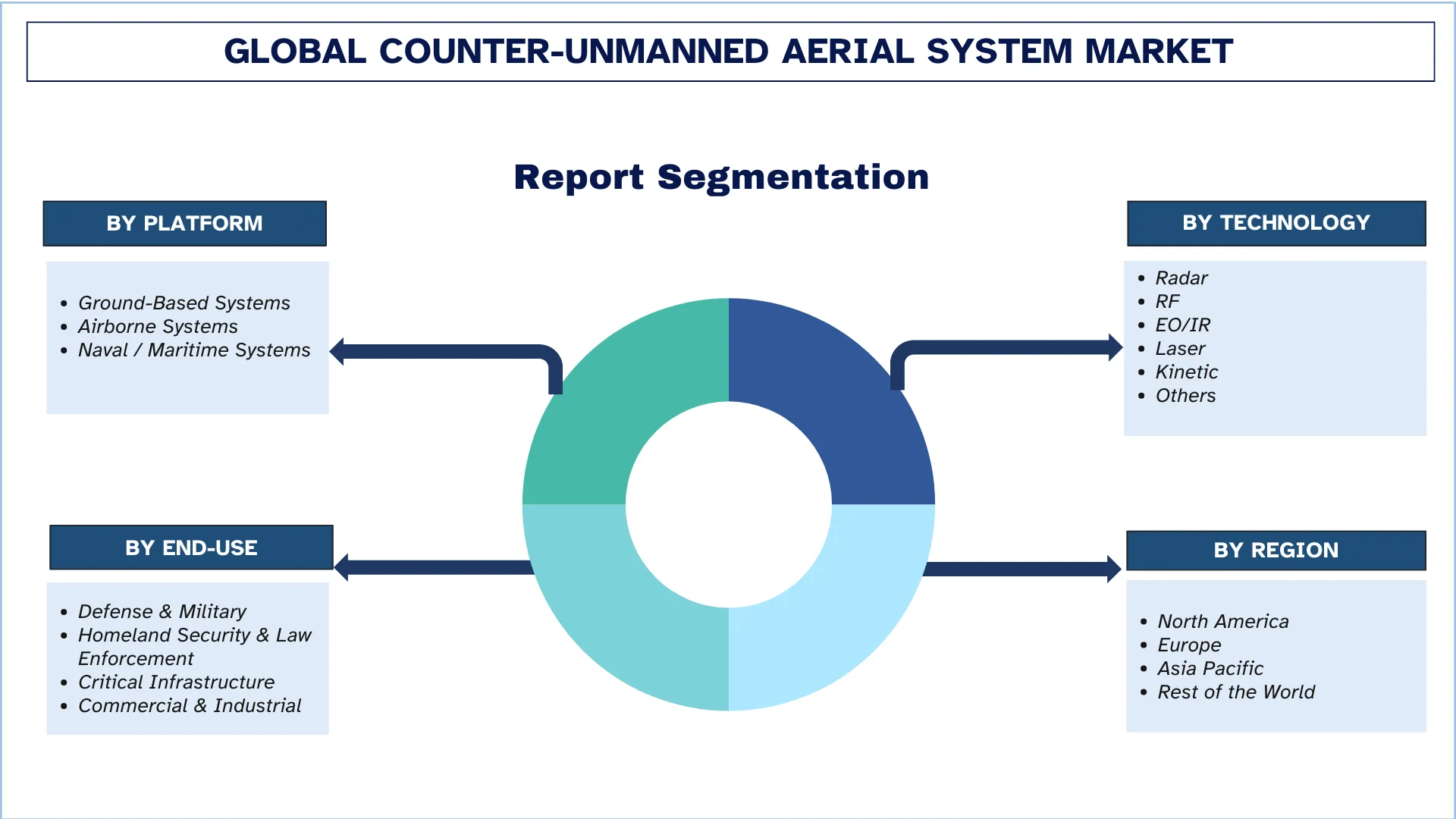
Emphasis on Platform (Ground-Based Systems, Airborne Systems, and Naval / Maritime Systems); Technology (Radar, RF, EO/IR, Laser, Kinetic, and Others); End-Use (Defense & Military, Homeland Security & Law Enforcement, Critical Infrastructure, and Commercial & Industrial); and Region/Country
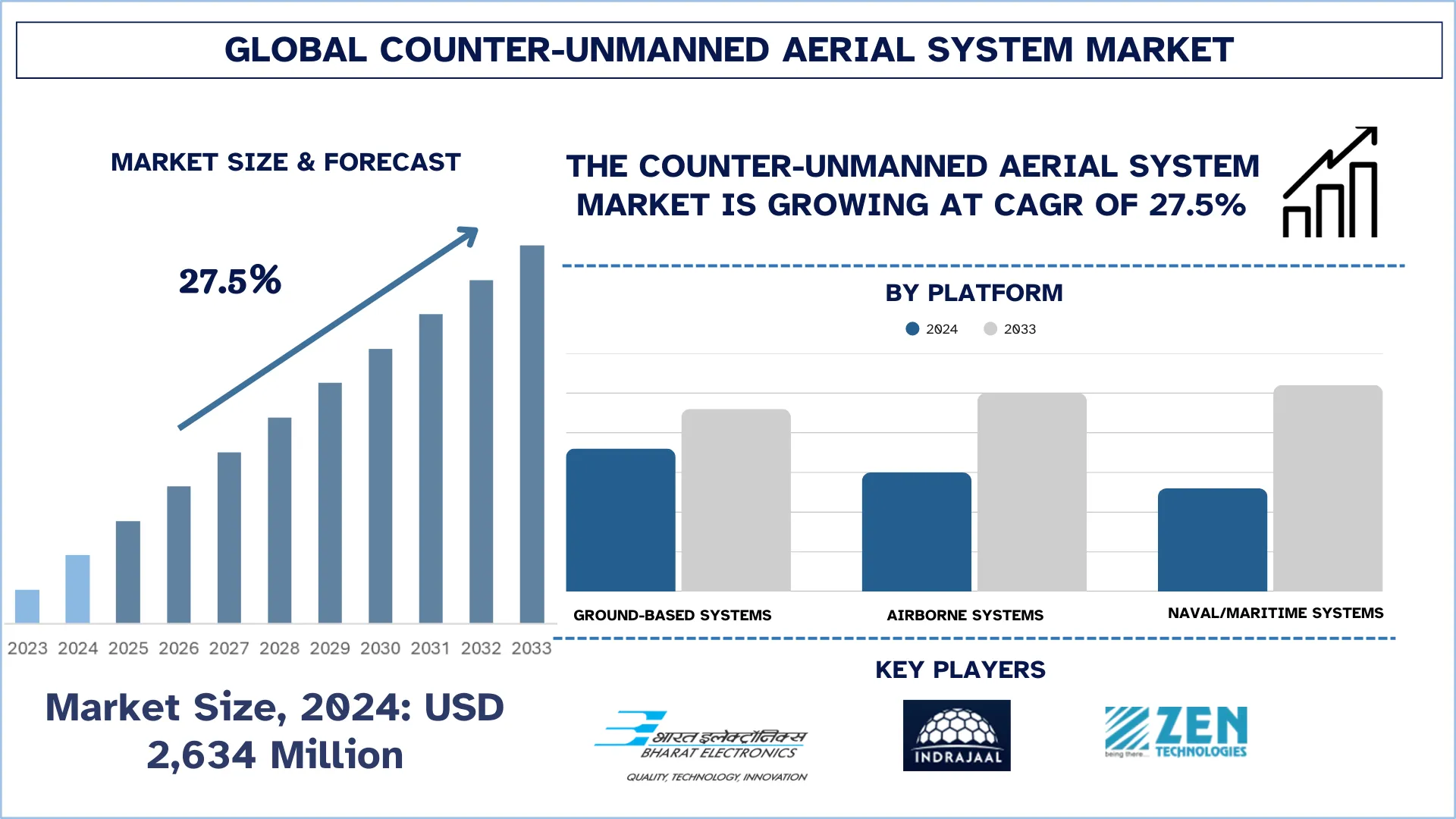
Global Counter-Unmanned Aerial System Market Size & Forecast
The Global Counter-Unmanned Aerial System Market was valued at USD 2,634 million in 2024 and is expected to grow at a strong CAGR of around 27.5% during the forecast period (2025-2033F), driven by the rapid proliferation of low-cost commercial drones and the rising misuse of UAVs for surveillance, smuggling, and hostile attacks near sensitive locations.
Counter-Unmanned Aerial System Market Analysis
CUAS or Counter-UAS (Unmanned Aircraft System) is a military term for solutions that are designed to detect, track, and ultimately disrupt and destroy unmanned airborne vehicles. In commercial and industrial applications, the term anti-drone is often used. Drones were once a product limited to the military domain, but in recent years, this technology has exploded in popularity. The most common types of CUAS systems rely on RF triangulation or passive RF detection to detect a UAV by its radio frequency. Higher-end solutions pair RF detection with 3D radar in order to track a target even if it has no RF signal. Once a solution is detected, it is tracked using a PTZ surveillance camera. If considered a threat, a countermeasure is employed. In most systems, these countermeasures are limited to an RF jammer, which disrupts or takes over the control and GPS of the drone, usually forcing it to land. Infiniti’s ADDS (Airborne Drone Defense System) utilizes jammers but can also integrate UAVs with net guns and/or HEW (High Energy Weapons), depending on the type of threat and distance needed for intervention.
Global Counter-Unmanned Aerial System Market Trends
This section discusses the key market trends that are influencing the various segments of the global Counter-Unmanned Aerial System market, as found by our team of research experts.
Rise of Mobile and Portable CUAS Platforms
The development of mobile and portable CUAS platforms is becoming an important future market trend as security agencies need more and more remedies in the form of flexible and fast deployable counter-drone systems. Compared to hard-wired systems, mobile vehicle-mounted and man-portable systems make it possible to respond to emerging threats in a battlefield, border area, mass gathering, and VIP security operations in real-time. The increasing worry about the drones encroaching on temporal or remote areas is becoming an incentive to lightweight and compact systems that are easy to operate. The technological changes in miniaturized radar, RF detection, and portable jamming equipment are also facilitating this trend and making portable CUAS systems more efficient, versatile, and flexible to operate in varied conditions.
Counter-Unmanned Aerial System Industry Segmentation
This section provides an analysis of the key trends in each segment of the global counter-unmanned aerial system market report, along with forecasts at the global, regional, and country levels for 2025-2033.
The Ground-Based Systems Segment Dominates the Global Counter-Unmanned Aerial System Market
Based on the platform category, the market is categorized into ground-based systems, airborne systems, and naval/maritime systems. Among these, the ground-based systems currently hold the largest market share in the counter-unmanned aircraft systems market because of their extensive use in military bases, borders, airports, and other critical infrastructural facilities. The ground-based systems are cost-efficient and easy to integrate with the existing air defense systems and can serve both in defense and civilian protection solutions, making them dominant. However, the airborne systems are likely to experience the greatest growth in the future due to the growing need for layered air defense, better situational awareness on the battlefield, and the requirement to counter threats of long-range and swarm drones in dynamic battlefields.
The Defense & Military Segment Dominates the Global Counter-Unmanned Aerial System Market.
Based on the end-use category, the market is segmented into defense & military, homeland security & law enforcement, critical infrastructure, and commercial & industrial. Among these, defense & military hold the maximum market share in the Counter-Unmanned Aircraft System market due to large procurement budgets, continuous modernization programs, and the urgent need to counter drone-based threats in battlefield and border security operations. Military forces worldwide are investing heavily in integrated detection and mitigation systems to address asymmetric warfare and swarm-drone risks. However, the most extensive growth in the future is projected to be in the critical infrastructure category due to the increasing cases of drone incursions in and around airports, energy plants, and transport congestions, as well as heightened regulatory pressure to enhance the security of the civilian airspace.
The Asia-Pacific region is the Fastest-Growing region in the Global Counter-Unmanned Aerial System market
The Asia-Pacific region is expected to grow fastest due to rising geopolitical tensions, border security issues, and rapid defence modernization initiatives by APAC countries. The increased cases of drone incursions and cross-border surveillance activities have increased the demand for superior detection and mitigation measures. Also, civilian demand for counter-drone technologies is increasing due to expanding critical infrastructure, urbanization, and large-scale events. Strong government investments, growing defense manufacturing initiatives, and increasing adoption of advanced radar, RF, and directed energy systems further accelerate regional market growth.
China held a Dominant share of the Asia-Pacific Counter-Unmanned Aerial System Market in 2024
China held the dominant share of the Asia-Pacific Counter-Unmanned Aerial System market in 2024, due to high defense spending, unparalleled military development, and large domestic production capacity. The nation has heavily invested in coordinated air defense systems and counter-drone capabilities to deal with the security of the borders, the tension at the regional level, as well as the increasing threat of unmanned attacks. The radar, electronic warfare, and directed energy systems that are regionally developed by China have enhanced its market strength. Also, the increase in the protection needs of critical infrastructure and metropolitan areas has helped in further promotion of the use of advanced counter-UAS systems nationwide.

Counter-Unmanned Aerial System Industry Competitive Landscape
The global counter-unmanned aerial system market is competitive, with several global and international market players. The key players are adopting different growth strategies to enhance their market presence, such as partnerships, agreements, collaborations, geographical expansions, and mergers and acquisitions.
Top Counter-Unmanned Aerial System Market Companies
Some of the major players in the market are Northrop Grumman, Bharat Electronics Ltd., Indrajaal Drone Defence India Private Limited, Zen Technologies Limited, Aidin Technologies Pvt Ltd., Saab AB, AeroVironment, Inc., Dedrone Holdings, Inc.(Axon Enterprise, Inc.), The RF Technology Group Ltd., and Fortem Technologies.
Recent Developments in the Counter-Unmanned Aerial System Market
In August 2025, L3Harris Technologies launched a new Counter-Unmanned Systems (C-UxS) initiative to consolidate and accelerate its portfolio of counter-drone technologies aimed at identifying, tracking, and defeating evolving unmanned threats across air, land, and sea domains. The effort leverages existing systems such as VAMPIRE™, CORVUS-RAVEN, Nimble Finch, and Drone Guardian, combined with advanced sensors, AI/ML tools, mission software, and electronic warfare capabilities to address emerging challenges from cheaper, rapidly evolving UAVs and drone swarms.
In November 2024, AeroVironment agreed to acquire BlueHalo in an all-stock transaction valued at approximately $4.1 billion, creating a diversified defense technology leader with expanded CUAS, directed energy, electronic warfare, and autonomous systems capabilities. This strategic move is expected to strengthen AeroVironment’s position in counter-drone solutions and broader air defense technologies.
Global Counter-Unmanned Aerial System Market Report Coverage
Report Attribute | Details |
Base year | 2024 |
Forecast period | 2025-2033 |
Growth momentum | Accelerate at a CAGR of 27.5% |
Market size 2024 | USD 2,634 million |
Regional analysis | North America, Europe, APAC, Rest of the World |
Major contributing region | The North America region is expected to dominate the market during the forecast period. |
Key countries covered | U.S., Canada, Germany, U.K., Spain, Italy, France, China, Japan, and India. |
Companies profiled | Northrop Grumman, Bharat Electronics Ltd., Indrajaal Drone Defence India Private Limited, Zen Technologies Limited, Aidin Technologies Pvt Ltd., Saab AB, AeroVironment, Inc., Dedrone Holdings, Inc.(Axon Enterprise, Inc.), The RF Technology Group Ltd., and Fortem Technologies. |
Report Scope | Market Trends, Drivers, and Restraints; Revenue Estimation and Forecast; Segmentation Analysis; Demand and Supply Side Analysis; Competitive Landscape; Company Profiling |
Segments Covered | By Platform, By Technology, By End-Use, and By Region/Country |
Reasons to Buy the Counter-Unmanned Aerial System Market Report:
The study includes market sizing and forecasting analysis confirmed by authenticated key industry experts.
The report briefly reviews overall industry performance at a glance.
The report covers an in-depth analysis of prominent industry peers, primarily focusing on key business financials, type portfolios, expansion strategies, and recent developments.
Detailed examination of drivers, restraints, key trends, and opportunities prevailing in the industry.
The study comprehensively covers the market across different segments.
Deep dive regional-level analysis of the industry.
Customization Options:
The global counter-unmanned aerial system market can further be customized as per the requirements or any other market segment. Besides this, UnivDatos understands that you may have your own business needs; hence, feel free to contact us to get a report that completely suits your requirements.
Table of Content
Research Methodology for the Global Counter-Unmanned Aerial System Market Analysis (2023-2033)
We analyzed the historical market, estimated the current market, and forecasted the future market of the global counter-unmanned aerial system market to assess its application in major regions worldwide. We conducted exhaustive secondary research to gather historical market data and estimate the current market size. To validate these insights, we carefully reviewed numerous findings and assumptions. Additionally, we conducted in-depth primary interviews with industry experts across the counter-unmanned aerial system value chain. After validating market figures through these interviews, we used both top-down and bottom-up approaches to forecast the overall market size. We then employed market breakdown and data triangulation methods to estimate and analyze the market size of industry segments and sub-segments.
Market Engineering
We employed the data triangulation technique to finalize the overall market estimation and derive precise statistical numbers for each segment and sub-segment of the global counter-unmanned aerial system market. We split the data into several segments and sub-segments by analyzing various parameters and trends, including platform, technology, end-use, and regions within the global counter-unmanned aerial system market.
The Main Objective of the Global Counter-Unmanned Aerial System Market Study
The study identifies current and future trends in the global counter-unmanned aerial system market, providing strategic insights for investors. It highlights regional market attractiveness, enabling industry participants to tap into untapped markets and gain a first-mover advantage. Other quantitative goals of the studies include:
Market Size Analysis: Assess the current and forecast market size of the global counter-unmanned aerial system market and its segments in terms of value (USD).
Counter-Unmanned Aerial System Market Segmentation: Segments in the study include areas of platform, technology, end-use, and region.
Regulatory Framework & Value Chain Analysis: Examine the regulatory framework, value chain, customer behavior, and competitive landscape of the counter-unmanned aerial system industry.
Regional Analysis: Conduct a detailed regional analysis for key areas such as Asia Pacific, Europe, North America, and the Rest of the World.
Company Profiles & Growth Strategies: Company profiles of the counter-unmanned aerial system market and the growth strategies adopted by the market players to sustain the fast-growing market.
Frequently Asked Questions FAQs
Q1: What is the global counter-unmanned aerial system market’s current market size and growth potential?
As of 2024, the global counter-unmanned aerial system market size is USD 2,634 million. The market is projected to grow at a strong CAGR of 27.5% between 2025 and 2033. The strong growth outlook is driven by rising drone-related security threats and increasing defense investments worldwide.
Q2: Which segment has the largest share of the global counter-unmanned aerial system market by platform category?
The ground-based C-UAS systems segment holds the largest market share globally, owing to its widespread deployment for military bases, border security, airports, and critical infrastructure protection.
Q3: What are the driving factors for the growth of the global counter-unmanned aerial system market?
Top growth drivers of the counter-unmanned aerial system market include:
• Rising Security Threats from Rogue Drones
• Expansion of Critical Infrastructure Protection Needs
• Increasing Geopolitical Tensions and Asymmetric Warfare
Q4: What are the emerging technologies and trends in the global counter-unmanned aerial system market?
Emerging trends in the counter-unmanned aerial system market include:
• Rise of Mobile and Portable CUAS Platforms
• Expansion of Regulatory Frameworks
Q5: What are the key challenges in the global counter-unmanned aerial system market?
Key challenges in the counter-unmanned aerial system market include:
• High System Costs
• False Positives and Detection Limitations
Q6: Which region dominates the global counter-unmanned aerial system market?
North America dominates the global C-UAS market, supported by strong defense spending, early adoption of advanced counter-drone technologies, and the presence of leading industry players in the region.
Q7: Who are the key competitors in the global Counter-Unmanned Aerial System market?
Top players in the Counter-Unmanned Aerial System industry include:
• Northrop Grumman
• Bharat Electronics Ltd.
• Indrajaal Drone Defence India Private Limited
• Zen Technologies Limited
• Aidin Technologies Pvt Ltd.
• Saab AB
• AeroVironment, Inc.
• Dedrone Holdings, Inc.(Axon Enterprise, Inc.)
• The RF Technology Group Ltd.
• Fortem Technologies
Q8: What investment opportunities exist in the Counter-Unmanned Aerial System market?
The market offers strong investment potential due to rising defense budgets, increasing commercial security applications, and rapid technological advancements in AI and directed-energy systems. High-growth opportunities exist in mobile C-UAS platforms, urban air mobility protection, and emerging economies.
Q9: How is regulatory policy shaping the growth of the global C-UAS market?
Evolving government regulations around drone detection, airspace management, and counter-drone deployment are significantly influencing market expansion. Supportive defense policies and clearer legal frameworks for mitigation technologies are enabling broader adoption across military and civilian sectors.
Related Reports
Customers who bought this item also bought




Aeroderivative Sensor Market: Current Analysis and Forecast (2025-2033)
Emphasis on Sensor Type (Temperature Sensors, Pressure Sensors, Vibration Sensors, Flame Sensors, and Others); Service Provider (OEMs and Aftermarket); End-User (Industrial, Marine, Aerospace & Defense, Power & Energy, and Oil & Gas); and Region/Country
Kamikaze Drone Market: Current Analysis and Forecast (2026-2034)
Emphasis on Type (Fixed-wing System and Rotary-wing System); Range (Short range(10-20km), Medium range(20-100km), and Long range(>100km)); Platform (Ground based, Airborne, and Naval); Autonomy (Man in the loop and Fully Autonomous); and Region/Country
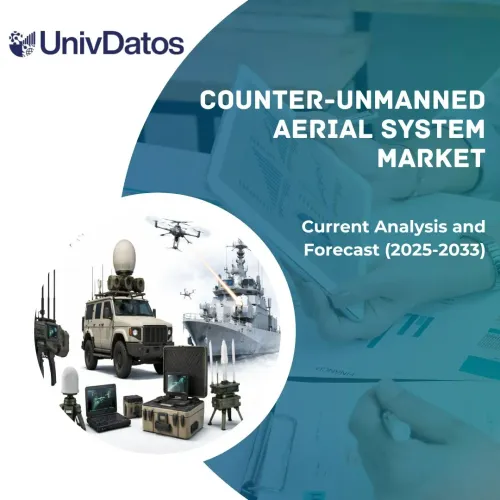
Counter-Unmanned Aerial System Market: Current Analysis and Forecast (2025-2033)
Emphasis on Platform (Ground-Based Systems, Airborne Systems, and Naval / Maritime Systems); Technology (Radar, RF, EO/IR, Laser, Kinetic, and Others); End-Use (Defense & Military, Homeland Security & Law Enforcement, Critical Infrastructure, and Commercial & Industrial); and Region/Country

Middle East & Africa Turboprop Aircraft Market: Current Analysis and Forecast (2025-2033)
Emphasis By Aircraft Type (Light Turboprop Aircraft, Medium Turboprop Aircraft, and Heavy Turboprop Aircraft), by End-User (Government & Defense, Commercial Operators, and Private Operators), By Country (Saudi Arabia, UAE, Egypt, South Africa, Turkey, Israel, and the Rest of Middle East & Africa)