Nuclear Bunker Market: Current Analysis and Forecast (2025-2033)
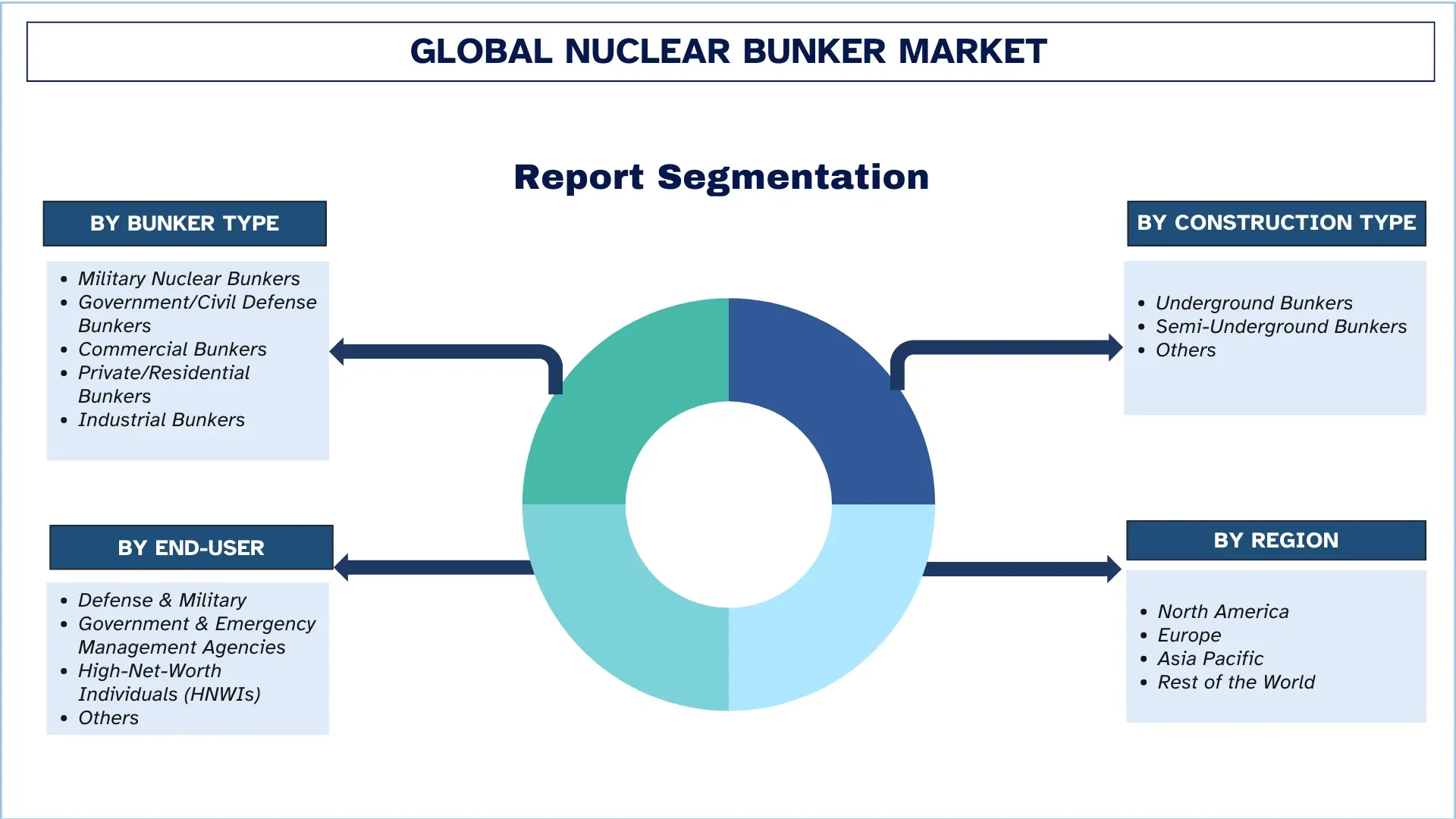
Emphasis on Bunker Type (Military Nuclear Bunkers, Government/Civil Defense Bunkers, Commercial Bunkers, Private/Residential Bunkers, and Industrial Bunkers); Construction Type (Underground Bunkers, Semi-Underground Bunkers, and Others); End-User (Defense & Military, Government & Emergency Management Agencies, High-Net-Worth Individuals (HNWIs), and Others); and Region/Country
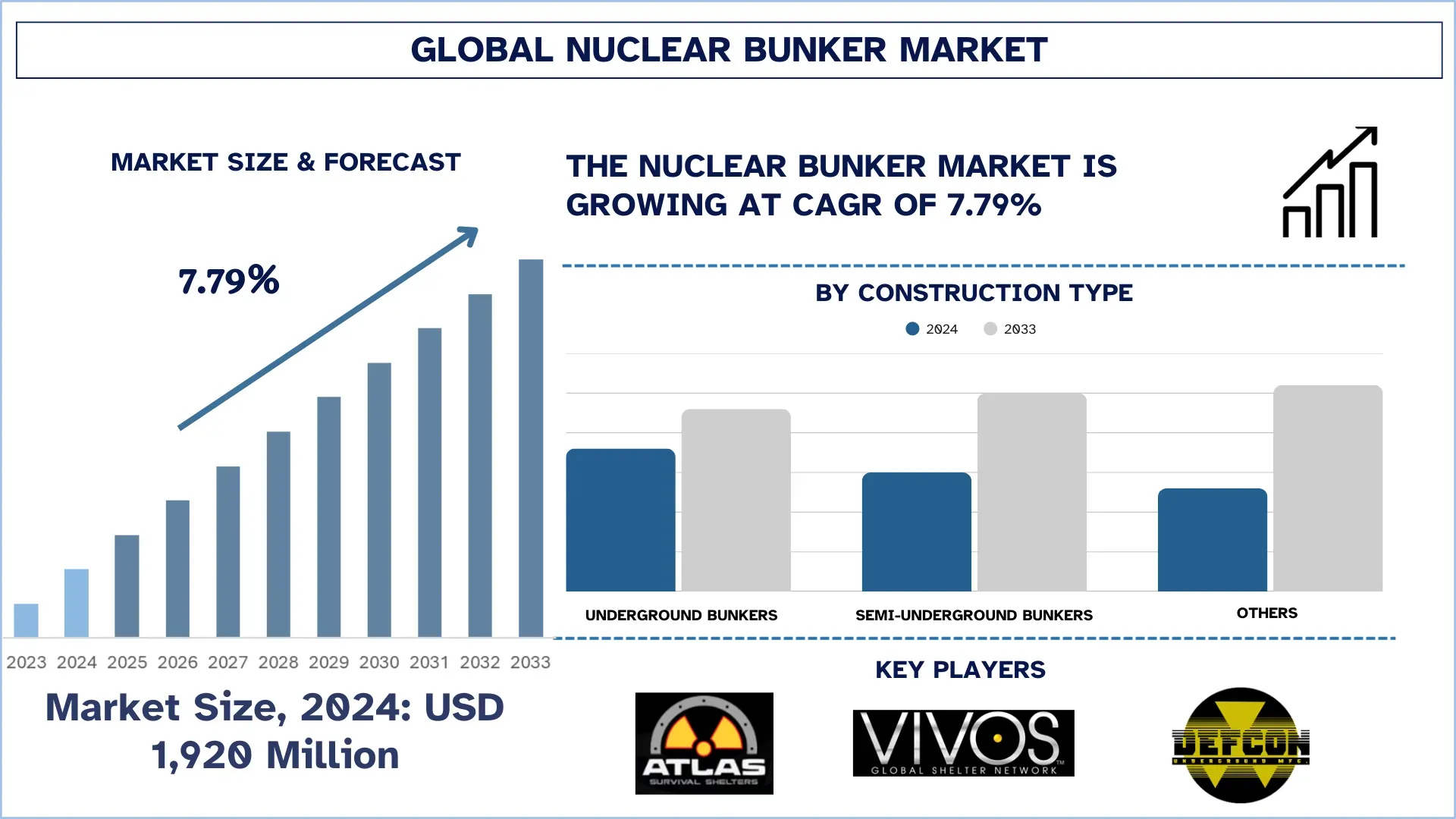
Global Nuclear Bunker Market Size & Forecast
The Global Nuclear Bunker Market was valued at USD 1,920 million in 2024 and is expected to grow at a strong CAGR of around 7.79% during the forecast period (2025-2033F), driven by rising geopolitical tensions and nuclear threat perceptions, prompting governments and defense agencies to strengthen civil defense and continuity-of-operations infrastructure.
Nuclear Bunker Market Analysis
A nuclear bunker is a specially designed and reinforced building that is constructed to shield people, important resources, and vital processes against the impacts of nuclear explosions, such as blast pressure, heat, radiation, and electromagnetic pulses. Nuclear bunkers are typically built underground or heavily shielded, with advanced ventilation and filtration systems, radiation shielding, a self-sufficient power and water supply, and a secure communications infrastructure.
The nuclear bunker market is growing because of the rise in geopolitical instability, an increase in the perception of nuclear threat, and an increase in the emphasis on national security and civil defense preparedness in various regions. Governments and the military are investing in hardened infrastructure below the earth to provide continuity to operations and security of strategic infrastructure against nuclear, missile, and hybrid attacks.
Global Nuclear Bunker Market Trends
This section discusses the key market trends that are influencing the various segments of the global Nuclear Bunker market, as found by our team of research experts.
Shift Toward Deep Underground and Multi-Layered Hardened Bunker Designs
The nuclear bunker market is experiencing an evident change towards long underground and multiple-layered hardened bunker construction as future threats get more complex and destructive. Such sophisticated designs also offer a lot more resistance to both nuclear blast pressure and radiation penetration and electromagnetic pulses than traditional shallow shelters. Survivability and structural integrity are enhanced through multilayer construction incorporating reinforced concrete, steel, shock-absorbing layers, and advanced radiation shielding. The greater depth of the underground location is also beneficial for concealment. Defense modernization initiatives increased civil defense requirements, and the mounting need by governments, military forces, and operators of critical infrastructures to have bunkers that can survive the next generation of nuclear and missile attacks is driving this trend.
Nuclear Bunker Industry Segmentation
This section provides an analysis of the key trends in each segment of the global nuclear bunker market report, along with forecasts at the global, regional, and country levels for 2025-2033.
The Military Nuclear Bunkers Segment Dominates the Global Nuclear Bunker Market
Based on the bunker type category, the market is categorized into military nuclear bunkers, government/civil defense bunkers, commercial bunkers, private/residential bunkers, and industrial bunkers. Among these, the greatest market share is in military nuclear bunkers, where it deals with large-scale long-term investments by defense ministries to provide strategic command centers, weapons storage, and continuity-of-operations infrastructures, especially in nuclear-capable countries and alliance participants such as NATO. However, the private/residential bunkers will have the highest growth rate, which will occur due to geopolitical insecurity, heightened geopolitical awareness of nuclear and disaster threats, and increased demand by high-net-worth individuals of geopolitical-level survival shelters, particularly in developed economies.
The Underground Bunkers Segment Dominates the Global Nuclear Bunker Market.
Based on the construction type category, the market is categorized into underground bunkers, semi-underground bunkers, and others. Among these, underground bunkers have the largest market share as they provide the best protection in case of nuclear blast, radiation, and electromagnetic pulse. Due to this, they are most preferred by the defense forces, governments, and operators of critical infrastructure. However, semi-underground bunkers are projected to experience a higher growth rate as the construction cost has been reduced, the construction timeline decreases, and the high-net-worth individuals and commercial users, who require a balance between protection, accessibility, and affordability, are expected to adopt this more in urban and space-constrained areas.
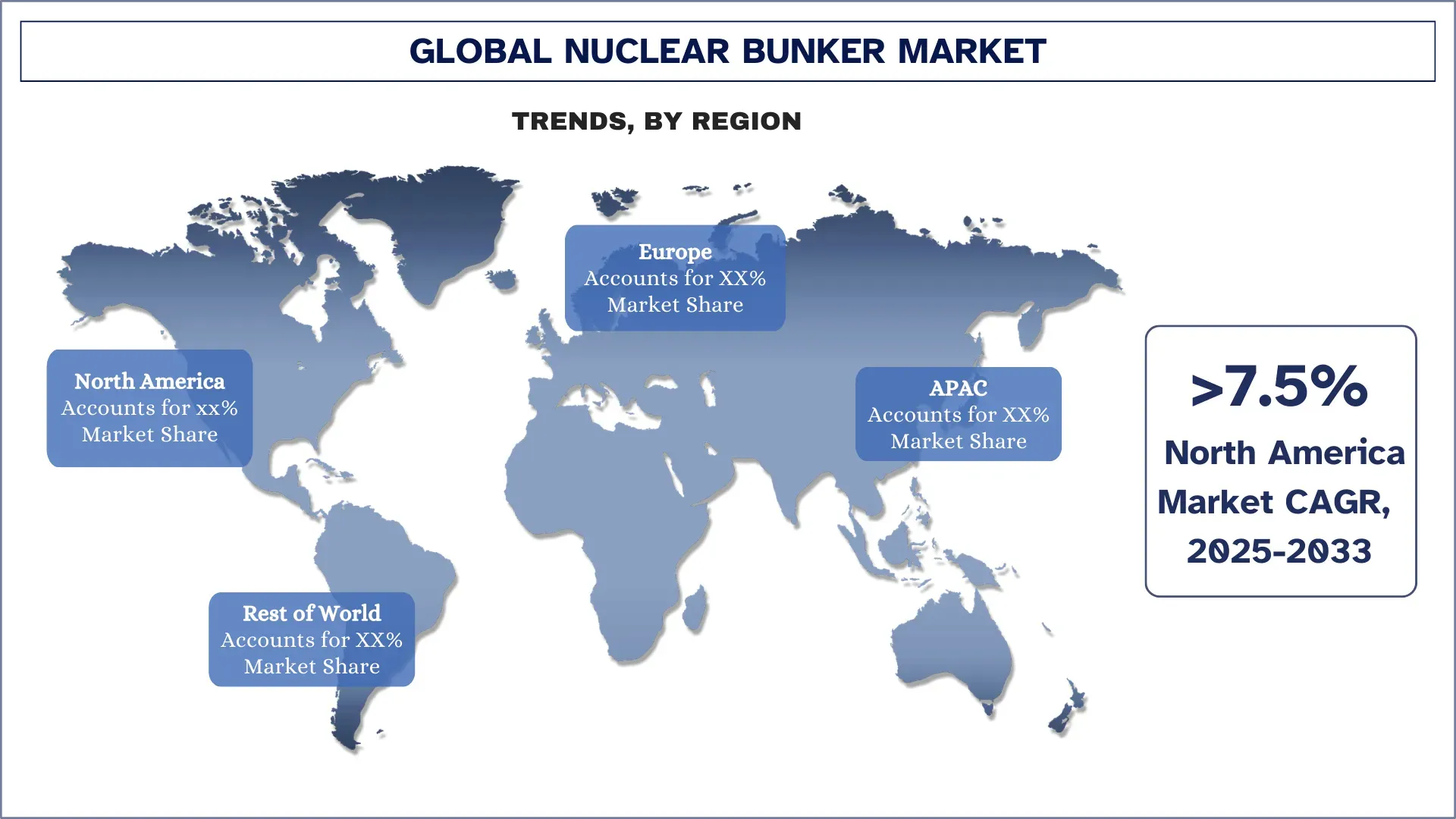
North America holds the largest market share in the global Nuclear Bunker market
North America held the largest market share in the nuclear bunker market due to substantial defense spending, a well-developed military infrastructure, and a growing interest in strategic security. Majorly, the United States allocates substantial resources to hardened command-and-control structures, missile defense systems, and underground secure installations to protect U.S. leadership and key facilities. Market leadership is further supported by substantial government funding and the presence of specialized bunker construction and engineering firms. Moreover, growing concern about geopolitical and nuclear threats has increased demand for private bunkers among the region's wealthy citizens.
The United States held a Dominant share of the North America Nuclear Bunker Market in 2024
The United States dominated the North America nuclear bunkers market because it is strategically oriented to homeland security, high levels of civil defense, as well as massive investments in resilient infrastructure. There is a wide range of underground facilities that support defense preparedness, emergency governance, and the protection of critical military and civilian assets. Adding to this, ongoing renovation of older underground facilities, along with the introduction of new technologies for blast-resistant materials and radiation shields, further supports market growth. Moreover, a growing understanding of nuclear and geopolitical threats has generated interest among non-governmental users, as more wealthy individuals have opted to purchase and install private and commercial bunkers.
Nuclear Bunker Industry Competitive Landscape
The global nuclear bunker market is competitive, with several global and international market players. The key players are adopting different growth strategies to enhance their market presence, such as partnerships, agreements, collaborations, geographical expansions, and mergers and acquisitions.
Top Nuclear Bunker Market Companies
Some of the major players in the market are Atlas Survival Shelters, LLC®, The Vivos Group, Hardened Shelters LLC, USA Bunker Company, Nomad Bunkers, ARK-Bunkers, DEFCON Bunkers, Northwest Shelter Systems, Fortified Estate, LLC, and Del Zotto Products of Texas, Inc.
Recent Developments in the Nuclear Bunker Market
In October 2025, Switzerland launched one of its biggest shelter modernization programs since the Cold War, investing hundreds of millions into upgrading its nationwide network of roughly 370,000 bunkers designed to protect every citizen. Over the next 15 years, 200 major facilities will be retrofitted with modern ventilation, filtration, and reinforced engineering to withstand nuclear, biological, and chemical threats, reflecting heightened security concerns in Europe’s evolving geopolitical landscape.
In July 2025, Bunker Hill Mining Corp. announced progress on its Idaho underground infrastructure project, advancing construction toward a safe and resilient underground facility with 67% completion after successful equity financing and debt restructuring. The expansion of underground excavations and the development of secure structural elements reflect a growing industry focus on hardened subterranean infrastructure, which can inform future nuclear bunker design and civil protection frameworks.
Global Nuclear Bunker Market Report Coverage
Report Attribute | Details |
Base year | 2024 |
Forecast period | 2025-2033 |
Growth momentum | Accelerate at a CAGR of 7.79% |
Market size 2024 | USD 1,920 million |
Regional analysis | North America, Europe, APAC, Rest of the World |
Major contributing region | The North America region is expected to dominate the market during the forecast period. |
Key countries covered | U.S., Canada, Germany, U.K., Spain, Italy, France, China, Japan, and India. |
Companies profiled | Atlas Survival Shelters, LLC®, The Vivos Group, Hardened Shelters LLC, USA Bunker Company, Nomad Bunkers, ARK-Bunkers, DEFCON Bunkers, Northwest Shelter Systems, Fortified Estate, LLC, and Del Zotto Products of Texas, Inc. |
Report Scope | Market Trends, Drivers, and Restraints; Revenue Estimation and Forecast; Segmentation Analysis; Demand and Supply Side Analysis; Competitive Landscape; Company Profiling |
Segments Covered | By Bunker Type, By Construction Type, By End-User, and By Region/Country |
Reasons to Buy the Nuclear Bunker Market Report:
The study includes market sizing and forecasting analysis confirmed by authenticated key industry experts.
The report briefly reviews overall industry performance at a glance.
The report covers an in-depth analysis of prominent industry peers, primarily focusing on key business financials, type portfolios, expansion strategies, and recent developments.
Detailed examination of drivers, restraints, key trends, and opportunities prevailing in the industry.
The study comprehensively covers the market across different segments.
Deep dive regional-level analysis of the industry.
Customization Options:
The global nuclear bunker market can further be customized as per the requirements or any other market segment. Besides this, UnivDatos understands that you may have your own business needs; hence, feel free to contact us to get a report that completely suits your requirements.
Table of Content
Research Methodology for the Global Nuclear Bunker Market Analysis (2023-2033)
We analyzed the historical market, estimated the current market, and forecasted the future market of the global nuclear bunker market to assess its application in major regions worldwide. We conducted exhaustive secondary research to gather historical market data and estimate the current market size. To validate these insights, we carefully reviewed numerous findings and assumptions. Additionally, we conducted in-depth primary interviews with industry experts across the nuclear bunker value chain. After validating market figures through these interviews, we used both top-down and bottom-up approaches to forecast the overall market size. We then employed market breakdown and data triangulation methods to estimate and analyze the market size of industry segments and sub-segments.
Market Engineering
We employed the data triangulation technique to finalize the overall market estimation and derive precise statistical numbers for each segment and sub-segment of the global nuclear bunker market. We split the data into several segments and sub-segments by analyzing various parameters and trends, including bunker type, construction type, end-user, and regions within the global nuclear bunker market.
The Main Objective of the Global Nuclear Bunker Market Study
The study identifies current and future trends in the global nuclear bunker market, providing strategic insights for investors. It highlights regional market attractiveness, enabling industry participants to tap into untapped markets and gain a first-mover advantage. Other quantitative goals of the studies include:
Market Size Analysis: Assess the current and forecast market size of the global nuclear bunker market and its segments in terms of value (USD).
Nuclear Bunker Market Segmentation: Segments in the study include areas of bunker type, construction type, end-user, and region.
Regulatory Framework & Value Chain Analysis: Examine the regulatory framework, value chain, customer behavior, and competitive landscape of the nuclear bunker industry.
Regional Analysis: Conduct a detailed regional analysis for key areas such as Asia Pacific, Europe, North America, and the Rest of the World.
Company Profiles & Growth Strategies: Company profiles of the nuclear bunker market and the growth strategies adopted by the market players to sustain the fast-growing market.
Frequently Asked Questions FAQs
Q1: What is the global nuclear bunker market’s current market size and growth potential?
As of 2024, the global nuclear bunker market size is USD 1,920 million. The market is projected to grow at a strong CAGR of 7.79% between 2025 and 2033, driven by rising geopolitical risks, increased defense investments, and growing demand for disaster-resilient infrastructure worldwide.
Q2: Which segment has the largest share of the global nuclear bunker market by bunker type category?
The military nuclear bunkers segment holds the largest share of the global nuclear bunker market due to high defense spending on hardened command centers, strategic facilities, and continuity-of-operations infrastructure by governments and armed forces.
Q3: What are the driving factors for the growth of the global nuclear bunker market?
Top growth drivers of the nuclear bunker market include:
• Rising geopolitical tensions
• Increased defense spending
• Increasing interest from high-net-worth individuals in long-term survival and disaster-resilient shelters
Q4: What are the emerging technologies and trends in the global nuclear bunker market?
Emerging trends in the nuclear bunker market include:
• Shift toward deep underground and multi-layered hardened bunker designs
• Growing preference for self-sustaining bunkers with renewable energy and water recycling systems
Q5: What are the key challenges in the global nuclear bunker market?
Key challenges in the nuclear bunker market include:
• High construction and maintenance costs
• Ethical, political, and public perception concerns related to nuclear preparedness investments
Q6: Which region dominates the global nuclear bunker market?
North America dominates the global nuclear bunker market due to high defense budgets, advanced military infrastructure, strong government focus on continuity-of-operations planning, and rising adoption of private and commercial bunkers across the region.
Q7: Who are the key competitors in the global nuclear bunker market?
Top players in the nuclear bunker industry include:
• Atlas Survival Shelters, LLC®
• The Vivos Group
• Hardened Shelters LLC
• USA Bunker Company
• Nomad Bunkers
• ARK-Bunkers
• DEFCON Bunkers
• Northwest Shelter Systems
• Fortified Estate, LLC
• Del Zotto Products of Texas, Inc.
Q8: What investment opportunities exist in the global nuclear bunker market for businesses and investors?
The nuclear bunker market offers strong investment opportunities in bunker modernization projects, modular and prefabricated bunker solutions, and advanced ventilation, shielding, and self-sustaining technologies. Growing defense budgets and rising private-sector demand further enhance long-term return potential.
Q9: What strategic developments are shaping competition in the nuclear bunker market?
Key strategic developments include partnerships between defense contractors and technology providers, investments in R&D for advanced blast-resistant materials, and expansion into private and commercial bunker solutions. Companies are also focusing on geographic expansion and compliance with evolving defense and civil protection regulations
Related Reports
Customers who bought this item also bought
Aeroderivative Sensor Market: Current Analysis and Forecast (2025-2033)
Emphasis on Sensor Type (Temperature Sensors, Pressure Sensors, Vibration Sensors, Flame Sensors, and Others); Service Provider (OEMs and Aftermarket); End-User (Industrial, Marine, Aerospace & Defense, Power & Energy, and Oil & Gas); and Region/Country
Kamikaze Drone Market: Current Analysis and Forecast (2026-2034)
Emphasis on Type (Fixed-wing System and Rotary-wing System); Range (Short range(10-20km), Medium range(20-100km), and Long range(>100km)); Platform (Ground based, Airborne, and Naval); Autonomy (Man in the loop and Fully Autonomous); and Region/Country
Counter-Unmanned Aerial System Market: Current Analysis and Forecast (2025-2033)
Emphasis on Platform (Ground-Based Systems, Airborne Systems, and Naval / Maritime Systems); Technology (Radar, RF, EO/IR, Laser, Kinetic, and Others); End-Use (Defense & Military, Homeland Security & Law Enforcement, Critical Infrastructure, and Commercial & Industrial); and Region/Country
Middle East & Africa Turboprop Aircraft Market: Current Analysis and Forecast (2025-2033)
Emphasis By Aircraft Type (Light Turboprop Aircraft, Medium Turboprop Aircraft, and Heavy Turboprop Aircraft), by End-User (Government & Defense, Commercial Operators, and Private Operators), By Country (Saudi Arabia, UAE, Egypt, South Africa, Turkey, Israel, and the Rest of Middle East & Africa)