Kamikaze Drone Market: Current Analysis and Forecast (2026-2034)
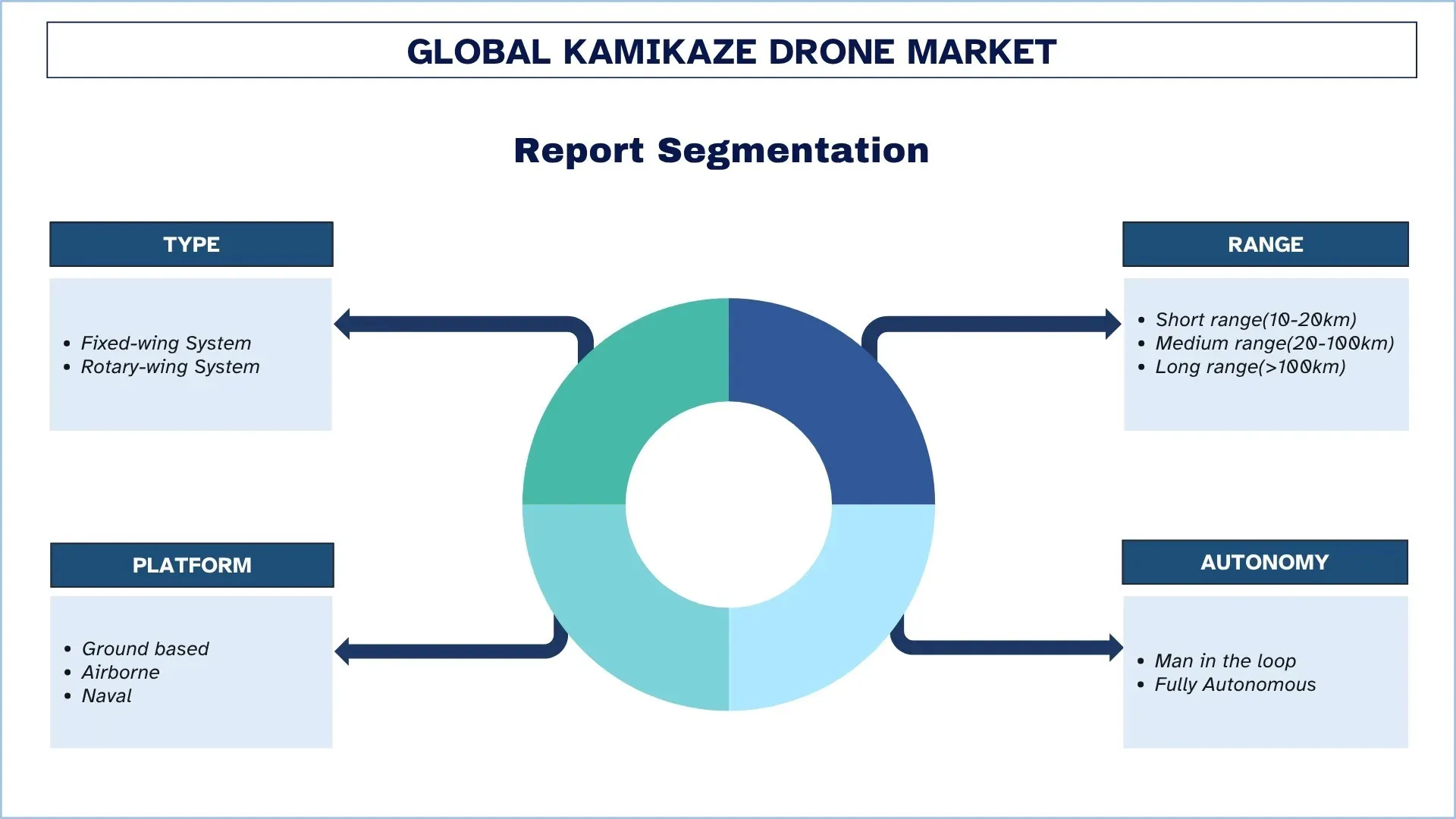
Emphasis on Type (Fixed-wing System and Rotary-wing System); Range (Short range(10-20km), Medium range(20-100km), and Long range(>100km)); Platform (Ground based, Airborne, and Naval); Autonomy (Man in the loop and Fully Autonomous); and Region/Country
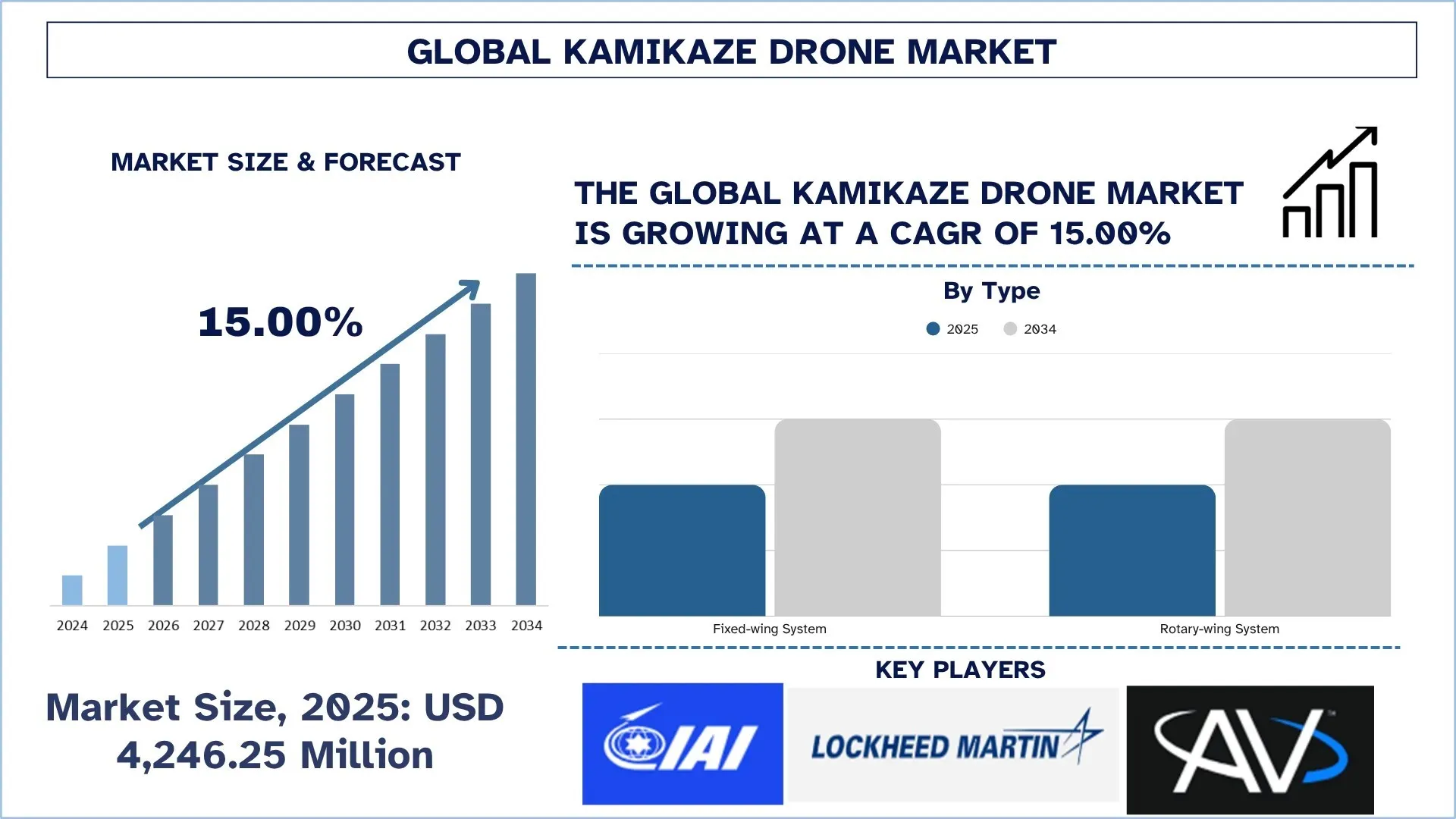
Global Kamikaze Drone Market Size & Forecast
The Global Kamikaze Drone Market was valued at USD 4,246.25 million in 2025 and is expected to grow at a strong CAGR of around 15.00% during the forecast period (2026-2034F), driven by the rising defense modernization spending, growing procurement of loitering munitions for tactical and strategic missions, and increasing adoption of autonomous and AI-enabled kamikaze drone systems.
Kamikaze Drone Market Analysis
The aerospace and defense industry is undergoing rapid change due to the kamikaze drone market, with defense forces increasingly demanding a strike system that combines precision, mobility, persistence, and cost-effectiveness in a single platform. These drones play a vital role. Munitions that loiter, popularly known as kamikaze drones, are becoming strategically relevant due to their ability to meet modern battlefield demands for speed in targeting, reduced operator exposure, and the ability to be deployed quickly and flexibly in contested operational areas. There are two developments that are gaining significance in this transition. Also, increased expenditure on defense modernization is generating good demand for loitering munitions that can facilitate tactical precision strike, border security, anti-armor operations, and distributed operations. Moreover, the market is progressively converging on autonomous and AI-enabled systems as the most prominent technological trend, supported by enhanced target recognition, mission planning, navigation resilience, and adaptation to multi-domain combat conditions. As these changes go on, the kamikaze drone market is expanding opportunities in defense OEMs, subsystem suppliers, software developers, and military integrators in the next-generation land, airborne, and intelligent battlefield platforms.
Global Kamikaze Drone Market Trends
This section discusses the key market trends that are influencing the various segments of the global Kamikaze Drone market, as found by our team of research experts.
Rising Adoption of Autonomous and AI-Enabled Systems Is Emerging as a Key Market Trend
The emerging trend in technologies shaping the market for kamikaze drones is the increasing shift toward autonomous and AI-based systems, the most promising step for commercial and military development. The newer systems, with their enhanced combination of onboard processing, aided target recognition, advanced edge computing, improved mission planning, and enhanced resilience in communication-denied or GPS-contested environments, are gaining increasing acceptance compared with earlier loitering munition platforms, which relied more on manual control and simple terminal guidance. Autonomy and AI are proving to be the most commercially defensible distinction in the wider market, with the application of these technologies across tactical strikes, infantry-portable munitions, helicopter-launched platforms, and more expansive multi-domain operations. Defense manufacturers are continuously enhancing the performance of products and mission software, so autonomous loitering munition technology has become more applicable across a wider range of use cases. In February 2025, UVision and Omnisys announced plans to combine the BRO mission planning and optimization solution offered by Omnisys with the HERO loitering munition family provided by UVision, aiming to achieve greater automation in mission planning and battlefield management. Similarly, in October 2025, AeroVironment introduced next-generation Switchblade systems and announced that the Switchblade 600 Block 2 has improved AI/ML-enabled onboard processing, and the Switchblade 400 has assisted target recognition and autonomous target detection and classification capabilities. Therefore, vendors are growing their AI-enabled portfolios to gain access to high-speed, high-reliability combat applications.
Kamikaze Drone Industry Segmentation
This section provides an analysis of the key trends in each segment of the global Kamikaze Drone market report, along with forecasts at the global, regional, and country levels for 2026-2034.
The Fixed-wing System segment held a significant share during the forecast period (2026-2034).
Based on type, the Global Kamikaze Drone market is segmented into Fixed-wing System and Rotary-wing System. In 2025, the Fixed-wing System segment held a significant share of the market. This has been largely due to its extended scope of operations, enhanced stamina, enhanced payload capacity, and its ability to be used in long-distance patrols and precision strikes. The use of fixed-wing kamikaze drones is gaining increasing significance in contemporary warfare due to their ability to cover larger ranges, be deployed longer, and enable participation in conflict at affordable costs. Necessities, such as the rising requirement of loitering munitions to provide reliable performance on the battlefield, quick deployment capacity, and greater tactical flexibility, are also aiding in confirming the spot of the segment.
The Medium range (20–100 km) Segment Dominates the Global Kamikaze Drone Market.
Based on range, the Global Kamikaze Drone market is segmented into Short range (10–20 km), Medium range (20–100 km), and Long range (>100 km). In 2025, the Medium range (20–100 km) segment held a significant share of the market. This has been largely contributed to by its balanced operational reach, mission flexibility, cost-effectiveness, and applicability across a wide range of tactical strikes. Medium-range kamikaze drones are gaining importance in contemporary battlefields since the ability to carry out surveillance, track targets, and deliver precision strikes can be achieved at relatively less cost and complexity than many long-range systems. The market need is also bolstered by the growing demand for loitering munitions capable of delivering predictable battlefield effectiveness in border security, mobile warfare, and rapid response operations, an aspect that is helping the segment consolidate its market position.
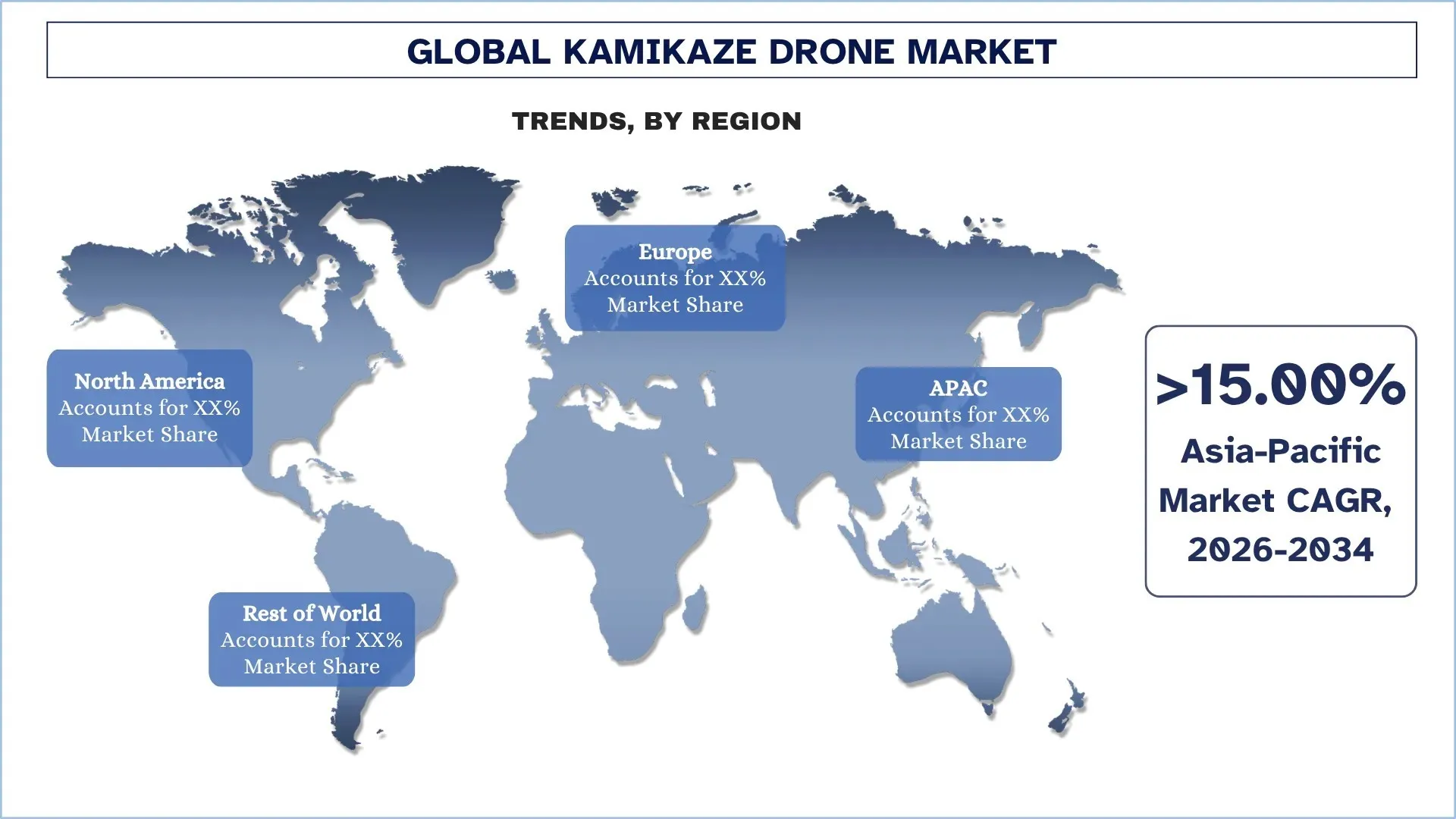
North America holds the largest market share in the global Kamikaze Drone market
The North American kamikaze drone market in 2025 will be highly motivated by high defense spending in the region, modernization of military programs, and companies involved in the development of leading technologies of unmanned systems. The increase in development of the market in the region will be enhanced by the increasing demand for precision strike, tactical surveillance, and cost-effective loitering munition systems in the defense and homeland security applications. Also, the growing emphasis on independent war potential, AI-controlled target-kill systems, and above-modern battlefield systems is hastening the adoption of kamikaze drones in North America.
The United States held a dominant share of the North American Kamikaze Drone Market in 2025
In 2025, the United States dominated the North American kamikaze drone market because of its powerful defense industrial foundation, quick acknowledgment of superior loitering munition systems, and innovative unmanned strike engineering conveyed by the large players like AeroVironment and other domestic defense technology agendas. Increasing needs in precision strike, tactical reconnaissance, and affordable combat systems in defense, as well as homeland security applications, are contributing to market expansion. The United States is also enhancing market prospects through increased investment in domestic drone production, greater targeting autonomy, and the capabilities of artificial intelligence (AI) to formulate mission systems. Moreover, intense research and development efforts, massive modernization campaigns of large military forces, and the extensive introduction of dedicated loitering munition systems are only making the United States even more prominent in the world market.
Kamikaze Drone Industry Competitive Landscape
The global Kamikaze Drone market is competitive, with several global and international market players. The key players are adopting different growth strategies to enhance their market presence, such as partnerships, agreements, collaborations, geographical expansions, and mergers and acquisitions.
Top Kamikaze Drone Market Companies
Some of the major players in the market are Israel Aerospace Industries, Lockheed Martin Corporation, AeroVironment, Inc., RAFAEL Advanced Defense Systems Ltd., BAYKAR TECH, Elbit Systems Ltd., Northrop Grumman, Rheinmetall AG, Teledyne FLIR Defense Inc., and Thales.
Recent Developments in the Kamikaze Drone Market
In February 2026, AeroVironment announced that it had received a $186 million U.S. Army delivery order for next-generation Switchblade 600 Block 2 and Switchblade 300 Block 20 loitering munition systems, marking the Army’s first procurement of AV’s upgraded Switchblade family under its existing five-year LUS contract.
In January 2026, UVision and Mistral announced that the HERO 90 loitering munition had been selected for the U.S. Army’s LASSO program, an urgent effort to provide Brigade Combat Teams with a man-portable precision anti-armor capability.
In January 2026, EDGE Group and Indra Group announced plans to establish a new defense manufacturing company in Spain focused on the development, production, and lifecycle support of loitering munitions and smart weapons for Spanish and broader European defense programs
In October 2025, AeroVironment unveiled the next generation of Switchblade loitering munitions, including the Switchblade 600 Block 2, Switchblade 400, and Switchblade 300 Block 20 with EFP, aimed at delivering more scalable lethality, mission flexibility, and multi-domain employment options.
In May 2025, WB Group announced that Poland’s Armament Agency had signed a framework agreement for the delivery of nearly 10,000 WARMATE loitering munitions, which the company described as the largest loitering ammunition order ever placed worldwide.
Global Kamikaze Drone Market Report Coverage
Report Attribute | Details |
Base year | 2025 |
Forecast period | 2026-2034 |
Growth momentum | Accelerate at a CAGR of 15.00% |
Market size 2025 | USD 4,246.25 million |
Regional analysis | North America, Europe, APAC, Rest of the World |
Major contributing region | The North America region is expected to dominate the market during the forecast period. |
Key countries covered | U.S., Canada, Germany, U.K., Spain, Italy, France, China, Japan, and India. |
Companies profiled | Israel Aerospace Industries, Lockheed Martin Corporation, AeroVironment, Inc., RAFAEL Advanced Defense Systems Ltd., BAYKAR TECH, Elbit Systems Ltd., Northrop Grumman, Rheinmetall AG, Teledyne FLIR Defense Inc., and Thales |
Report Scope | Market Trends, Drivers, and Restraints; Revenue Estimation and Forecast; Segmentation Analysis; Demand and Supply Side Analysis; Competitive Landscape; Company Profiling |
Segments Covered | By Type, By Range, By Platform, By Autonomy, and By Region/Country |
Reasons to Buy the Kamikaze Drone Market Report:
The study includes market sizing and forecasting analysis confirmed by authenticated key industry experts.
The report briefly reviews overall industry performance at a glance.
The report covers an in-depth analysis of prominent industry peers, primarily focusing on key business financials, type portfolios, expansion strategies, and recent developments.
Detailed examination of drivers, restraints, key trends, and opportunities prevailing in the industry.
The study comprehensively covers the market across different segments.
Deep dive regional level analysis of the industry.
Customization Options:
The global Kamikaze Drone market can further be customized as per the requirements or any other market segment. Besides this, UnivDatos understands that you may have your own business needs; hence, feel free to contact us to get a report that completely suits your requirements.
Table of Content
Research Methodology for the Global Kamikaze Drone Market Analysis (2024-2034)
We analyzed the historical market, estimated the current market, and forecasted the future market of the global Kamikaze Drone market to assess its application in major regions worldwide. We conducted exhaustive secondary research to gather historical market data and estimate the current market size. To validate these insights, we carefully reviewed numerous findings and assumptions. Additionally, we conducted in-depth primary interviews with industry experts across the Kamikaze Drone value chain. After validating market figures through these interviews, we used both top-down and bottom-up approaches to forecast the overall market size. We then employed market breakdown and data triangulation methods to estimate and analyze the market size of industry segments and sub-segments.
Market Engineering
We employed the data triangulation technique to finalize the overall market estimation and derive precise statistical numbers for each segment and sub-segment of the global Kamikaze Drone market. We split the data into several segments and sub-segments by analyzing various parameters and trends, including type, range, platform, autonomy, and regions within the global Kamikaze Drone market.
The Main Objective of the Global Kamikaze Drone Market Study
The study identifies current and future trends in the global Kamikaze Drone market, providing strategic insights for investors. It highlights regional market attractiveness, enabling industry participants to tap into untapped markets and gain a first-mover advantage. Other quantitative goals of the studies include:
Market Size Analysis: Assess the current and forecast market size of the global Kamikaze Drone market and its segments in terms of value (USD).
Kamikaze Drone Market Segmentation: Segments in the study include areas of type, range, platform, autonomy, and region.
Regulatory Framework & Value Chain Analysis: Examine the regulatory framework, value chain, customer behavior, and competitive landscape of the Kamikaze Drone industry.
Regional Analysis: Conduct a detailed regional analysis for key areas such as Asia Pacific, Europe, North America, and the Rest of the World.
Company Profiles & Growth Strategies: Company profiles of the Kamikaze Drone market and the growth strategies adopted by the market players to sustain the fast-growing market.
Frequently Asked Questions FAQs
Q1: What is the current market size and growth potential of the global Kamikaze Drone market?
The global Kamikaze Drone market is valued at USD 4,246.25 million in 2025, driven by rising procurement of loitering munitions for tactical and strategic missions and the increasing integration of autonomous and AI-enabled capabilities.
Q2: Which segment has the largest share of the global Kamikaze Drone market by Type?
The Fixed-wing System segment currently leads the market, supported by the growing demand for long-endurance, high-range, and cost-effective loitering munition platforms in tactical strike missions, border surveillance, defense operations, and battlefield reconnaissance applications.
Q3: What are the driving factors for the growth of the global Kamikaze Drone market?
Key growth drivers include growing geopolitical tensions, rising defense modernization spending, and increasing demand for precision strike capabilities.
Q4: What are the emerging technologies and trends in the global Kamikaze Drone market?
Major trends include the rising adoption of autonomous and AI-enabled systems, the shift toward low-cost mass-produced systems, and the increasing focus on electronic warfare resilience.
Q5: What are the key challenges in the global Kamikaze Drone market?
Major challenges include electronic warfare vulnerability, supply chain constraints, and export control and regulatory barriers.
Q6: Which region dominates the global Kamikaze Drone market?
North America dominates the market due to its high defense spending, early adoption of advanced loitering munition technologies, strong military modernization ecosystem, and the presence of leading kamikaze drone manufacturers and defense system developers.
Q7: Who are the key competitors in the global Kamikaze Drone market?
Top players in the Kamikaze Drone industry include:
• Israel Aerospace Industries
• Lockheed Martin Corporation
• AeroVironment, Inc.
• RAFAEL Advanced Defense Systems Ltd.
• BAYKAR TECH
• Elbit Systems Ltd.
• Northrop Grumman
• Rheinmetall AG
• Teledyne FLIR Defense Inc.
• Thales
Q8: What opportunities are emerging for new entrants and technology providers in this market?
Major opportunities include the expansion of localized manufacturing capabilities, advancement in autonomy and mission software, and growing demand across emerging defense markets.
Q9: How is the increasing focus on electronic warfare resilience influencing the Kamikaze Drone market?
The increasing focus on electronic warfare resilience is driving demand for kamikaze drones with improved navigation, communication protection, and operational reliability in contested environments. As militaries prepare for GPS-denied and signal-jammed battlefields, the need for loitering munition systems capable of maintaining mission performance under electronic disruption is rising, which is supporting market development.
Related Reports
Customers who bought this item also bought





Aeroderivative Sensor Market: Current Analysis and Forecast (2025-2033)
Emphasis on Sensor Type (Temperature Sensors, Pressure Sensors, Vibration Sensors, Flame Sensors, and Others); Service Provider (OEMs and Aftermarket); End-User (Industrial, Marine, Aerospace & Defense, Power & Energy, and Oil & Gas); and Region/Country
Kamikaze Drone Market: Current Analysis and Forecast (2026-2034)
Emphasis on Type (Fixed-wing System and Rotary-wing System); Range (Short range(10-20km), Medium range(20-100km), and Long range(>100km)); Platform (Ground based, Airborne, and Naval); Autonomy (Man in the loop and Fully Autonomous); and Region/Country
Counter-Unmanned Aerial System Market: Current Analysis and Forecast (2025-2033)
Emphasis on Platform (Ground-Based Systems, Airborne Systems, and Naval / Maritime Systems); Technology (Radar, RF, EO/IR, Laser, Kinetic, and Others); End-Use (Defense & Military, Homeland Security & Law Enforcement, Critical Infrastructure, and Commercial & Industrial); and Region/Country

Middle East & Africa Turboprop Aircraft Market: Current Analysis and Forecast (2025-2033)
Emphasis By Aircraft Type (Light Turboprop Aircraft, Medium Turboprop Aircraft, and Heavy Turboprop Aircraft), by End-User (Government & Defense, Commercial Operators, and Private Operators), By Country (Saudi Arabia, UAE, Egypt, South Africa, Turkey, Israel, and the Rest of Middle East & Africa)