Low-altitude Communication Network Market: Current Analysis and Forecast (2025-2033)
Emphasis on Type (Low-altitude Logistics Network, Low-altitude Travel Network, and Airspace Supervision Network); Application (Transportation, Culture and Tourism, Agriculture, Medical, and Others); and Region/Country
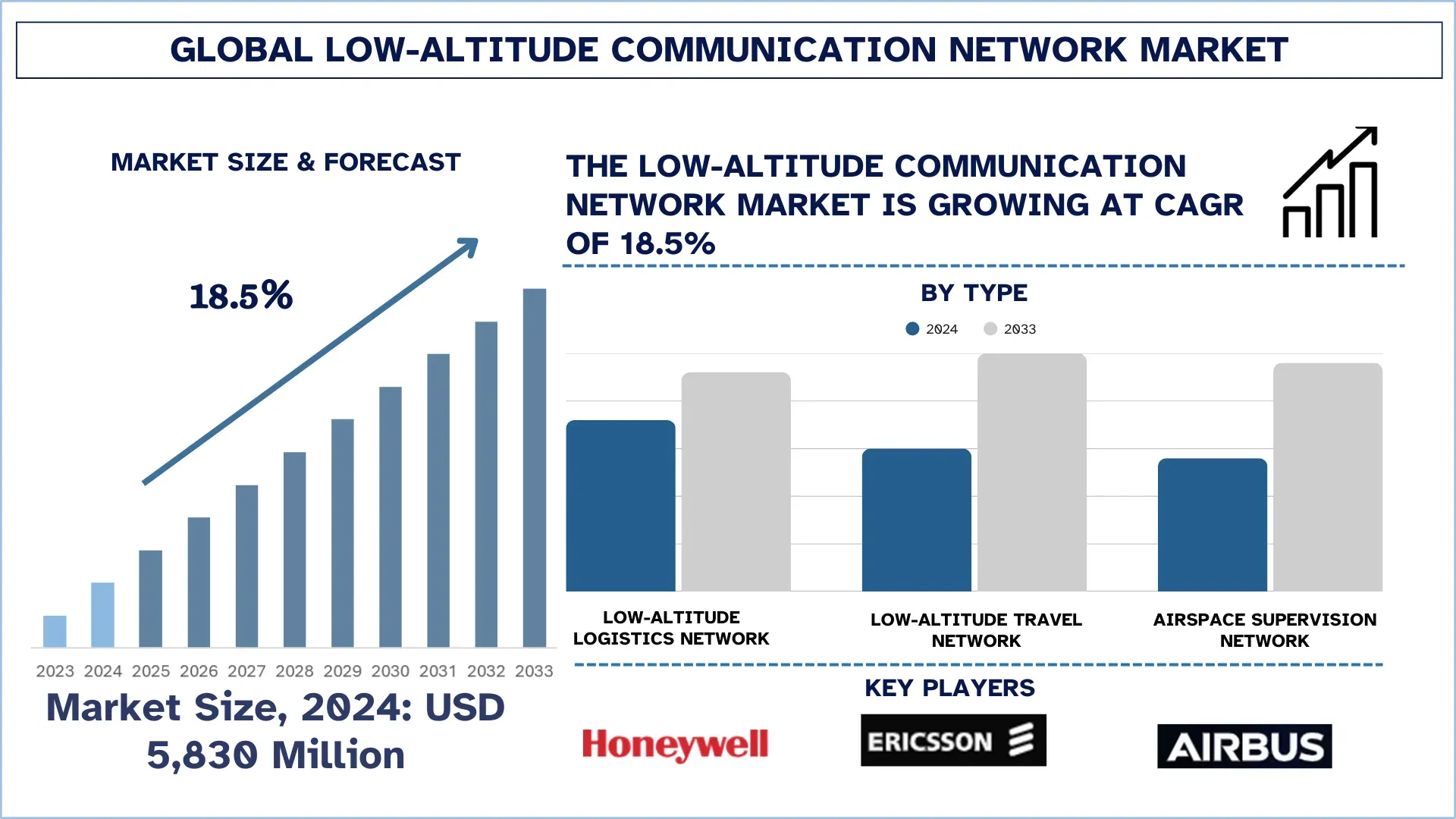
Global Low-altitude Communication Network Market Size & Forecast
The Global Low-altitude Communication Network Market was valued at USD 5,830 million in 2024 and is expected to grow at a strong CAGR of around 18.5% during the forecast period (2025-2033F), driven by the rapid growth of drones, eVTOLs, and urban air mobility, which require reliable real-time connectivity for navigation, command, and control.
Low-altitude Communication Network Market Analysis
A Low-altitude Communication Network is a complex, integrated communications system used to provide real-time, reliable low-altitude connectivity to aerial platforms, such as drones, unmanned aerial vehicles (UAVs), and electric vertical take-off and landing (eVTOL) aircraft. The low-altitude communication networks are very important in the following applications, such as logistics, urban air mobility, agriculture, emergency services, and public safety, which provide secure, low-latency, and high-capacity communication in the increasingly congested low-altitude airspace.
The low-altitude communication network market is expanding as the use of drones, unmanned aerial vehicles (UAVs), and urban air mobility platforms increases, driving demand for low-latency, reliable connectivity. Rapid adoption is being driven by the need to transmit real-time data in a crisis. The development of 5G, satellite, and edge computing allows air-to-ground and air-to-air communication to be smooth. Moreover, low-altitude networks are gaining investments due to the smart city programs and the growth of autonomous systems.
Global Low-Altitude Communication Network Market Trends
This section discusses the key market trends that are influencing the various segments of the global low-altitude communication network market, as found by our team of research experts.
Increasing use of private and hybrid communication networks
Increased adoption of private and hybrid communication networks is a major future market trend in the low-altitude communication network market, driven by the need for secure, reliable, and low-latency communications. As drone, UAV, and eVTOL activities continue to grow across vital industries such as defense, logistics, healthcare, and public safety, the use of public networks is no longer an option, as issues of congestion, security, and predictable performance arise. Privacy networks have superior control, better cybersecurity, and quality of service assurance compared to public 5G and shared wireless networks. Moreover, hybrid networks combining privately owned infrastructure with cellular and satellite networks provide continuous coverage, redundancy, and scale across urban and remote regions.
Low-Altitude Communication Network Industry Segmentation
This section provides an analysis of the key trends in each segment of the global low-altitude communication network market report, along with forecasts at the global, regional, and country levels for 2025-2033.
The Low-Altitude Logistics System Segment Dominates the Global Low-Altitude Communication Network Market
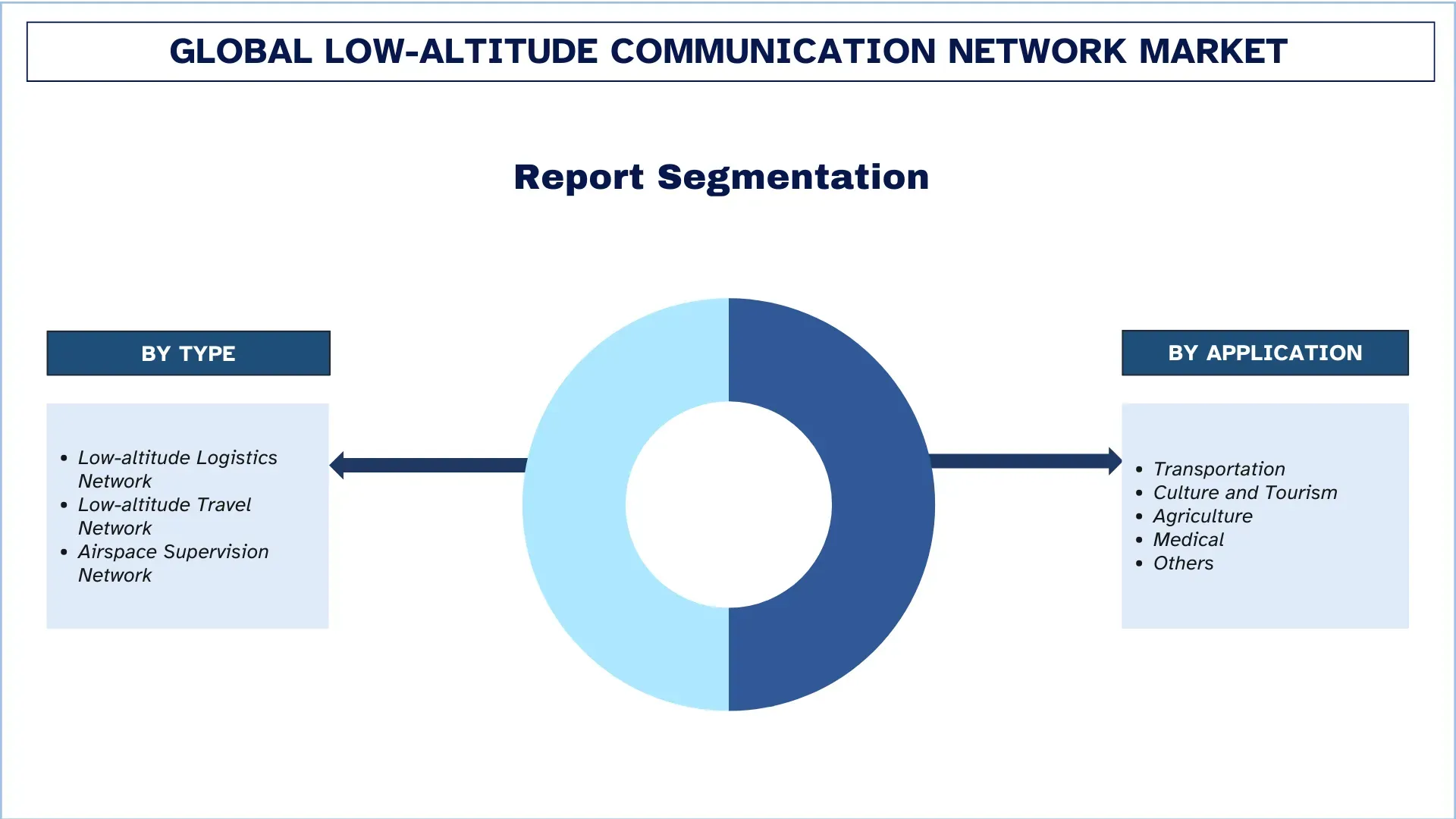
Based on the type category, the market is categorized into low-altitude logistics network, low-altitude travel network, and airspace supervision network. Among these, the low-altitude logistics system has the highest market share due to the high use of drones for last-mile delivery and inventory management, as well as automated transport services, and consequently, to a massive deployment of communication infrastructure to support these logistics processes and real-time data connections. This segment has good commercial demand and early adoption over travel networks and supervision systems that are yet to mature. However, in the future, airspace supervision networks will experience the highest rate of growth because regulatory frameworks and sophisticated monitoring systems will be important in controlling dense UAVs and urban air mobility traffic and in maintaining safety and compliance in low-altitude airspace.
The Agriculture Segment Dominates the Global Low-Altitude Communication Network Market.
Based on the application category, the market is segmented into transportation, culture and tourism, agriculture, medical, and others. Among these, the market share of transportation is the highest, as it includes crucial areas such as drone deliveries, traffic control, and infrastructure inspection, which require an extensive communication network to exchange real-time data, navigate, and organize fleet operations across different settings. This large-scale commercial and industrial use leads to increased revenue and usage in comparison with other industries. However, in the future, the agricultural sector will boom, as precision farming and crop surveillance will be supported by robust, low-altitude wireless systems enabling the deployment of sensors, UAVs, and automated processes that enhance crop productivity and efficiency.
The Asia-Pacific region is the fastest-growing region in the Global Low-Altitude Communication Network Market
The Asia-Pacific region is the most rapidly expanding market in the global Low-altitude Communication Network market, with its high rate of urbanization, growing smart city projects, and growth in the use of drones and UAVs in the commercial markets. China, Japan, South Korea, and India are majorly investing in 5G networks, digital aviation, and low-altitude airspace management to accommodate logistics, agriculture, surveillance, and disaster response applications. High government interest, rising military spending, and the availability of large manufacturing sectors for UAVs and communication devices further promote growth. Moreover, the growing need for efficient connectivity in cities with high population density is further driving the mass deployment of low-altitude communication networks.
China held a Dominant share of the Asia-Pacific Low-altitude Communication Network Market in 2024
China dominated the Asia-Pacific low-altitude communication network market, driven by its massive commercialization of low-altitude communication networks. There has been a fast adoption of communication networks by unmanned aerial systems in the country to inspect industries, provide security to people, monitor the power grid, and perform smart logistics. Close cooperation of telecom operators, local governments, and technology providers has facilitated pilot zones and city-wide low-altitude network deployments. Further, the presence of leadership in the production of UAVs, base stations, and networking equipment lowers implementation costs and speeds up adoption in China. The ongoing attention to the policy on digital infrastructure and use of airspace further intensified China's strength in the Asia-Pacific low-altitude communication network market.
For instance, in November 2025, Technology giant ZTE, operator China Unicom Liaoning, and Dalian Changhai Airport announced the successful launch of a 5G-Advanced (5G-A) ISAC private network aimed at improving low-altitude security and airport safety.
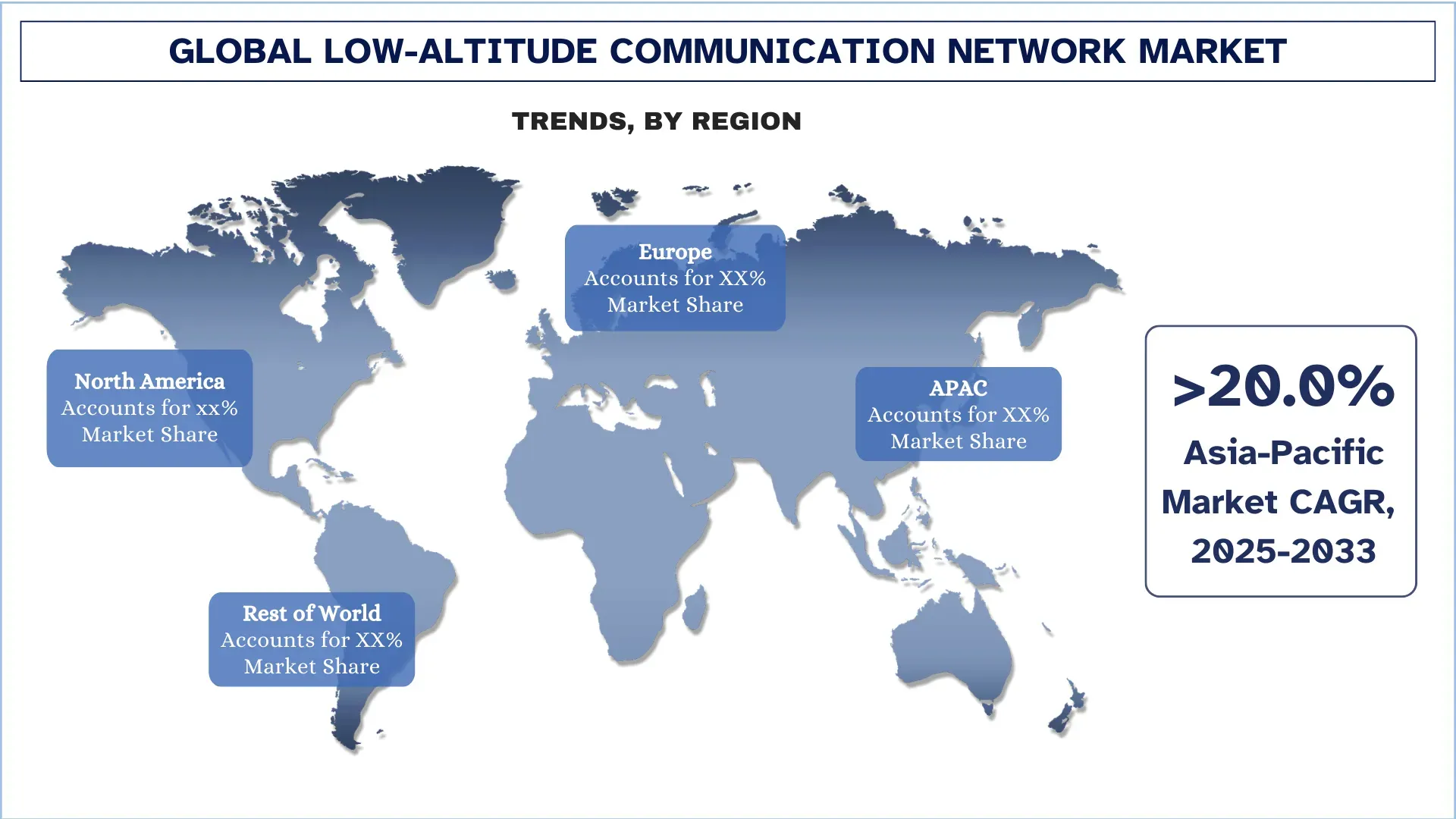
Low-altitude Communication Network Industry Competitive Landscape
The global low-altitude communication network market is competitive, with several global and international market players. The key players are adopting different growth strategies to enhance their market presence, such as partnerships, agreements, collaborations, geographical expansions, and mergers and acquisitions.
Top Low-Altitude Communication Network Market Companies
Some of the major players in the market are Honeywell International Inc., Ericsson, Airbus, BAE Systems, EHang Holdings Limited, Qualcomm Technologies, Inc., L3Harris Technologies, Inc., Lockheed Martin Corporation, Northrop Grumman, and Collins Aerospace.
Recent Developments in the Low-Altitude Communication Network Market
In May 2025, EHang expanded its strategic partnership with China Communications Information & Technology Group (CCIT) and CCCC-FHDI to jointly build low-altitude aviation infrastructure for coastal and river-based air mobility. EHang and its partners planned to cooperate on infrastructure planning, digital systems, and service networks to accelerate the development of the low-altitude economy and support broader commercial eVTOL operations.
In March 2024, China Telecom actively optimized its 5G-Advanced (5G-A) network deployment in key regions to support the development of the low-altitude economy and enhance communications for low-altitude applications. China Telecom’s efforts are aimed at strengthening connectivity and infrastructure necessary for aerial services and low-altitude digital ecosystems.
Global Low-Altitude Communication Network Market Report Coverage
Report Attribute | Details |
Base year | 2024 |
Forecast period | 2025-2033 |
Growth momentum | Accelerate at a CAGR of 18.5% |
Market size 2024 | USD 5,830 million |
Regional analysis | North America, Europe, APAC, Rest of the World |
Major contributing region | The North America region is expected to dominate the market during the forecast period. |
Key countries covered | U.S., Canada, Germany, U.K., Spain, Italy, France, China, Japan, and India. |
Companies profiled | Honeywell International Inc., Ericsson, Airbus, BAE Systems, EHang Holdings Limited, Qualcomm Technologies, Inc., L3Harris Technologies, Inc., Lockheed Martin Corporation, Northrop Grumman, and Collins Aerospace. |
Report Scope | Market Trends, Drivers, and Restraints; Revenue Estimation and Forecast; Segmentation Analysis; Demand and Supply Side Analysis; Competitive Landscape; Company Profiling |
Segments Covered | By Type, By Application, and By Region/Country |
Reasons to Buy the Low-Altitude Communication Network Market Report:
The study includes market sizing and forecasting analysis confirmed by authenticated key industry experts.
The report briefly reviews overall industry performance at a glance.
The report covers an in-depth analysis of prominent industry peers, primarily focusing on key business financials, type portfolios, expansion strategies, and recent developments.
Detailed examination of drivers, restraints, key trends, and opportunities prevailing in the industry.
The study comprehensively covers the market across different segments.
Deep dive regional-level analysis of the industry.
Customization Options:
The global low-altitude communication network market can further be customized as per the requirements or any other market segment. Besides this, UnivDatos understands that you may have your own business needs; hence, feel free to contact us to get a report that completely suits your requirements.
Table of Content
Research Methodology for the Global Low-altitude Communication Network Market Analysis (2023-2033)
We analyzed the historical market, estimated the current market, and forecasted the future market of the global low-altitude communication network market to assess its application in major regions worldwide. We conducted exhaustive secondary research to gather historical market data and estimate the current market size. To validate these insights, we carefully reviewed numerous findings and assumptions. Additionally, we conducted in-depth primary interviews with industry experts across the low-altitude communication network value chain. After validating market figures through these interviews, we used both top-down and bottom-up approaches to forecast the overall market size. We then employed market breakdown and data triangulation methods to estimate and analyze the market size of industry segments and sub-segments.
Market Engineering
We employed the data triangulation technique to finalize the overall market estimation and derive precise statistical numbers for each segment and sub-segment of the global low-altitude communication network market. We split the data into several segments and sub-segments by analyzing various parameters and trends, including type, application, and regions within the global low-altitude communication network market.
The Main Objective of the Global Low-altitude Communication Network Market Study
The study identifies current and future trends in the global low-altitude communication network market, providing strategic insights for investors. It highlights regional market attractiveness, enabling industry participants to tap into untapped markets and gain a first-mover advantage. Other quantitative goals of the studies include:
Market Size Analysis: Assess the current and forecast market size of the global low-altitude communication network market and its segments in terms of value (USD).
Low-altitude Communication Network Market Segmentation: Segments in the study include areas of type, application, and region.
Regulatory Framework & Value Chain Analysis: Examine the regulatory framework, value chain, customer behavior, and competitive landscape of the low-altitude communication network industry.
Regional Analysis: Conduct a detailed regional analysis for key areas such as Asia Pacific, Europe, North America, and the Rest of the World.
Company Profiles & Growth Strategies: Company profiles of the low-altitude communication network market and the growth strategies adopted by the market players to sustain the fast-growing market.
Frequently Asked Questions FAQs
Q1: What is the global low-altitude communication network market’s current market size and growth potential?
As of 2024, the global low-altitude communication network market size is USD 5,830 million. The market is projected to grow at a strong CAGR of 18.5% between 2025 and 2033, driven by the rising adoption of drones, UAVs, and advanced aerial communication technologies worldwide.
Q2: Which segment has the largest share of the global low-altitude communication network market by type category?
The low-altitude logistics network segment accounts for the largest market share due to increasing use of drones for last-mile delivery, warehousing, and real-time logistics operations.
Q3: What are the driving factors for the growth of the global low-altitude communication network market?
Top growth drivers of the low-altitude communication network market include:
• Rapid growth in drone, UAV, and eVTOL deployments for commercial and government applications.
• Expansion of low-altitude logistics and last-mile delivery networks
• Advancements in 5G, edge computing, and air-to-ground communication technologies
Q4: What are the emerging technologies and trends in the global low-altitude communication network market?
Emerging trends in the low-altitude communication network market include:
• Increasing use of private and hybrid communication networks
• Growing focus on secure, encrypted communication systems for aerial networks
Q5: What are the key challenges in the global low-altitude communication network market?
Key challenges in the low-altitude communication network market include:
• High infrastructure deployment and maintenance costs.
• Cybersecurity and data privacy risks in aerial communication systems
Q6: Which region dominates the global low-altitude communication network market?
North America leads the global low-altitude communication network market due to advanced telecom infrastructure, early adoption of drone technologies, and strong investments in defense and commercial aerial communication systems.
Q7: Who are the key competitors in the global low-altitude communication network market?
Top players in the low-altitude communication network industry include:
• Honeywell International Inc.
• Ericsson
• Airbus
• BAE Systems
• EHang Holdings Limited
• Qualcomm Technologies, Inc.
• L3Harris Technologies, Inc.
• Lockheed Martin Corporation
• Northrop Grumman
• Collins Aerospace
Q8: What investment and commercialization opportunities exist in the low-altitude communication network market?
The market offers strong opportunities in private network deployment, drone traffic management systems, urban air mobility infrastructure, and region-specific low-altitude network rollouts, supported by rising government and enterprise spending.
Q9: How do regulatory frameworks and airspace management policies impact the development of low-altitude communication networks?
Regulatory policies directly influence network deployment, spectrum allocation, and operational scalability, making compliance, standardized airspace management, and government collaboration critical for successful market entry and long-term growth.
Related Reports
Customers who bought this item also bought




Aeroderivative Sensor Market: Current Analysis and Forecast (2025-2033)
Emphasis on Sensor Type (Temperature Sensors, Pressure Sensors, Vibration Sensors, Flame Sensors, and Others); Service Provider (OEMs and Aftermarket); End-User (Industrial, Marine, Aerospace & Defense, Power & Energy, and Oil & Gas); and Region/Country
Kamikaze Drone Market: Current Analysis and Forecast (2026-2034)
Emphasis on Type (Fixed-wing System and Rotary-wing System); Range (Short range(10-20km), Medium range(20-100km), and Long range(>100km)); Platform (Ground based, Airborne, and Naval); Autonomy (Man in the loop and Fully Autonomous); and Region/Country

Counter-Unmanned Aerial System Market: Current Analysis and Forecast (2025-2033)
Emphasis on Platform (Ground-Based Systems, Airborne Systems, and Naval / Maritime Systems); Technology (Radar, RF, EO/IR, Laser, Kinetic, and Others); End-Use (Defense & Military, Homeland Security & Law Enforcement, Critical Infrastructure, and Commercial & Industrial); and Region/Country

Middle East & Africa Turboprop Aircraft Market: Current Analysis and Forecast (2025-2033)
Emphasis By Aircraft Type (Light Turboprop Aircraft, Medium Turboprop Aircraft, and Heavy Turboprop Aircraft), by End-User (Government & Defense, Commercial Operators, and Private Operators), By Country (Saudi Arabia, UAE, Egypt, South Africa, Turkey, Israel, and the Rest of Middle East & Africa)