Southeast Asia Small Arms and Ammunition Market: Current Analysis and Forecast (2025-2033)
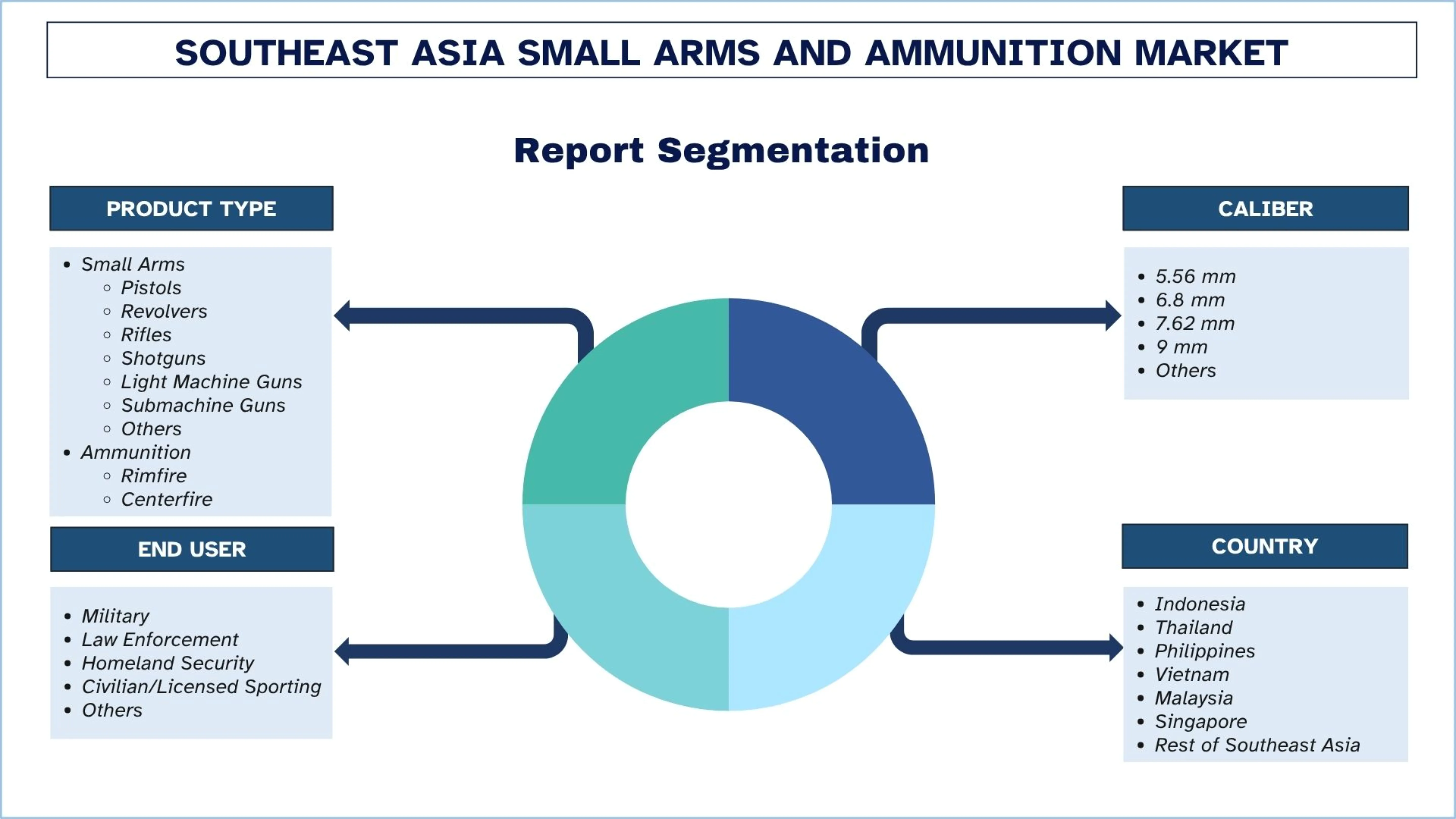
Emphasis on Product Type (Small Arms {Pistols, Revolvers, Rifles, Shotguns, Light Machine Guns, Submachine Guns, Others}, Ammunition {Rimfire, Centerfire}); Caliber (5.56 mm, 6.8 mm, 7.62 mm, 9 mm, Others); End User (Military, Law Enforcement, Homeland Security, Civilian/Licensed Sporting, Others); and Country.
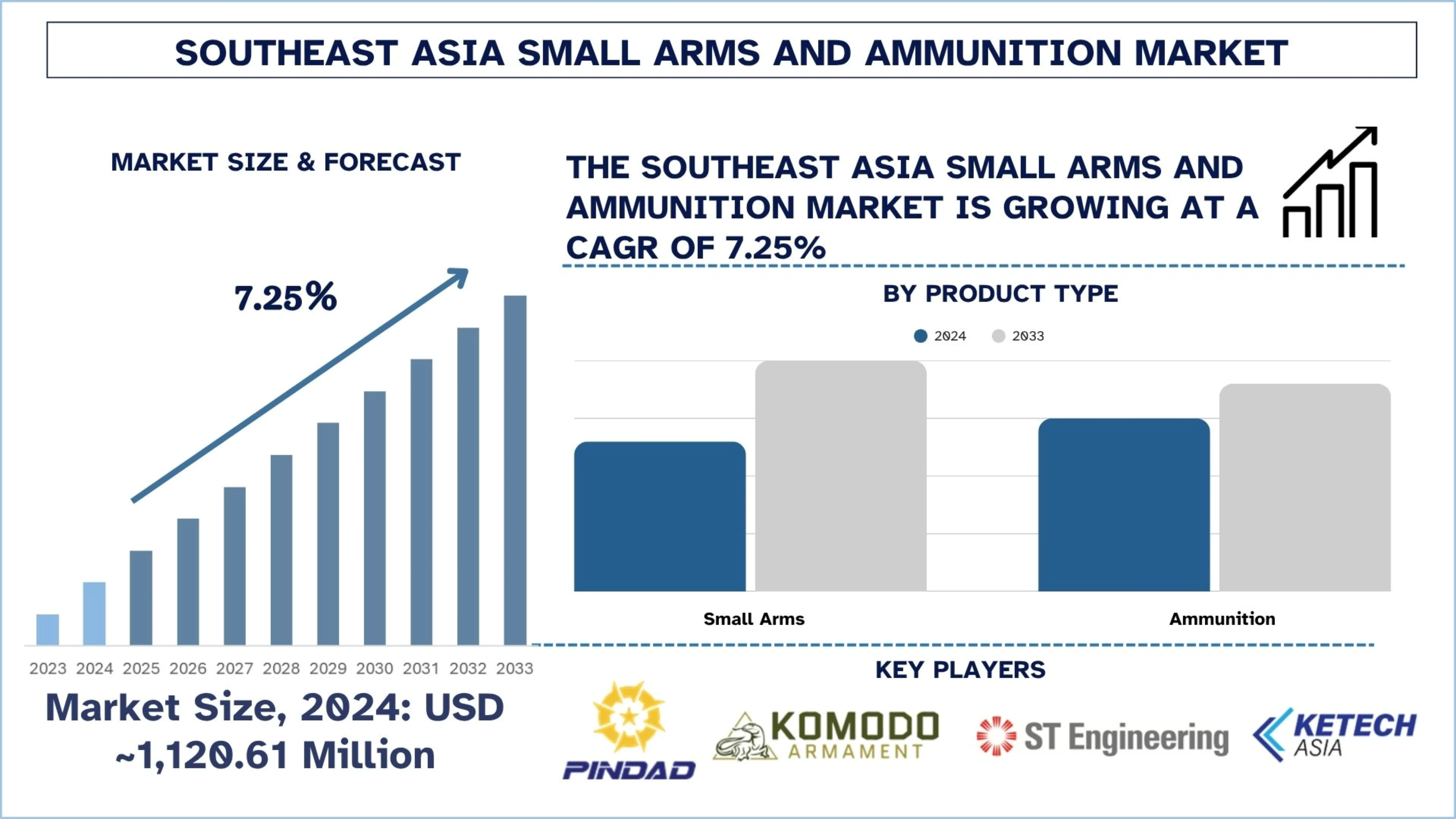
Southeast Asia Small Arms and Ammunition Market Size & Forecast
The Southeast Asia Small Arms and Ammunition Market was valued at ~USD 1,120.61 million in 2024 and is expected to grow at a strong CAGR of approximately 7.25% during the forecast period (2025-2033F), driven by rising regional defense budgets supporting infantry weapons procurement.
Southeast Asia Small Arms and Ammunition Market Analysis
Small Arms and Ammunition are handheld firearms, which are aimed to be used by individuals or crews, such as pistols, rifles, shotguns, submachine guns, and light machine guns, and also the cartridges and rounds of these firearms. It is used in the military, law enforcement, and homeland security, as well as in licensed civilian markets, and is needed for defense procurement, tactical operations, and routine ammunition replacement.
In Southeast Asia, the localization of ammunition assembly, the expansion of licensed weapons manufacturing, the modernization of infantry weapons stocks, and the rise in the acquisition of modular-rifle systems that are interchangeable in caliber. Adding to this, an increase in manufacturing efficiency by governments and defense suppliers, driven by improved machining capacity, metallurgy, and ballistic testing. The procurement systems are also moving towards long-term supply contracts to build strategic ammunition reserves, and law enforcement agencies are moving towards compact tactical arms for use in urban battles and rapid operations. There is also a tendency to make a few markets integrate better compatibility with optics, lightweight materials, and standardized NATO-caliber platforms to improve interoperability in joint operations and regional defense exercises.
For example, on May 14, 2024, SME Ordnance (SMEO), a subsidiary company of National Aerospace and Defence Industries Sdn. Bhd announced two more strategic partnerships that were forged during DSA Malaysia 2024 aimed at advancing small arms ammunition production and distribution in both local and international markets. SMEO signed a Memorandum of Understanding (MOU) with SAC Arms Sdn Bhd, a leading distributor for small calibre ammunition. This collaboration signifies a significant step forward in meeting the increasing demands of the defence market.
Southeast Asia Small Arms and Ammunition Market Trends
This section discusses the key market trends that are influencing the various segments of the Southeast Asia Small Arms and Ammunition market, as found by our team of research experts.
Growing Adoption of NATO-Compatible Calibers
The trend in the market of Southeast Asia is the growing popularity of NATO-compatible calibers, in particular, 5.56 mm and 9 mm, with infantry weapon systems modernized and the need to enhance the level of interoperability with the adjacent armies. This change facilitates interoperability when military forces engage in joint operations, multinational operations, and ammunition logistics. Also, enables procurement authorities to access a broader supplier base and eliminate reliance on old-caliber inventories. Additionally, manufacturers are retaliating by aligning production lines with internationally approved cartridge specifications and contemporary rifle platforms. In the long term, the trend will impact the future procurement requirements, inventory scheduling, and ammunition sourcing planning in the region.
Southeast Asia Small Arms and Ammunition Industry Segmentation
This section provides an analysis of the key trends in each segment of the Southeast Asia Small Arms and Ammunition market, along with forecasts at the country level for 2025-2033.
The ammunition market is expected to grow at a significant CAGR during the forecast period (2025-2033).
Based on product type, the market is segmented into small arms (pistols, revolvers, rifles, shotguns, light machine guns, submachine guns, others) and ammunition (rimfire, centerfire). Among these, the ammunition market held a dominant share of the market in 2024. This segment drives recurring demand for ammunition purchases due to training, operational deployments, reserve stocking, and replacement demands. The continuous consumption of ammunition, unlike that of weapon platforms, is urging manufacturers to increase production capacity, enhance supply accessibility, and secure long-term defense contracts. This repeat buying trend would provide a consistent demand base and direct impact on continued market growth in Southeast Asia. For example, on December 10, 2025, the CSG secured a significant contract to supply small-calibre ammunition to the Ministry of Defence of a Southeast Asian state. The value of the contract amounts to several hundred million US dollars. In doing so, CSG is delivering on its strategy to expand supplies of small-calibre ammunition from its companies into the defence and security segment, as well as providing continued market diversification and strengthening the company’s position in the global defence supply chain.
The military segment held a significant share of the market in 2024.
Based on the end user, the market is segmented into military, law enforcement, homeland security, civilian/licensed sporting, and others. Among these, the military segment held the dominant share of the Southeast Asia Small Arms and Ammunition market in 2024. This is mainly because the national defense modernization policy still focuses on infantry preparedness, ammunition stocks, and the replacement of outdated small arms. The high-volume purchase agreements, multi-year acquisition strategy, and long-term security priorities give manufacturers certainty at long-term demand. The scale of purchases by the military workforce also shapes patterns of more widespread adoption, establishing technical standards for calibers, weaponry, and supply needs at the regional level. For example, on February 18, 2025, CARACAL, a regional leader in high-performance small arms within EDGE, one of the world’s leading advanced technology and defence groups, signed an agreement with Ketech Asia, an advanced ammunition producer and small arms solutions provider, for the assembly and manufacturing of CARACAL’s CAR 816 assault rifle in Malaysia. The CAR 816 is a high-performance, mission-proven assault rifle chambered in 5.56x45mm NATO.
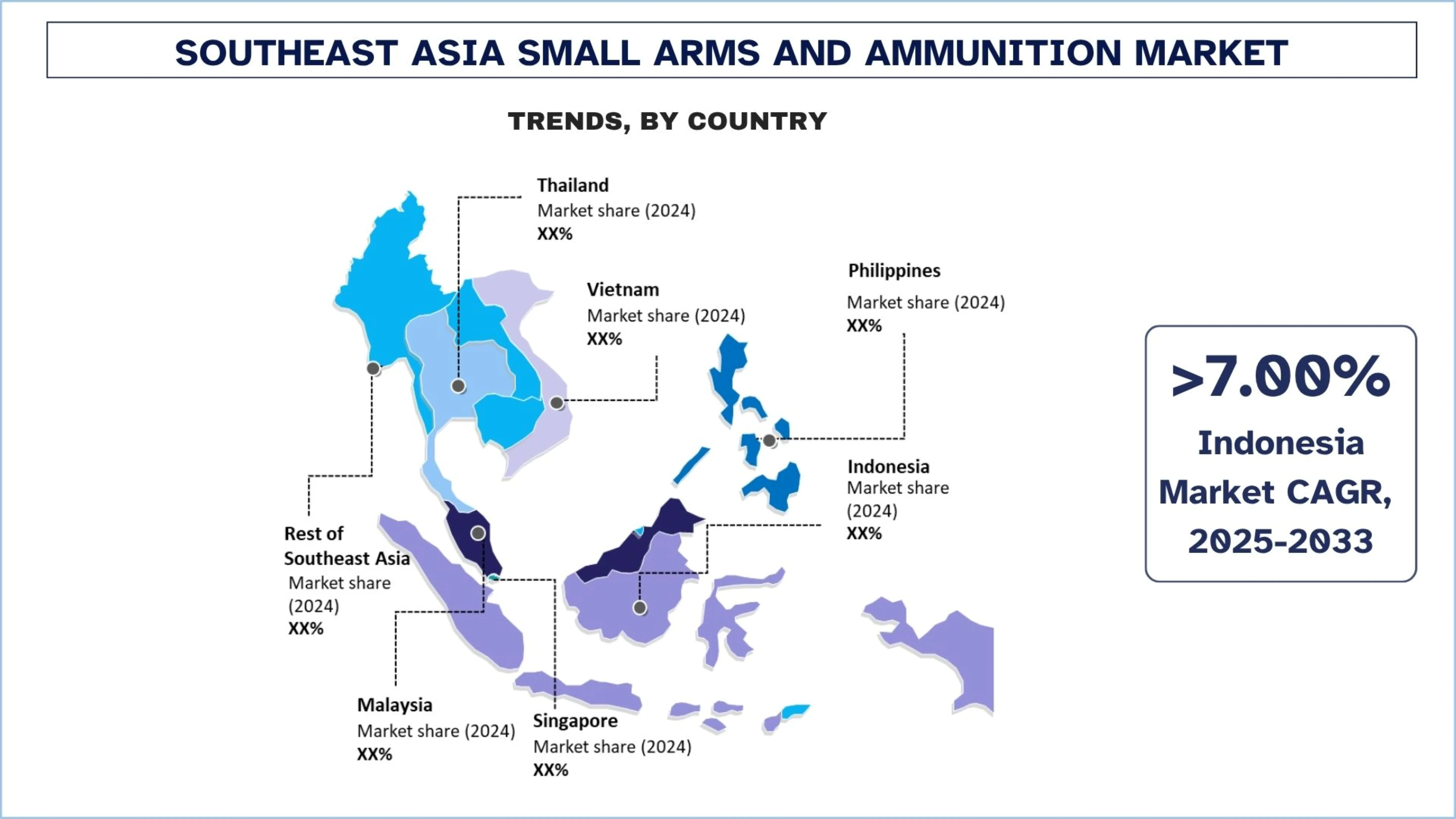
Indonesia held a dominant share of the Southeast Asian Small Arms and Ammunition market in 2024
Indonesia held a dominant share of the small arms and ammunition market in Southeast Asia because of its extensive domestic defense production base, broader military modernization programs, and ongoing purchases for the army, navy, and internal security. The country's focus on local production reduces reliance on imports and supports the ongoing capacity development of ammunition and rifle manufacturing. Increased border security demands, maritime defense concerns, and reserve stocking up further reinforce enduring procurement demand. Moreover, the government supports the country in maintaining self-reliance in the defense industry, stimulating technological updates and long-range supply planning, thereby driving market growth in Indonesia.
For instance, on May 14, 2024, EDGE, one of the world’s leading advanced technology and defence groups, signed a USD 27 million (AED 99 million) agreement to supply an ammunition production line to PT Pindad, an Indonesian state-owned enterprise and one of Asia’s leading defence manufacturers. The agreement is for the production of 5.56x45mm and 7.62x51mm calibre ammunition, and is aligned with the Indonesian Ministry of Defence’s objective to increase local job creation and sovereign manufacturing capabilities. The ammunition facility is scheduled to commence production in 2026. The agreement is part of an ongoing effort between both countries that aims to increase bilateral trade to USD 10 billion by 2030 under the Comprehensive Economic Partnership Agreement.
Southeast Asia Small Arms and Ammunition Industry Competitive Landscape
The Southeast Asia Small Arms and Ammunition market is competitive, with several global and international market players. The key players are adopting different growth strategies to enhance their market presence, such as partnerships, agreements, collaborations, new product launches, geographical expansions, and mergers and acquisitions.
Top Southeast Asia Small Arms and Ammunition Companies
Some of the major players in the market are PT Pindad (Persero), Komodo Armament Indonesia, ST Engineering, SME Ordnance Sdn. Bhd. (National Aerospace and Defence Industries Sdn. Bhd.), Ketech Asia Sdn Bhd, MEGA ARMS SDN BHD, Armscor International, Inc., Narac Arms Industry Co., Ltd., and Others
Recent Developments in the Southeast Asia Small Arms and Ammunition Market
On February 8, 2026, Malaysia’s first high-automation ammunition manufacturing facility owned by Ketech Asia Sdn. Bhd. (Ketech Asia) In Kuala Lipis, Pahang, it operated at full capacity. Defence Security Asia, Ketech Asia Business Development Manager, announced that the facility is currently producing up to 130 million rounds of 9mm and 5.56mm ammunition annually for the domestic market.
On August 12, 2025, SMPP Limited of India and the Philippines’ Asia Defence and Firepower Corporation (ADFC) signed a memorandum of understanding to establish a joint venture company in the Philippines. The new entity will manufacture, assemble, and distribute SMPP defense products, including ballistic protection systems, advanced helmets, modular armor plates, and ammunition components, directly supporting Manila’s Self-Reliant Defence Posture program. Under Philippine law, the venture will maintain a majority Filipino ownership of at least 60 percent, granting access to tax incentives, duty-free imports, and direct defense procurement channels.
Southeast Asia Small Arms and Ammunition Market Report Coverage
Report Attribute | Details |
Base year | 2024 |
Forecast period | 2025-2033 |
Growth momentum | Accelerate at a CAGR of 7.25% |
Market size 2024 | ~USD 1,120.61 million |
Country analysis | Indonesia, Thailand, Philippines, Vietnam, Malaysia, Singapore, Rest of Southeast Asia |
Major contributing Country | The Philippines is expected to experience the highest CAGR during the forecast period. |
Companies profiled | PT Pindad (Persero), Komodo Armament Indonesia, ST Engineering, SME Ordnance Sdn. Bhd. (National Aerospace and Defence Industries Sdn. Bhd.), Ketech Asia Sdn Bhd, MEGA ARMS SDN BHD, Armscor International, Inc., Narac Arms Industry Co., Ltd., Others |
Report Scope | Market Trends, Drivers, and Restraints; Revenue Estimation and Forecast; Segmentation Analysis; Demand and Supply Side Analysis; Competitive Landscape; Company Profiling |
Segments Covered | By Product Type, By Caliber, By End User, By Country |
Reasons to Buy the Southeast Asia Small Arms and Ammunition Market Report:
The study includes market sizing and forecasting analysis confirmed by authenticated key industry experts.
The report briefly reviews overall industry performance at a glance.
The report covers an in-depth analysis of prominent industry peers, primarily focusing on key business financials, product portfolios, expansion strategies, and recent developments.
Detailed examination of drivers, restraints, key trends, and opportunities prevailing in the industry.
The study comprehensively covers the market across different segments.
Customization Options:
The Southeast Asia Small Arms and Ammunition market can further be customized as per requirements or any other market segment. Besides this, UnivDatos understands that you may have your own business needs; hence, feel free to contact us to get a report that completely suits your requirements.
Table of Content
Research Methodology for the Southeast Asia Small Arms and Ammunition Market Analysis (2023-2033)
We analyzed the historical market, estimated the current market, and forecasted the future market of the Southeast Asian Small Arms and Ammunition market to assess its application in major countries. We conducted exhaustive secondary research to gather historical market data and estimate the current market size. To validate these insights, we carefully reviewed numerous findings and assumptions. Additionally, we conducted in-depth primary interviews with industry experts across the Southeast Asian Small Arms and Ammunition value chain. After validating market figures through these interviews, we used both top-down and bottom-up approaches to forecast the overall market size. We then employed market breakdown and data triangulation methods to estimate and analyze the market size of industry segments and sub-segments.
Market Engineering
We employed the data triangulation technique to finalize the overall market estimation and derive precise statistical numbers for each segment and sub-segment of the Southeast Asia Small Arms and Ammunition market. We split the data into several segments and sub-segments by analyzing various parameters and trends, including product type, caliber, end user, and country within the Southeast Asian Small Arms and Ammunition market.
The Main Objective of the Southeast Asia Small Arms and Ammunition Market Study
The study identifies current and future trends in the Southeast Asia Small Arms and Ammunition market, providing strategic insights for investors. It highlights market attractiveness, enabling industry participants to tap into untapped markets and gain a first-mover advantage. Other quantitative goals of the studies include:
Market Size Analysis: Assess the current and forecast market size of the Southeast Asia Small Arms and Ammunition market and its segments in terms of value (USD).
Southeast Asia Small Arms and Ammunition Market Segmentation: Segments in the study include areas of product type, caliber, end user, and country.
Regulatory Framework & Value Chain Analysis: Examine the regulatory framework, value chain, customer behavior, and competitive landscape of the Southeast Asia Small Arms and Ammunition industry.
Country Analysis: Conduct a detailed country analysis for key areas such as Indonesia, Thailand, the Philippines, Vietnam, Malaysia, Singapore, and the Rest of Southeast Asia.
Company Profiles & Growth Strategies: Company profiles of the Southeast Asia Small Arms and Ammunition market and the growth strategies adopted by the market players to sustain the fast-growing market.
Frequently Asked Questions FAQs
Q1: What is the Southeast Asia Small Arms and Ammunition market’s current market size and growth potential?
The Southeast Asia Small Arms and Ammunition market was valued at ~USD 1,120.61 million in 2024 and is projected to expand at a CAGR of 7.25% from 2025 to 2033. The growth is being supported by rising defense expenditure, military modernization programs, recurring ammunition procurement, and a stronger regional focus on border security and tactical readiness.
Q2: Which segment has the largest share of the Southeast Asia Small Arms and Ammunition market by product type?
Ammunition held the largest share of the Southeast Asia Small Arms and Ammunition market because it requires continuous replenishment for military training, operational deployment, reserve stockpiling, and law-enforcement use. Compared with weapon systems, ammunition generates recurring procurement demand, making it the dominant revenue contributor across Southeast Asian defense supply chains.
Q3: What are the driving factors for the growth of the Southeast Asia Small Arms and Ammunition market?
Market growth is driven by increasing regional defense budgets, modernization of infantry weapons, expansion of homeland security programs, maritime security concerns, and government support for domestic ammunition manufacturing. Rising procurement by military and police agencies is also strengthening long-term demand.
Q4: What are the emerging technologies and trends in the Southeast Asia Small Arms and Ammunition market?
Key trends include growing adoption of NATO-compatible calibers such as 5.56 mm, increasing demand for lightweight modular rifles, expansion of precision ammunition use, integration of advanced optics compatibility, and gradual localization of ammunition production for strategic self-reliance.
Q5: What are the key challenges in the Southeast Asia Small Arms and Ammunition market?
Major challenges include strict arms transfer regulations, long defense procurement approval cycles, dependence on imported critical weapon components, fluctuating raw material costs, and geopolitical sensitivity surrounding cross-border defense supply agreements.
Q6: Which country dominates the Southeast Asia Small Arms and Ammunition market?
Indonesia dominates the regional market due to its strong domestic defense manufacturing ecosystem, broad military procurement programs, and established indigenous production capability in both small arms and ammunition. Sustained defense modernization further supports its leading market position.
Q7: Who are the key players in the Southeast Asia Small Arms and Ammunition market?
Leading companies in the Southeast Asia Small Arms and Ammunition market include:
• PT Pindad (Persero)
• Komodo Armament Indonesia
• ST Engineering
• SME Ordnance Sdn. Bhd. (National Aerospace and Defence Industries Sdn. Bhd.)
• Ketech Asia Sdn Bhd
• MEGA ARMS SDN BHD
• Armscor International, Inc.
• Narac Arms Industry Co., Ltd.
• Others
Q8: What investment opportunities are emerging in the Southeast Asia Small Arms and Ammunition market?
Investment opportunities are increasing in localized ammunition manufacturing, licensed weapon assembly, ballistic testing infrastructure, and defense supply-chain partnerships. Governments across Southeast Asia are encouraging domestic production to reduce dependence on imports, creating space for technology transfer, joint ventures, and long-term industrial participation.
Q9: How is defense modernization influencing procurement strategies in the Southeast Asia Small Arms and Ammunition market?
Defense modernization is shifting procurement toward lighter assault rifles, NATO-compatible calibers, precision ammunition, and long-term replenishment contracts. Military agencies are increasingly prioritizing operational flexibility, interoperability, and inventory standardization, which is reshaping supplier selection and production planning across the regional market.
Related Reports
Customers who bought this item also bought





Aeroderivative Sensor Market: Current Analysis and Forecast (2025-2033)
Emphasis on Sensor Type (Temperature Sensors, Pressure Sensors, Vibration Sensors, Flame Sensors, and Others); Service Provider (OEMs and Aftermarket); End-User (Industrial, Marine, Aerospace & Defense, Power & Energy, and Oil & Gas); and Region/Country
Kamikaze Drone Market: Current Analysis and Forecast (2026-2034)
Emphasis on Type (Fixed-wing System and Rotary-wing System); Range (Short range(10-20km), Medium range(20-100km), and Long range(>100km)); Platform (Ground based, Airborne, and Naval); Autonomy (Man in the loop and Fully Autonomous); and Region/Country
Counter-Unmanned Aerial System Market: Current Analysis and Forecast (2025-2033)
Emphasis on Platform (Ground-Based Systems, Airborne Systems, and Naval / Maritime Systems); Technology (Radar, RF, EO/IR, Laser, Kinetic, and Others); End-Use (Defense & Military, Homeland Security & Law Enforcement, Critical Infrastructure, and Commercial & Industrial); and Region/Country

Middle East & Africa Turboprop Aircraft Market: Current Analysis and Forecast (2025-2033)
Emphasis By Aircraft Type (Light Turboprop Aircraft, Medium Turboprop Aircraft, and Heavy Turboprop Aircraft), by End-User (Government & Defense, Commercial Operators, and Private Operators), By Country (Saudi Arabia, UAE, Egypt, South Africa, Turkey, Israel, and the Rest of Middle East & Africa)